“It's the condition of my life that I've been able to give up smoking. That's a good thing, a positive thing. But it's also a condition of my life that I have to think about it all the time.”
— Henry Perowne reflecting on his past addiction.

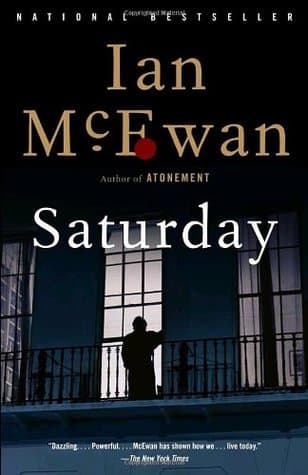
Ian McEwan (2004)
Genre
Literary Fiction
Reading Time
360 min
Key Themes
See below
Sign in to track this book
On a single Saturday, a contented neurosurgeon's ordinary London day off unravels into a terrifying confrontation with a disturbed young man, forcing him to use his medical knowledge to protect his family amidst a city on the brink of war.
On a Saturday morning in February 2003, neurosurgeon Henry Perowne wakes before dawn in his London home. He sees a strange, fiery aircraft over the city, at first fearing a terrorist attack, but later learns it is an old Russian cargo plane with engine trouble. The city prepares for a large anti-Iraq War protest, which Henry views with some skepticism, though he understands the political situation. He thinks about his comfortable life, his job, and his family: wife Rosalind, a lawyer, and adult children Daisy, a poet, and Theo, a blues musician. He plans a day of squash, shopping, and a family dinner.
Henry drives to his squash game with his anesthetist, Jay Strauss, navigating crowded streets filled with protestors. A distraction leads to a minor car accident. The other driver, Baxter, a young, threatening man, confronts Henry aggressively. Henry, using his professional instincts, notices Baxter's constricted pupils, facial tics, and erratic behavior, diagnosing him with Huntington's disease, a degenerative neurological disorder. He tries to calm the situation by explaining his diagnosis, which only angers Baxter, making him feel exposed. Baxter, with two associates, threatens Henry and demands money.
During the confrontation, Henry subtly assesses Baxter and his companions, realizing the immediate danger. He distracts Baxter by mentioning his medical condition, then quickly drives away, leaving Baxter and his friends shouting threats. Henry reaches his squash game, shaken but outwardly composed. He plays with Jay, but his mind keeps returning to the encounter, the unsettling diagnosis, and the lingering threat. He feels a deep unease, a sense that his secure world has been briefly broken by unpredictable violence.
After squash, Henry tries to resume his Saturday plans. He visits his elderly mother, who has dementia, finding comfort in their brief, if often disconnected, talks. He then goes food shopping for the evening's family dinner, where Daisy and Theo are expected. Despite these attempts to return to normal, the memory of Baxter and his threats continues to bother him. He finds himself scanning the streets, feeling more vulnerable and aware of potential danger beneath everyday life. He looks forward to the family gathering for comfort and protection.
As evening approaches, Henry's daughter, Daisy, a successful poet, arrives from New York, followed by his son, Theo, a talented blues musician. The house fills with their youthful energy and creative talks. Daisy reads some of her new poems, met with pride and critical appreciation from her parents. Theo plays his guitar, showing his musical skill. Rosalind, Henry's wife, returns from work, and the family settles into the comfortable rhythm of their shared life, their individual successes and aspirations joining together. Dinner preparations are underway, promising a warm, intimate evening.
Just as the family is about to eat dinner, the doorbell rings. Henry opens it to find Baxter and his accomplice, Nige, on his doorstep. Baxter, seeking revenge and humiliation, forces his way into the house, holding a knife. The peaceful family evening shatters. Baxter terrorizes the family, demanding money and asserting his control. He forces Theo to play his guitar, then breaks it, and humiliates Daisy, demanding she strip and recite a poem. The family is frozen with fear, their secure world completely violated.
During the terrifying ordeal, Henry remains calm, observing Baxter's worsening condition. He realizes Baxter is suffering from a full Huntington's chorea attack, made worse by stress and possibly drug use. Henry calmly but firmly confronts Baxter, repeating his diagnosis and explaining the symptoms, appealing to Baxter's fear of his own body and future. He offers to help Baxter, suggesting he could lessen his symptoms, even subtly implying a medical intervention could be a form of 'mercy.' This calculated medical assessment and promise of relief momentarily disarms Baxter, who becomes confused and vulnerable.
As Henry continues to talk Baxter down, using his medical vulnerability, Rosalind seizes an opportunity. She grabs a heavy medical textbook and strikes Nige, knocking him unconscious. This diversion allows Henry to tackle Baxter, who is already disoriented by his illness and Henry's psychological manipulation. In the struggle, Baxter is subdued. Police, alerted by a neighbor, arrive shortly after, taking Baxter and Nige into custody. The family is safe, but deeply traumatized by the violation of their home and the terror they endured.
After the invasion, the Perowne family processes the trauma. Police investigate, and the house is disrupted. Daisy is particularly shaken, having been directly threatened. Henry and Rosalind comfort their children and each other, finding strength in their family bond. The incident forces Henry to confront the fragility of his carefully built life and the constant presence of violence and unpredictability in the world. Despite the horror, there is a deep sense of relief and gratitude for their survival and unity.
Later that night, Henry receives an emergency call from the hospital. Baxter, having suffered a severe cerebral hemorrhage during his arrest or the struggle, needs immediate neurosurgery. Henry, the very man Baxter terrorized, is the only surgeon available with the necessary expertise. He performs the life-saving operation, showing his professional dedication and ethical commitment, even to his attacker. This surreal turn of events brings a strange, almost poetic, closure to Henry's Saturday, highlighting the complex intersection of personal trauma and professional duty.
Henry finishes the surgery in the early hours of Sunday morning. He returns home to find Rosalind awake, waiting for him. They share a quiet moment, the weight of the past day still heavy between them. The experience has changed Henry's perspective, making him more aware of his family's preciousness and the precariousness of peace. As the new day dawns, bringing the promise of recovery and healing, Henry reflects on the extraordinary events of his Saturday, and the resilience of human connection in the face of chaos.
The Protagonist
Henry's arc involves a profound re-evaluation of his comfortable, rational world, forced to confront the unpredictable and violent aspects of humanity, ultimately affirming the resilience of family and his professional ethics.
The Supporting
Rosalind's arc highlights her resilience and quick thinking under extreme duress, solidifying her role as a strong, protective matriarch.
The Supporting
Daisy's arc shows her transition from a celebrated artist to a traumatized survivor, highlighting the fragility of creative expression in the face of violence.
The Supporting
Theo's arc demonstrates his quiet resilience and his commitment to his art, even after it is physically attacked.
The Antagonist
Baxter's arc is tragic, moving from aggressor to victim of his own deteriorating health, ultimately requiring the life-saving intervention of the man he terrorized.
The Supporting
Jay's role is largely static, serving as a foil and a symbol of Henry's ordinary life before its disruption.
The Supporting
Nige's arc is brief and ends with his incapacitation by Rosalind, serving as a secondary threat to be overcome.
The novel carefully builds Henry Perowne's ordered, rational world, only to systematically break it down over a single day. The opening scene with the mysterious aircraft hints at external threats, while the anti-war protests reflect societal unrest. The home invasion, however, directly violates Henry's personal sanctuary, showing how easily the appearance of civilization can be stripped away by irrational violence and individual pathology. Henry's job as a neurosurgeon, dealing with the brain's delicate order, contrasts sharply with the chaos he experiences.
“He knew this feeling. The world was about to change. Something had broken up there, something in the order of things.”
Henry Perowne is a man of science and reason, constantly analyzing and diagnosing. His first encounter with Baxter shows this, as he tries to defuse the situation with a medical diagnosis. However, Baxter represents pure irrationality and violence, unaffected by reason. The novel's climax sees Henry using his intellect and medical knowledge not just to diagnose, but to psychologically manipulate Baxter, turning his illness into a weapon against him. This shows that reason, while powerful, must sometimes adapt to or confront irrational forces on their own terms.
“He was a man who believed in the explicability of things, in the power of reason to penetrate and order the world.”
Despite being terrorized by Baxter, Henry Perowne, as a neurosurgeon, is ultimately called upon to save his life. This central irony explores the limits and demands of professional ethics. Henry's ability to separate his personal trauma and perform a life-saving operation on his attacker shows a deep, if detached, form of empathy inherent in his profession. It forces a consideration of whether empathy is a choice or a professional obligation, and how one combines personal animosity with the universal Hippocratic oath.
“It was impossible to feel anything for this man, to connect him to the thug who had invaded his home. This was a brain, a problem to be solved.”
Throughout the novel, Henry's family — Rosalind, Daisy, and Theo — is his greatest source of comfort, meaning, and security. His home is a sanctuary of intellectual and artistic life. The invasion of this home and the threat to his family is the ultimate violation. However, it is also through his family's collective strength, Rosalind's quick action, and their shared love that they survive the ordeal. The family unit emerges from the trauma battered but unbroken, reaffirming its role as a fundamental source of human resilience and belonging.
“This was the true measure of his wealth, the sum of his good fortune. This was his family, his rock.”
The novel is set against the impending Iraq War and the large anti-war protests in London. While Henry at first views these global events with some detachment, the narrative subtly links the pervasive sense of unease and potential for violence in the wider world to the personal invasion of his home. The external chaos mirrors and perhaps even foreshadows the internal chaos that erupts in his life, suggesting that no individual, however privileged or insulated, can entirely escape the anxieties and dangers of the larger world.
“The world was a place of endless trouble, and he had his own share of it now, right here in his living room.”
An early morning sighting that foreshadows disruption and external threats.
The mysterious, fiery aircraft Henry observes at dawn serves as an immediate symbol of disruption and potential catastrophe. It introduces an element of uncertainty and fear into Henry's otherwise predictable Saturday, foreshadowing the later, more personal invasion of his home. It sets a tone of unease and vulnerability, hinting that the world is not as stable or controllable as Henry might wish, reflecting the broader anxieties of 2003 with terrorism and war.
The protagonist's professional way of seeing and understanding the world.
Henry's 'medical gaze' is a crucial plot device. His neurosurgeon's training allows him to observe, analyze, and diagnose, even in non-clinical settings. This is most evident in his immediate diagnosis of Baxter's Huntington's disease during their initial confrontation. This professional lens not only provides insight into Baxter's character but also becomes a key tool in Henry's survival, enabling him to exploit Baxter's condition to disarm him during the home invasion. It highlights the intersection of intellect and survival.
The central dramatic event that shatters the protagonist's sense of security.
The home invasion is the pivotal plot device, serving as the dramatic climax of the novel. It represents the ultimate violation of Henry's personal sanctuary and challenges his belief in an ordered, rational world. This event forces Henry and his family to confront raw, irrational violence, testing their resilience and moral boundaries. It is the catalyst for Henry's profound re-evaluation of his life and values, forcing him out of his comfortable detachment and into direct, terrifying conflict.
A specific medical condition that drives the antagonist's behavior and provides a means for his defeat.
Baxter's Huntington's disease functions as a multifaceted plot device. It provides a medical explanation for his erratic and violent behavior, making him a complex antagonist rather than a purely evil one. Crucially, Henry's ability to diagnose and then articulate this condition becomes the psychological weapon he uses to disorient and ultimately overpower Baxter during the home invasion. Furthermore, it sets up the ironic twist of Henry later operating on Baxter, highlighting the ethical dilemmas of his profession.
“It's the condition of my life that I've been able to give up smoking. That's a good thing, a positive thing. But it's also a condition of my life that I have to think about it all the time.”
— Henry Perowne reflecting on his past addiction.
“The feeling of well-being, of being in the right place, at the right time, with the right people, is a fragile thing.”
— Henry's morning contentment before the day's events unfold.
“He knew it, this feeling, this pure unadulterated joy. It was the feeling of a problem solved, a task completed, a thing made whole.”
— Henry after successfully completing a complex neurosurgery.
“It's not about being brave. It's about not being a coward.”
— Daisy Perowne discussing her acting philosophy with her father.
“He thought of the many small kindnesses that people performed for each other without thinking, the endless, quiet, anonymous acts of decency.”
— Henry observing interactions in London, appreciating human nature.
“There are times when the world seems to turn on a single axis, and all points lead to one moment.”
— Henry sensing the escalating tension and significance of the day.
“The great thing about the human mind is its capacity for self-deception.”
— Henry pondering his own biases and assumptions.
“He was a man who loved his work, and who believed in its power to do good.”
— Description of Henry Perowne's dedication to his profession.
“The truth was, he liked to be busy. He liked the feeling of having a purpose, of being useful.”
— Henry's internal thoughts on his drive and motivation.
“You can't just walk away from your own life. It follows you.”
— Daisy's comment on personal responsibility and consequence.
“The world was full of coincidences, of course, but sometimes they seemed to gather themselves into a pattern, a design.”
— Henry reflecting on the improbable sequence of events.
“He felt the peculiar, almost mystical connection between thought and action, between intention and consequence.”
— Henry considering the moral implications of his choices.
“The brain was a universe, and he was its cartographer.”
— Henry Perowne's profound understanding and appreciation for the human brain.
“A good day, a beautiful day, a day of quiet domesticity, was always vulnerable.”
— Henry's early morning thoughts, foreshadowing the day's disruption.
Ready to see how well you understood this book? Take our interactive quiz with 10 questions.

Ian Russell McEwan is an English novelist and screenwriter. In 2008, The Times featured him on its list of "The 50 greatest British writers since 1945" and The Daily Telegraph ranked him number 19 in its list of the "100 most powerful people in British culture".







