“The library was a forest of words, a wilderness of stories. It was a place where you could get lost and find yourself again.”
— Mirrin's initial wonder at the Great Library of the Sanctuary, a central location.

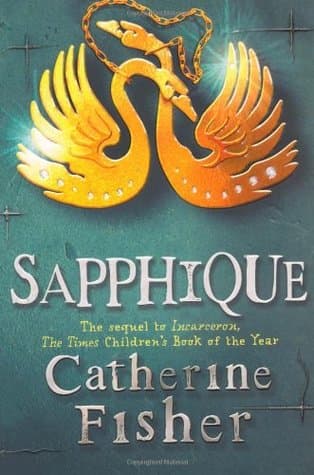
Catherine Fisher (2008)
Genre
Fantasy / Science Fiction / Young Adult
Reading Time
9-10 hours
Key Themes
See below
Sign in to track this book
A prisoner escapes a sentient, high-tech prison only to become a pawn in a royal conspiracy in the Luddite outside world. Meanwhile, his friends brave the prison's dangers to find a mythical artifact that may offer true freedom.
Finn escapes the living prison Incarceron with help from Maestra and Claudia, arriving in the Outside world. Instead of the technological paradise he imagined, he finds a society bound by 'Protocol,' a strict return to a past era without advanced technology and with rigid social rules. He feels disoriented by the natural world, the quiet after Incarceron's constant hum, and the strange customs. Claudia, the Warden's daughter, who helped him escape, plans to present him as Prince Giles, the lost heir to the throne. Finn struggles with the lie, feeling like a prisoner again, but this time in a golden cage of expectations and unfamiliar rules, under the watchful eyes of Claudia and the Royal Court.
Inside Incarceron, Finn's oathbrother, Keiro, and their friend, Attia, remain. Believing Finn truly escaped, they now seek the legendary glove Sapphique supposedly used to break free. Their search takes them through dangerous, changing parts of Incarceron, where they fight the prison's defenses and traps. They meet the mysterious Steel Wolves and must navigate the prison's complex, often deadly machines. Incarceron itself, a living entity, seems to actively block their progress, suggesting it also wants the glove for its own reasons. Their hope for freedom depends entirely on this mythical item.
Claudia, wanting to avoid her arranged marriage to Caspar and restore her family's status, carefully teaches Finn the manners and history of Prince Giles. She introduces him to the Royal Court, where he faces doubt and scrutiny from powerful figures like the Grand Duchess and the King. Claudia invents a backstory for Finn's 'return,' explaining his confusion as a result of his long captivity and escape trauma. She skillfully sways court opinions and navigates the dangerous politics, using her intelligence to counter every doubt, determined to solidify Finn's position as the rightful heir, despite his own uncertainty.
Just as Finn reluctantly starts to accept his role as Prince Giles, a new challenger appears: Rix, a young man who also claims to be Prince Giles. Rix arrives with a powerful court faction, including the Grand Duchess, who quickly support him. This development ruins Claudia's careful plan and puts Finn in greater danger. The court is now divided, and the legitimacy of both claimants needs proof, leading to tests and investigations. Finn, with no real memory of being Giles, is at a disadvantage against Rix, who seems more believable to many.
As Keiro and Attia continue their dangerous journey through Incarceron, they uncover parts of the prison's past and Sapphique's true story. They learn Sapphique was not just an inmate but a powerful figure, possibly one of Incarceron's creators or early inhabitants, with unique abilities. Through old data crystals and the prison's own 'memories' accessed through specific interfaces, they discover the prison's complex and often sad history, its purpose, and its change into a sentient entity. These discoveries deepen their understanding of Incarceron and the glove's importance, which connects to the prison's core and Sapphique's power.
The King's declining health becomes a major factor in the succession crisis. His mind is unclear, making him unable to make decisions, which further empowers the factions supporting Rix. Claudia, desperate to secure Finn's position, believes that if Finn can 'cure' the King, it will confirm his legitimacy. This leads to a desperate search for a remedy, and Claudia even tries using a forbidden Incarceron device, a 'healing' chair, on the King, hoping its advanced technology can restore him. This act against Protocol further endangers her and Finn, as using such technology is strictly forbidden and seen as wrong.
Throughout his time Outside, Finn doubts his own identity. He has fragmented memories of Incarceron, but no true recollection of being Prince Giles. The constant pressure from Claudia to play the role, combined with court scrutiny, causes him great stress. He feels like an imposter, caught between the harsh reality of his past in Incarceron and the artificiality of his present as a supposed prince. He questions his origins, his purpose, and whether he belongs anywhere, fighting an inner conflict that threatens to expose him as a fraud.
After many trials, Keiro and Attia find Sapphique's legendary glove. They discover it is not just an escape tool but a powerful device that can control Incarceron itself, allowing its user to manipulate the prison's systems and even its consciousness. The glove has a dark appeal, offering great power but also hinting at a terrible cost. Keiro, tempted by the control it offers over their captor, faces a moral choice: use the glove to escape, possibly harming Incarceron further, or find another way. This choice will decide their fate and the future of the living prison.
In a moment of clear thinking, the King reveals important information that changes the court's view of the succession crisis. He exposes the Grand Duchess as the mastermind of a long-standing conspiracy, revealing she has manipulated events for years, including the disappearance of the real Prince Giles and the creation of Rix's claim. The King's confession, though brief, gives vital clues about the Outside world's true link to Incarceron and the extent of the Grand Duchess's ambition. This revelation turns the tide against Rix and throws the court into chaos, as the real nature of the power struggle comes to light.
The climax shows the linked fates of Finn and Prince Giles. It is revealed that Finn is not Prince Giles, but rather a creation or 'son' of Incarceron, with some of Sapphique's essence, connecting him uniquely to the prison. The real Prince Giles, it turns out, was indeed lost, but not as thought. The boundaries between Incarceron and the Outside are shown to be more permeable than previously understood, suggesting a shared origin or a deliberate connection. This truth redefines Finn's identity, his purpose, and the nature of both worlds, setting up a confrontation between Incarceron and the Outside.
With the truth known, a desperate final act begins. Finn, now understanding his true nature, must choose his loyalty. Keiro, having decided about the glove, tries to use its power to help himself and Attia escape, possibly creating a new breach between Incarceron and the Outside. This leads to a chaotic fight within the prison, as Incarceron resists the manipulation of its core. At the same time, Claudia and Finn face the consequences of the Grand Duchess's exposed plot, with their lives at stake as they navigate the unstable court and the implications of Finn's true identity. The two storylines meet as the possibility of a permanent connection between the worlds appears.
The Protagonist
Finn transforms from a resourceful but uncertain inmate to a figure who understands his unique connection to Incarceron and the Outside, accepting his true, complex identity.
The Protagonist
Claudia evolves from a cynical, self-serving manipulator to someone who genuinely cares for Finn and questions the foundations of her society, valuing truth and freedom over status.
The Supporting
Keiro matures from a loyal follower to a leader capable of making difficult moral choices for the greater good, even when tempted by power.
The Supporting
Attia grows from a vulnerable but resourceful survivor to a confident and essential member of the team, proving her strength and loyalty.
The Antagonist/Setting
Incarceron's true nature as a sentient, evolving entity is gradually revealed, showing its capacity for both creation and destruction, and its deep connection to the Outside.
The Mentioned/Influential
Sapphique's legend is deconstructed, revealing his true role and powers, and his lasting impact on both Incarceron and Finn.
The Supporting
The Warden's authority and control are slowly eroded as his secrets are exposed and his daughter defies him, leading to his downfall.
The Antagonist
The Grand Duchess's carefully constructed web of lies and power is ultimately unraveled, exposing her as a ruthless conspirator.
The Antagonist
Rix's claim to the throne is exposed as a fabrication, revealing him as a manipulated figure rather than a legitimate heir.
The novel explores identity, especially through Finn's journey. He struggles with who he is—an inmate, a lost prince, or something else. His memory loss and the constant pressure to fit an assigned identity show how self is constructed. This theme also applies to Claudia, who feels trapped by her societal role, and to Incarceron itself, which questions its own purpose. Characters constantly try to understand their origins and find where they belong, whether in the 'freedom' of Outside or the 'home' of Incarceron.
““I am not Giles. I am Incarceron. I am the prison.””
The main theme is the many sides of freedom and imprisonment. Incarceron is a literal prison, but the 'Outside' world, with its strict 'Protocol' and social rules, is another form of confinement for characters like Claudia and Finn. The perceived freedom of escape often leads to new, unexpected prisons. The book asks if true freedom is physical release or breaking free from societal expectations, internal doubts, and illusions. Both worlds, despite their differences, place severe limits on their inhabitants, suggesting true freedom is an internal state or accepting one's reality.
““Outside is just a prison of another kind.””
The novel constantly blurs the lines between what is real and what is believed. Finn's fragmented memories, the court's reliance on made-up histories, and Incarceron's nature as a living, changing entity all contribute to this theme. Characters struggle to tell truth from lies, often relying on stories rather than facts. 'Protocol' itself is a collective agreement to live in a manufactured past, showing how societies can create their own realities. This theme challenges readers to question what they believe and how their perceptions shape their understanding of the world.
““Everything you see, everything you touch, is a fabrication. A lie.””
A central conflict is the sharp contrast between advanced technology and rigid tradition. Incarceron embodies cutting-edge, sentient technology, while the Outside world follows a strict 'Protocol' that rejects all modern advancements, forcing a return to a simpler, almost medieval way of life. This creates tension, as characters from Incarceron struggle to adapt to the primitive Outside, and Outside characters are both fascinated and repulsed by glimpses of Incarceron's tech. The theme explores the dangers of unchecked technological progress versus the stagnation of denying progress, and how both can become oppressive systems.
““The Protocol was a prison. More subtle, perhaps, but just as inescapable.””
Power dynamics and corruption are present both in the Royal Court Outside and within Incarceron. The Grand Duchess manipulates the succession for her own gain, while the Warden keeps his power through deceit and control. Even Incarceron, despite its initial good purpose, has become corrupted, its systems twisted into a brutal prison. The novel examines how power, whether political or technological, can corrupt people and institutions, leading to oppression, injustice, and the suppression of truth. Characters constantly compete for control, showing the moral compromises made in the pursuit of influence.
““Power is a disease, and it spread fast in this court.””
A sentient, self-evolving prison that is a character in itself.
Incarceron is not merely a setting but a complex, conscious entity. Its ability to shift its internal geography, create new dangers, and even communicate with its inhabitants makes it a dynamic antagonist. It functions as a plot device by actively hindering or aiding characters based on its own mysterious will, driving the internal narrative of Keiro and Attia. Its sentience also allows for the exploration of themes like artificial intelligence, control, and the nature of consciousness itself, blurring the lines between technology and life.
Finn's lack of memory about his past, particularly his supposed identity as Prince Giles.
Finn's amnesia is a crucial plot device that drives much of the narrative. It creates suspense and mystery around his true identity, forcing both Finn and the reader to question every piece of information. This device allows for exposition to be revealed gradually, as Finn recovers fragments of his past. It also serves to heighten his vulnerability and reliance on Claudia, while simultaneously making his claim to the throne difficult to prove, thereby fueling the court intrigue and the emergence of a rival claimant.
A strict societal rule in the Outside world that shuns advanced technology.
The Protocol is a foundational plot device that defines the entire Outside world. It creates a stark contrast with Incarceron's high-tech environment, generating immediate conflict for Finn as he struggles to adapt. It functions as a source of societal control and oppression, driving Claudia's desire for rebellion. The Protocol's arbitrary nature and the severe consequences for violating it create tension and demonstrate the dangers of extreme traditionalism, while also serving as a barrier to understanding the true connection between the two worlds.
A legendary artifact believed to grant escape or control over Incarceron.
Sapphique's glove is a classic MacGuffin, acting as the primary objective for Keiro and Attia's storyline within Incarceron. Its mythical status and the belief that it can facilitate escape provide a clear goal and motivation. As the story progresses, the glove's true nature and powers are revealed to be far more complex than simple escape, becoming a device that unveils deeper truths about Incarceron's origins and Sapphique's abilities, ultimately offering the wielder a choice between freedom and immense power over the prison itself.
A rival claimant to the throne, mirroring Finn's claim as Prince Giles.
The introduction of Rix, another young man claiming to be Prince Giles, serves as a classic doppelganger plot device. It immediately creates heightened conflict and doubt around Finn's legitimacy, forcing him and Claudia to work harder to prove his identity. Rix's presence allows for direct comparisons between the two 'princes,' highlighting their different strengths and weaknesses. Ultimately, his role is to expose the political machinations of the Grand Duchess and to further complicate the mystery surrounding the real Prince Giles and Finn's true origins.
“The library was a forest of words, a wilderness of stories. It was a place where you could get lost and find yourself again.”
— Mirrin's initial wonder at the Great Library of the Sanctuary, a central location.
“There are always two sides to a story, and sometimes a third. The truth is often a thing of many facets, like a jewel.”
— One of the older Sisterhood members imparting wisdom to Mirrin about history and perspective.
“Fear is a cold companion, but it can also be a sharp spur.”
— Mirrin reflecting on her own fear and how it sometimes motivates her.
“Some doors, once opened, can never truly be closed again.”
— A warning given to Mirrin about the consequences of her choices and delving into forbidden knowledge.
“The past is not dead. It is merely sleeping, waiting for someone to wake it.”
— Mirrin contemplating the ancient history and forgotten secrets within the Sanctuary.
“Knowledge is power, but power can be a dangerous thing in the wrong hands.”
— A recurring theme as Mirrin uncovers powerful ancient technologies and their potential for misuse.
“The greatest prison is often the one we build for ourselves, with our own doubts and fears.”
— Mirrin struggling with her self-imposed limitations and internal conflicts.
“Even the smallest spark can ignite the greatest fire.”
— Mirrin realizing the profound impact of her seemingly small actions.
“Sometimes the answers you seek are not found in books, but in the silence between the words.”
— A mentor advising Mirrin to trust her intuition and look beyond literal interpretations.
“To truly understand something, you must first be willing to question everything you think you know.”
— Mirrin's journey of discovery often involves challenging established beliefs.
“The future is not written in stone, but in the choices we make today.”
— Mirrin grappling with the weight of her decisions and their potential to alter the future.
“Not all monsters dwell in the dark; some wear the brightest robes.”
— Mirrin's growing disillusionment with some of the authority figures within the Sanctuary.
“Silence can be a weapon, or a shield, or a canvas for the unspoken.”
— Mirrin observing how different characters use silence in various ways.
“The world is wider than you can imagine, and stranger than you can dream.”
— Mirrin's expanding worldview as she learns more about the world beyond the Sanctuary.
Ready to see how well you understood this book? Take our interactive quiz with 10 questions.







