“I’m James Stark, also known as Sandman Slim. I was murdered, went to Hell, escaped, and now I’m back in L.A. And I’m pissed.”
— Stark's opening narration, establishing his identity and predicament.

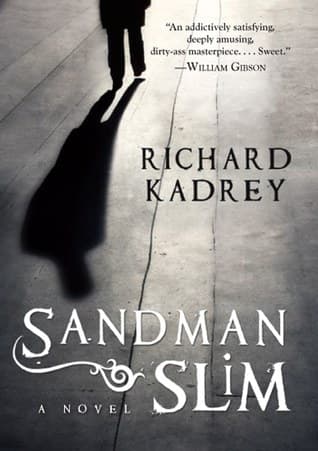
Richard Kadrey (2009)
Genre
Fantasy / Mystery
Reading Time
776 min
Key Themes
See below
Sign in to track this book
After escaping eleven years as a hitman in Hell, James Stark returns to a supernatural Los Angeles for revenge, only to find himself embroiled in an even larger cosmic battle between Heaven and Hell, all while saddled with a talking head.
James Stark, known as Sandman Slim, escapes Hell after eleven years, where he fought in gladiatorial pits for demons. He emerges in a Hollywood cemetery, disoriented and immediately confronted by thugs. Stark quickly dispatches them, showing his combat skills and dark magic. His first goal is to find his former group of magicians who betrayed him: Mason, Kasabian, and their leader, Allegra. He learns the magical world has changed significantly, with new power structures and little regard for his past. Stark wants revenge against those who condemned him.
Stark visits his old contact, the demon Legion, who now runs a pawn shop called 'The Golden Rule'. Legion, a shapeshifting demon with multiple personalities, is initially unhelpful but eventually gives Stark cryptic clues and a severed, still-living, talking head named Kasabian. This Kasabian is not the magician Stark seeks, but a former associate who was gruesomely punished. He becomes a reluctant, often annoying, source of information and dark humor. Kasabian's presence forces Stark to confront the grotesque realities of the magical underworld and provides a constant, unwanted companion.
Stark begins investigating his betrayers. He learns that Allegra is now a powerful figure in the magical community, and Mason has also gained status. His search leads him to a magic club where he meets Candy, a bartender who seems to know more than she reveals. Stark's questions connect him to the ongoing mystery of the Black Dahlia murders, a case with supernatural ties that seems to link to his former group. He realizes his revenge mission is more complicated than a simple confrontation.
As Stark investigates, he repeatedly meets members of the Golden Vigil, a secret organization that polices the supernatural world. They try to maintain a fragile balance between humanity and the occult. Led by the enigmatic Mammon, the Vigil sees Stark as a dangerous, unpredictable element. Their encounters are often violent, with Stark demonstrating his combat skills against their agents, but also revealing their significant resources and influence. The Vigil's interference adds another layer of opposition to Stark's already dangerous quest, making him a target for multiple factions.
Stark eventually finds Mason, now a powerful sorcerer involved in dark dealings. Mason reveals that Allegra has become even more formidable, gaining immense power within the magical hierarchy, possibly connected to angelic forces. The betrayal was not just about power, but about a larger scheme to manipulate the balance between Heaven and Hell. Stark realizes his former friends were not ordinary magicians, but participants in a vast, cosmic conspiracy, making his personal fight part of a much larger struggle.
Stark uncovers a cult called the 'Empty Men', who are performing ritualistic murders. These murders are not random but part of a larger magical working designed to open a portal or summon a powerful entity. The cult's actions link to Allegra's plans and the Black Dahlia murders, suggesting a deep plot. Stark realizes the sacrifices are meant to empower Allegra and her allies. Stopping them is important not only for his revenge but for Los Angeles's safety. He reluctantly takes on a protector role.
Stark finally confronts Allegra, who is now incredibly powerful, having allied with a faction of angels. Allegra reveals her ambition: to cleanse the world of all 'taint', including humans and demons, to create a new, pure order. She sees Stark's time in Hell as a necessary sacrifice for her plan. The confrontation is brutal, with Allegra wielding immense divine power. Stark, however, uses his demonic abilities and experience from Hell to counter her, showing that his 'taint' is also a source of strength. He discovers that angels are not always benevolent.
Mammon, the leader of the Golden Vigil, reveals his true nature and intentions. He is not just an enforcer but a powerful entity with his own agenda, using the Vigil to manipulate events. He explains that Allegra's actions, while destructive, are part of a larger cosmic game he is playing, one that balances the forces of Heaven and Hell. Mammon has used Stark as a pawn, knowing his return from Hell would disrupt the existing order and create opportunities for his own plans. Stark realizes he has been caught in a much larger, divine conflict.
The climax involves Stark in a brutal, city-spanning battle against Allegra and her angelic forces. He is helped by unexpected allies, including Candy and even the reluctant Kasabian. Stark uses his blend of demonic powers, street smarts, and resilience to fight against overwhelming odds. During the battle, it is revealed that Allegra's plan involves a ritual that would wipe out all supernatural beings not aligned with her vision. Stark disrupts her ritual, but not before suffering severe losses and experiencing further betrayal, reinforcing his cynical view of the world.
Stark, though badly wounded, survives the confrontation. Allegra is defeated, but the cost is high, and the magical landscape of Los Angeles is changed. Stark finds himself in a world where his past is still a burden, but his actions have made him a reluctant protector. He does not get the clean revenge he sought, but he has prevented a disaster. With Kasabian still attached, and new threats emerging, Stark realizes his fight is far from over. He is still Sandman Slim, the man from Hell, but now with a grudging sense of responsibility for the city he once only wanted to escape.
The Protagonist
Stark begins as a purely revenge-driven antihero but gradually evolves into a reluctant protector of Los Angeles, accepting his role in the larger supernatural conflicts.
The Supporting
Kasabian remains largely unchanged in his physical state but develops a grudging loyalty and companionship with Stark.
The Antagonist
Allegra's power and fanaticism grow throughout the story, leading to her ultimate defeat but not necessarily a change of ideology.
The Supporting
Legion's character remains consistent as a self-interested information broker, adapting to the changing power dynamics.
The Supporting
Candy evolves from a mysterious observer to an active and powerful ally, revealing her true magical heritage.
The Antagonist/Supporting
Mammon's true nature as a powerful, manipulating entity is revealed, solidifying his role as a grand schemer.
The Supporting/Antagonist
Mason's rise in power is shown, but he remains a secondary antagonist, ultimately overshadowed by Allegra.
The Mentioned/Antagonist
The cult serves as a plot device to advance Allegra's plans and is eventually dismantled by Stark.
Stark's main motivation after returning from Hell is revenge against those who betrayed him. However, his journey forces him to confront larger issues, leading him to protect Los Angeles from greater threats. While he never fully gives up his cynical, vengeful nature, his actions suggest a reluctant move toward responsibility beyond personal revenge. This is clear in his decision to disrupt Allegra's apocalyptic plans, even though it complicates his personal revenge. The book explores if true redemption is possible for someone so deep in violence, or if it is just a different path to the same end.
“You want to know what Hell is? It’s not fire and brimstone. It’s a place where everything you ever cared about is taken from you, and then you’re forced to watch it all burn.”
The novel blurs the lines between good and evil. Stark, a demon-killing hitman from Hell, is the protagonist, while Allegra, who allies with angels, is the main antagonist. Angels are shown as manipulative and destructive, while some demons, like Legion, are simply self-interested. This challenges traditional ideas of morality, suggesting that 'good' and 'evil' are often subjective and that power corrupts across the spectrum. Stark's own 'evil' actions in Hell make him uniquely able to fight a 'good' gone wrong, showing that even darkness can serve a purpose.
“Good and evil? That's what the priests preach to keep the sheep in line. Out here, there's just power, and what you do with it.”
Stark's eleven years in Hell have left him deeply traumatized, both physically and psychologically. He has lost everything—his friends, his lover, his humanity—and carries the scars of his experiences. His cynicism, violent tendencies, and inability to form deep connections are all direct results of his trauma. The talking head Kasabian also represents extreme loss and trauma. The story explores how people cope with immense suffering and its lasting impact on their identity and worldview, often leading to a hardened, emotionally distant facade.
“You don't come back from Hell the same person. You come back something else. Something harder. Something broken.”
The novel shows how power corrupts, no matter its source (demonic, angelic, or magical). Allegra, once Stark's lover, becomes a ruthless fanatic consumed by her own vision, empowered by angels. Mammon, the leader of the Golden Vigil, manipulates events and sacrifices lives for his grand design. Even Stark, with his demonic abilities, struggles to control his violent impulses. The story suggests that unchecked power, even with seemingly good intentions, leads to destruction and moral compromise, creating a cycle of violence and betrayal in the supernatural world.
“Everyone wants to save the world. The trick is making sure you don't destroy it in the process.”
A macabre, sentient severed head serving as exposition and comic relief.
Kasabian, the talking head, functions as a unique and grotesque sidekick. He provides Stark with crucial information about the changed magical landscape of Los Angeles, often through cynical commentary or reluctant admissions. His presence also serves as a constant reminder of the horrific nature of the supernatural world and the consequences of magical transgressions. Furthermore, Kasabian injects dark humor and banter into the narrative, breaking the tension and highlighting Stark's own desensitized nature. He is a mobile, albeit unwilling, information source and a symbol of the book's gritty, irreverent tone.
A secret organization policing the supernatural, often clashing with Stark.
The Golden Vigil acts as an antagonistic force and a source of world-building. Initially appearing as a seemingly legitimate, albeit ruthless, authority attempting to maintain order, their true nature as a manipulative organization under Mammon's control is gradually revealed. They introduce various magical threats and rules to Stark, forcing him to navigate a complex political landscape. The Vigil's clashes with Stark highlight his anti-establishment nature and his refusal to be controlled, while also demonstrating the intricate power dynamics at play in the supernatural world of Los Angeles.
A real-world historical mystery infused with supernatural elements.
The inclusion of the Black Dahlia murders serves to ground the supernatural narrative in a tangible, real-world mystery, lending a sense of dark history to the magical underworld. It acts as a plot hook, connecting Stark's personal revenge quest to a larger, more sinister magical ritual orchestrated by Allegra and the Empty Men. By intertwining a notorious unsolved crime with occult practices, the novel enhances its gritty, urban fantasy atmosphere and suggests that the supernatural has always been intertwined with human history, operating just beneath the surface of everyday reality.
Abilities gained in Hell, making Stark a uniquely powerful protagonist.
Stark's demonic powers, acquired during his eleven years as a hitman in Hell, are a central plot device. These abilities, including enhanced strength, resilience, and mastery of dark magic, make him a formidable force against both human and supernatural foes. They explain his survival in Hell and his effectiveness upon his return. However, they also come with a cost, marking him as 'tainted' and often causing him internal conflict. These powers are essential for him to confront the increasingly powerful antagonists, highlighting that sometimes, fighting fire with fire is the only option, even if it means embracing a part of the darkness.
“I’m James Stark, also known as Sandman Slim. I was murdered, went to Hell, escaped, and now I’m back in L.A. And I’m pissed.”
— Stark's opening narration, establishing his identity and predicament.
“Living in L.A. is like living in a movie. Everyone’s got a script, and they’re all trying to get you to play a part in it.”
— Stark's cynical observation about Los Angeles and its inhabitants.
“The problem with being dead is it makes you think. And I had a lot of time to think in Hell.”
— Stark reflecting on his time in Hell and the introspection it forced upon him.
“There are two kinds of people in the world: those who have seen the inside of a demon’s stomach, and those who haven’t.”
— Stark's grim categorization of humanity, based on his experiences.
“Revenge is a dish best served with a side of overkill.”
— Stark's personal philosophy on vengeance, highlighting his brutal approach.
“Sometimes the only way to get a straight answer out of someone is to threaten them with a rusty spoon.”
— Stark's pragmatic and violent approach to interrogation.
“Magic isn't about waving a wand; it's about knowing what you want and being willing to pay the price.”
— Stark's explanation of true magic, emphasizing sacrifice and will.
“Hell changes you. It doesn’t make you stronger, just… different. More brittle in some places, harder in others.”
— Stark's internal reflection on the lasting effects of his time in Hell.
“Every time you think you’ve seen it all, L.A. finds a way to surprise you. Usually with something trying to kill you.”
— Stark's ongoing commentary on the dangerous and unpredictable nature of Los Angeles.
“I don't believe in happy endings. I believe in surviving.”
— Stark's cynical and pragmatic outlook on life and its outcomes.
“You can take the man out of Hell, but you can’t take Hell out of the man.”
— A common sentiment from Stark, highlighting that his experiences in Hell are a permanent part of him.
“The dead don’t forgive. They just wait.”
— Stark's understanding of the enduring nature of vengeance and the supernatural.
“Sometimes the monsters are the only ones you can trust.”
— Stark's paradoxical view on alliances, often finding loyalty in unexpected places.
“I’m not a hero. I’m just a guy who got royally screwed over and decided to do something about it.”
— Stark's self-assessment, rejecting the label of hero and embracing his vigilante nature.
Ready to see how well you understood this book? Take our interactive quiz with 10 questions.
Biography coming soon.







