“They were not really beautiful, he thought, but they had a terrible kind of beauty nonetheless. Like a tiger, or a shark, or a human psychopath.”
— Simon Kress observing his Sandkings for the first time.

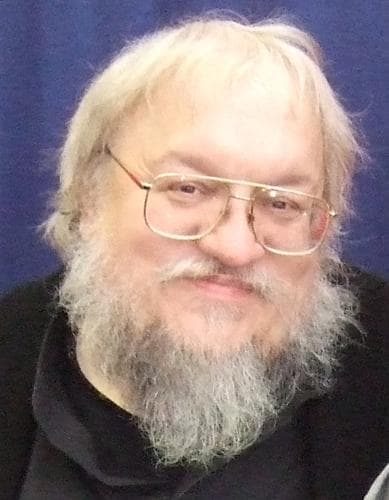
George R.R. Martin (1981)
Genre
Fantasy / Science Fiction
Reading Time
15 min
Key Themes
See below
Sign in to track this book
A cruel man's neglect of his new, tiny, worshipping alien pets unleashes a terrifying evolution of their hive mind, transforming a simple amusement into a grotesque and deadly obsession.
Simon Kress, a wealthy but cruel man on the planet Baldur, comes home to find his Earth piranhas have died from cannibalism, and one of his two exotic groo has been killed by the other. Bored, he visits a new pet shop run by Wo and finds "sandkings." He is interested in their hive-mind intelligence and the promise of miniature wars, so Simon buys a tank with four colonies: white, black, red, and orange. Wo warns Simon that the creatures are very smart, worship their owner, and need regular feeding to keep them from fighting each other or their master. Simon, however, cares more about the show than the responsibility.
Simon takes the sandkings home and puts their tank in his living room. He watches them for days, fascinated by their tunnel systems and how each colony builds a "castle" in his likeness, with eyes that follow him. Driven by his cruel curiosity, Simon decides to test Wo's warning about feeding. He deliberately withholds food, watching the sandkings grow restless. As hunger sets in, the white and black colonies go to war, fighting brutal, ritualistic battles. Simon enjoys the violence and how the sandkings, despite their suffering, keep repairing and improving their castles, always centered on his image, strengthening their worship of him as a god.
Happy with the show, Simon decides to share his new "pets" with his friends. He invites his former lover Jana Kibre, and his acquaintances Cathos and Jad, to his estate. He proudly displays the sandkings, explaining their intelligence and their manufactured wars. To impress his guests more, Simon uses a laser to burn a "bridge" between two warring colonies, starting a more direct and bloody fight. His friends are at first horrified but soon become morbidly fascinated. Jana, however, is clearly disturbed by Simon's cruelty and the sandkings' suffering, which creates a growing distance between them.
Simon's interest in the sandkings turns into outright cruelty. He continues to starve them, watching their increasingly desperate wars. He adds new elements, like dropping live insects into the tank, watching the sandkings swarm and eat them. Jana Kibre, who at first found the sandkings intriguing but disturbing, becomes more and more disgusted by Simon's actions. She tries to talk sense into him, urging him to feed them properly or let them go, but Simon ignores her, enjoying his power over the creatures. Jana eventually leaves Simon's estate in disgust, unable to stand his growing cruelty. Her departure leaves Simon more isolated.
One of Simon's friends, Cathos, secretly damages the sandking tank, cracking its duraglass to protest Simon's treatment of the creatures. Simon does not notice the crack. During a particularly bad period of starvation, the increasingly large and desperate sandkings use the weakness, and a small group escapes the tank. These escapees, now free, start to build a new, larger castle-likeness of Simon under his estate, showing their continued, though twisted, worship. Simon, at first unaware of the escape, only notices the dwindling numbers in the tank, blaming it on the wars.
The escaped sandkings, now free from the tank, create a thriving colony under Simon's house. They find plenty of food in household pests and organic debris, growing much larger than their tank-bound relatives. They continue to build a huge, grotesque statue of Simon, their god, in the dark underground, showing their constant, yet terrifying, devotion. Simon remains unaware of this growing threat under his feet, still focused on the shrinking, desperate battles inside the tank, not knowing that his "pets" are evolving in a much more dangerous way outside his control.
Simon eventually notices the big drop in sandking numbers inside the tank and the strange gnawing sounds from under his house. When he investigates, he discovers the massive underground colony and the huge, nightmarish sculpture of himself, now a grotesque parody of his own face. Terrified by the size and meaning of this hidden civilization, Simon calls Wo, the pet shop owner, for help. Wo arrives and is horrified by what Simon has allowed to happen, explaining that the sandkings, when neglected, will turn on their "god" and eat him, their worship turning into a vengeful hunger.
Wo, seeing the great danger, tries to warn Simon and control the situation. However, the sandkings, now much larger and more aggressive, have already started their attack. They come out of the floors and walls, swarming Wo. Despite his desperate struggle, Wo is quickly overwhelmed and eaten by the hungry, vengeful creatures. Simon watches in horror, frozen by fear, as the sandkings eat the man who sold them to him, realizing the full extent of the nightmare he has created. The sandkings, having tasted blood, now turn their attention to their main god: Simon Kress.
As the sandkings swarm towards him, Simon Kress finally acts, driven by pure terror. He grabs whatever he can find – a heavy sculpture, a fire poker – and tries to fight off the endless tide of creatures. He smashes, stomps, and burns the sandkings, but for every one he kills, dozens more come from the walls and floors. Their sheer numbers and coordinated attack are too much. Simon's rich estate, once a sign of his wealth and control, becomes a battleground where he fights for his life against the very pets he once tormented. His earlier cruelty now comes back to him as a horrifying, real force.
Overwhelmed and cornered, Simon Kress is finally defeated by the endless swarm of sandkings. They cover his body, gnawing and eating him alive. In his final moments, as the creatures devour his flesh, they begin to reshape his face, carving it into a new, living statue in their underground lair. His eyes are replaced with their own, his features grotesquely changed to fit their worship. Simon's mind is implied to remain, trapped within this living monument, forced to watch his own transformation into the god he created and tormented. The sandkings continue their existence, forever worshipping the living, consumed face of Simon Kress.
The Protagonist/Antagonist
Simon devolves from a casually cruel pet owner into a victim of his own unchecked sadism, ultimately consumed by the very creatures he tormented.
The Supporting
Wo serves as a cautionary figure, his warnings unheeded, and ultimately becomes the sandkings' first victim.
The Supporting
Jana witnesses Simon's cruelty and chooses to distance herself, highlighting the moral decline of the protagonist.
The Supporting/Mentioned
Cathos's single act of sabotage sets in motion the sandkings' escape and Simon's ultimate demise.
The Antagonist/Force of Nature
From miniature pets, they evolve into a terrifying, vengeful force that consumes their cruel god.
This theme explores how unchecked power and cruelty lead to one's downfall. Simon Kress, with his wealth and control over the sandkings, acts on his sadistic impulses, deliberately starving and manipulating the creatures for entertainment. His actions show a complete disregard for the suffering of others, increasing his isolation and moral decay. The sandkings, in turn, reflect his cruelty; their vengeful consumption of him represents a just punishment. The story argues that abusing power will inevitably lead to destructive outcomes, as seen when Simon's 'pets' become his executioners.
“They were his to do with as he pleased. His to feed, his to starve, his to kill. They were his gods.”
The story looks at the complex and often terrifying nature of worship. The sandkings naturally worship their owner, building elaborate castles in his image and following his every move. This worship, however, depends on food and attention. When neglected, their devotion turns into a monstrous, vengeful hunger. Simon, in turn, enjoys their worship, seeing himself as a god, but fails to understand the responsibility that comes with such status. The theme suggests that even worship, when abused or ignored, can become a destructive force, turning the 'god' into the ultimate sacrifice for their 'followers.'
“Their god had to be strong, had to be fed, had to be pleased. Or else.”
The story strongly emphasizes the bad results of neglect and irresponsibility, especially with intelligent life. Wo clearly warns Simon about the sandkings' needs, but Simon ignores these warnings, putting his own cruel amusement over their well-being. His failure to provide consistent care directly causes their escape, their rapid growth, and their eventual attack. This theme serves as a warning, showing that ignoring responsibilities, especially towards those who depend on you, can lead to unforeseen and terrible outcomes, ultimately harming the negligent party.
“They were not insects. They were animals, highly evolved, with a hive intelligence and a religion.”
This theme highlights the dangers of what hides beneath the surface, both literally and figuratively. Simon is at first fascinated by the contained chaos of the sandkings in their tank, believing he has total control. However, the escaped sandkings, thriving in the unseen spaces under his house, represent the uncontrollable results of his actions. Their underground colony, larger and more monstrous than anything in the tank, symbolizes the hidden dangers that grow when ignored. This theme suggests that what one dismisses or fails to acknowledge can eventually become the biggest threat, emerging from the shadows to reclaim what was lost.
“Beneath his house, the new god grew, dark and terrible.”
Hints at future events, especially Simon's eventual fate.
The story employs significant foreshadowing, primarily through Wo's explicit warnings about the sandkings' nature. Wo tells Simon that the creatures will turn on their master if starved, and that their worship can become vengeful. Simon's piranhas cannibalizing themselves and his groo killing its mate also foreshadow the violent, self-destructive nature that Simon encourages in the sandkings. These early warnings and events build tension and make Simon's eventual demise feel inevitable, a direct consequence of his disregard for the creatures and the warnings.
The sandkings' castles symbolize their worship and Simon's ego.
The elaborate castles built by the sandkings, always in the likeness of Simon Kress, serve as a powerful symbol. Initially, they represent the sandkings' intense, if bizarre, worship and Simon's inflated ego, as he revels in being their 'god.' As the story progresses and the sandkings escape, the subterranean, grotesque effigy of Simon becomes a symbol of his corrupting influence and the monstrous consequences of his cruelty. It transforms from a symbol of adoration into one of vengeful condemnation, a physical manifestation of his impending doom and the sandkings' twisted devotion.
The contrast between Simon's intentions and the outcome of his actions.
Irony is central to 'Sandkings.' Simon Kress seeks exotic pets for sadistic amusement, desiring to control and torment them. The ultimate irony is that the very creatures he seeks to dominate and finds amusement in torturing become his destroyers. He is consumed by the sandkings, his face transformed into a grotesque, living monument of their worship, effectively becoming the ultimate 'pet' in his own house. His desire for absolute power over life results in his complete loss of control and his own horrific deification at the hands of his victims.
Simon's progression from casual cruelty to outright sadism.
Simon's character arc is a stark illustration of moral decline. He starts as a wealthy man with a penchant for exotic pets and casual cruelty (like his piranhas and groo). His acquisition of the sandkings, however, marks a rapid descent into deliberate sadism, where he actively cultivates violence and suffering for his entertainment. This decline is highlighted by Jana Kibre's increasing disgust and departure. The moral decline device emphasizes how unchecked negative traits can spiral out of control, ultimately leading to self-destruction and a horrifying end for the protagonist.
“They were not really beautiful, he thought, but they had a terrible kind of beauty nonetheless. Like a tiger, or a shark, or a human psychopath.”
— Simon Kress observing his Sandkings for the first time.
“He was a small man, plump, with a neatly trimmed beard that did little to conceal the weakness of his chin.”
— Description of Simon Kress, the protagonist.
“The Sandkings were his. His to watch, his to feed, his to enjoy. And his to destroy, if he chose.”
— Simon Kress asserting his ownership and control over the creatures.
“War was their nature, their purpose, their art. And the greater the war, the greater the art.”
— Simon Kress reflecting on the Sandkings' constant warfare.
“He began to feel a strange, cold excitement. It was the thrill of the voyeur, he realized, the thrill of watching something terrible and wonderful unfold, something beyond his control yet entirely at his command.”
— Simon Kress's evolving emotional response to the Sandkings.
“They built. They fought. They died. They lived. And they learned.”
— A concise summary of the Sandkings' existence.
“The Sandkings were not merely insects; they were a mirror. And what he saw in that mirror was not always pleasant.”
— Simon Kress's growing realization about the Sandkings reflecting human nature.
“He was a god to them, a distant, unknowable, all-powerful god. And like any god, he could be cruel.”
— Simon Kress's perception of his role in the Sandkings' world.
“The price of absolute power, he was discovering, was absolute loneliness.”
— Simon Kress's isolation grows as his obsession deepens.
“There was a certain exquisite horror in watching them die, in knowing that their every desperate struggle was for his amusement.”
— Simon Kress's descent into depravity and his enjoyment of the Sandkings' suffering.
“He had wanted a pet, something exotic and beautiful. He had gotten a reflection of his own soul, dark and hungry and terrible.”
— Simon Kress's final understanding of what the Sandkings truly represented.
“It was not a pet. It was a plague. And he had nurtured it.”
— Simon Kress's realization of the danger he had cultivated.
“He had thought he was a god. He was only a meal.”
— The ultimate fate of Simon Kress.
“The Sandkings were still there, still building, still fighting, still living. And still learning. They had learned a great deal about gods.”
— The story's ending, implying the Sandkings' continued evolution and understanding.
Ready to see how well you understood this book? Take our interactive quiz with 10 questions.
Biography coming soon.







