
Biography coming soon.

J.D. Robb (2008)
Genre
Thriller / Mystery / Science Fiction / Romance
Reading Time
12 Minutes
Key Themes
See below
Sign in to track this book
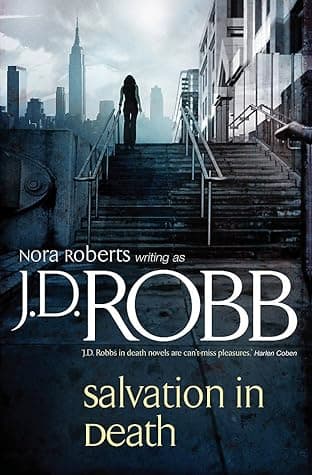
Detective Eve Dallas navigates a treacherous path of identity theft, gang violence, and religious deception when a priest is poisoned during mass, only for a second murder to shatter her investigation.
During a funeral Mass at St. Christobal's in East Harlem, Father Miguel Flores collapses and dies on the altar after drinking consecrated wine. Detective Lieutenant Eve Dallas and her team arrive to a scene of chaos and grief. Initial examination confirms the wine had potassium cyanide, a lethal dose. The parishioners are devastated, and the community is in shock. Eve, with her husband Roarke, begins securing the scene and interviewing witnesses, including Father Flores's assistant, Father Mara, and various churchgoers. The church setting immediately raises questions about the motive and the killer's identity; the murder seems both public and deeply personal.
Dr. Charlotte Mira's autopsy reveals surprising facts about Father Miguel Flores. He had extensive plastic surgery, removed tattoos, and scars from old knife wounds, suggesting a violent past unlike his priestly image. His fingerprints are not in any known databases. This discovery changes the investigation from a simple poisoning to a complex case of identity theft and a hidden past. Eve realizes 'Father Flores' lived under an assumed identity, and the murder motive likely came from who he was before becoming a priest, not his current role. The team begins uncovering his true identity.
Eve and her team examine the few clues left by the deceased. They discover the man known as Father Flores was Rafael 'Rafa' Soto, a high-ranking member of the 'Los Diablos' gang. Rafa was thought to have died years ago in a gang war. The plastic surgery and new identity were part of his escape from that life. The investigation now focuses on former associates and rivals of Los Diablos, as well as anyone who knew Rafa's true identity and sought revenge. The motive becomes clearer: a delayed act of retribution for past actions, possibly related to his betrayal of the gang or someone within it.
Just as Eve starts to understand Rafa's past, a second murder occurs, again during a church service. This time, Maria Sanchez, a beloved elderly parishioner, is poisoned with cyanide. The murder happens in front of an even larger congregation, causing more terror and confusion in the community. The link to the first murder is clear, but Maria's background offers no obvious ties to Rafa's gang history. This suggests either a copycat killer, a diversion, or that the true motive is more deeply rooted within the church community itself, or perhaps a personal vendetta against anyone connected to Rafa's new life.
The investigation into Maria Sanchez shows she was not just an innocent parishioner. Maria had a strong connection to Rafa's past life; she was the mother of his former girlfriend, Elena, whom Rafa had accidentally killed years ago during a gang confrontation. Maria had helped Rafa escape the gang and establish his new identity as Father Flores. Her reasons were a mix of grief for her daughter, a wish for Rafa's redemption, and a need to atone for her own past involvement in the gang's activities. This revelation links both victims and provides a key piece of the puzzle, narrowing the suspect pool to those who knew about this secret arrangement.
Eve discovers the killer is Luis Sanchez, Maria's son and Elena's brother. Luis had been a deep-cover informant for the police for years, working to bring down Los Diablos. He had seen Rafa murder Elena and had been consumed by a desire for revenge. Luis had found Rafa's new identity and had been carefully planning his retribution. He saw Rafa's priestly life as a mockery of justice and a betrayal of Elena's memory. Maria's murder was a calculated move to silence her, as she was the only one who truly knew the extent of Rafa's transformation and could interfere with Luis's final act of vengeance.
Confronted with the evidence, Luis Sanchez confesses. He talks about his hatred for Rafa, the pain of losing his sister, and the years he spent living a double life, working to destroy the gang that had taken so much from him. He saw Rafa's death as a necessary act of justice, and his mother's death as a tragic but unavoidable result of her protecting Rafa. Luis believes he is justified, seeing himself as an instrument of vengeance. Eve, while understanding his pain, must uphold the law, leading to a tense confrontation where she tries to bring him in without more violence.
The confrontation with Luis happens in a secluded location, where he has prepared to make his final stand. He is armed and desperate, convinced he did what was right. Eve, using her sharp psychological insight and combat skills, disarms and apprehends Luis without lethal force. The arrest ends the murder spree that terrorized East Harlem. The case affects Eve deeply, showing the complex interaction of justice, revenge, and redemption. The community must deal with the shocking revelations about their beloved priest and the dark secrets that had been hidden so long.
After the arrests, Eve thinks about the case's meaning. She considers salvation, both spiritual and personal, and how people seek it in various ways, sometimes violent ones. The story of Rafa Soto's attempted redemption and Luis Sanchez's relentless pursuit of vengeance shows the blurred lines between good and evil, justice and revenge. Eve finds comfort and perspective in her relationship with Roarke, who offers insight into the human capacity for change and the lasting power of love and forgiveness, even after tragedy. The case strengthens Eve's commitment to justice, even when it is difficult and heartbreaking.
The St. Christobal community, though shaken, begins to heal. Father Mara leads the grieving parishioners, offering comfort and guidance. The church, once a symbol of peace, now bears the scars of violence and deception, but also becomes a place for collective mourning and resilience. Eve and her team ensure the community receives support and understanding. The case ends with a sense of closure, but also with the understanding that such events affect a community deeply, challenging their faith and their perceptions of those they trusted.
The Protagonist
Eve deepens her understanding of the human capacity for both redemption and vengeance, reinforcing her commitment to justice while grappling with the moral ambiguities of the case.
The Supporting
Roarke continues to be Eve's anchor and confidant, offering a grounded perspective on the moral complexities of the case and reinforcing their deep bond.
The Victim
His arc is presented retrospectively, showing his transformation from a violent gang member to a priest seeking redemption, ultimately failing to escape the consequences of his past actions.
The Antagonist
Luis's arc reveals his transformation from a grieving brother to a calculated avenger, culminating in his arrest and the realization of his deep-seated pain and moral justifications.
The Victim/Supporting
Her retrospective arc reveals her journey from a grieving mother to a secret protector, ultimately paying the price for her complicity in Rafa's hidden life.
The Supporting
Peabody continues to grow in her role as Eve's partner, demonstrating increasing competence and offering steady support amidst the case's emotional turmoil.
The Supporting
Dr. Mira provides psychological context for the extreme actions of the characters, reinforcing her role as Eve's intellectual and emotional support.
The Supporting
Whitney continues to demonstrate his unwavering trust and support for Eve, allowing her the space to pursue the complex investigation.
The Supporting
Father Mara steps up to lead his congregation through a period of immense grief and confusion, embodying the spiritual resilience of the community.
The novel explores the possibility and limits of redemption. Rafa Soto tries to leave his violent past and find salvation as Father Flores, but his old life violently reclaims him. The story asks if true redemption is possible when past sins remain unatoned for in the eyes of others. Maria Sanchez's actions are also driven by a desire for Rafa's redemption and her own atonement. The narrative questions if forgiveness, both self-forgiveness and from others, is achievable, or if some actions are irrevocably unforgivable, leading to an endless cycle of retribution.
“Salvation. Redemption. Forgiveness. All of it complicated by the mess of human choices, human error, human evil.”
A central conflict is the difference between seeking justice through legal means and taking personal revenge. Luis Sanchez believes he is delivering justice for his sister's murder, bypassing the legal system he serves as an informant. His actions force Eve to confront the raw, emotional drive for retribution and its devastating consequences. The novel portrays revenge as a consuming force that ultimately destroys the avenger, while true justice, though often imperfect and slow, aims for order and impartiality. Eve's role is to uphold the law, even when she understands the killer's pain.
“Justice wasn't about personal satisfaction. It was about balance. It was about the law.”
Identity is a key theme, as Father Miguel Flores is revealed to be a man living under an assumed identity, having undergone extensive physical and personal change. This raises questions about whether a person can truly escape their past and reinvent themselves. The novel explores the layers of deception, both self-deception and the deception practiced on others, and how these hidden identities inevitably unravel. Luis Sanchez also lives a double life, hiding his true intentions. The story shows how identity is shaped by both personal choice and the inescapable legacy of one's past actions.
“You can change your face, change your name, but you can't change what you did. Not really.”
Set in a Catholic church, the novel explores faith, both spiritual and secular. The murder in a sacred space challenges the parishioners' faith and their ideas of holiness. It explores how faith can be a source of comfort and redemption, but also how it can be tested by human evil and deception. Father Flores's journey into priesthood, genuine or not, represents a search for meaning. The community's struggle to understand the crimes reflects a broader human search for belief and hope in the face of tragedy and moral ambiguity.
“There was a holiness here, an expectation of peace, that made the brutal reality of murder even uglier.”
The victim's true identity is concealed, driving the initial investigation.
The plot hinges on the fact that Father Miguel Flores is not who he appears to be. His extensive plastic surgery, removed tattoos, and lack of a criminal record initially mislead the investigation. This device creates a compelling mystery, forcing Eve to delve into the victim's past to uncover his true identity as Rafael 'Rafa' Soto, a former gang member. The mistaken identity not only provides a motive for the murder (related to his past life) but also complicates the search for the killer, as no one in his current life truly knew him. It highlights the difficulty of escaping a violent past.
A second murder initially appears to diverge from the first, but ultimately reveals a deeper connection.
The murder of Maria Sanchez, an elderly parishioner, initially acts as a red herring. It occurs in a similar manner to Father Flores's death (poisoning in church), leading the team to consider a copycat killer or a broader attack on the church. However, Eve's meticulous investigation reveals Maria's hidden connection to Rafa Soto's past and her role in his new identity. This second murder is later revealed to be a calculated act by Luis Sanchez to eliminate a witness and cover his tracks, rather than a separate, unrelated crime. It deepens the mystery before ultimately clarifying the killer's full motive and plan.
Characters living under assumed identities or concealing their true intentions.
Both the victim, Father Miguel Flores (Rafael Soto), and the killer, Luis Sanchez, lead double lives. Rafa Soto transforms himself into a priest to escape his violent gang past, embodying a profound change in identity. Luis Sanchez, while serving as a police informant, secretly harbors a burning desire for personal vengeance, meticulously planning his retribution while appearing to be a law-abiding citizen. This device underscores the themes of identity, deception, and the inescapable nature of one's past. It creates layers of complexity and suspense, as Eve must peel back these hidden lives to uncover the truth.
The initial perception of the victim is completely false, complicating the investigation.
The initial perception of Father Miguel Flores as a holy, benevolent priest is completely shattered by forensic evidence, making him an 'unreliable victim' in terms of his presented identity. This forces Eve to distrust initial assumptions and dig deeper into everyone's story. The discrepancy between his public persona and his violent past is crucial to the plot. Similarly, Maria Sanchez, initially seen as an innocent victim, is revealed to have a complex, hidden role in Rafa's deception, making her past a key to solving the case. This device constantly challenges Eve's (and the reader's) understanding of who these characters truly are.
Ready to see how well you understood this book? Take our interactive quiz with 10 questions.
Biography coming soon.







