“Guilt is a hunter.”
— Joana's reflection on the burden of her past actions and survival.

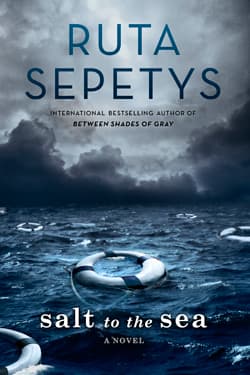
Ruta Sepetys (2016)
Genre
Historical Fiction / Young Adult / Romance
Reading Time
391 min
Key Themes
See below
Sign in to track this book
In the brutal winter of WWII's Eastern Front, a Lithuanian nurse, a Prussian soldier with stolen art, and a pregnant Polish girl meet on the overcrowded Wilhelm Gustloff, a ship sailing into the icy Baltic. Their hope for freedom clashes with an unimaginable maritime tragedy.
The story begins with four separate narratives in January 1945. Joana Vilkas, a Lithuanian nursing student, flees the Soviet advance, feeling guilty about leaving her cousin and family. Florian Beck, a young Prussian art restorer, deserts the German army. He carries a secret satchel of amber art from Königsberg, determined to protect it from Nazi seizure. Emilia Staszewska, a pregnant 15-year-old Polish girl, is alone and scared, trying to reach the German port of Gotenhafen (Gdynia). Alfred Frick, a pompous German sailor on the Wilhelm Gustloff, is shown through his self-important letters. He believes he is important despite his low rank. These different paths start to come together as they all head toward the Baltic coast, hoping to escape the Eastern Front and find safety.
Joana meets Florian after he saves her group from a Russian soldier. Despite initial distrust, especially from Joana who thinks Florian is a deserter, they form a tense alliance. Their group grows to include a blind shoemaker, an old woman named Eva, and the 'shoe poet' boy. Emilia, weak and alone, eventually finds them. Her advanced pregnancy is a constant worry. As they travel through the harsh East Prussian winter, facing starvation, frostbite, and the constant danger of Soviet soldiers, their shared vulnerability makes them rely on each other. Florian, at first withdrawn, starts to feel responsible for the group, especially Emilia.
As the journey continues, the characters' pasts start to appear. Joana deals with the memory of her cousin, Lina, and the ethical problems she faced in her nursing work. Florian, a master forger and restorer, carries the secret of the amber art. He believes he protects German heritage from Hitler's rule. He is also haunted by his sister's death and the forced labor he endured. Emilia's silence and fear hint at a trauma she experienced from Soviet soldiers, which is the reason for her pregnancy. The group learns to handle these unspoken burdens. Moments of shared humanity break through the fear and suspicion. Florian's art skills help them get supplies.
After a difficult journey with close calls with Soviet soldiers and the constant threat of starvation and exposure, the group finally reaches the bombed port city of Gotenhafen. The Wilhelm Gustloff, a large former cruise liner now used for Operation Hannibal, is their last hope for survival. The port is chaotic, with thousands of desperate refugees trying to get passage. Joana uses her nursing credentials to get passage for her group, while Florian uses his cleverness. They board the Gustloff, a ship designed for 1,800 but now packed with over 10,000 people, mostly women, children, and wounded soldiers. Alfred, meanwhile, continues to boast in his letters about his 'important' role on the ship.
Life aboard the Wilhelm Gustloff is a small picture of the war's destruction. The ship is dangerously overcrowded, with refugees packed into every available space. Sanitation is poor, food is scarce, and the air is thick with worry. Despite the grim reality, small hopes appear. Joana, using her nursing skills, helps care for the sick and injured. Florian, though still guarded, feels drawn to Joana and increasingly protects Emilia. A tentative romance starts between Joana and Florian. Emilia, close to labor, gets comfort and care from Joana. Alfred, unaware of the real suffering around him, continues his self-important duties, patrolling the decks and fantasizing about his superior rank.
As the Wilhelm Gustloff sails the icy Baltic Sea, Emilia goes into labor. With Joana's help and Florian's support, she gives birth to a baby girl, whom she names Halina. The birth of a new life on the crowded, tense ship is a strong moment of hope and vulnerability. It strengthens the bond between Joana, Florian, and Emilia, making their alliance a makeshift family. Florian feels a deep connection to the baby, seeing her as a symbol of innocence and a reason to fight for survival. This event briefly overshadows the journey's danger and the constant fear of U-boat attacks.
On the night of January 30, 1945, the unthinkable happens. The Wilhelm Gustloff, sailing through the dark, icy waters of the Baltic Sea, is hit by three torpedoes from a Soviet submarine. The impact is catastrophic, throwing the ship into immediate chaos. Lights fail, the ship lists violently, and panic breaks out among the thousands of trapped passengers. Alfred, at first unaware, is thrown into the horrifying reality. Joana, Florian, Emilia, and baby Halina, along with their companions, are thrust into a desperate fight for survival. They fight against the crowd, the freezing water, and the rapidly sinking vessel.
Amidst the loud screams and the rapidly tilting decks, the group tries to get to the lifeboats. The sheer number of people, the icy conditions, and the lack of organization make escape very difficult. Many lifeboats are frozen to their davits or cannot be launched. Joana, Florian, and Emilia, with Halina, struggle to stay together. Florian's strength and quick thinking are important. They face horrors: people crushed in the stampede, others freezing to death in the water, and the overwhelming feeling of impending doom. Alfred, in his panic, focuses only on his own survival, showing his true cowardice.
As the Wilhelm Gustloff sinks into the icy Baltic, the refugees are thrown into the freezing water. Many die from hypothermia or are crushed by debris. The blind shoemaker and the 'shoe poet' boy are lost in the chaos. Old Eva, in a selfless act, sacrifices herself to save baby Halina by wrapping her in her own shawl before dying from the cold. Florian, despite his own injuries and the weight of his amber satchel, desperately tries to keep Joana, Emilia, and Halina alive. Joana uses her nursing instincts to care for the injured in the water. The scale of the tragedy becomes clear, with thousands freezing or drowning around them.
After hours in the freezing water, clinging to debris, Joana, Florian, Emilia, and baby Halina are among the few rescued by a German torpedo boat. They are brought to safety, but the experience leaves them deeply scarred. Florian finally tells Joana the truth about his amber satchel. Emilia confesses the full horror of her past and Halina's father's identity. While they have survived the physical ordeal, the psychological wounds of the sinking, the loss of their companions, and the broader trauma of the war will stay with them. The story ends with the survivors dealing with their grief and an uncertain future, forever linked by the shared tragedy of the Wilhelm Gustloff.
The Protagonist
Joana moves from being burdened by guilt and fear to finding strength and a sense of family with Florian and Emilia, embracing her role as a caregiver and survivor.
The Protagonist
Florian transforms from a solitary, secretive deserter focused on an artistic mission to a protective, loving individual who values human connection and life above all else.
The Protagonist
Emilia moves from a state of profound trauma and isolation to finding a supportive family in Joana and Florian, and ultimately embracing motherhood and a fragile hope for the future.
The Antagonist/Supporting
Alfred remains static in his delusion and cowardice, his narrative serving as a foil to the true heroism and suffering of others, ultimately meeting a pathetic end.
The Supporting
He remains a symbol of innocent observation and childhood resilience until his tragic loss during the sinking.
The Supporting
He remains a source of wisdom and calm until his tragic death during the sinking, having offered guidance and comfort to the group.
The Supporting
Eva's arc culminates in a selfless act of sacrifice, saving baby Halina and providing a beacon of humanity amidst the chaos.
The Mentioned
His influence is primarily established in Florian's backstory and motivations, not through direct interaction within the present narrative.
The Supporting
Halina represents pure innocence and the future, her survival being a driving force and a symbol of hope for the main characters.
A main theme is the will to survive against great odds. Joana, Florian, Emilia, and their companions endure freezing temperatures, starvation, constant threats of violence, and the sinking of the Gustloff. Their resilience shows in their continued movement, resourcefulness, and refusal to give up, even with great loss. Emilia giving birth on the ship and the group's effort to protect the baby, seeing her as a reason to keep going, shows this theme.
“''Sometimes, when you least expect it, you find hope from a most unexpected place.''”
The novel clearly shows the damaging psychological and physical effects of war, especially on civilians and children. Emilia's rape and pregnancy, the Shoe Poet's observations, and the constant fear and loss for all characters show the widespread trauma. The large number of deaths during the Gustloff sinking shows how war destroys without care. The characters face horrors, losing any innocence they had before their journeys began.
“''War is chaos. It's a tornado. So you're just trying to find some place to stand.''”
Each main character struggles with their identity in wartime. Joana deals with her guilt and her role as a healer. Florian questions his loyalty and his purpose as an artist. Emilia seeks safety and a place for herself and her unborn child. They are all refugees, without homes and often without national identities, looking for a new place to belong. Their journey together makes them redefine who they are, not by their pasts or nationalities, but by their shared humanity and connections to each other, forming a new, makeshift family.
“''I had been defined by my family, my country, my choice of study. Now, I was a refugee. A nothing.''”
Despite the harsh circumstances, the novel emphasizes the strength of human connection, empathy, and compassion. The bonds between Joana, Florian, Emilia, and the other refugees are important for their survival. Acts of kindness, sharing resources, and mutual protection provide light amid the darkness. Joana's nursing instincts, Florian's protectiveness, and Eva's sacrifice for baby Halina all show how humanity can continue even in extreme hardship, countering the inhumanity of war.
“''There is a time for everything. A time for hope and a time for despair. A time for living and a time for dying. A time for love and a time for hate. A time for war and a time for peace. A time for remembering and a time for forgetting.''”
The theme of truth and deception appears in the stories. Florian carries the secret of the amber art and his desertion. Emilia hides the traumatic truth of her pregnancy. Alfred lives in a self-made fantasy of importance, deceiving himself and his fictional correspondent. The characters must decide which truths to reveal and to whom, often for their own protection or to stay sane. The novel explores different forms of truth—historical, personal, and emotional—and how war shapes and hides them.
“''Shame is a hunter. It stalks us through life, whispering that we don't deserve what we've been given.''”
Four distinct voices narrate the story, offering varied insights and building suspense.
The novel is structured with four alternating first-person narrators: Joana, Florian, Emilia, and Alfred. This allows the reader to experience the events from different emotional and ideological viewpoints, creating a rich, multifaceted understanding of the historical context and the characters' individual struggles. The short, alternating chapters build suspense and highlight the subjective nature of truth and experience during wartime. This technique also allows Sepetys to cover a broad spectrum of refugee experiences, from the compassionate to the delusional.
A symbolic treasure representing stolen heritage, artistic passion, and Florian's burden.
Florian's satchel, filled with stolen amber art pieces, serves as a powerful symbol. Initially, it represents his past as an art restorer, his connection to beauty, and his rebellion against Nazi appropriation. As the journey progresses, it becomes a physical and metaphorical burden, weighing him down but also giving him a sense of purpose beyond mere survival. The amber itself, a fossilized resin, symbolizes preserved history and the enduring beauty that can be found even in the face of destruction, contrasting with the fleeting nature of human life.
An epistolary narrative providing a stark, delusional counterpoint to the other characters' reality.
Alfred's sections are presented as letters he writes to a fictional girlfriend, Anni. This epistolary device provides a unique, often darkly humorous, and ultimately tragic contrast to the harsh realities faced by the other protagonists. His self-aggrandizing tone, prejudiced views, and complete disconnect from the suffering around him highlight the delusion and moral decay that could exist even amidst immense human tragedy. His narrative serves as a foil, emphasizing the authenticity and gravity of the other characters' experiences and the true scale of the Gustloff disaster.
A historical vessel transformed into a symbol of both hope and catastrophic loss.
The Wilhelm Gustloff is not just the setting for the climax but a powerful symbol throughout the book. Initially, it represents salvation, a massive ship offering a chance to escape the advancing Red Army and reach safety. However, its transformation from a luxury liner to an overcrowded refugee transport, and its eventual sinking, makes it a symbol of the war's destructive power, the false promises of safety, and the unprecedented scale of human loss. It embodies the hidden histories and forgotten tragedies of World War II.
“Guilt is a hunter.”
— Joana's reflection on the burden of her past actions and survival.
“Fate is a hunter.”
— Florian's contemplation of destiny and the forces shaping their journey.
“Shame is a hunter.”
— Emilia's inner turmoil over her traumatic experiences and secrets.
“War is catastrophe. It breaks families in irretrievable pieces.”
— A general observation on the devastating impact of war.
“I had escaped the wolf, but in the forest I had become one.”
— Florian's realization of how survival has changed him.
“The dead are only dead if they are forgotten.”
— A reflection on memory and legacy amidst loss.
“Hope is a pocket of possibility.”
— Joana's optimistic outlook despite dire circumstances.
“We all have secrets. Some are just heavier than others.”
— Acknowledgment of the burdens each character carries.
“The heart is an arrow. It demands aim to land true.”
— A poetic thought on love and direction in life.
“In the end, we all become stories.”
— Reflection on how lives are remembered and narrated.
“Sometimes it is the dream that saves us.”
— The idea that hope and imagination can sustain people.
“Courage is a weapon we must wield ourselves.”
— Emphasizing personal agency in facing fears.
“The sea can be a cruel mother.”
— Describing the perilous journey across the Baltic Sea.
“We were all refugees of our own pasts.”
— Highlighting how each character is fleeing personal history.
Ready to see how well you understood this book? Take our interactive quiz with 10 questions.

Biography coming soon.







