Scene 1: Robert de Baudricourt's Castle
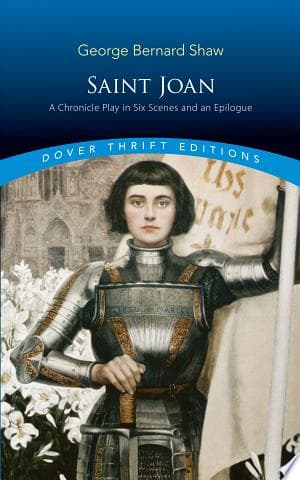
The play opens at Vaucouleurs, in Robert de Baudricourt's castle. Robert is frustrated by his servants' incompetence and France's war against England. Joan, a young peasant girl, arrives and insists that God has commanded her to lead the French army and crown the Dauphin, Charles VII, at Reims. Despite initial disbelief and mockery from Robert and his steward, Joan's unwavering conviction, combined with her ability to predict events and influence others, eventually sways Robert. He is astonished when his hens begin laying again after Joan's arrival, and his soldiers are suddenly willing to follow her. He reluctantly agrees to provide her with a horse, armor, and an escort to Chinon to meet the Dauphin.
Scene 2: Chinon Castle
At Chinon, the Dauphin, Charles VII, is weak, indecisive, and cowardly. He is surrounded by advisors like the Archbishop of Reims, Lord de La Trémouille, and Gilles de Rais (Bluebeard), who are more interested in court intrigue and personal gain than in fighting the English. When Joan arrives, Charles tries to test her by hiding among his courtiers. However, Joan immediately identifies him, claiming divine guidance. She convinces him and his council that she is sent by God to drive out the English and crown him at Reims. Her sincerity and passion, along with a private conversation where she seemingly reveals a secret known only to Charles, win him over, and she is given command of the army.
Scene 3: Orleans Battlefield
The scene shifts to the English camp near Orleans, where the Earl of Warwick and his chaplain, John de Stogumber, discuss the unsettling news of Joan's arrival and her victories. They are joined by Peter Cauchon, Bishop of Beauvais, who is deeply concerned about Joan's claims of direct divine inspiration, seeing it as a challenge to the Church's authority. Joan, accompanied by Dunois (the Bastard of Orleans), arrives on the battlefield. She rallies the demoralized French troops, leading them in a daring and successful assault against the English fortifications. Her courage and faith turn the tide of the battle, lifting the siege of Orleans and marking a turning point in the Hundred Years' War. Dunois, initially skeptical, comes to recognize her extraordinary leadership.
Scene 4: Orleans Aftermath
Following the victory at Orleans, Joan insists on marching directly to Reims to crown the Dauphin, as she believes God commands. However, Dunois, the Archbishop, and other French commanders argue against it, citing strategic difficulties and the need for more careful planning. They are wary of Joan's impulsiveness and her disregard for conventional military tactics. Joan grows frustrated with their worldly concerns and lack of faith. She publicly challenges Dunois to pray for a favorable wind to cross the Loire River, which miraculously appears. This event further strengthens her reputation as a divine instrument but also increases the unease among the established powers who feel their authority undermined by her direct connection to God.
Scene 5: Reims Cathedral
The coronation of Charles VII at Reims Cathedral is a moment of triumph for France and the fulfillment of Joan's mission. However, the scene also highlights her growing isolation. While the French nobles and clergy celebrate, they also express their discomfort with Joan. The Archbishop warns her against pride and heresy, and even Dunois suggests she should return home now that her work is done. Charles, now King, feels threatened by her popularity and influence. Joan, despite her success, feels a deep sense of loneliness and misunderstanding. She reaffirms her commitment to God's will and her desire to continue fighting the English, even as she senses the shifting loyalties and the growing resentment against her.
Scene 6: The English Camp at Rouen
Bishop Cauchon and the Earl of Warwick meet in the English camp at Rouen to discuss Joan's capture. Cauchon, representing the Church, sees Joan as a dangerous heretic whose direct communication with God bypasses the Church's authority, threatening its very foundation. Warwick, representing feudal nobility, sees her as a threat to the established social order and the concept of nation-states, as her appeals to French nationalism undermine feudal loyalties. They agree that Joan must be dealt with, not just as a military prisoner, but as a challenge to their respective institutions. They decide she must be tried by an ecclesiastical court, ensuring that the charges will focus on heresy and witchcraft, rather than solely on military matters.
Scene 7: Joan's Trial
Joan is brought before an ecclesiastical court in Rouen, presided over by Bishop Cauchon, the Inquisitor, and other English and French clerics. She faces relentless questioning regarding her visions, her male attire, and her refusal to submit to the authority of the Church. Joan steadfastly defends her actions, claiming her voices come directly from God and that she is accountable only to Him. She struggles to understand the legal and theological intricacies of the charges against her, maintaining her simple faith. The judges, particularly the Inquisitor, are determined to make her confess to heresy, viewing her individualism and direct connection to God as a grave threat to the Church's hierarchical structure.
Scene 8: The Abjuration
Under immense pressure, facing the threat of immediate burning and terrified by the prospect of eternal damnation, Joan is presented with a document of abjuration. She is told that if she signs it, she will be spared the stake and sentenced to perpetual imprisonment. Overwhelmed and exhausted, she reluctantly signs the document, effectively confessing to heresy and renouncing her voices. However, the moment she learns that her sentence means imprisonment for life, she realizes she cannot live without her freedom and her voices. She retracts her abjuration, declaring that her voices were indeed from God and that she prefers death to denying them.
Scene 9: The Execution
Having retracted her abjuration, Joan is condemned as a relapsed heretic. She is led to the marketplace in Rouen to be burned at the stake. Before her execution, she asks for a cross, which is given to her by a kind English soldier. As the flames rise, she cries out to God and her voices. Her death deeply affects those who witness it, particularly John de Stogumber, the English chaplain, who is deeply shaken by her courage and the horror of the act. He realizes the great injustice they have committed. Joan's martyrdom cements her status as a saint and a symbol of faith and defiance, leaving a lasting impact on history.
Epilogue: Twenty-Five Years Later
Twenty-five years after Joan's death, an Epilogue takes place in the Dauphin's bedroom. Charles VII, now a successful king, is visited by the ghosts of characters from the play: Warwick, Cauchon, Dunois, and even John de Stogumber, who has become a changed man. They discuss Joan's rehabilitation trial, which has cleared her name and declared her a martyr. They reflect on her impact, the political and religious implications of her life and death, and the irony of her official recognition by the very institutions that condemned her. The scene culminates with a vision of Joan herself, who asks if she should return to Earth. The characters, though acknowledging her sainthood, express their discomfort with her return, highlighting humanity's resistance to true saints and prophets.