“The soul can survive the body. The mind, too, can survive the body. But the heart... the heart always breaks.”
— Reflecting on enduring suffering and loss.

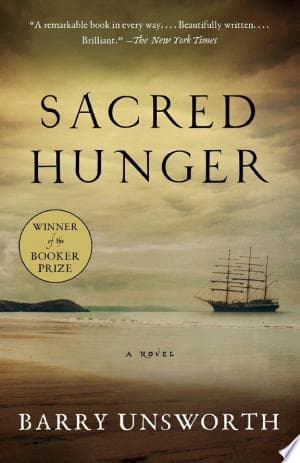
Barry Unsworth (2012)
Genre
Literary Fiction / Historical Fiction
Reading Time
10-12 hours
Key Themes
See below
Sign in to track this book
On an 18th-century slave ship, a doctor, a merchant's son, and a desperate crew create a hidden community in the Florida wilderness, only to face a relentless pursuit of revenge.
In 1752, William Kemp, a Liverpool merchant facing financial ruin, invests his entire fortune in fitting out a slave ship, the 'Liverpool Merchant'. His son, Erasmus Kemp, an ambitious young man, sees this venture as his only way to wealth, hoping it will allow him to marry Miss Melicent Bell. Erasmus pressures his father to make the ship seaworthy, despite its age and poor condition. Dr. Matthew Paris, William Kemp's nephew, a physician outcast for his progressive views and personal tragedy, agrees to serve as the ship's surgeon. He seeks to escape his past and find purpose beyond the corrupt society he dislikes. Captain Thurston, known for his brutality and efficiency, commands the ship.
The 'Liverpool Merchant' sails to the West African coast, where Captain Thurston and his crew acquire enslaved people. Matthew Paris is horrified by the conditions and inhumanity he sees, both in the slave factories on shore and later on the ship. During the difficult Middle Passage, disease, especially ophthalmia, spreads among the captives below deck. Captain Thurston, fearing an epidemic that would destroy his 'cargo', orders the sick slaves thrown overboard. Matthew strongly protests this decision, leading to a direct conflict between the two men. Thurston's cruelty extends to his crew, as he maintains order through fear and severe punishment.
The captain's decision to throw sick slaves overboard, along with his general brutality towards both slaves and crew, fuels growing resentment. Matthew Paris, seeing the suffering and the captain's increasing madness, sympathizes more and more with the enslaved. A severe storm hits the ship, further destabilizing the already tense situation. During the chaos, a coordinated mutiny erupts. The enslaved people, helped by some of the crew tired of Thurston's tyranny, rise up. In the violence that follows, Captain Thurston is killed, and the ship is badly damaged, eventually running aground off the coast of Spanish Florida. Many lives are lost in the shipwreck.
Against all odds, a group of survivors, including former slaves and mutinous crew members, reach the Florida shore. Led by Matthew Paris, who uses his medical knowledge and moral compass to guide them, and assisted by resourceful individuals like the African leader Kwamena, they decide to form a new, independent community. They go deep into the wilderness, establishing a hidden settlement away from European eyes. Here, they try to create a society based on shared labor, mutual respect, and a rejection of the hierarchical systems they left behind. They learn to hunt, farm, and build, aiming for a utopian existence, though tensions and challenges arise from their diverse backgrounds.
News of the 'Liverpool Merchant's' disappearance eventually reaches Liverpool. William Kemp is devastated, but Erasmus, driven by ambition and the perceived loss of his inheritance, refuses to accept the ship's total loss. He is obsessed with recovering the 'cargo' and the financial investment, seeing it as his only way to secure his future with Miss Bell. Erasmus begins a relentless quest to track down the missing ship and its survivors. He travels to various ports, questioning sailors and gathering information, his determination becoming fanatical. His pursuit becomes a consuming vendetta, fueled by greed and a strong sense of entitlement.
Life in the Florida settlement is hard. While they achieve some self-sufficiency, the community faces many difficulties. They deal with the harsh environment, the constant threat of discovery by Spanish or British forces, and internal disputes from cultural differences and past problems. Matthew Paris acts as a mediator and healer, trying to keep peace and enforce a fair system of justice for all. Kwamena, with his leadership and survival knowledge, becomes an essential figure. Despite the hardships, they build homes, cultivate crops, and establish a working society, blending African and European customs.
Years pass, but Erasmus Kemp's resolve remains strong. His pursuit of the 'Liverpool Merchant' becomes legendary, showing his tenacity and ruthlessness. He develops a network of informants and tirelessly follows every lead, no matter how small. His quest takes him across the Atlantic and through the Caribbean. Eventually, through sheer persistence and luck, he finds fragmented clues and rumors that suggest a group of survivors, including former slaves, might have established a hidden community in Florida. This discovery reignites his desire for retribution and wealth, and he begins to gather a party to track them down.
Armed with his information, Erasmus organizes a well-equipped expedition to Florida, hiring mercenaries and experienced woodsmen. His main goal is to reclaim the 'cargo' – the surviving slaves – and punish those responsible for the mutiny and the loss of his father's ship. He is driven by a cold desire for financial recovery and a deep need for revenge, especially against Matthew Paris, whom he blames for the ship's downfall. The journey into the Florida wilderness is arduous and dangerous, but Erasmus's focus pushes his men forward, overcoming natural obstacles and the threat of hostile natives.
After a long and difficult trek, Erasmus's expedition finally finds the hidden settlement. The peaceful life of the maroon community is shattered by the arrival of the heavily armed outsiders. A tense standoff leads to a violent confrontation. The community, led by Matthew Paris and Kwamena, fights to defend their freedom and their way of life against Erasmus's forces. The battle is fierce, marked by desperation on both sides. Lives are lost, and the fragile utopia they had painstakingly built is threatened with total destruction, forcing Matthew and his people to make desperate choices to preserve their liberty.
The confrontation ends with many casualties on both sides. Erasmus Kemp, though perhaps not fully achieving his desired revenge or financial recovery, is forever changed by the experience, his obsession leading him to a hollow victory. Matthew Paris, deeply scarred by the violence, must deal with the broken remains of his utopian dream and the difficult task of leading his people to an uncertain future. The novel concludes by reflecting on the lasting impact of greed, exploitation, and the human cost of the slave trade, leaving the ultimate fate of the maroon community unclear but their fight for freedom clear.
The Protagonist
Matthew transforms from a disillusioned individual seeking escape to a courageous leader who attempts to build a utopian society, facing immense moral and practical challenges.
The Antagonist
Erasmus's initial ambition hardens into a pathological obsession for wealth and revenge, leading him to a hollow and destructive pursuit.
The Supporting
William's desperate gamble leads to his financial and personal collapse, illustrating the perils of the slave trade beyond the human cost.
The Supporting
Thurston's escalating brutality leads directly to his downfall and the mutiny.
The Supporting
Kwamena transforms from a captive to a co-leader, instrumental in the survival and flourishing of the maroon community.
The Mentioned
Her role is static; she serves as a catalyst for Erasmus's ambition rather than undergoing personal development.
The Supporting
Billy's innocence is shattered by the horrors he witnesses, but he finds a new path within the maroon community.
The Supporting
The Bosun remains a static figure of brutality, loyal to the system of violence.
The novel shows how the relentless pursuit of wealth, especially through the slave trade, corrupts individuals and society. William Kemp's desperate gamble, Erasmus Kemp's obsession, and Captain Thurston's brutal efficiency are all driven by money. This theme is clear in Erasmus's decades-long hunt for the 'Liverpool Merchant' and its 'cargo', showing how monetary value is placed above human life. The story suggests that this 'hunger' for profit distorts moral judgment and causes suffering, revealing the dark side of early global capitalism.
“''It was the sacred hunger, the hunger for gold, that drove men to such deeds.''”
Unsworth vividly portrays the dehumanization in the slave trade, from the brutal captures to the conditions of the Middle Passage. Enslaved Africans are treated as 'cargo' and 'commodities', their humanity denied. However, the novel also shows their resilience, resistance, and ability to form communities. Kwamena's leadership, the mutiny, and the creation of the maroon settlement highlight the strength and spirit of those subjected to such cruelty. Their struggle to maintain identity and build a new society is a testament to the human will.
“''They were not cargo. They were people, and they wanted to live.''”
A main theme is the attempt to create a utopian society in the Florida wilderness, free from the hierarchical systems of the British Empire. Matthew Paris and the survivors, both former slaves and crew, try to build a community based on equality, shared labor, and mutual respect. This ideal, however, faces constant challenges from internal tensions due to diverse backgrounds and past problems, as well as the external threat of discovery. The confrontation with Erasmus's forces highlights the fragility of such ideals in a world driven by greed and revenge, questioning if true utopia is possible.
“''We can make a new world here, if we only have the will.''”
The novel explores the moral compromises characters make when faced with the realities of the slave trade. William Kemp's desperate venture, the crew's involvement, and even Matthew Paris's initial decision to serve on a slave ship represent different forms of giving in morally. However, Matthew's journey also offers a path to redemption. By actively resisting Captain Thurston's cruelty, helping the mutiny, and dedicating himself to the maroon community, he tries to make up for his initial involvement and live by his principles. His story suggests that even in the darkest circumstances, individuals can choose to fight for justice and make amends.
“''There was no innocence to be found on such a voyage, only degrees of complicity.''”
The slave ship functions as a self-contained representation of the entire slave economy and its inherent brutality.
The 'Liverpool Merchant' is more than just a setting; it's a symbolic microcosm of the entire slave trade and the oppressive British Empire. Its cramped, disease-ridden decks reflect the systemic dehumanization and suffering. The power dynamics between Captain Thurston, the crew, and the enslaved people mirror the broader societal hierarchy of the era. The ship becomes a crucible where moral boundaries are tested and broken, forcing characters to confront the true nature of their world. Its eventual destruction and the subsequent formation of the maroon community symbolize a violent rejection of that established order.
The contrasting and intertwined odysseys of Matthew Paris and Erasmus Kemp drive the narrative.
The novel employs parallel journeys for Matthew Paris and Erasmus Kemp. Matthew's journey is one of moral awakening, escape from societal corruption, and the difficult pursuit of a utopian ideal. Erasmus's journey, conversely, is a relentless, decades-long descent into obsessive greed and vengeance, driven by a desire to reclaim lost wealth. These two contrasting paths, one towards liberation and community, the other towards retribution and material gain, create narrative tension and highlight the central thematic conflicts of the book. Their eventual collision forms the climax, representing the clash of opposing moral and economic ideologies.
The Florida wilderness provides a testing ground for new societal models and personal transformation.
The uncharted wilderness of Spanish Florida serves as a crucial plot device. It is a space removed from the 'civilized' world, allowing the survivors of the 'Liverpool Merchant' to shed the constraints and hierarchies of European society. Here, they are forced to adapt, cooperate, and forge a new social contract. The wilderness tests their resilience, their ability to live in harmony with nature, and their capacity for self-governance. It is both a sanctuary and a harsh environment, enabling the creation of their maroon community while simultaneously exposing its vulnerabilities to external threats.
Matthew Paris's writings provide an intimate, reflective, and often critical perspective on events.
Though not explicitly a full journal, Matthew Paris's role as a physician and an educated observer allows for moments of internal reflection and critical commentary, often framed as letters or mental notes. These provide a more intimate and philosophical insight into the horrors of the slave trade and the challenges of building a new society. His observations serve to articulate the novel's themes of moral compromise, human suffering, and the search for justice, offering a counterpoint to the more action-driven narrative and deepening the reader's understanding of the moral landscape.
“The soul can survive the body. The mind, too, can survive the body. But the heart... the heart always breaks.”
— Reflecting on enduring suffering and loss.
“There are some things you can never forgive yourself for, no matter how much you try to make amends.”
— A character grappling with profound guilt over past actions.
“To be free is not merely to cast off one's chains, but to live in a way that respects and enhances the freedom of others.”
— Discussing the true meaning of freedom beyond physical liberation.
“Memory is a cruel master, a relentless reminder of what was and what can never be again.”
— A character haunted by vivid memories of a lost past.
“The sea, she takes everything in the end. Everything.”
— A sailor's fatalistic view of the ocean's power and indifference.
“You can try to escape your past, but it always catches up with you, in the quietest moments, in the darkest corners of your mind.”
— The inescapable nature of one's history and its impact.
“There is a hunger in us all, a sacred hunger, for something more than what this world offers.”
— Exploring the core theme of human longing and spiritual yearning.
“Justice is a luxury few can afford, and even fewer receive.”
— A cynical observation on the inequality of the justice system.
“Hope is a dangerous thing, a flickering candle in a storm, but without it, there is only darkness.”
— Contemplating the fragility and necessity of hope in dire circumstances.
“The line between savagery and civilization is often thinner than we care to admit.”
— Reflecting on the brutal realities of human nature and societal norms.
“A man can lose everything but his dignity, and if he loses that, he has lost himself entirely.”
— Emphasizing the importance of self-respect and integrity.
“The silence of the innocent is often more deafening than the cries of the guilty.”
— A poignant remark on the suffering of those who cannot speak for themselves.
“History is written by the victors, but the truth is whispered in the hearts of the vanquished.”
— Questioning official narratives and acknowledging untold stories.
“Love, even in its most twisted forms, can still bind us, still drive us to impossible acts.”
— Examining the complex and powerful nature of love, even amidst cruelty.
Ready to see how well you understood this book? Take our interactive quiz with 10 questions.

Barry Unsworth FRSL was an English writer known for his historical fiction. He published 17 novels, and was shortlisted for the Booker Prize three times, winning once for the 1992 novel Sacred Hunger.







