“Sometimes you have to break the rules to do what's right.”
— Jessie ponders her choices as she realizes the severity of the situation.

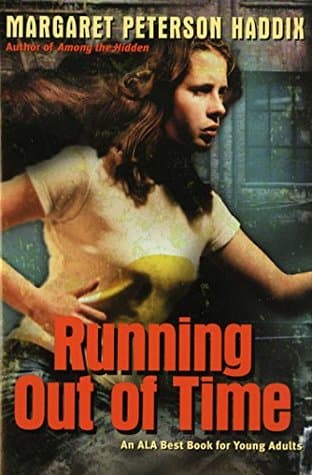
Margaret Peterson Haddix (1995)
Genre
Children's / Historical Fiction / Mystery / Science Fiction / Young Adult
Reading Time
180 min
Key Themes
See below
Sign in to track this book
A young frontier girl, Jessie, races against a deadly epidemic in her secluded 1840s village, only to uncover a shocking truth that sends her into a bewildering modern world to save her family.
Jessie Keyser, a thirteen-year-old living in the village of Clifton, Indiana, which appears to be in the 1840s, sees fear and illness spread among the children. Her younger sister, Katie, becomes very sick with diphtheria, a disease that has already killed several other children. Jessie's mother, Sarah, in desperation, tells Jessie that Clifton is not truly in the past; it is a carefully built historical preserve. She explains that the 'disease' is a modern illness that the village's doctors cannot cure because they are trained in 19th-century medicine. Sarah sends Jessie on a dangerous mission: to escape Clifton and find a cure in the outside world, which Sarah calls the 'present day,' before more children die.
With specific instructions from her mother, Jessie goes to the 'pump house,' a hidden exit from Clifton. She finds a secret passage leading to a modern road. Overwhelmed by the sight of cars, paved roads, and an unfamiliar landscape, Jessie struggles to understand her surroundings. She remembers her mother's warning to be careful of everyone and to find a specific person: a man named Frank Lyle, her mother's brother. Jessie's first encounter with the outside world is confusing and scary, as she tries to navigate a world unlike anything she has known.
Jessie eventually gets a ride with a kind truck driver heading towards Indianapolis. During her trip, she hears a news report about a controversial and secret historical preservation project called 'Clifton.' The report mentions a genetic experiment and a rich, powerful man named Mr. Neeley, who funds the project. Jessie realizes with horror that Clifton is not just a historical village, but a controlled environment where children, including herself, are part of a medical experiment, unknowingly living in a made-up past. This discovery increases her urgency and fear.
Following her mother's instructions, Jessie finds Frank Lyle's house. Frank at first doubts Jessie's story, thinking she is a runaway or confused. However, Jessie's detailed knowledge of Clifton and her family convinces him. Frank reveals he is a journalist who has tried to expose Mr. Neeley's unethical 'Clifton Project' for years, but has not found enough solid evidence. He explains that Mr. Neeley's project involves raising children in an isolated, disease-free place to study their immunity, then exposing them to diseases to test new cures. This confirms Jessie's worst fears about Clifton's true purpose.
Frank Lyle, understanding the seriousness of the situation and the immediate danger to the children, agrees to help Jessie. They plan to expose Mr. Neeley and his unethical experiments. Jessie must return to Clifton with modern medicine for the diphtheria and gather clear proof of the project's existence and its human rights violations. Frank will contact his journalistic sources and prepare to make the story public once Jessie provides the necessary evidence. The stakes are very high, as the lives of all the Clifton children, and possibly Jessie's own, depend on their success.
Equipped with modern antibiotics and a hidden camera, Jessie makes the dangerous trip back to Clifton. She successfully re-enters the village, barely avoiding detection by the guards, called 'patrollers.' The village is in a state of growing panic, with more children getting sick. Jessie gives the medicine to Katie and other sick children, hoping it will work. Her main goal now is to gather photographic evidence of the modern equipment and facilities hidden within Clifton, proving to the outside world that it is not a real 1840s village but a complex scientific experiment.
While trying to photograph the hidden surveillance cameras and other modern items within Clifton, Jessie is discovered by Mr. Neeley's security. She is caught and brought before Mr. Neeley. Neeley, a cold and calculating man, explains his twisted reasoning for the Clifton Project, believing he is helping humanity by finding cures. He tries to manipulate Jessie, saying her parents willingly joined the project, agreeing to raise their children in Clifton for certain benefits. Jessie, however, remains firm, understanding the great cruelty of his actions.
As Jessie is questioned, Frank Lyle, having received a signal or confirmation from Jessie (implied by their plan), releases his story. He broadcasts the truth about the Clifton Project, presenting the evidence he has gathered and Jessie's testimony. The news causes a huge public outcry and media frenzy. Authorities are forced to act, sending a team to Clifton. A tense standoff occurs between Mr. Neeley's private security and the arriving government officials, ending with the forced entry into the village and the rescue of the children.
The children of Clifton, including Katie, are safely removed from the village and receive proper medical care. Mr. Neeley is arrested, and his unethical project is stopped. Jessie, her family, and the other Clifton residents now face the hard task of adjusting to the modern world, a world they had only just begun to understand. The book ends with Jessie thinking about the changes in her life, the loss of her innocent view of the world, and the challenges ahead for her and the other children as they join a society very different from the one they grew up in.
After the rescue, Jessie reunites with her parents, Sarah and Thomas Keyser. The reunion is mixed, as Jessie deals with the knowledge that her parents knowingly participated in the Clifton Project. Her mother explains their reasons, driven by a wish for a 'better,' simpler life and a belief that the project was harmless for their children. While Jessie understands their view, she also feels betrayed. The family begins the long, difficult process of healing and adapting to a world that is both freeing and overwhelming, facing the future together but with a changed understanding of trust and truth.
The Protagonist
Jessie transforms from an innocent, naive girl into a strong, determined young woman who exposes a grave injustice and saves her community.
The Supporting
Sarah moves from passive acceptance of Clifton's reality to actively defying its rules to save her children, ultimately facing the consequences of her choices.
The Supporting
Frank moves from frustrated, isolated investigator to the key figure in bringing down a powerful, unethical organization, finally achieving his long-sought goal.
The Antagonist
Neeley remains steadfast in his conviction, never truly acknowledging the immorality of his actions, and ultimately faces legal consequences for his hubris.
The Supporting
Katie's arc is largely passive, serving as a catalyst for Jessie's actions and a symbol of the children's peril and eventual salvation.
The Supporting
Thomas is forced to confront the harsh reality of his choices and the true nature of his family's existence, learning to adapt to a world he never imagined.
The Mentioned
The Patrollers remain static figures of authority and control, ultimately overpowered by external forces.
The Supporting
The truck driver serves a brief but pivotal role, providing initial assistance and exposition, and then exits the narrative.
The story focuses on Jessie learning that her entire life in Clifton has been a carefully created lie. This theme explores how easily reality can be controlled and how people see truth based on their surroundings. Jessie's journey outside Clifton breaks her understanding, making her question everything she was taught. The village itself is a huge deception, kept for scientific reasons, showing the moral problems of making up reality for others.
“What if everything I'd ever known was a lie? What if everything I'd ever believed was wrong?”
The novel examines the ethical limits of scientific experimentation, especially with human subjects. Mr. Neeley's Clifton Project, which raises children in isolation only to expose them to disease, is a chilling example of science pursued without moral guidance. The story asks if the chance of a cure justifies exploiting and deceiving innocent lives, making readers consider the responsibility that comes with scientific power. It shows the conflict between seeking knowledge and protecting human dignity.
“We were doing something wonderful for mankind. You simply cannot understand the grandness of my vision.”
Jessie's change from a sheltered village girl to a brave and determined protagonist shows the theme of courage. She faces great fear, confusion, and danger, both inside and outside Clifton, yet she continues for her sister and the other children. Her journey shows the power of individual action, proving that even a young person can challenge powerful systems and bring about important change when driven by belief and a sense of justice.
“I was just a kid. What could I do? But then I remembered Katie, and I knew: I had to do something.”
The sharp difference between Clifton's 1840s appearance and the modern world outside is a main theme. Jessie's confusing experiences with cars, electricity, and current society highlight the fast pace of technological and social change. This theme explores the challenges of adapting, the appeal of a simpler past, and the certainty of progress. It also points out how artificial it is to try and keep a past that no longer exists, especially when it costs human freedom and truth.
“It was like stepping into a different century, only it wasn't a different century; it was the same one, just... different.”
The strength of family bonds drives the story, as Jessie's love for Katie fuels her mission. However, the theme also explores the difficulties of family relationships when trust is broken. Jessie deals with her parents' betrayal, as they knowingly placed her and her siblings in the Clifton Project. This highlights the tough balance between parental love, the desire for a 'better' life, and the moral compromises made, forcing Jessie to change her understanding of her family.
“How could my own parents have done this to us? How could they have lied?”
A secret passage connecting the fabricated past to the present.
The pump house serves as the physical portal between Clifton's 1840s illusion and the modern world. It is a crucial plot device that allows Jessie to transition between realities, symbolizing the breaking of the illusion. Its existence is a carefully guarded secret, known only to a few, and its discovery by Jessie marks the true beginning of her journey into the unknown. It literally opens the door for the protagonist to confront the truth.
The catalyst for Jessie's mission and the revelation of Clifton's true nature.
The outbreak of diphtheria among the children of Clifton is the central inciting incident. It creates immediate urgency and forces Sarah Keyser to reveal the truth about the village and send Jessie on her mission. Without this life-threatening crisis, the children of Clifton might have remained indefinitely unaware of their true circumstances. It highlights the vulnerability of the children and the moral imperative to act, driving the entire plot forward.
A crucial source of exposition and revelation for Jessie about the Clifton Project.
While riding with the truck driver, Jessie overhears a news report on the radio that provides vital information about the 'Clifton Project,' Mr. Neeley, and the controversial genetic experiments. This device is a concise way to deliver critical backstory and context directly to the protagonist, confirming her suspicions and deepening her understanding of the conspiracy. It allows the narrative to quickly inform both Jessie and the reader about the sinister reality behind Clifton.
A tool for gathering irrefutable evidence of Clifton's modern nature.
Frank Lyle provides Jessie with a miniature modern camera to take back into Clifton. This device is essential for generating the concrete evidence needed to expose Mr. Neeley's project to the public. It transforms Jessie from a messenger into an active investigator, giving her the means to prove that Clifton is not a genuine historical village but a modern, technologically advanced experiment. The photos are the 'smoking gun' that Frank needs for his exposé.
“Sometimes you have to break the rules to do what's right.”
— Jessie ponders her choices as she realizes the severity of the situation.
“The past is not always what it seems.”
— Jessie begins to uncover the truth about her village and its origins.
“How can something so perfect be so wrong?”
— Jessie reflects on her idyllic village life versus the harsh reality she's learning.
“Fear can make you do things you never thought you would.”
— Jessie pushes past her apprehension to venture into the unknown.
“Even in the simplest lives, there are secrets.”
— Jessie realizes her seemingly transparent village holds deep, dark secrets.
“Time is a river, and we are all just floating along.”
— Jessie's mother uses this metaphor to explain their isolation and the passage of time.
“Sometimes the greatest dangers are the ones you can't see.”
— Jessie understands the unseen threat of disease and the modern world.
“The world outside is vast and strange, but it's also real.”
— Jessie's first impressions of the 'outside' world challenge her preconceived notions.
“Ignorance is not bliss when lives are at stake.”
— Jessie argues against maintaining the village's isolation and lack of knowledge.
“A mother's love knows no bounds, even across time.”
— Jessie's mother makes a desperate plea to save her children, showcasing her love.
“The hardest choices are the ones where there's no clear right answer.”
— Jessie grapples with the ethical dilemmas of her mission.
“We are all connected, whether we know it or not.”
— Jessie realizes the interconnectedness of her village with the modern world.
“Hope is a powerful thing, even when everything seems lost.”
— Despite the overwhelming odds, Jessie maintains a glimmer of hope for her family.
Ready to see how well you understood this book? Take our interactive quiz with 10 questions.

Biography coming soon.

Dan Gemeinhart
4.5
Kate O'Hearn
4.4

Jeanne Birdsall
4.4

Jen Wang
4.4
Wendelin Van Draanen
4.3

John Marsden
4.3

Chris Van Allsburg
4.3
Jennifer A. Nielsen
4.2