“What will you give me if I spin this straw into gold for you?”
— Rumpelstiltskin offers to help the miller's daughter in exchange for a reward.

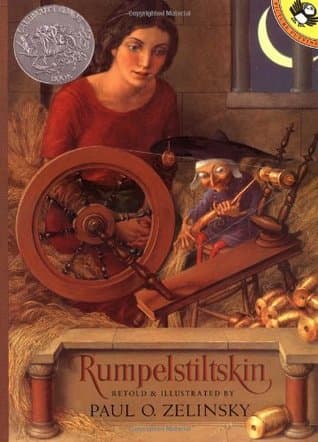
Paul O. Zelinsky (1986)
Genre
Fantasy / Children's / Creativity
Reading Time
15 min
Key Themes
See below
Sign in to track this book
A miller's daughter must spin straw into gold or die, a task she accomplishes with the help of a mysterious imp who demands her firstborn child as payment.
A miller, wanting to impress a powerful king, falsely claims his daughter, Lisa, can spin straw into gold. The king, who loves wealth, calls the girl to his castle. He takes her to a large room full of straw, gives her a spinning wheel, and says if she does not spin all the straw into gold by morning, she will die. Lisa, who has no such skill, is left alone, scared and sad, knowing her father's lie has put her life in danger.
As Lisa cries in the straw-filled room, a small, strange man appears. He asks why she is crying, and she tells him her impossible problem. The man offers to spin the straw into gold for her, but wants payment. Having nothing else, Lisa gives him her pearl necklace. The man then sits at the spinning wheel and spins all the straw into shiny gold thread by morning. When the king arrives, he is surprised and happy, but his desire for wealth grows, making him demand more.
The king, seeing the success of the first night, is not happy. He takes Lisa to a bigger room, filled with a lot of straw, and threatens her with death if she does not spin it all into gold by morning. Again, Lisa is left alone, overwhelmed by the impossible job. The strange man appears again, offering his help. This time, Lisa gives him her ring, which he takes. He spins all the straw into gold again, making the king happier and Lisa safe from immediate danger for a while.
Still not happy, the king takes Lisa to a third, even grander room, filled with a huge amount of straw. He promises her that if she can spin all this straw into gold, he will marry her and make her queen. If she fails, she will die. The man appears a third time. Lisa, having no more jewelry to offer, is very upset. The man then suggests a scary deal: if she agrees to give him her first child when she becomes queen, he will spin the straw into gold. Desperate and seeing no other choice, Lisa agrees to the terrible condition.
The man spins the large pile of straw into gold, filling the room with wealth. The king, very happy with the money, keeps his promise and marries Lisa, making her his queen. Life as queen is good at first, and the scary deal with the man fades from her memory among the luxury of her new life. Time passes, and the queen has her first child, a baby boy, bringing happiness to her royal life and the kingdom.
One day, soon after her son's birth, the strange man suddenly appears in the queen's room. He calmly reminds her of their deal: her first child for his help in spinning straw into gold. The queen, who had forgotten the promise, is shocked and upset. She pleads with him, offering all the kingdom's riches, but the man does not change his mind. He says a living thing is more valuable to him than all treasures and gets ready to take her baby.
Seeing the queen's deep sadness and tears, the man, perhaps feeling some pity, gives her a small chance to keep her child. He tells her that if she can guess his name within three days, she can keep her baby. If she fails, he will take the child. The queen, with new hope, agrees to the challenge. She immediately sends messengers throughout the kingdom to find every name they can.
The queen's messengers return with many names, both common and unusual. For the first two days, the queen tries every name she knows and every name her messengers brought her. She tries names like John and Peter, and more unique ones like Caspar and Melchior. Each time, the man appears, listens to her guesses, and with a smirk, says she is wrong. The queen grows more desperate as the deadline gets closer and her son's future is uncertain.
On the evening of the second day, one of the queen's messengers, having gone far into the woods looking for more names, finds a small, hidden hut. Looking inside, he sees the same strange man dancing wildly around a fire. To the messenger's surprise, the man is singing a happy song, revealing his name: "Tomorrow I brew, today I bake, and then the baby I will take. For little does my lady dream that Rumpelstiltskin is my name!" The messenger rushes back to the castle to tell the queen what he found.
On the third and final day, when the man appears to claim the baby, the queen first tries a few more wrong names to build suspense. Then, with a confident smile, she asks, "Is your name Rumpelstiltskin?" The man is very angry. His face turns red, he stomps his foot so hard it goes deep into the floor, and in his rage, he tears himself in two. With a final, angry scream, Rumpelstiltskin disappears forever, freeing the queen and her child from his terrible deal.
The Protagonist
From a terrified, passive victim, Lisa transforms into a clever and determined queen who fights to protect her child.
The Antagonist
Introduced as a mysterious helper, he reveals his malevolent nature, only to be outsmarted and destroyed by his own hubris.
The Supporting
Remains largely static, driven by greed, but inadvertently provides Lisa with a position of power.
The Supporting
His initial boast triggers the entire narrative, but he has no further character development.
The Supporting
Plays a pivotal role in the climax by bringing the crucial information to the queen.
The miller's lie about his daughter's ability to spin straw into gold starts the story. This lie puts Lisa in a dangerous situation, showing how simple exaggerations can have bad results. The king's greed, caused by this lie, then increases the demands, showing how one lie can lead to bigger problems. The queen's later secret deal with Rumpelstiltskin happens because she tries to keep the first lie going.
“One day it happened that the miller was talking with the king, and to make himself seem important, he said, 'I have a daughter who can spin straw into gold.'”
Lisa's desperate situation, facing death from the king, makes her make more and more dangerous deals with Rumpelstiltskin. At first, she trades items (a necklace, a ring), but as the danger grows, her desperation leads her to promise her first child. This idea looks at the moral compromises people make under great pressure and the lasting, often forgotten, results of such agreements. The story warns about the real cost of making deals when you are most vulnerable.
“When the little man asked, 'What will you give me then, if I spin it for you?' she had nothing left but her firstborn child, and in her desperation, she promised it to him.”
Rumpelstiltskin's name is his most protected secret and his main source of power and weakness. Knowing his name gives the queen power over him, letting her break the terrible deal. This shows the old belief in the special meaning of true names, connecting identity to control. By saying his name when he is proud, Rumpelstiltskin accidentally gives the queen the way to defeat him. This shows how even the most powerful can be brought down by a small piece of information.
“'Tomorrow I brew, today I bake, and then the baby I will take. For little does my lady dream that Rumpelstiltskin is my name!'”
The king's great desire for gold is a main opposing force in the story. He constantly demands more gold, increasing the danger for Lisa, and only marries her because he thinks she can make wealth. His obsession blinds him to the human cost of his demands and stops him from seeing the magic at work. This idea shows how uncontrolled greed can lead to exploitation and suffering, pushing characters to desperate acts to satisfy it.
“But the king's greed only grew, and the next morning he led her to an even larger room filled with straw.”
A classic fairy tale structure that builds tension and signifies completion.
The 'Rule of Three' is prominently used throughout the story, enhancing its narrative rhythm and escalating tension. Lisa is presented with three rooms of straw, each progressively larger, and is given three days to guess Rumpelstiltskin's name. This repetition with variation builds suspense, emphasizes the growing stakes, and provides a clear structural progression towards the climax. It's a common device in folklore, making the story feel familiar and satisfying as the final attempt or challenge is met.
A supernatural being who offers aid for a sinister price.
Rumpelstiltskin embodies the archetype of the magical helper, but with a malevolent twist. He possesses extraordinary abilities (spinning straw into gold) that are beyond human reach, offering a solution to an impossible problem. However, his assistance always comes with a steep, often hidden, price. This device introduces a supernatural element and creates the central conflict, as the protagonist becomes indebted to a powerful, unpredictable force. He represents both a solution and a new, greater threat.
An early agreement that hints at future conflict and consequences.
The bargain for the firstborn child serves as significant foreshadowing. While Lisa makes the promise in a moment of extreme desperation and later forgets it, the reader is aware of the terrible consequence looming over her future. This creates dramatic irony and suspense, as the audience anticipates the little man's inevitable return to claim his prize, making the queen's later distress more poignant and the eventual resolution more impactful.
A classic motif where a secret name holds power and offers a chance at freedom.
The guessing of Rumpelstiltskin's name is a central plot device, rooted in ancient folklore's belief in the power of names. It transforms the queen's struggle from a physical impossibility (spinning gold) into an intellectual challenge. The riddle-like nature of the task creates a race against time and highlights the antagonist's vulnerability. It provides a clever, non-violent means for the protagonist to defeat a powerful magical entity, emphasizing wit over strength.
“What will you give me if I spin this straw into gold for you?”
— Rumpelstiltskin offers to help the miller's daughter in exchange for a reward.
“I have nothing to give you.”
— The miller's daughter's desperate reply when she has no reward to offer.
“Then promise me your firstborn child.”
— Rumpelstiltskin's chilling demand after the miller's daughter becomes queen.
“The queen was in despair and thought of all the things she had promised.”
— Narration describing the queen's anguish when Rumpelstiltskin returns to claim her child.
“I will give you three days to guess my name. If you cannot, the child is mine.”
— Rumpelstiltskin's challenge to the queen, offering a final chance.
“Is your name Conrad? No. Is your name Harry? No.”
— The queen's failed attempts to guess Rumpelstiltskin's name on the first day.
“The little man danced about the fire, singing, 'Tonight I bake, tomorrow I brew, the next I'll have the young queen's child.'”
— A messenger overhears Rumpelstiltskin celebrating prematurely in the woods.
“Is your name Rumpelstiltskin?”
— The queen's triumphant final guess, revealing the little man's name.
“The devil told you that! The devil told you that!”
— Rumpelstiltskin's furious reaction upon hearing his name guessed correctly.
“He stamped his right foot so hard that it went into the ground up to his waist.”
— Rumpelstiltskin's dramatic and violent reaction to losing the challenge.
“Then he took hold of his left foot with both hands and tore himself in two.”
— The gruesome conclusion of Rumpelstiltskin's rage, leading to his demise.
“The miller's daughter became queen, and she and the king lived happily ever after.”
— The story's closing line, highlighting the queen's eventual peace and prosperity.
Ready to see how well you understood this book? Take our interactive quiz with 10 questions.

Biography coming soon.







