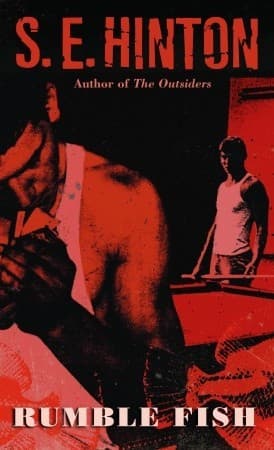
“If you're going to be a rumble fish, you have to be the toughest, meanest rumble fish in the sea.”
— The Motorcycle Boy explaining his philosophy to Rusty-James about their gang's reputation.

Genre
Children's / Young Adult
Reading Time
90 min
Key Themes
See below
Sign in to track this book
In a gritty world of street fights and pool halls, a tough-talking teen idolizes his enigmatic, motorcycle-riding older brother, only to discover that chasing his brother's legend might shatter his own.
The story starts with Rusty-James, a high school gang leader, facing Smoker, a member of a rival gang from across the river. Rusty-James is with his best friends, Steve and Biff. The fight happens after Rusty-James's girlfriend, Patty, flirts with Smoker. During the fight, Rusty-James is losing until the Motorcycle Boy, his older brother, shows up. The Motorcycle Boy's presence and calm way make the other gang scared, ending the fight without him doing anything. Rusty-James admires him greatly and wants to be just like his brother, who everyone in their neighborhood looks up to.
After the fight, Rusty-James, Steve, and the Motorcycle Boy go to Benny's, their usual spot, a pool hall and diner. The Motorcycle Boy, despite his reputation, often seems distant and thoughtful, which frustrates Rusty-James. Later, Rusty-James finds Patty, his girlfriend, with another boy, Bill, in a car. Angry and feeling betrayed, Rusty-James confronts them, which leads to a fight where he beats Bill. Patty then says she broke up with Rusty-James because he was violent and obsessed with the Motorcycle Boy, leaving him sad and confused about his relationships.
Rusty-James spends time with the Motorcycle Boy, trying to understand his older brother's often unclear and thoughtful views on life, gangs, and their future. The Motorcycle Boy says he wants to see the ocean and talks about how limited their small town is. Their talk shows how different Rusty-James's desire for street fame is from the Motorcycle Boy's desire for something more. Their alcoholic father is mostly absent, and their mother left years ago, so the brothers mostly take care of themselves. This creates a deep, unspoken bond between them despite their differences.
Steve, Rusty-James's best friend, feels more and more uneasy with the violence and lack of direction in their gang life. He says he wants to leave the neighborhood and go to school, which Rusty-James struggles to understand. Steve's growing distance and his clear disinterest in street fighting make Rusty-James feel alone. Rusty-James feels his world shrinking as his friends, like Biff, also start to leave, and the old gang system that once defined his life begins to fall apart around him. The exciting days of gang fights seem to be ending, leaving Rusty-James unsure of his place.
The Motorcycle Boy disappears for several days, making Rusty-James very worried. He searches for him, fearing the worst. When the Motorcycle Boy finally comes back, he says he went to California, fulfilling his long-held wish to see the ocean. He talks about how big and free it felt, showing his strong desire for a life beyond their confined neighborhood. His return brings Rusty-James temporary relief, but also shows the Motorcycle Boy's growing distance from their shared reality and his brother's world.
During a minor fight, Rusty-James is stabbed. He is taken to the hospital for surgery. While recovering, he finds out he has permanent damage and has lost some of his hearing. This injury is a turning point, making Rusty-James face his own death and the results of his violent life. The Motorcycle Boy visits him in the hospital, showing concern for a rare moment, and Rusty-James, for the first time, feels truly weak and less unbeatable than he once thought.
Wanting a change and perhaps to make a statement against how confined their lives are, the Motorcycle Boy robs a bank. He does not take any money, instead breaking the glass and setting off the alarm. He then waits for the police. Rusty-James, hearing about this, rushes to the scene with Steve. A police officer shoots and kills the Motorcycle Boy while he resists arrest. Rusty-James sees this, and the senseless act and his brother's death shatter his world and his perfect image of the Motorcycle Boy.
After the Motorcycle Boy's death, Rusty-James is devastated. He struggles to deal with the loss and the destruction of his identity, which was so tied to his brother. Steve, despite their growing differences, stays a loyal friend, offering support. The police lieutenant who shot the Motorcycle Boy gives Rusty-James some perspective, suggesting that the Motorcycle Boy was 'rumble fish' in a 'finger bowl,' meaning his brother was too big for their small world. This insight, along with Steve's continued presence, gives Rusty-James a fragile hope that he might be able to escape the cycle of violence and find a different path for himself, away from the river.
The Protagonist
Rusty-James starts as an impulsive, violent teenager seeking to replicate his brother's legend, but through loss and injury, he begins to question his path and consider a future beyond the streets.
The Supporting/Catalyst
The Motorcycle Boy remains largely static in his philosophical detachment, but his desperate final act serves as a catalyst for Rusty-James's change.
The Supporting
Steve grows increasingly disillusioned with their street life, solidifying his resolve to escape and pursue a different, educated future.
The Supporting
Patty moves from being Rusty-James's girlfriend to breaking up with him, choosing a path away from his violent world.
The Supporting
The father remains largely unchanged, a static representation of parental failure.
The Supporting
Smoker serves as an initial antagonist, quickly receding from the main plot after the opening scene.
The Supporting
Biff remains a loyal follower, but his gradual distancing reflects the fading of the gang's influence.
The Supporting
Cassandra serves as a temporary romantic interest, showing Rusty-James's struggle to move past Patty.
The Mentioned
The lieutenant's role is primarily to deliver a key metaphorical explanation at the climax.
Rusty-James's identity is first completely tied to his brother's image and his fame as a tough street fighter. He always tries to be 'just like the Motorcycle Boy.' The story shows his struggle to create his own identity separate from his brother's shadow and the expectations of his gang. The Motorcycle Boy's own search for meaning, which ends tragically, forces Rusty-James to face who he is without his idol and to think about a different future. His injury and his brother's death make him start this painful self-discovery.
“He was the toughest, coolest, most respected cat on this side of the river. And I wanted to be just like him.”
Violence is everywhere in Rusty-James's world, from street fights to everyday aggression. The novel clearly shows the immediate physical and emotional cost of this violence, such as Rusty-James getting stabbed and losing some hearing. More deeply, it shows how violence traps people in a harmful cycle, limiting their futures and causing sadness. Patty leaving and Steve wanting to get away show how violence pushes loved ones away. The Motorcycle Boy's final, self-destructive act of violence against society is a sad end, showing that even the 'coolest' people cannot escape its hold unharmed.
“It was like being in a fish bowl, but nobody had told us we were fish.”
Both Rusty-James and the Motorcycle Boy, in different ways, deal with the limits of their environment. Rusty-James holds onto the old idea of gang fame, a way to mentally escape from the ordinary and harsh reality. The Motorcycle Boy, however, wants to physically leave, dreaming of seeing the ocean and experiencing a world beyond their town. His trip to California and his last, desperate act show this strong desire for freedom from a life he sees as a 'finger bowl.' Steve also shows this theme, actively trying to escape through education.
“I wanted to see the ocean. I wanted to see it so bad I could taste it.”
The novel's core is the strong and complex bond between Rusty-James and the Motorcycle Boy. Rusty-James's loyalty and admiration for his brother drive many of his actions. Despite the Motorcycle Boy's distance, there is an unspoken understanding and protective feeling between them. This theme also includes Rusty-James's friendship with Steve, whose loyalty lasts even as their paths diverge. The breaking or changing of these bonds is central to Rusty-James's growth, as he learns what true loyalty means when facing tragedy.
“He was my brother. He was the only person who understood anything.”
The enigmatic, almost mythical figure representing unattainable ideals and tragic wisdom.
The Motorcycle Boy functions as an archetypal 'wise fool' or 'tragic hero.' He is simultaneously revered and misunderstood, possessing a profound, almost prophetic, understanding of their world's limitations, yet unable to find a place within it. His legend precedes him, influencing everyone, especially Rusty-James. He embodies the allure of cool detachment and power, but also the ultimate futility of such a life, serving as a cautionary tale for Rusty-James's own aspirations. His actions are often symbolic, such as his desire to see the ocean or his final, non-monetary bank robbery.
A literal and metaphorical device highlighting the Motorcycle Boy's unique perception.
The Motorcycle Boy's colorblindness is a significant literal and metaphorical device. Literally, it sets him apart and explains his unique perception of the world, seeing things in shades of gray. Metaphorically, it symbolizes his ability to see beyond superficial appearances and the 'colors' of gang affiliations, recognizing the inherent sameness and futility beneath the surface. It underscores his detachment and his philosophical outlook, suggesting he perceives a deeper, starker reality that others, like Rusty-James, cannot or choose not to see.
A central metaphor representing aggression, confinement, and self-destruction.
The rumble fish (Siamese fighting fish) are a powerful recurring symbol. These beautiful but aggressive fish, kept in separate bowls because they would kill each other if together, represent the characters, particularly the Motorcycle Boy and Rusty-James, and their confined, violent existence. The Motorcycle Boy's fascination with them, and the lieutenant's final description of him as a 'rumble fish in a finger bowl,' perfectly encapsulates the theme of individuals too wild or too confined for their environment, leading to inevitable self-destruction or conflict. They are a metaphor for the boys' lives on the streets.
A symbolic boundary dividing worlds and representing stagnation.
The river in the story serves as a geographical and symbolic boundary. It divides the town into 'our side' and 'their side,' fueling gang rivalries and reinforcing a sense of tribalism and confinement. It represents the stagnant, unchanging nature of their lives and the limitations of their world. Crossing the river signifies entering rival territory, while the Motorcycle Boy's desire to see the ocean highlights a yearning to transcend this narrow, divisive boundary and find a broader, more open existence beyond their river-bound reality.
“If you're going to be a rumble fish, you have to be the toughest, meanest rumble fish in the sea.”
— The Motorcycle Boy explaining his philosophy to Rusty-James about their gang's reputation.
“I don't know why people think it's so important to be happy. I'd rather be alive.”
— Rusty-James reflecting on his brother's outlook after a violent encounter.
“Things are always changing. The only thing that stays the same is that things are always changing.”
— The Motorcycle Boy's observation about life's constant flux.
“You can't depend on anybody. You can only depend on yourself.”
— Rusty-James learning a harsh lesson after being betrayed.
“Sometimes I think I'm the only sane person left in this whole insane world.”
— The Motorcycle Boy expressing his alienation from society.
“I wanted to be like him. I wanted to be the Motorcycle Boy.”
— Rusty-James admitting his idolization of his older brother.
“You can't go back. You can only go forward.”
— A character advising Rusty-James after he tries to relive past glories.
“The world is full of people who are afraid to take a chance.”
— The Motorcycle Boy criticizing societal conformity.
“I don't want to be a hero. I just want to be left alone.”
— Rusty-James expressing weariness with gang life and expectations.
“You have to be careful what you wish for. You might get it.”
— A warning given to Rusty-James about his desire for violence and fame.
“There's no such thing as a free ride. Everything costs something.”
— The Motorcycle Boy explaining the harsh realities of life to his brother.
“I'm not afraid of dying. I'm afraid of not living.”
— Rusty-James contemplating his reckless behavior and its meaning.
“Sometimes the only way to stay sane is to go a little crazy.”
— The Motorcycle Boy's paradoxical advice about coping with a chaotic world.
“You can't change the past, but you can let it change you.”
— Reflection on how Rusty-James's experiences shape his future.
Ready to see how well you understood this book? Take our interactive quiz with 10 questions.
Biography coming soon.
Dan Gemeinhart
4.5
Kate O'Hearn
4.4

Jeanne Birdsall
4.4

Jen Wang
4.4
Wendelin Van Draanen
4.3

John Marsden
4.3

Chris Van Allsburg
4.3
Jennifer A. Nielsen
4.2