“The first thing you learn is that you always gotta have a plan. The second thing you learn is that the plan never works.”
— Lucas Davenport reflecting on his approach to police work and life.

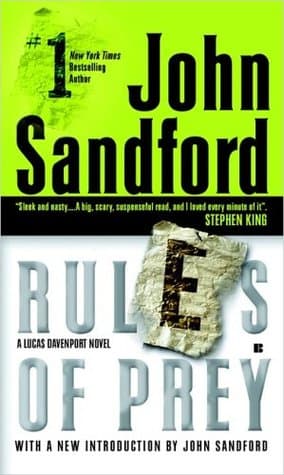
John Sandford (1989)
Genre
Thriller / Mystery
Reading Time
480 min
Key Themes
See below
Sign in to track this book
A serial killer who enjoys outsmarting the police with traps meets his intellectual match in Lieutenant Lucas Davenport.
The book starts with the murder of wealthy Minneapolis businessman William Compton. His throat is cut, and a note is found pinned to his chest: 'Rules of Prey.' The note is a poem, suggesting a game between the killer and police. Lieutenant Lucas Davenport, a decorated but controversial homicide detective, is called to the scene. Davenport, known for his methods and intelligence, sees the killer's taunt and the careful nature of the crime, setting up a long investigation. The lack of motive and the theatrical presentation suggest a killer who enjoys the act and outsmarting law enforcement.
Soon, Dr. Evan Cooper, a respected surgeon, is murdered similarly. This time, the killer leaves a more detailed message, still referencing the 'Rules of Prey' but also including a drawing of a dog. The media calls the killer 'Maddog.' Lucas Davenport and his team, including detectives Del Capslock and Lily Rothenberg, cannot find a connection between the victims beyond their prominence and wealth. Davenport starts to understand that the killer is not just a murderer; he plans his crimes and enjoys the psychological warfare with police. The 'Maddog' name shows the killer's predatory nature and enjoyment of the hunt.
As the Maddog investigation continues, Lucas Davenport's personal life is complicated. He has a casual relationship with Sarah Jensen, a psychiatrist, and still has feelings for his ex-wife, Jenny. His main focus is the case, and he spends hours reviewing evidence and profiles, trying to understand the killer. He visits Sarah for insights into a serial killer's mind, using their talks to refine his understanding of Maddog's reasons and methods. His approach often puts him at odds with his superiors, especially Chief Mike Francisco, but his history of solving difficult cases gives him some freedom.
The Maddog strikes again, murdering Judge Robert DeSpain. Each murder is carefully done, leaving little evidence and increasing public fear and police frustration. The 'Rules of Prey' notes continue, each one more complex and mocking. Davenport and his team work constantly, but leads are few, and media scrutiny is intense. The lack of a clear motive or connection, other than the victims' high social standing, puzzles the investigators. Davenport realizes the killer is not just targeting the wealthy, but specific individuals who fit an unknown pattern in his game.
By studying the killer's notes and victim profiles, Lucas Davenport starts to understand the Maddog's 'Rules of Prey.' He realizes the killer is not choosing random wealthy victims; he targets individuals who, in his view, represent societal flaws. The notes are not just taunts but clues, describing the killer's moral code. Davenport understands that the Maddog sees himself as a judge and executioner, punishing those he thinks are corrupt or deserve death. This allows Davenport to start predicting the killer's next moves and narrow the victim pool, giving the investigation direction.
The story sometimes shifts, showing the killer's identity to the reader as Louis Vullion, a brilliant, charismatic, and disturbed individual. Vullion is a successful software entrepreneur who carefully plans each murder, enjoying the challenge and thrill. We see his thoughts, his justifications for his actions, and his enjoyment of the game with Davenport. Vullion's background shows childhood trauma and a sense of superiority, fueling his desire to 'cleanse' society and prove his intelligence by outsmarting police. He sees Davenport as a worthy opponent.
Based on his understanding of Maddog's 'rules' and victim type, Davenport sets a trap, using a high-profile, seemingly vulnerable person as bait. Police watch the potential victim's home, hoping to catch Maddog. However, Vullion, always alert, senses the increased police presence and avoids the trap. He does not abandon his plan but adapts, choosing a different, equally high-profile target, showing his flexibility and ability to anticipate police actions. This near-miss increases the rivalry between Davenport and Vullion, confirming for Davenport that he is dealing with a very intelligent adversary.
After much research, Davenport finds a subtle connection between the victims: they were all involved in a past legal case that resulted in a miscarriage of justice, specifically concerning the death of Vullion's sister years before. This reveals the motive, showing Vullion's murders as revenge against a system and individuals he feels wronged him and his family. The 'Rules of Prey' are Vullion's personal justice, and the victims are those he holds responsible for his past trauma.
With Vullion's identity known, Lucas Davenport and his team start a manhunt. They track Vullion to his high-tech home, but he escapes, starting a chase. Vullion, knowing Davenport is after him, enjoys the direct confrontation, seeing it as the ultimate test of his intelligence. The pursuit becomes personal for Davenport, as he feels the pressure to stop Vullion before he can kill again. The game moves from abstract clues to a direct, physical hunt across the city.
The chase ends in a psychological battle, with Vullion continuing to taunt Davenport, even making direct contact. Vullion tries to set one final trap for Davenport, intending to frame or kill him. Davenport, however, anticipates Vullion's moves, using his knowledge of the killer's ego and love of games against him. The climax sees Davenport cornering Vullion in a remote place. After a final, intense confrontation where Vullion tries to manipulate Davenport, the detective kills the Maddog in a violent struggle, ending his terror.
The Protagonist
Davenport's arc involves deepening his understanding of truly depraved minds, solidifying his reputation as a formidable investigator, and reaffirming his commitment to his dangerous profession.
The Antagonist
Vullion's arc is one of escalating confidence and depravity, culminating in his fatal confrontation with Davenport as his 'game' ends.
The Supporting
Sarah's arc involves her continued support for Lucas and her grappling with the dangers inherent in his life and their relationship.
The Supporting
Del's arc primarily involves his role as a steadfast and reliable member of Davenport's team, growing in his experience with high-stakes investigations.
The Supporting
Lily's arc shows her developing her investigative skills and proving her capability in a challenging, high-profile case.
The Supporting
Francisco's arc highlights the constant tension between effective policing and political expediency, as he balances Davenport's results with departmental demands.
The Supporting
Jenny's role remains consistent, serving as a reminder of Davenport's past and the challenges of his personal life.
The Mentioned
Compton's role is static, serving as the catalyst for the investigation.
The book explores the mind of a psychopathic killer, Louis Vullion (Maddog). It looks at his lack of empathy, his justifications for murder, and his enjoyment of the act. Vullion sees himself as a judge and executioner, operating under his own 'rules of prey,' which he believes are morally superior. The theme is shown through Vullion's careful planning, his taunting notes, and his thoughts, revealing an intelligent person driven by superiority and a desire for revenge, not typical motives.
“He didn't kill for money, or for passion, or for hate. He killed because it was fun.”
A main theme is the unclear line between justice and personal revenge. Louis Vullion believes he is giving justice by punishing people he holds responsible for past wrongs, especially his sister's death. His 'Rules of Prey' are his personal code of 'justice.' In contrast, Lucas Davenport represents the legal system's pursuit of justice, bound by laws and evidence. The book makes the reader consider how personal trauma can turn justice into a violent, self-serving quest for revenge, and the need to uphold a structured legal system, even if it is not perfect.
“He wasn't a criminal. He was a judge. And he was very, very good at his job.”
The book's core is the intellectual battle between Lucas Davenport and Louis Vullion. Both characters are intelligent, and the killer designs his crimes as a 'game' to challenge police. The 'Rules of Prey' notes are not just taunts but clues, part of Vullion's performance. Davenport must use his intelligence, intuition, and understanding of human psychology to figure out the killer's patterns and predict his moves. This theme shows the strategic and psychological parts of criminal investigation, where the battle of wits is as important as evidence.
“It was a game, pure and simple. And he was the referee, the scorekeeper, and the only player who really mattered.”
The book explores the effect of high-stakes criminal investigations on detectives' personal lives, especially Lucas Davenport. His dedication to solving the Maddog case consumes him, affecting his relationships with Sarah Jensen and Jenny. The constant exposure to crimes and the psychological burden of hunting a serial killer lead to emotional isolation and blurred personal and professional lines. This theme shows the sacrifices made by those who fight crime, often at the expense of their own well-being.
“He knew he was good at this, but sometimes, he wondered if it was worth the price.”
Cryptic messages left by the killer, serving as taunts and clues.
The 'Rules of Prey' notes are a central plot device. They are poems or cryptic messages left at each crime scene by Louis Vullion, pinned to his victims. These notes serve multiple functions: they are a direct taunt to the police, a signature for the killer, and, most importantly, they contain subtle clues about Vullion's twisted moral code and his motivations. Lucas Davenport's ability to decipher these 'rules' is crucial to understanding the killer's pattern and eventually identifying him, transforming them from mere taunts into vital investigative tools.
Alternating between Davenport's investigation and Vullion's planning.
The narrative employs shifting perspectives, primarily focusing on Lucas Davenport's investigation but occasionally interspersing chapters or scenes from Louis Vullion's point of view. This device allows the reader to understand the killer's meticulous planning, his psychological state, and his warped justifications, creating a sense of dramatic irony and heightening the tension. By revealing the killer's identity early to the reader, the story becomes less about 'who' and more about 'how' Davenport will catch him, emphasizing the intellectual game between them.
The media-assigned nickname for the killer, influencing public perception and the killer's ego.
The 'Maddog' persona is a plot device that arises from the killer's actions and media coverage. The name, inspired by a drawing left at a crime scene, quickly becomes synonymous with the killer. This persona influences public fear, puts pressure on the police, and feeds Louis Vullion's ego, as he revels in the notoriety. The 'Maddog' identity also shapes Davenport's understanding of the killer as a predatory, untamed force, guiding his psychological profiling and investigative approach, and solidifying the image of a relentless, animalistic hunter.
Lucas Davenport's wealth and disregard for protocol as a narrative driver.
Lucas Davenport's character itself acts as a plot device. His personal wealth, expensive tastes, and willingness to bend or break rules set him apart from typical police detectives. This allows him freedoms that other officers wouldn't have, such as pursuing leads without immediate budgetary constraints or ignoring bureaucratic red tape. His unconventional nature often creates friction with superiors but also enables him to think outside the box, mirroring the killer's own unique intelligence, making him a fitting adversary for the Maddog and driving the narrative through his unorthodox choices.
“The first thing you learn is that you always gotta have a plan. The second thing you learn is that the plan never works.”
— Lucas Davenport reflecting on his approach to police work and life.
“Never kill anyone you know. It leads to the police.”
— One of the 'rules' the serial killer follows, establishing his twisted methodology.
“If you're going to kill someone, make sure it's someone who deserves it.”
— Another rule from the killer, showing his self-justification.
“Cops are like mushrooms. Keep them in the dark and feed them shit.”
— Davenport's cynical view of police bureaucracy and politics.
“The world is full of monsters with friendly faces.”
— Davenport musing on the nature of evil in ordinary settings.
“Never leave physical evidence. That's the first rule.”
— The killer's foundational rule, emphasizing his meticulous nature.
“Sometimes you have to break the rules to catch the bad guys.”
— Davenport justifying his unconventional methods in pursuit of justice.
“Fear is a weapon. Use it.”
— The killer exploiting fear to control and manipulate his victims.
“The best way to hide is in plain sight.”
— Reflecting on how killers often blend into society unnoticed.
“You can't outthink a madman, but you can outlast him.”
— Davenport's strategy in dealing with unpredictable criminals.
“Every killer has a pattern. Find it, and you find him.”
— Davenport explaining his investigative approach to profiling.
“In this business, luck is just another word for being prepared.”
— Davenport on the role of chance in solving crimes.
“The dead don't care about justice. Only the living do.”
— A grim reminder of the stakes in homicide investigations.
“Rules are for people who don't know how to break them properly.”
— Davenport's rebellious attitude toward authority and procedure.
Ready to see how well you understood this book? Take our interactive quiz with 10 questions.

Biography coming soon.







