BookBrief
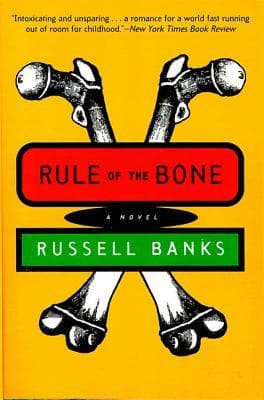
Rule of the Bone cover
Archivist's Choice

Rule of the Bone

Russell Banks (1995)

Genre

Literary Fiction / Young Adult

Reading Time

390 min

Key Themes

See below

Track Your Reading

Sign in to track this book

A teen runaway named Bone navigates the drug-fueled world of 1990s rural New York, finding his way to self-discovery and belonging.

Synopsis

Fifteen-year-old Chappie, an outcast, lives a chaotic life in upstate New York. After a failed bike theft, he gets involved with older delinquents. This leads to a car theft and an encounter with I-Man, a charismatic Rastafarian. Chappie finds belonging and purpose in I-Man's community, learning about their culture and spirituality, and taking on the name 'Bone.' Their peaceful life ends when a drug deal goes wrong, leading to violence and a police raid. Bone escapes, becoming a fugitive, and begins a journey to find his estranged girlfriend, Deena. His search brings him back to his troubled past, where he uncovers a devastating truth about Deena. Determined to rescue her, Bone makes a plan, confronts his world's harsh realities, and ultimately starts a new life with Deena, hoping for a fresh start.
Reading time
390 min
Difficulty
Medium
Pacing
Moderate
Mood
Gritty, Reflective, Raw, Desperate, Hopeful
✓ Read this if...
You enjoy coming-of-age stories with a gritty, authentic voice and complex, morally ambiguous characters.
✗ Skip this if...
You prefer lighthearted narratives or are uncomfortable with themes of drug use, violence, and social marginalization.

Plot Summary

The Bike Shop and the First Score

Chappie, a fourteen-year-old, lives in a run-down house in upstate New York. He introduces himself as 'Bone.' He works part-time at a bike shop owned by Mr. Fiske, who is gruff but somewhat caring. Bone and his friend, Curtis, decide to steal bikes from a storage unit, a plan Bone created. During the theft, a caretaker surprises them, leading to a frantic escape. Bone's home life is messy, marked by his mother's alcoholism and a tense relationship with her abusive boyfriend, Ken. His younger sister, Deena, often fends for herself, and Bone feels he must protect her, even as he moves toward delinquency.

The Car Theft and Meeting I-Man

After the bike theft, Bone and Curtis try to steal a car for a joyride. The plan fails, and they crash the car, barely getting away. Fearing trouble from both the law and Ken, Bone runs away from home. He hitchhikes aimlessly, ending up in a small, isolated town. There, he meets I-Man, a charismatic and mysterious Jamaican Rastafarian who works at a roadside diner. I-Man, with his calm manner, immediately takes an interest in Bone, offering him food and a sympathetic ear, unlike the adults Bone has known.

Life with I-Man and the Rastafarian Community

I-Man invites Bone to live with him and his friends in a secluded, shared home in the woods, which they call 'The Promised Land.' Bone learns about the Rastafarian way of life, including their spiritual beliefs, diet, and use of marijuana, which they call 'ganja.' He fully adopts the name 'Bone,' leaving his old identity behind. Here, he experiences a sense of belonging and acceptance he has never known. I-Man acts as a mentor, teaching Bone about self-reliance, respect, and finding his own truth. This offers a clear alternative to the consumer-driven and often violent world Bone left.

The Drug Deal and the Confrontation

I-Man and his community grow and sell marijuana. Bone sees a drug deal go wrong, leading to a violent fight with a group of buyers. The incident breaks the peaceful image of their shared life and makes Bone face the dangers of their chosen lifestyle. He sees I-Man's vulnerability and the risks they all face. This event is a turning point for Bone, making him question if his new life is sustainable or moral, despite the comfort and belonging he has found.

The Encounter with Ken

While running an errand in town, Bone unexpectedly meets Ken, his mother's abusive boyfriend, who has been looking for him. The confrontation is tense and violent, with Ken trying to drag Bone back home. Bone, strengthened by his time with I-Man and the Rastas, resists fiercely. The struggle draws attention, and Bone manages to escape. The encounter leaves him shaken, realizing his past is not easily left behind. This event reinforces his desire to stay away from his old life and strengthens his commitment to I-Man and the community.

The Raid and the Escape

The Promised Land is raided by the police, likely because of a tip about their marijuana cultivation. The raid is sudden and chaotic, with Bone and I-Man barely escaping capture. They must abandon their home and most of their belongings, becoming fugitives again. This event marks the end of Bone's peaceful, if dangerous, time with the Rastafarians and puts him back into an unstable and uncertain state. It also highlights how uncertain their existence is and the constant threat from the outside world.

Life on the Run and the Search for Deena

Bone and I-Man go on the run, hitchhiking and living off the land, always looking over their shoulders. During this time, Bone thinks more and more about his younger sister, Deena. He feels deep guilt for leaving her and a growing desire to ensure her safety. He tells I-Man about his longing, and I-Man, understanding Bone's bond with his sister, supports his decision to try and find her, even if it means risking their own freedom.

The Return Home and the Revelation

Bone eventually returns to his old hometown, with I-Man accompanying him. He secretly watches his former house, where he discovers Ken is gone and his mother lives with another man. More troubling, he learns that Deena has been placed in foster care because of the unstable home. This news deeply upsets Bone, confirming his fears about his sister's well-being and fueling his resolve to rescue her from the system.

The Plan to Rescue Deena

Bone, with I-Man's guidance, plans to get Deena out of foster care. He knows he cannot just take her, as that would make him a kidnapper. Instead, he considers different ways to legally or semi-legally reunite with her. This period shows Bone's growing maturity and his dedication to his sister, moving from selfish acts to a selfless mission. I-Man helps him think through the implications and risks.

The Meeting with Deena and the New Beginning

Bone arranges a meeting with Deena through a sympathetic social worker. The reunion is emotional, and Deena is happy to see her brother. Bone explains his desire to care for her, and she agrees. With I-Man's continued presence, Bone and Deena begin a new, uncertain journey together. The ending suggests a future where Bone, having found his 'rule of the bone' – his inner moral guide – is committed to protecting his sister and building a life free from his past's problems, guided by I-Man's lessons.

Principal Figures

Bone (Chappie)

The Protagonist

Bone transforms from a lost, delinquent teenager into a more self-aware, responsible, and morally grounded young man who prioritizes his sister's well-being over his own freedom.

I-Man

The Supporting

I-Man remains a consistent, guiding force, providing stability and wisdom that helps shape Bone's transformation.

Deena

The Supporting

Deena's arc is largely static as a symbol, but her placement in foster care catalyzes Bone's final, transformative actions.

Ken

The Antagonist

Ken remains a static figure of abuse and threat, serving as a constant external antagonist driving Bone's actions.

Bone's Mother

The Supporting

Her character remains largely unchanged, serving as a stable point of dysfunction that Bone must escape.

Mr. Fiske

The Supporting

Mr. Fiske remains a minor, static character, a brief touchstone in Bone's early life.

Curtis

The Supporting

Curtis's role diminishes as Bone leaves his old life behind, serving mainly as a memory of Bone's past.

Themes & Insights

Search for Identity and Belonging

Bone's journey is a quest to define himself outside his traumatic past. He changes his name from 'Chappie' to 'Bone' and actively seeks a community where he feels accepted. This is clearest in his time with I-Man and the Rastafarian group, where he finds a sense of family and purpose he never had at home. The communal living, shared beliefs, and I-Man's mentoring give him a way to discover who he is when not defined by his abusive home or delinquent actions. His eventual decision to take responsibility for Deena shows a mature understanding of his identity, based on care and connection.

“The rule of the bone is: you got to find your own rule. You got to find your own bone.”

I-Man

The Corrupting Influence of Society vs. Natural Living

The novel contrasts the 'civilized' society Bone leaves with the 'natural' and communal life he finds with the Rastafarians. Bone's hometown is shown as a place of poverty, abuse, and moral decay, where institutions like family and law enforcement fail him. In contrast, the Rastafarian community, living off the land and following their own spiritual laws, offers a seemingly purer, more real existence. While it has dangers (like drug dealing), this alternative lifestyle rejects societal norms and searches for a more meaningful, less corrupt way of life. Bone's return to society to rescue Deena suggests a more complex understanding: complete escape is not possible, and one must navigate both worlds.

“That’s the white man’s world, mon. Babylon. You can’t live in Babylon and not be Babylon.”

I-Man

The Redemptive Power of Family and Responsibility

Despite his initial escape from responsibility and family, Bone's deep love for his younger sister, Deena, becomes his ultimate reason for change. His concern for her drives him back to the society he tried to escape. His decision to rescue her from foster care and commit to caring for her marks a shift from self-preservation to selfless devotion. This theme suggests that true freedom and identity are found not in isolation or escape, but in embracing connections and responsibilities, especially to those who are vulnerable. Deena represents innocence and the chance for a new, healthier 'family' Bone can build.

“I knew I had to go back for her. I knew it in my bones.”

Bone

Coming of Age and Moral Development

The novel is a coming-of-age story, tracing Bone's change from a rebellious youth to a young man with a clear moral sense. His early actions are driven by impulse and survival, but his experiences with I-Man and the Rastafarian community show him different ethical ways of thinking. He learns about integrity, self-respect, and the consequences of actions, both personal and communal. The journey ends with his conscious decision to take responsibility for Deena, showing deep moral growth and a mature understanding of what it means to be a protector and provider, guided by his 'rule of the bone' – his inner sense of right and wrong.

“You can run from Babylon, mon, but you can’t run from yourself.”

I-Man

Plot Devices & Literary Techniques

First-Person Vernacular Narration

Bone's authentic, unpolished voice drives the narrative.

The entire novel is narrated in the first person by Bone, using his distinct, unpolished, and often raw vernacular. This device immediately immerses the reader in Bone's perspective, making his experiences feel immediate and authentic. His voice reflects his youth, his lack of formal education, and his unique worldview, filled with observations that are both naive and profound. It allows for direct access to his thoughts, fears, and moral struggles, shaping the reader's perception of events and other characters through his unfiltered lens. This style is crucial for establishing his character as an 'anti-hero' in the tradition of Holden Caulfield.

The Mentor Figure (I-Man)

A wise, older character who guides the protagonist's moral and spiritual development.

I-Man serves as a classic mentor figure in Bone's journey. He provides not just physical shelter and sustenance but also spiritual and philosophical guidance. He introduces Bone to a new way of life, a different belief system (Rastafarianism), and teaches him about self-awareness and personal responsibility. I-Man's wisdom, patience, and consistent moral presence are instrumental in Bone's transformation from a lost, angry boy into a more thoughtful and principled young man. He represents an alternative father figure, offering the love and guidance Bone lacked in his biological family.

Symbolism of 'The Promised Land'

The secluded Rastafarian dwelling represents an idealized escape and temporary haven.

The Rastafarian community's hidden dwelling in the woods, which they call 'The Promised Land,' functions as a powerful symbol. It represents an idealized sanctuary, a place of escape from the corrupting influences of mainstream society ('Babylon'). For Bone, it is a temporary haven where he finds belonging, learns self-sufficiency, and experiences a form of familial love. However, its eventual discovery and raid by the police underscore the fragility of such utopian ideals and the impossibility of a complete escape from the outside world, highlighting that even in 'paradise,' danger and societal pressures can intrude.

The Road Trip/Journey Motif

The physical act of traveling mirrors Bone's internal quest for self-discovery.

Bone's flight from home and his subsequent travels with I-Man embody the traditional 'road trip' or journey motif. Each new location and encounter on the road contributes to his education and self-discovery. The physical act of moving from place to place, away from his past, mirrors his internal journey of shedding old identities and forging new ones. The uncertainty of the road reflects his own internal state of flux and his search for a stable path. The journey ultimately leads him back to a different understanding of 'home' and responsibility.

Critical analysis

Notable Quotes

I was born. I grew up. I went to school. I didn't learn nothin'. I got high. I got drunk. I got laid. I didn't care about nothin'. I got caught. I got busted. I got sent away. I started to care.

Bone's opening monologue, summarizing his early life and turning point.

The thing about being a loser is, you don't even know you are one until someone else tells you. And then it's too late.

Bone reflecting on his past actions and the labels society puts on him.

Everyone's got a story, even the ones who act like they don't. And most of the time, the ones who act like they don't are the ones with the best stories.

Bone's observation about people's hidden lives and experiences.

It's hard to be good when everyone expects you to be bad. It's like you got to fight your own self just to prove them wrong.

Bone struggling with his reputation and trying to change.

The world is full of people who want to tell you who you are, but only you can really know. And sometimes, even you don't know.

Bone's internal struggle with self-definition and external pressures.

Love is a messed up thing, man. It can make you do crazy stuff, good crazy and bad crazy.

Bone's thoughts on his relationships and the complexities of love.

Sometimes you gotta run away to find out where you belong.

Bone's justification for his journey and search for a place in the world.

Freedom ain't just about not being in jail. It's about being able to choose what you do and who you are.

Bone's evolving understanding of true freedom beyond physical confinement.

You can't really escape your past, not entirely. It's always there, like a shadow. But you can learn to walk in the light.

Bone contemplating the lasting impact of his past mistakes and his efforts to move forward.

Family ain't always blood. Sometimes it's the people who stick by you when no one else will.

Bone reflecting on the unconventional bonds he forms with others.

There are some things you just gotta do yourself, even if you're scared. No one else can do 'em for you.

Bone facing a difficult decision or challenge alone.

The worst kind of loneliness is when you're surrounded by people but still feel all alone.

Bone experiencing isolation despite being in company.

It's funny how you don't realize how much something means to you until it's gone. And then it's too late to get it back.

Bone's reflection on lost opportunities or relationships.

Growing up ain't just about getting older. It's about learning who you are and what you stand for.

Bone's coming-of-age journey and his developing sense of values.

Quiz

Test Your Knowledge

Ready to see how well you understood this book? Take our interactive quiz with 10 questions.

10
Questions
~5
Minutes
?
Best Score

Key Questions (FAQ)

Bone is the protagonist, a fifteen-year-old white boy whose real name is Chappie. He lives in a small, economically depressed town in upstate New York, initially squatting in an abandoned school bus with his friend, Mike, and Mike's girlfriend, Tina, after being kicked out of his mother's home.

About the author







