“There are no fairy tales in the real world. Just stories that prepare you for it.”
— Rhiannon thinks about her mother's pragmatic view of stories.

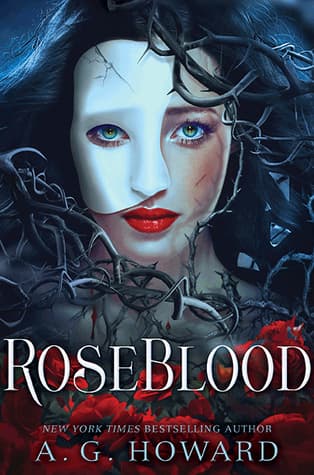
A.G. Howard (2017)
Genre
Fantasy / Mystery / Young Adult / Romance
Reading Time
10-12 hours
Key Themes
See below
Sign in to track this book
A cursed opera singer finds forbidden romance with a mysterious phantom's son at a haunted French conservatory, forcing him to choose between his spectral father's dark designs and her survival.
Seventeen-year-old Rune Germaine has an extraordinary operatic voice, but every performance makes her physically ill. Diagnosed with a mysterious vocal illness, her mother, Elara, enrolls her in RoseBlood Conservatory, a music school outside Paris in an old, supposedly haunted opera house. Rune, despite loving to sing, dislikes her mother's control and the constant pressure. When she arrives, she feels a strong connection to the old building and its sad atmosphere, sensing a presence beyond the ordinary. She hopes this new place will offer a cure or at least a break from her condition.
Soon after arriving, Rune meets a mysterious, handsome boy named Thorn in the conservatory's graveyard. He wears old-fashioned clothes and appears and disappears at will, making Rune curious. At the same time, Rune starts having vivid hallucinations and dreams, often involving a masked figure and a beautiful singer. These visions come with a strange sense of familiarity, as if she is remembering something forgotten. Her vocal illness, instead of improving, seems to get worse, especially when she tries to sing, making her question what is really wrong with her.
Rune discovers that RoseBlood Conservatory was once the opera house where the original Phantom of the Opera, Erik Destler, lived. She learns about his tragic past and the legends of his lasting presence. As she searches the school's archives, she finds similarities between her experiences and the phantom's obsession with music and a muse. Thorn, who is more than a regular student, warns Rune about the phantom's influence, sensing a dangerous connection forming between Rune and the spectral entity. He implies that the phantom wants Rune as his new muse, a fate he wants to prevent.
Rune and Thorn become close friends in secret. Thorn's presence affects Rune uniquely; when he is near, her vocal illness lessens, and she feels well. He reveals that he is the son of the original Phantom of the Opera, Erik Destler, and Christine Daaë, and that he has lived for centuries, bound to the opera house. He explains that Rune is a descendant of Christine Daaë, carrying a piece of Christine's soul, which makes her a target for Erik. Their shared history and the phantom's influence draw them closer as they deal with Erik's obsession and their growing feelings.
The Phantom, Erik Destler, begins to communicate with Rune directly, not through visions but through her mind. He promises her perfect vocal ability if she surrenders to him. He reveals his plan: he intends to use Rune's voice and her connection to Christine Daaë to fully resurrect Christine, moving Rune's soul into the past and Christine's soul into Rune's body. This ritual, he believes, will finally reunite him with his beloved muse. Rune is horrified, realizing that her vocal illness is Erik's power trying to claim her, and that her unique voice is both her greatest gift and her greatest danger.
Thorn is torn between his loyalty to his father, Erik, who raised him and is his only family, and his love for Rune. Erik demands that Thorn help him with the ritual, promising him a future with a resurrected Christine as his mother. However, Thorn knows this would mean Rune's destruction. He recognizes his father's manipulative love and the danger Rune is in. He must choose between fulfilling his father's centuries-long desire and protecting the woman he loves, even if it means betraying his only parent and facing Erik's anger.
Erik, growing impatient, arranges a grand performance at the conservatory's opera house, planning to use it for the soul-transfer ritual. He begins to fully possess Rune, making her voice inhumanly loud, but also draining her life. Thorn steps in, trying to stop the ritual and protect Rune, even as Erik uses his full spectral power. A chaotic fight happens in the opera house, with Erik's illusions and power threatening to overwhelm them. Rune, despite her weakening state, must find an inner strength to resist Erik's control.
In a struggle, Thorn realizes the only way to stop Erik and save Rune is to break his father's connection to the living world, even if it means destroying the last of Erik himself. He makes the painful decision to let Erik go, accepting that his father's tormented spirit can never find peace. Thorn uses his own abilities, inherited from Erik, to dismantle the ritual and weaken his father's hold on Rune. This act of love and sacrifice saves Rune from being a vessel for Christine and ends Erik's torment, allowing him to finally pass on.
With Erik gone, Rune's vocal illness vanishes. She is no longer drained by her singing and can embrace her talent without fear. The traumatic events leave their mark, but Rune finds comfort and strength with Thorn. Thorn, free from his father's shadow and the burden of his centuries-long existence, begins to truly live. They decide to stay at RoseBlood, not as prisoners of its past, but as guardians of its future. They are ready to explore their growing relationship and Rune's now unburdened vocal potential, free from the phantom's curse.
Rune and Thorn, having faced Erik's dark legacy, choose to remain at RoseBlood. Rune continues to improve her voice, no longer ill, and finds joy in music again. Thorn, no longer bound by his father's will or the opera house, embraces his freedom and his love for Rune. They begin to build a life together, understanding that their connection lasts beyond time and tragedy. The conservatory, once a place of haunting and manipulation, becomes a symbol of their enduring love and the triumph of life over the past's shadows.
The Protagonist
Rune transforms from a victim of her affliction and her mother's control into a powerful, self-possessed young woman who embraces her unique heritage and vocal gift.
The Love Interest / Supporting Protagonist
Thorn evolves from a prisoner of his past and his father's legacy into a free individual capable of choosing his own destiny and embracing love.
The Antagonist
Erik's arc is tragic; he remains trapped by his obsession until his final defeat, which ultimately grants his tormented spirit peace.
The Mentioned / Ancestral Figure
Christine's 'arc' is largely historical; her legacy influences the present, and her spirit is finally laid to rest with Erik's defeat.
The Supporting
Elara's arc is minor; she remains largely unchanged, focused on Rune's career, but her actions inadvertently set Rune on her path to self-discovery.
The Supporting
Gaston's arc is static; he serves primarily as a supportive friend to Rune.
The Supporting
Madame Valerius's arc is minor; she remains a figure of authority, largely unaware of the magical events unfolding.
Rune's vocal talent is at first a curse, making her ill and a target for the Phantom. This theme shows how a gift can become a burden when it controls one's life and identity. Rune struggles to separate her self-worth from her voice and the expectations on her. Only when she confronts the source of her illness, Erik's desire to possess her voice, can she reclaim her talent as her own, seeing it as strength instead of weakness. Her illness only lifts after Erik's influence is gone.
“My voice was a beautiful cage, trapping me in a cycle of performance and pain.”
The novel contrasts Rune and Thorn's pure, selfless love with the Phantom's possessive, destructive obsession for Christine. Erik's 'love' is a desire to control, willing to sacrifice Rune's soul to bring back his past. Thorn's love for Rune comes from mutual respect and a desire to protect her. It ends with him defying his father and making a sacrifice for her well-being. This theme shows the difference between true connection and desperately clinging to a past ideal, showing how obsession destroys.
“He didn't love me. He loved the echo of someone else in me.”
Both Rune and Thorn are at first bound by the past. Rune is tied by her ancestral connection to Christine and the Phantom's curse. Thorn is tied by his centuries-long existence under his father's influence. The story explores the struggle to break free from inherited destinies and historical burdens. Rune must confront her lineage and claim her own future. Thorn must choose his own path, even if it means betraying his only parent. Their journey is about breaking ties with a haunting history to embrace a self-determined future.
“We were not just echoes of the past; we were the future, forging our own song.”
Music and opera are central to the novel, not just as a setting but as a powerful force. Rune's voice is both her gift and her curse, a way for both beauty and Erik's power. The opera house, once a stage for grand performances, becomes a battleground where music is used for both creation and destruction. The theme explores how art can stir deep emotions, inspire, and even be used for dark purposes. Ultimately, when used with true intent, it can be a source of healing and freedom, as seen when Rune finally sings without pain.
“Music was the breath of this place, and sometimes, it felt like it breathed me in too.”
The RoseBlood Conservatory, an old opera house, serves as both setting and a character itself.
The RoseBlood Conservatory, formerly the Paris Opéra, is not merely a backdrop but a living, breathing entity imbued with the history and lingering presence of the Phantom. Its hidden passages, forgotten archives, and grand stage create an atmospheric and claustrophobic environment that traps the characters within its supernatural influence. The building's architecture and history directly facilitate the plot, providing the Phantom with his domain and the means to manipulate Rune and Thorn. Its very walls seem to hum with the echoes of past performances and tragedies, enhancing the gothic mystery and romantic tension.
Rune's lineage connects her directly to Christine Daaé, making her a target for the Phantom.
Rune's status as a direct descendant of Christine Daaé, and her carrying a 'fragment' of Christine's soul, is a crucial plot device. This connection explains both Rune's extraordinary voice and her mysterious vocal affliction, which is a symptom of Erik's attempts to possess her. It provides the Phantom with a means to potentially resurrect Christine, driving his actions and creating the central conflict. This device binds Rune to the opera house's history and explains her unique susceptibility to Erik's influence, making her destiny intertwined with the past.
Rune's illness after singing, a manifestation of the Phantom's influence.
Rune's debilitating vocal affliction, which drains her energy and causes her physical pain after every performance, serves as a significant plot device. Initially presented as a medical mystery, it is later revealed to be a direct consequence of Erik Destler's attempts to siphon her life force and prepare her as a vessel for Christine's resurrection. This illness not only provides a compelling personal struggle for Rune but also acts as a tangible sign of the Phantom's encroaching power, driving the characters to seek a cure and ultimately confront the supernatural forces at play.
The Phantom's ability to create illusions and manipulate minds.
Erik Destler's supernatural powers of creating vivid illusions and exerting mind control are key plot devices. He uses these abilities to haunt Rune, appearing in her dreams and visions, and to manipulate the environment of RoseBlood, making it a disorienting and terrifying place. These powers allow him to further his agenda of possessing Rune and to exert psychological pressure on both her and Thorn, blurring the lines between reality and nightmare. This device heightens the mystery and suspense, making it difficult for characters to discern truth from the Phantom's machinations.
“There are no fairy tales in the real world. Just stories that prepare you for it.”
— Rhiannon thinks about her mother's pragmatic view of stories.
“Sometimes the greatest love stories are also the greatest tragedies.”
— A reflection on the nature of love and loss.
“Music is not just sound; it's a language, a memory, a feeling that transcends words.”
— Rhiannon's deep connection to music and its power.
“The past is never truly dead. It lingers, a shadow ready to consume the present.”
— The lingering influence of past events and curses.
“Some curses aren't meant to be broken. Some are meant to be understood.”
— A different perspective on dealing with ancient curses.
“Every melody has a counterpoint, every light its shadow, every beauty its beast.”
— Contemplating the balance of opposing forces.
“It's hard to recognize your own reflection when someone else's shadow is always falling over you.”
— Rhiannon struggling with her identity in the shadow of Briar Rose.
“Love isn't about finding someone perfect. It's about seeing an imperfect person perfectly.”
— A romantic ideal expressed amidst the supernatural.
“The greatest prison is a mind that refuses to see beyond its own walls.”
— Discussing mental limitations and perceptions.
“Sometimes, the most important journey is the one you take into yourself.”
— Rhiannon's internal struggle and growth.
“Silence can be louder than any scream, especially when it holds a secret.”
— The power of unspoken truths and hidden knowledge.
“Even a rose, beautiful and captivating, has thorns to protect its heart.”
— A metaphor for vulnerability and self-preservation.
“Destiny is not a road you find, but a road you build, brick by painful brick.”
— The active role in shaping one's own future.
“The greatest enchantments are not in spells, but in the stories we tell ourselves.”
— The power of personal narrative and belief.
Ready to see how well you understood this book? Take our interactive quiz with 10 questions.







