“I was Rose Justice, and I was going to fly.”
— Rose's determination to become a pilot, despite initial setbacks and societal expectations.

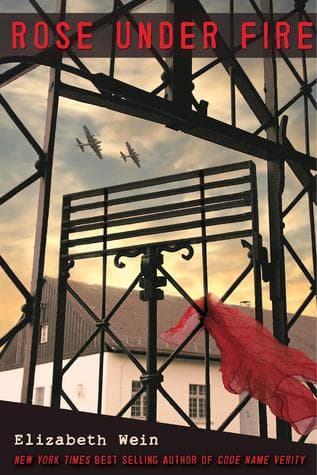
Elizabeth Wein (2013)
Genre
Historical Fiction / Young Adult
Reading Time
7 hours
Key Themes
See below
Sign in to track this book
An American ATA pilot, captured by Nazis and sent to Ravensbrück, finds strength in sisterhood and hope amidst unimaginable brutality.
Rose Justice, an eighteen-year-old American pilot for the Air Transport Auxiliary (ATA), is based in England during World War II. She ferries planes across war-torn Europe. Rose enjoys flying and finds comfort in writing poetry, often using her flight logs to record her thoughts. She is a bright, optimistic young woman, new from America, and somewhat naive about the war's full horrors. Her close friend and fellow ATA pilot, Maddie Brodatt, from *Code Name Verity*, recently died. This loss affects Rose deeply, yet she continues her vital work, determined to help the war effort.
On a routine ferry flight from Paris to England, Rose pilots a new Spitfire. German fighters attack her plane. Despite her efforts, her Spitfire is hit, forcing her to bail out over occupied France. She parachutes into enemy territory and is quickly captured by German soldiers. The initial shock and fear are immense, as her relatively sheltered life as a pilot abruptly ends with the harsh reality of being a prisoner of war. Her capture marks a terrifying shift from the freedom of the skies to enemy hands.
After her capture, the Gestapo intensely interrogates Rose. They are particularly interested in her American nationality and her role as a female pilot. They try to get information about Allied operations, hoping to use her for their own purposes. Rose, though scared, remains composed, giving only her name, rank, and serial number, following the code of conduct for prisoners of war. She resists their psychological tactics and physical threats, showing unexpected resilience despite her youth. Her refusal to cooperate frustrates her captors.
After interrogations, Rose is unexpectedly taken, not to a POW camp, but to Ravensbrück concentration camp, a place for women. The journey is harrowing, and her arrival at the camp is shocking and disorienting. They strip her of her belongings, clothes, and identity, cut her hair, and give her a striped prisoner uniform. The immense suffering, brutal conditions, and dehumanization are immediately clear, a stark contrast to anything she has ever known. She receives prisoner number 72007, a stark symbol of her lost individuality.
Inside Ravensbrück, Rose quickly learns that survival depends on solidarity. She is assigned to Barracks 10, where she meets a diverse group of women. Among them are Elodie, a brave French Resistance fighter, and Roza, a Polish doctor imprisoned for her involvement in the Polish underground. These women, along with others like Lisette and Irina, become Rose's lifeline. They share meager rations, offer emotional support, and teach her the unwritten rules of camp survival. Their friendship provides a glimmer of hope amidst constant despair and brutality, allowing Rose to hold onto her humanity.
Life in Ravensbrück is a relentless cycle of starvation, forced labor, and fear. Rose is assigned to hard labor in the camp's textile factory, working long hours under cruel guards. She witnesses unspeakable violence, random killings, and the slow decline of her fellow prisoners. Lack of food, sanitation, and medical care takes a heavy toll. Rose struggles with the physical demands and psychological trauma, her optimism slowly eroding under the camp's horrors. The constant threat of selection and death hangs over every moment.
Rose and her friends discover the horrifying truth about the 'Rabbits' (Kaninchen) — young Polish women subjected to brutal surgical experiments by camp doctors. These experiments involve deliberately infecting wounds or breaking bones to study gangrene and other conditions, often without anesthesia. The 'Rabbits' are left disfigured and often die from the procedures. Witnessing their suffering, particularly that of a young girl named Karolina, deeply affects Rose. This revelation strengthens her resolve to survive and to bear witness to these atrocities, understanding the importance of their stories being told.
Amidst the despair, Rose and her friends find ways to resist. They share poetry, tell stories, and even hold a clandestine Christmas celebration. Rose continues to write poems in secret, using them to process her experiences and preserve her identity. Elodie's spirit and Roza's quiet strength inspire Rose. These small acts of defiance, like sharing bread or a whispered song, become powerful symbols of their enduring humanity and their refusal to let the Nazis break their spirits. They cling to the hope of liberation, however distant.
As the war ends, Soviet forces finally liberate the camp. Rose, along with many of her friends, is among the survivors. Liberation brings immense relief, but it is not a simple return to normalcy. Rose is physically emaciated and profoundly traumatized. The joy of freedom is lessened by the immense loss and indelible memories of what she witnessed. She reunites with her family and tries to adjust to life outside the camp, but the psychological scars of Ravensbrück are deep, making it hard to reconcile her past with her present.
Back in America, Rose struggles to describe the horrors she endured. Her family, though loving, cannot fully grasp the depth of her trauma. She feels isolated, burdened by unspeakable memories. However, encouraged by her friend Maddie's brother, Jamie, and the memory of her fellow prisoners, Rose finds the courage to speak. She begins to write about her experiences, turning her secret poems into a powerful testimony. Ultimately, she testifies at the Nuremberg Trials, giving voice to the 'Rabbits' and all those who suffered at Ravensbrück, fulfilling her promise to bear witness and ensure their stories are never forgotten.
The Protagonist
Rose transforms from a naive, optimistic pilot into a traumatized survivor who finds her voice and purpose in testifying to the atrocities she witnessed.
The Supporting
Elodie maintains her strong spirit and commitment to resistance throughout her imprisonment, serving as a pillar of strength for Rose.
The Supporting
Roza consistently demonstrates unwavering compassion and resilience, using her medical knowledge to help others despite the extreme conditions.
The Supporting
Lisette endures the camp's horrors with quiet resilience, finding comfort and strength in the makeshift family of Barracks 10.
The Supporting
Irina's arc is one of sustained endurance, embodying the quiet, resilient strength of many prisoners.
The Supporting
Karolina's arc is tragic, as she endures horrific medical experimentation, becoming a symbol of the camp's atrocities and a driving force for Rose's testimony.
The Supporting
Jamie helps Rose navigate her trauma after the war, providing her with the support and encouragement needed to begin healing and speaking out.
The Antagonist
Günther remains a consistently cruel and unyielding antagonist, representing the oppressive force of the Nazi regime.
Friendship is essential for survival in Ravensbrück. Rose, Elodie, Roza, and the other women in Barracks 10 form a strong bond, sharing meager rations, offering emotional support, and performing small acts of defiance. For example, when Rose first arrives, disoriented, Elodie's practical advice and Roza's quiet compassion help her adapt. Their shared humanity and mutual reliance allow them to endure conditions that would otherwise break them, showing that even in the darkest circumstances, human connection is a powerful source of strength and hope.
“We were not just prisoners; we were a family. We were each other's keepers.”
A central theme is the moral need to bear witness to atrocities and ensure victims' stories are not forgotten. Rose initially struggles with Ravensbrück's trauma, finding it impossible to describe her experiences. However, the memory of her friends, especially the 'Rabbits' like Karolina, compels her to speak out. Her journey from silent suffering to publicly testifying at the Nuremberg Trials highlights survivors' deep responsibility to share their truths, turning personal pain into a powerful act of remembrance and justice for those who cannot speak for themselves. Her poems become her testimony.
“I will remember. I will remember them all. And I will tell their story.”
Rose begins as a naive, optimistic young woman, full of the joy of flying and poetry. Her capture and imprisonment at Ravensbrück brutally strip away her innocence, exposing her to unimaginable cruelty and suffering. She witnesses death, starvation, and the depravity of the 'Rabbits' experiments. Despite this deep loss of innocence, Rose's spirit is remarkably resilient. She adapts, finds strength in friendships, and ultimately emerges from the camp not broken, but transformed, showing the human capacity to endure and find purpose even after the deepest despair.
“The girl who flew planes was gone. In her place was a survivor, a witness.”
Poetry and language are crucial for Rose's survival and resistance. Before capture, she uses poetry to express her joy in flying. In Ravensbrück, writing poems in secret helps her maintain identity, process trauma, and document the horrors she sees. Sharing stories, songs, and bits of literature among prisoners provides solace and connection, reminding them of their humanity. After liberation, Rose's ability to articulate her experiences through writing becomes her most powerful tool for healing and advocating for justice, proving that words are a form of profound resistance.
“Words were weapons, too. They could be used to remember, to condemn, to heal.”
The story is told through Rose's letters and journal entries, primarily addressed to her deceased friend Maddie.
The novel is primarily structured as a series of letters and journal entries written by Rose Justice, often addressed to her deceased best friend, Maddie Brodatt, or sometimes to her family. This epistolary format allows the reader direct access to Rose's inner thoughts, fears, and observations, making her experiences intensely personal and immediate. It also highlights her desperate need to communicate and process her trauma, both during and after her imprisonment. The act of writing itself becomes a survival mechanism, a way for Rose to maintain her sanity and preserve her identity amidst the dehumanizing conditions of Ravensbrück, and later, to bear witness.
Maddie's earlier death in *Code Name Verity* subtly foreshadows the dangers Rose will face.
The novel implicitly references Maddie Brodatt's fate from *Code Name Verity*, where she dies while on a mission. While not explicitly detailed within *Rose Under Fire*, Maddie's known death sets a somber tone and subtly foreshadows the extreme dangers and potential for loss that Rose herself will face. It reminds the reader that even skilled and brave pilots are vulnerable in wartime, making Rose's capture and imprisonment feel like a real and ever-present threat, rather than an improbable twist. This connection to the previous novel grounds Rose's story in a broader context of wartime sacrifice and loss.
The young Polish women subjected to medical experiments symbolize the camp's ultimate depravity.
The 'Rabbits' (Kaninchen) are young Polish women at Ravensbrück who are subjected to horrific medical experiments. This group serves as a powerful symbol of the extreme inhumanity and scientific depravity of the Nazi regime. Their suffering, particularly Karolina's, is a central catalyst for Rose's determination to survive and bear witness. They represent the most vulnerable victims and the systematic abuse of human beings in the camps. Their presence elevates the narrative beyond general suffering, focusing on a specific, documented atrocity that demands remembrance and justice, giving Rose a concrete mission for her testimony.
Rose's poetry functions as a personal coping mechanism, a secret act of resistance, and a historical record.
Rose's poetry is more than just a hobby; it is a vital plot device. Initially, it expresses her joy and perspective as a pilot. In Ravensbrück, writing poems in secret becomes her primary coping mechanism, allowing her to process the trauma, maintain her sense of self, and preserve her observations. These poems are a secret act of defiance against a regime that seeks to strip away individuality. Post-liberation, her collected poems transform into a powerful historical record and the foundation of her testimony, demonstrating how art can serve as both personal therapy and a vehicle for collective memory and justice.
“I was Rose Justice, and I was going to fly.”
— Rose's determination to become a pilot, despite initial setbacks and societal expectations.
“There are some things you can't forgive. And some things you can't forget.”
— Rose reflecting on the atrocities she witnessed and the lasting impact of war.
“We were girls. We were young. We were pilots. We were going to win this war.”
— Rose's sense of camaraderie and purpose with her fellow ATA pilots.
“It was one thing to read about war in the papers, another to see it up close, to feel its breath on your neck.”
— Rose's realization of the brutal reality of war after experiencing it firsthand.
“Sometimes you have to break the rules to do what's right.”
— Rose's moral dilemma and decision to act on her conscience, even if it means defying authority.
“The sky was not a place of escape; it was a place of work, of danger, of responsibility.”
— Rose's evolving perspective on flying, from a romantic ideal to a serious duty.
“Fear can be a useful thing. It can keep you alive.”
— Rose learning to navigate dangerous situations and use her fear as a tool for survival.
“Even in the darkest places, there can be light.”
— Rose finding hope and human connection amidst the horrors of Ravensbrück.
“I learned that courage isn't about not being afraid, it's about doing what you have to do even when you are.”
— Rose's personal growth and understanding of true courage through her experiences.
“The past is never really past. It lives inside you.”
— Rose grappling with the lingering effects of her trauma and the memories of war.
“We were all just trying to survive, one day at a time.”
— The shared experience of prisoners in Ravensbrück, focusing on the daily struggle for existence.
“Silence can be a weapon, or it can be a shield.”
— Rose realizing the power of both speaking out and keeping silent in different circumstances.
“Sometimes the greatest strength is found in helping others.”
— Rose discovering the importance of solidarity and mutual support among her fellow prisoners.
“Home wasn't a place anymore. It was the people I loved.”
— Rose's evolving definition of 'home' after her experiences, focusing on relationships.
Ready to see how well you understood this book? Take our interactive quiz with 10 questions.

Biography coming soon.







