“There are no monsters, only people.”
— Early in Rose's journey, reflecting on Norman's abuse.

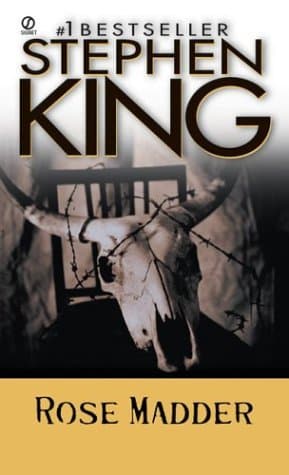
Stephen King (1995)
Genre
Thriller / Fantasy / Mystery
Reading Time
12-15 hours
Key Themes
See below
Sign in to track this book
Fleeing her abusive husband, Rosie discovers a mysterious painting that offers both refuge and a dangerous gateway to a mythical world where she must confront her past and fight for her future.
Rosie Daniels has endured fourteen years of physical and psychological abuse from her husband, Norman Daniels, a police detective. One morning, a single drop of blood from Norman's nose lands on her hand. This triggers a sudden, terrifying realization that he will eventually kill her, just as he once beat their unborn child to death. Seizing an opportunity while Norman is asleep, Rosie impulsively packs a small bag, takes Norman's credit card, and flees their home in Junction City, without a clear destination. She travels by bus, making several transfers to obscure her trail, finally arriving in an unfamiliar city, which she later learns is called 'The City.' She checks into a women's shelter under the assumed name 'Rose Smith' to begin a new, anonymous life, haunted by the constant fear of Norman finding her.
In the City, Rosie gets a job as a receptionist at a hotel and finds a small apartment. She begins to build a semblance of normalcy, making a friend named Anna Stevenson at work and starting to regain some independence. One day, while exploring an antique shop, she is drawn to a painting titled 'Rose Madder.' The painting depicts a woman in a rose madder colored toga, standing in a clearing, with a labyrinth in the background and a one-eyed, snarling bull-like creature in the foreground. Rosie feels an intense, magnetic pull towards it, despite its unsettling elements. She uses Norman's credit card for a final, desperate time to purchase the painting, knowing it's a risky move that could expose her location.
Rosie discovers that the painting is more than just art; it is a portal to another world. Initially, she can only hear sounds from within it, but eventually, she can step through, finding herself in the very landscape depicted. She meets the woman from the painting, who calls herself Rose Madder, and learns of a quest involving a labyrinth and a sleeping lion. Meanwhile, in her real life, Rosie meets Bill Steiner, a kind and gentle man who owns a pawn shop. They develop a romantic relationship, and Bill becomes a source of comfort and stability, helping Rosie to heal from her past trauma and build confidence. She keeps the painting's true nature a secret from him, fearing he wouldn't believe her or might think she's insane.
Back in Junction City, Norman is enraged by Rosie's disappearance and her use of his credit card. His abusive tendencies escalate, and he becomes obsessed with finding her. Using his police contacts, investigative skills, and brutal determination, he meticulously tracks her credit card activity, following a trail of breadcrumbs across the country. He tortures and kills a prostitute who resembles Rosie, believing he is getting closer to his wife. His pursuit becomes a homicidal rampage, fueled by a twisted sense of betrayal and ownership, and he leaves a trail of violence and intimidation in his wake, moving ever closer to the City where Rosie is hiding.
Rosie re-enters the painting world, where Rose Madder reveals more about her purpose. Rose Madder is a goddess figure, and her world is a manifestation of Rosie's own repressed anger and strength. Rosie is tasked with a quest: to retrieve a jewel from the sleeping lion in the labyrinth and deliver it to the goddess's temple. This jewel is needed for Rose Madder's full awakening and for Rosie's own empowerment. Rosie navigates the dangerous, surreal landscape, encountering the one-eyed bull-like creature, called the 'Minotaur,' which represents her husband Norman's predatory nature and the trauma he inflicted upon her. The journey is physically and emotionally taxing, pushing Rosie to confront her deepest fears.
Within the painting, Rosie enters the labyrinth and confronts the Minotaur, a symbolic representation of Norman and his abuse. She uses her wits and a specific phrase given to her by Rose Madder to temporarily subdue the creature, allowing her to reach the sleeping lion. She successfully retrieves the jewel from the lion's paw, completing the first part of her quest. This act of courage and defiance within the painting world empowers Rosie in her real life, strengthening her resolve and helping her to shed some of her victim mentality. The experience changes her, preparing her for the inevitable confrontation with Norman in the real world.
Norman finally tracks Rosie to her apartment building. He murders her friend Anna Stevenson, who tries to protect Rosie, and then breaks into Rosie's apartment. He finds Rosie there with Bill Steiner, who is horrified by Norman's appearance and violent demeanor. Norman, filled with a murderous rage, attacks Bill, severely beating him. Rosie, no longer the terrified victim she once was, is forced to confront Norman directly. She realizes that her experiences in the painting have given her a new inner strength, and she must protect Bill and herself from Norman's final, deadly assault. The apartment becomes a battleground for survival.
In a desperate act, Rosie leads Norman into the painting world. She has the jewel and the knowledge of the painting's true power. Norman, dismissing the painting as a trick, follows her through the portal, his rage blinding him to the danger. Once inside, he is confronted by the Minotaur, which is now fully awake and enraged, a direct manifestation of his own monstrous nature. Rosie, having fulfilled her part of the quest, witnesses as the Minotaur tears Norman apart, ending his reign of terror. Rosie emerges from the painting, leaving Norman's fate sealed within its magical confines, and returns to Bill, who is severely injured but alive.
After Norman's death in the painting, Rosie takes Bill to the hospital, where he slowly recovers from his injuries. Rosie, now truly free from Norman's abuse, begins to build a new life with Bill. However, the painting's influence isn't entirely gone. The Minotaur, or at least its essence, seems to have followed her, manifesting in subtle ways – a feeling of being watched, a sense of residual darkness. Rosie understands that while Norman is gone, the trauma he inflicted will always be a part of her, but she now has the strength to face it. She sells the painting to a pawn shop owner, hoping to put it behind her.
Years later, Rosie is happily married to Bill and has a daughter, Caroline. She receives a package containing the Rose Madder painting. It seems the painting, or the force within it, has returned to her. Rosie realizes that the painting is not merely an escape but a symbol of her journey, her resilience, and the strength she found within herself. She understands that she can never fully escape her past, but she can integrate it into her present. She accepts the painting, not as a threat, but as a reminder of her power and survival, choosing to keep it in her home, no longer as a portal, but as a symbol of her transformation.
The Protagonist
From a terrified, abused victim, Rosie transforms into a strong, independent woman who confronts her abuser and reclaims her life.
The Antagonist
Norman remains a static character, consumed by his rage and ultimately destroyed by it, never showing remorse or change.
The Supporting
Bill remains a steadfast and supportive figure, helping Rosie on her journey to recovery and building a new life with her.
The Supporting/Supernatural
Rose Madder is a static, symbolic character who acts as a catalyst for Rosie's transformation.
The Supporting
Anna's arc is cut short by Norman's violence, serving as a tragic catalyst for Rosie's final confrontation.
The Supporting
Gert provides crucial initial support for Rosie, enabling her escape and new beginning.
The Supporting
Lefferts' arc shows his complicity in Norman's initial tracking, highlighting the reach of Norman's influence.
The Symbolic Antagonist
The Minotaur acts as a constant threat and a symbolic representation of Norman's evil, ultimately serving as the instrument of his demise.
The central theme involves Rosie's escape from and survival of long-term domestic abuse from her husband, Norman. The novel portrays the physical, psychological, and emotional toll of abuse, but also the resilience of the human spirit. Rosie's journey from victim to survivor, her struggle to reclaim her identity, and her eventual triumph over her abuser are at the core of the narrative. Specific scenes, like the initial escape or Norman's murder of Anna, show the constant threat and the courage required to break free.
“A single drop of blood, no bigger than a punctuation mark, had fallen onto the sheet. And suddenly Rosie knew.”
Rosie's journey is one of empowerment and self-discovery. Her interactions within the painting world, particularly with Rose Madder, guide her toward recognizing and embracing her own inner strength. The quest to retrieve the jewel and confront the Minotaur are metaphors for Rosie confronting her own fears and reclaiming her agency. She sheds the identity of 'Norman's wife' and discovers her own voice and power, learning to fight back not just physically, but emotionally and spiritually. This transformation is needed for her to build a new life.
“And she was not Rosie Daniels, the terrified woman who had run away from home fourteen years ago. She was Rose, and she was strong. She was in her own house now.”
The novel explores the chilling nature of evil through the character of Norman Daniels. He is not merely abusive but a psychopathic entity, without empathy, whose malevolence extends beyond Rosie to anyone who crosses his path. King explores how such evil can exist within seemingly normal societal structures (Norman is a police detective) and the insidious ways it can manipulate and destroy lives. The Minotaur in the painting is a symbolic representation of this primal, monstrous evil, showing how Norman's inner darkness manifests.
“He was a man who hated women, and he loved to hurt them. He loved it more than anything else in the world.”
A significant theme is the blurred line between fantasy and reality, particularly through the magical painting. The painting is not merely an escape but a parallel reality that directly impacts Rosie's real life. It provides her with the spiritual tools and courage needed to confront her real-world abuser. This interplay suggests that inner psychological battles can manifest in symbolic, fantastical ways, and that engaging with these inner landscapes can lead to tangible changes in one's external life. The painting is a bridge, where Rosie's inner strength is forged.
“It was just a painting, but it was also a door. And sometimes, a door was a very dangerous thing.”
Rosie's past trauma, particularly the loss of her unborn child due to Norman's violence, constantly haunts her. The novel explores how memory shapes her present fears and actions, and how she gradually processes and overcomes these deeply ingrained psychological wounds. Her journey involves not just escaping Norman, but escaping the mental prison his abuse created. The painting acts as a therapeutic space where she can confront these memories and the pain they represent, allowing her to eventually integrate her past without being defined by it.
“The memory was a bruise, always there, always throbbing, sometimes fading, but never quite gone.”
A magical portal to a parallel world that facilitates Rosie's psychological and physical transformation.
The Rose Madder painting is the central magical realism device in the novel. It functions as both a literal portal to a fantastical world and a metaphorical representation of Rosie's subconscious mind and her journey toward self-empowerment. It provides a space where Rosie can confront her trauma and find the strength to face Norman in the real world. The painting's world is a symbolic landscape where Rosie's internal struggles and repressed emotions are externalized, allowing her to interact with them and gain agency. It is the catalyst for her profound transformation and the ultimate instrument of Norman's demise.
A symbolic beast representing Norman's monstrous, abusive nature.
The Minotaur, the one-eyed, bull-like creature within the painting, is a powerful symbol of Norman Daniels's malevolence and the primal, predatory nature of his abuse. It embodies Rosie's deep-seated fear and the trauma he inflicted upon her. Rosie's confrontations with the Minotaur in the painting are metaphorical battles against her abuser, and its ultimate role in Norman's destruction signifies Rosie's final triumph over his psychological and physical hold. It transforms from a symbol of fear into an instrument of justice.
A practical and symbolic device for Rosie's escape and new beginning.
Rosie's decision to adopt the name 'Rose Smith' is a crucial plot device that underscores her desperate need for anonymity and a fresh start. Practically, it allows her to hide from Norman. Symbolically, it represents her shedding her old, abused identity as 'Rosie Daniels' and attempting to forge a new, independent self. The journey from 'Rosie Daniels' to 'Rose Smith' and eventually to a fully empowered 'Rose' (or 'Rose Madder') highlights her transformation and the reclamation of her true self, free from Norman's ownership.
A symbolic maze within the painting representing Rosie's journey through trauma and self-discovery.
The labyrinth within the Rose Madder painting is a classic literary symbol. It represents Rosie's complex and often terrifying psychological journey through her trauma, fears, and the challenges of self-discovery. Navigating the labyrinth to reach the sleeping lion and retrieve the jewel symbolizes her internal struggle to confront her past, overcome obstacles, and find her inner strength. It's a place of danger and confusion, mirroring the mental state of an abuse survivor, but also a path to eventual clarity and empowerment.
A small detail that acts as a powerful catalyst for Rosie's escape.
The single drop of Norman's blood that falls on Rosie's hand is a seemingly minor detail that serves as a profound catalyst for the entire plot. It's the 'last straw' that shatters Rosie's denial and triggers her realization that Norman will eventually kill her. This small, visceral detail breaks her long-standing Stockholm Syndrome, forcing her to recognize the immediate danger and make the life-altering decision to flee. It represents the point of no return for Rosie, initiating her journey of escape and transformation.
“There are no monsters, only people.”
— Early in Rose's journey, reflecting on Norman's abuse.
“The past is a wheel. It turns and turns and never stops turning.”
— Rose grappling with her traumatic past and the cyclical nature of abuse.
“Sometimes you have to go back to go forward.”
— Rose contemplating her decision to return to the painting.
“Love doesn't just sit there, like a stone, it has to be made, like bread; remade all the time, made new.”
— Gert, the mystical shopkeeper, offering wisdom to Rose.
“He understood that fear was a tool, and he used it to keep her small.”
— Rose realizing the deliberate nature of Norman's control.
“The world was full of magic, but you had to know where to look.”
— Rose's growing awareness of the supernatural elements around her.
“Some doors, once opened, can never be closed.”
— Referring to the gateway into the painting's world.
“She had survived, and that was the first victory.”
— Rose reflecting on her escape from Norman.
“The dead don't stay dead in some places.”
— A hint at the more fantastical and dangerous aspects of the painted world.
“There are things worse than death, Rose. Things that can steal your soul.”
— Gert warning Rose about the true nature of her adversaries.
“He was a disease, a cancer, and she had to cut him out.”
— Rose's determination to permanently remove Norman from her life.
“The painting was a mirror, reflecting not just what was, but what could be.”
— Rose understanding the symbolic and transformative power of the artwork.
“Sometimes the only way out is through.”
— Rose's realization that she must confront her fears and Norman directly.
“The truth had a way of coming out, no matter how deeply buried.”
— Rose's past catching up to her, and Norman's true nature being revealed.
Ready to see how well you understood this book? Take our interactive quiz with 10 questions.

Stephen Edwin King is an American author of horror, supernatural fiction, suspense, crime, science-fiction, and fantasy novels. Described as the "King of Horror", his books have sold more than 350 million copies as of 2006, and many have been adapted into films, television series, miniseries, and comic books. King has published over 65 novels/novellas, including seven under the pen name Richard Bachman, and five non-fiction books. He has also written approximately 200 short stories, most of which have been published in book collections.







