“It is so easy to be good when one is happy.”
— Rose reflects on her own contentment and moral behavior.

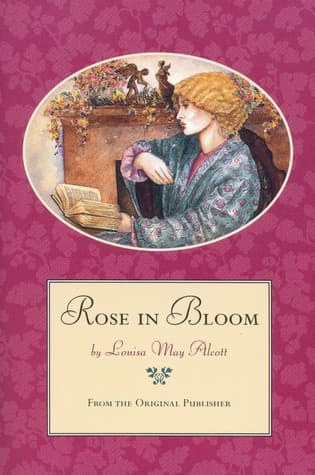
Louisa May Alcott (1876)
Genre
Children's / Historical Fiction / Young Adult / Romance
Reading Time
360 min
Key Themes
See below
Sign in to track this book
After her European tour, independent Rose Campbell navigates many suitors and societal expectations, determined to find genuine love and her own path at the 'Aunt Hill'.
Rose Campbell, now nineteen, returns to the 'Aunt Hill' in America after her two-year tour of Europe and the East with her guardian, Dr. Alec. Her six male cousins — Mac, Archie, Steve, Charlie, Geordie, and Jamie — along with her female cousin Phebe and other family members, greet her warmly. The family is excited to see Rose and, more subtly, to see which of the grown cousins she might choose as a husband. Rose feels uneasy amidst the celebration, sensing unspoken expectations and pressure to conform. She wants to maintain her independence and not rush into any decisions, especially about marriage.
Rose immediately becomes the object of affection from several cousins. Charlie, handsome but somewhat superficial, quickly declares his interest, mainly drawn to her beauty and fortune. Rose gently but firmly rejects him, seeing his superficiality. Archie, the most intellectual and serious cousin, also shows admiration through respectful attention and shared intellectual pursuits. Rose appreciates this but does not mistake it for deep romantic love. Rose begins to develop her own criteria for a partner, valuing character, shared values, and mutual respect over mere charm or wealth, a perspective she often discusses with her wise Uncle Alec.
Rose encourages her cousin Phebe, a talented singer, to pursue her musical education despite her humble background and social prejudices against women in professional careers. Rose uses her inheritance to fund Phebe's lessons and provide opportunities she would not otherwise have. This generosity shows Rose's philanthropic spirit and her desire to empower other young women. Phebe, initially hesitant, thrives under Rose's encouragement and financial support, showing the positive effect of Rose's thoughtful use of her wealth and influence.
Beyond her cousins, Rose meets other young men in Boston society. One is Captain Jasper, a charming but worldly individual more interested in Rose's social standing and fortune than her true self. Rose, guided by Uncle Alec's subtle advice and her own growing intuition, sees his superficiality and rejects his advances. These encounters confirm Rose's belief that she must choose a partner based on genuine affection and shared principles, not social pressure or material gain. She spends her time doing charity work, continuing her education, and enjoying her family's company, all while observing the world around her.
Charlie, despite Rose's earlier rejection, continues his reckless and self-indulgent lifestyle. His love for pleasure and lack of discipline lead him into debt and bad company. When he falls seriously ill from his excesses, Rose and Uncle Alec step in to nurse him. During his recovery, Charlie feels deep regret and decides to change, aiming to prove himself worthy of the family's trust. This event affects Rose, showing her the consequences of unchecked desires and the possibility of redemption, even for those she had initially dismissed.
Throughout this time, Mac, the steady and principled cousin, remains a quiet but constant presence. He never pressures Rose, instead offering genuine companionship, intellectual stimulation, and moral support. Rose finds herself increasingly drawn to his integrity, his dedication to his medical studies, and his unassuming kindness. Their shared values, serious discussions, and Mac's consistent respect for her independence make him stand out. Rose begins to realize her feelings for Mac are deepening beyond cousinly affection, recognizing their strong compatibility and mutual respect.
Jamie, another cousin, shows a strong desire to become a sculptor. Rose, seeing his talent and passion, encourages him wholeheartedly, as she did with Phebe. She supports his artistic education and believes in his potential, standing against some family members who might view art as an impractical career. Her support helps Jamie gain confidence and pursue his dreams, further showing Rose's role as a patron and advocate for individual passions within her family, using her influence and resources to help creativity and self-expression.
Rose dedicates herself to various charitable causes, especially those helping less fortunate young women and children. She establishes a club for working girls, providing education, recreation, and a safe space. Her efforts involve not just giving money but actively engaging with the community, offering her time and understanding. This commitment to social improvement solidifies her identity as a woman of purpose and shows her belief that wealth should be used for the greater good, not just for personal indulgence or status.
After reflecting and observing Mac's consistent character and genuine love, Rose realizes he is the only man she could truly marry. Mac, who has patiently waited and proven his worth through his actions and character, finally proposes. It is a moment of deep emotional connection, free from the superficiality and pressure of other suitors. Rose accepts, recognizing in Mac a partner who respects her independence, shares her values, and loves her for who she truly is, not for her fortune or social standing. Their engagement is the result of their shared growth and mutual understanding.
Rose and Mac begin to plan their future, one that combines Rose's desire for independence and purpose with Mac's dedication to his medical career and his quiet strength. Their union is presented not as an end to Rose's personal growth but as a partnership that will enable both of them to continue their individual and shared good works. The book ends with harmony and optimism, showing Rose having successfully navigated the challenges of wealth and societal expectations to choose a path true to herself and her values, surrounded by a family that has learned to respect her choices.
The Protagonist
From a naive but well-intentioned heiress, Rose matures into a discerning, purposeful young woman who confidently chooses her own path and partner.
The Supporting
Remains a consistent pillar of wisdom and support, his influence shaping Rose's independent spirit.
The Supporting
Develops from a quiet, studious cousin into Rose's devoted and respected partner, embodying the values she seeks.
The Supporting
Transforms from a timid, talented girl into a confident, aspiring professional singer, thanks to Rose's support.
The Supporting
Begins as a superficial pleasure-seeker, falls due to his excesses, and experiences a moment of genuine repentance and a desire for reform.
The Supporting
Remains a consistently intellectual and kind cousin, demonstrating a respectful but ultimately non-romantic affection for Rose.
The Supporting
Maintains his cheerful and energetic disposition throughout the story, a stable source of familial warmth.
The Supporting
Gains confidence in his artistic calling through Rose's encouragement and support.
The Mentioned
Attempts to court Rose for her fortune but is quickly dismissed, serving as a cautionary example of insincere suitors.
Rose's main struggle is to define herself apart from her wealth and family expectations. She resists pressure to marry for status or convenience, choosing a partner who respects her autonomy and shares her values. Her philanthropic work and her support for Phebe's and Jamie's artistic careers show her commitment to a purposeful life beyond traditional domestic roles. This theme is clear in her repeated rejections of suitors who do not meet her standards for genuine partnership and her determination to find her own path.
“"I mean to be a useful woman first, and a happy one if I can, but I won't be a toy, even if the gilded cage is ever so pretty."”
Rose inherits a large fortune, and a major theme is how she chooses to use it. Unlike some who might indulge in luxury, Rose actively uses her wealth for philanthropic efforts, supporting education for working girls, funding Phebe's singing lessons, and encouraging Jamie's artistic ambitions. She sees her money as a tool for good, a way to empower others and contribute positively to society, rather than a source of personal vanity or social influence. Her guardian, Uncle Alec, reinforces this perspective, guiding her towards responsible management.
“"Money is a good servant but a bad master, and I mean to keep mine in its place."”
The novel explores different forms of love and how to tell true affection from superficial interest. Rose is courted by several cousins and other suitors, each offering a different type of attention. She learns to distinguish between those who value her for her fortune or beauty (like Charlie or Captain Jasper) and those who genuinely appreciate her character, intellect, and independence (like Mac). Her journey shows the importance of shared values, mutual respect, and deep understanding as foundations for a lasting and fulfilling partnership.
“"I want a love that will help me to be my best self, not one that will make me a mere echo of another."”
The theme of character development is clear in Charlie's story. Initially superficial and self-indulgent, Charlie's reckless behavior leads to illness and debt. This crisis forces him to face his flaws and begin a path of redemption, aiming to prove his worth through genuine effort and self-improvement. Rose's compassionate response and the family's support for his recovery highlight the belief in the possibility of change and growth, even for those who have strayed.
“"I've been a fool, Rose, but I mean to be a man now, if you'll only let me try."”
Alcott explores the changing roles and expectations for women in the late 19th century. Rose, Phebe, and other female characters challenge traditional ideas of women's place, asserting their right to education, professional careers, and independent thought. Rose actively supports Phebe's singing career and establishes a club for working girls, advocating for women's economic and social empowerment. The novel champions the idea that women can be both loving partners and active, purposeful members of society, rejecting the notion that marriage is their sole aim.
“"I don't think a woman's life ought to be all love and marriage; there's a great deal more in it than that."”
A familial hub that represents both comfort and societal expectations.
The 'Aunt Hill' is the affectionate name for the large, bustling family home where Rose and her numerous cousins reside. It functions as a central stage for much of the novel's action, embodying the warmth and support of a large family but also the inherent pressures and expectations placed upon Rose. It serves as a microcosm of society, where Rose must navigate different personalities, romantic overtures, and the subtle demands of her relatives regarding her future. The 'Aunt Hill' is both a sanctuary and a testing ground for Rose's independence.
A narrative technique to highlight Rose's discerning nature and moral compass.
The presence of multiple suitors – including several cousins (Charlie, Archie, Mac) and external figures (Captain Jasper) – serves as a crucial plot device. Each suitor represents a different set of values, intentions, and approaches to courtship. By having Rose interact with and ultimately reject those who are superficial, opportunistic, or simply not aligned with her ideals, the narrative effectively showcases her intelligence, independence, and strong moral character. This device allows Rose's journey of self-discovery and her criteria for a true partner to unfold gradually and clearly.
A wise guardian figure who provides subtle guidance without dictating choices.
Uncle Alec serves as Rose's guardian and a consistent moral compass throughout the novel. His role is not to tell Rose what to do, but to provide thoughtful advice, gentle warnings, and unwavering support for her independent spirit. He encourages her to think for herself, to prioritize character over superficiality, and to use her wealth responsibly. His presence allows for exposition of Alcott's progressive ideas on education and women's roles, and he acts as a sounding board against which Rose can test her own burgeoning wisdom and resolve. He is a catalyst for her personal growth.
A means for Rose to demonstrate her character and purpose beyond personal gain.
Rose's active engagement in various philanthropic endeavors, such as funding Phebe's education, supporting Jamie's art, and establishing a club for working girls, is a significant plot device. These actions are not merely background details; they are central to Rose's character development and her assertion of purpose. They allow her to demonstrate her values, her compassion, and her commitment to using her wealth for the greater good. These activities also provide a contrast to the more frivolous pursuits of some other characters, solidifying Rose's identity as a thoughtful and responsible young woman.
“It is so easy to be good when one is happy.”
— Rose reflects on her own contentment and moral behavior.
“I want to be loved, not admired.”
— Rose expresses her desire for genuine affection over superficial praise.
“A little kingdom I possess, where thoughts and feelings dwell; and very hard the task I find of governing it well.”
— Rose contemplates self-control and inner governance.
“The best way to know God is to love many things.”
— A philosophical reflection on spirituality and appreciation.
“It is a great mistake to think that beauty is goodness.”
— Rose warns against equating physical appearance with moral character.
“I'd rather have a crust of bread and liberty than a palace and slavery.”
— Rose values freedom over material wealth.
“The best thing a girl can be is a good wife and mother.”
— A societal expectation discussed by characters, often challenged by Rose.
“Love is a flower that grows in any soil, works its sweet miracles undaunted by autumn frost or winter snow, blooming fair and fragrant all the year, and blessing those who give and those who receive.”
— A poetic description of love's resilience and beauty.
“I am not afraid of storms, for I am learning how to sail my ship.”
— Rose asserts her growing independence and resilience.
“The best way to cheer yourself is to try to cheer somebody else up.”
— Rose advises on finding personal happiness through helping others.
“Money is the root of all evil, and yet it is such a useful root that we cannot get on without it.”
— A pragmatic view on wealth and its dual nature.
“It takes two flints to make a fire.”
— Metaphor for relationships requiring mutual effort.
“The best thing to hold onto in life is each other.”
— Emphasizes the importance of human connection and support.
“I have nothing to offer but blood, toil, tears, and sweat.”
— Adapted sentiment reflecting dedication and hard work in personal endeavors.
Ready to see how well you understood this book? Take our interactive quiz with 10 questions.

Biography coming soon.

Dan Gemeinhart
4.5

Kate O'Hearn
4.4

Jeanne Birdsall
4.4

Jen Wang
4.4

Wendelin Van Draanen
4.3

John Marsden
4.3

Chris Van Allsburg
4.3
Jennifer A. Nielsen
4.2