“It was in the winter of 1931 that the Man of Perdition came to Rock Island.”
— Opening line, setting the scene for Michael O'Sullivan's story.

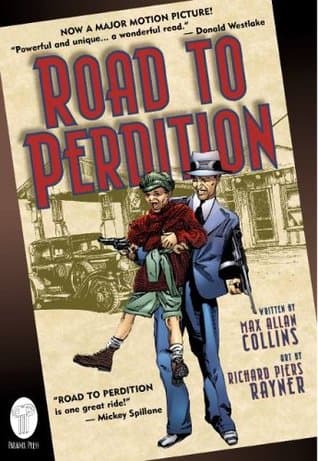
Max Allan Collins (1998)
Genre
Thriller / Historical Fiction / Mystery
Reading Time
296 min
Key Themes
See below
Sign in to track this book
A mob enforcer and his son seek bloody retribution in the Depression-era underworld after their family is massacred, forcing them to confront the cost of loyalty and vengeance.
In 1931 Rock Island, Illinois, Michael O'Sullivan, a seemingly ordinary family man, works as a trusted enforcer for John Looney, the Irish mob boss. One night, O'Sullivan's twelve-year-old son, Michael Jr., curious about his father's secretive life, hides in the back of his father's car. He sees O'Sullivan and Looney's son, Connor Looney, execute a rival gangster and his two bodyguards. This act shatters Michael Jr.'s view of his father and exposes him to the mob world, starting a chain of events that will change their lives.
Connor Looney, worried that Michael Jr. witnessed the murders, decides to eliminate the O'Sullivan family without his father John Looney's direct order. He tries to ambush O'Sullivan and his family at their home. Connor shoots and kills O'Sullivan's wife, Annie, and their younger son, Peter. O'Sullivan, though wounded, fights back, killing Connor's accomplices and escaping with Michael Jr. This event devastates O'Sullivan, turning his loyalty to the Looney family into a hunger for revenge, while Michael Jr. is left traumatized by the loss of his mother and brother.
After the massacre, O'Sullivan and Michael Jr. become fugitives. O'Sullivan, a man of deep Catholic faith, struggles with his violent job and the destruction of his family. He realizes his only path is to seek retribution against Connor Looney and others responsible for Annie and Peter's deaths. They escape Rock Island, heading towards Chicago, a city full of organized crime, where O'Sullivan plans to use his underworld connections to dismantle Looney's organization. Michael Jr., though terrified, must adapt to life on the run with his now-ruthless father.
O'Sullivan, understanding that money is power in the criminal underworld, begins robbing banks connected to John Looney's illegal businesses, cutting off his financial support. This draws the attention of Al Capone's Chicago Outfit, as Looney is a Capone affiliate. O'Sullivan's efficiency in these robberies becomes legendary, earning him the name 'The Angel of Death' from the press. Michael Jr. helps his father, often driving the getaway car, seeing his father become a cold, calculating killer. Their journey becomes a desperate race against time, with Capone's men and Looney's remaining forces hunting them.
As O'Sullivan's actions escalate and threaten the Capone-Looney alliance, Al Capone sends his enforcer, Frank Nitti, to eliminate O'Sullivan. Nitti, a cunning and brutal strategist, begins to track O'Sullivan and Michael Jr. across the Midwest. He uses various tactics, including manipulating local law enforcement and his network of informants. Nitti's involvement raises the stakes, as O'Sullivan now faces not just Looney's dwindling forces but the full might of America's most powerful criminal organization, making his quest for vengeance even more dangerous.
During their flight from Nitti and Looney's men, O'Sullivan and Michael Jr. find temporary shelter with a kind, childless farming couple. This brief period contrasts with their violent existence, allowing Michael Jr. to experience a semblance of normal life and offering O'Sullivan a moment to reflect on his actions and the son he is trying to protect. The farmer, a religious man, offers O'Sullivan spiritual comfort and a chance to confess his sins, which O'Sullivan accepts. This interlude highlights O'Sullivan's internal conflict and his desire for redemption, even as his path of vengeance continues.
O'Sullivan eventually corners John Looney, the man who ordered the hit on his family, in a secluded hideout. The confrontation is tense, with Looney trying to justify his actions and appeal to O'Sullivan's past loyalty. However, O'Sullivan's grief and rage override any sentiment. He executes Looney, fulfilling the primary goal of his vendetta. This act, while providing some closure, also leaves O'Sullivan with an emptiness, realizing that revenge cannot bring back his loved ones. Michael Jr. sees the aftermath, further understanding his father's capacity for violence.
Having exacted his revenge, O'Sullivan takes Michael Jr. to a beautiful, secluded house by a lake in a place called Perdition. He hopes to start a new life with his son, away from the violence of the mob. This peaceful setting is meant to be a sanctuary, a place where they can heal and rebuild their relationship. O'Sullivan, tired of the violence, longs for a quiet life. He believes they have escaped the underworld, but the shadows of their past, particularly Frank Nitti's pursuit, still remain.
Despite O'Sullivan's efforts to disappear, Frank Nitti, relentless and cunning, tracks them to the house in Perdition. Nitti sets a trap, ambushing O'Sullivan as he steps out of the house. In a final, desperate act of protection, O'Sullivan pushes Michael Jr. out of harm's way before Nitti and his men gun him down. O'Sullivan dies in Michael Jr.'s arms, his life ending violently, as it began. This tragic event leaves Michael Jr. orphaned but alive, a sign of his father's ultimate sacrifice and love.
Michael Jr., now an orphan, is found by the local sheriff, who arranges for him to live with the kind farming couple they had previously stayed with. He inherits his father's life savings, allowing him to live a comfortable life away from crime. Growing into adulthood, Michael Jr. reflects on his father's complex life – a loving family man, a religious Catholic, and a brutal killer. He understands the sacrifices his father made and the love that drove him. Michael Jr. chooses a different path, rejecting the violence that consumed his father, breaking the cycle of retribution, and living a life of peace, forever shaped by the 'road to perdition' they traveled.
The Protagonist
O'Sullivan transforms from a loyal mob enforcer struggling with his morality into a single-minded avenger, ultimately sacrificing himself to save his son.
The Co-protagonist/Narrator
Michael Jr. matures from an innocent boy into a young man scarred by trauma but ultimately chooses a path of peace, breaking the cycle of violence.
The Antagonist
Looney's reign as a mob boss crumbles as his actions lead to the destruction of his organization and his own death at O'Sullivan's hands.
The Antagonist
Connor's reckless actions lead to the massacre of O'Sullivan's family and ultimately his own demise as the first target of O'Sullivan's revenge.
The Supporting
Annie's character serves as a symbol of the innocent lives destroyed by mob violence, motivating O'Sullivan's revenge and Michael Jr.'s eventual rejection of that life.
The Supporting
Peter's character is a tragic symbol of lost innocence, his death serving as a powerful catalyst for the protagonist's journey of revenge.
The Antagonist
Nitti remains a consistent, implacable force of opposition, successfully completing his mission to eliminate O'Sullivan.
The Supporting
Capone's power remains largely unchallenged, demonstrating the vastness of the criminal underworld.
The novel shows how violence, once chosen, consumes lives and destroys innocence. Michael O'Sullivan, despite his initial moral struggles, becomes a brutal killer, losing parts of himself with each act of vengeance. The massacre of his family is a direct result of mob violence, and his path of retribution only continues the cycle. Michael Jr. is traumatized by witnessing this violence, first his father's hit, then the murder of his family, and finally his father's vengeful acts. The story suggests that while violence might offer a temporary solution or a sense of justice, its ultimate legacy is pain and destruction, as seen in O'Sullivan's tragic end.
“''I knew then that the only way to protect my son was to become what I truly was, a killer. And I would kill until no one was left to hurt us.''”
At its heart, the novel explores the complex relationship between fathers and sons. Michael O'Sullivan's journey is driven by his love for his sons, both the desire to avenge Peter and to protect Michael Jr. Michael Jr. deals with the conflicting images of his father – the loving parent and the ruthless killer. He fears his father but also comes to understand and admire his strength and protective instincts. The story asks what kind of legacy a father leaves behind, and whether a son can escape that legacy. Michael Jr.'s choice to reject violence at the end shows a breaking of the cycle, a different legacy.
“''He was my father, and I loved him. But he was also a monster, and I was terrified of him. It was a terrible thing to feel about the same man.''”
O'Sullivan's Catholic faith is a constant, though often challenged, part of his character. He seeks confession and guidance, struggling with the morality of his violent actions even as he commits them. The concept of 'perdition' refers to a state of eternal damnation, reflecting O'Sullivan's internal battle for his soul. While he finds a form of personal redemption through his ultimate sacrifice for Michael Jr., the story questions whether true redemption is possible for someone who has committed so many sins. Themes of sin, penance, and the hope for salvation are woven throughout O'Sullivan's journey, especially during his time with the farming family.
“''I prayed for forgiveness, but I knew in my heart that God could not forgive what I was about to do. And yet, I had to do it.''”
The characters, especially O'Sullivan and John Looney, believe they control their lives and the consequences of their actions within the criminal underworld. O'Sullivan, a master strategist, plans his revenge, but unexpected events, like Nitti's relentless pursuit, constantly disrupt his plans. Looney believes he can manage his son's volatility and maintain his power, but Connor's impulsive actions ultimately lead to the family's destruction. The narrative shows that in a world of violence and betrayal, true control is an illusion, and even the most powerful figures are subject to fate and the actions of others.
“''In our world, you think you control things, but then a single bullet, a single mistake, and everything unravels.''”
Michael Jr.'s accidental witnessing of a murder sets the entire plot in motion.
Michael Jr.'s presence in the car when his father and Connor Looney commit the murders is the inciting incident. This device immediately establishes the stakes and the central conflict. It shifts the story from a typical mob narrative to one focused on the consequences of the criminal world on an innocent family. It also creates the initial tension between O'Sullivan and Connor, leading directly to the massacre of O'Sullivan's family and his subsequent quest for revenge. Without Michael Jr.'s accidental witnessing, the tragic chain of events would not have unfolded.
The physical journey O'Sullivan and Michael Jr. undertake symbolizes their emotional and moral odyssey.
The narrative unfolds as a literal road trip, with O'Sullivan and Michael Jr. traveling across the Midwest to escape and pursue revenge. This physical journey serves as a powerful metaphor for their emotional and moral odyssey. As they move from place to place, their relationship evolves, Michael Jr. grows up, and O'Sullivan grapples with his identity. Each new location brings new challenges and encounters, pushing them further down their 'road to perdition,' forcing them to confront the brutal realities of their lives and the choices they've made.
The story is framed by Michael O'Sullivan Jr.'s adult reflections on his past.
The novel is largely narrated by an adult Michael O'Sullivan Jr., looking back on the events of his childhood. This retrospective narration provides a layer of maturity and reflection, allowing for deeper insights into the characters' motivations and the philosophical implications of their actions. It allows the reader to understand the lasting impact of the events on Michael Jr. and his ultimate choice to break the cycle of violence. This device also creates a sense of foreboding and tragedy, as the narrator often hints at the inevitable outcomes while recounting the past.
O'Sullivan's strong Catholic faith is in constant conflict with his violent profession, driving his internal struggles.
O'Sullivan's devout Catholicism is a prominent plot device, creating a profound internal conflict that drives his character arc. His frequent visits to confession, his prayers, and his discussions with the farming family's patriarch highlight his struggle to reconcile his faith with his life as a killer. This spiritual battle adds depth to his character, making his acts of violence more complex than simple revenge. It also frames the concept of 'perdition' as not just a physical destination but a spiritual state, emphasizing the moral stakes of his journey and his ultimate sacrifice for his son.
“It was in the winter of 1931 that the Man of Perdition came to Rock Island.”
— Opening line, setting the scene for Michael O'Sullivan's story.
“Sons are put on this earth to trouble their fathers.”
— Michael Sullivan Sr. reflecting on his relationship with his son, Michael Jr.
“My father always said that when you kill a man, you kill all that he could ever be.”
— Michael Jr. recalling his father's words, highlighting the moral weight of violence.
“A man's got to do what a man's got to do.”
— A common refrain, often used by Michael Sullivan Sr. to justify his actions.
“I never wanted this life for you.”
— Michael Sullivan Sr. expressing his regret over the violent path his son is forced to take.
“The only way to get rid of temptation is to yield to it.”
— A cynical observation about human nature, particularly in the criminal underworld.
“There are no innocent men, only varying degrees of guilt.”
— A dark view of the world, suggesting everyone is complicit in some way.
“He knew that some roads, once taken, could never be turned back from.”
— Michael Sullivan Sr. realizing the irreversible nature of his choices.
“Every man has his price.”
— A belief held by many characters, especially those in positions of power or corruption.
“Revenge is a dish best served cold.”
— A classic idiom that underpins the motivations of several characters seeking retribution.
“Silence can be louder than words.”
— Referring to the unspoken threats and understanding within the criminal world.
“The past is never really dead. It's not even past.”
— Reflecting on how past actions and decisions continue to haunt the present.
“You can never go home again.”
— The realization that their old life and innocence are irretrievably lost.
“Sometimes the only way to save a life is to take one.”
— A morally ambiguous justification for violence, often employed by Michael Sullivan Sr.
Ready to see how well you understood this book? Take our interactive quiz with 10 questions.

Biography coming soon.







