“Magic is like a river. It flows where it wants to, and if you try to block it, it'll just go around you.”
— Peter Grant reflecting on the nature of magic early in his training.

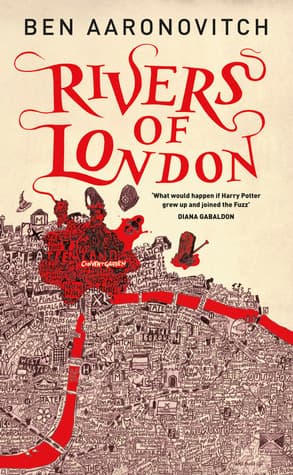
Ben Aaronovitch (2011)
Genre
Fantasy / Mystery
Reading Time
300 min
Key Themes
See below
Sign in to track this book
Rookie cop Peter Grant's mundane career takes a supernatural turn when he discovers he can speak to ghosts, thrusting him into a hidden London where ancient river gods and dark magic clash with modern policing as he apprentices under England's last officially sanctioned wizard.
Probationary Constable Peter Grant, on guard duty at a murder scene in Covent Garden, meets a ghost named Nicholas Wallbrook. Wallbrook, a jazz musician who died in 1957, describes the murderer to Peter. His superior, Detective Chief Inspector Seawoll, dismisses this. Peter's unusual report, however, catches the attention of Detective Chief Inspector Thomas Nightingale, England's last officially sanctioned wizard. Nightingale takes Peter in, revealing the existence of magic and the 'Folly', the police unit investigating magical crimes. Peter, at first skeptical, soon finds himself in a world he never knew existed, leaving behind his aspirations for a conventional detective career.
Peter moves into the Folly, Nightingale's old Georgian house in Bloomsbury, which is both headquarters and home. He learns about the history of English magic, the decline of the magical community, and Nightingale's position as the last active wizard. Nightingale starts Peter's magical education, beginning with Latin and the basics of 'vestigia' – magical traces left by events or people. Peter struggles with theory but shows an intuitive understanding of practical magic, especially in communicating with the deceased. He also learns about the 'Genii Loci', the spirits of London's rivers, and the balance Nightingale keeps with them.
More murders happen, all linked by a similar method: victims found with their faces flayed or disfigured, often near jazz clubs. Peter and Nightingale investigate, finding magic at each scene. Peter's ability to speak with ghosts is very helpful, as he interviews the spectral victims who provide fragmented clues about their attacker. The victims are not just ordinary people; some are connected to the jazz scene, and the killings become more violent and public, causing fear in London. Nightingale suspects a practitioner of 'broken magic' – a dangerous, uncontrolled form.
Nightingale introduces Peter to the powerful, old entities known as the Genii Loci – the personified spirits of London's rivers. Peter first meets Mama Thames, the matriarch, and her various 'children,' including Lady Tyburn and Father Thames. He attends a peace conference between them, where tensions are high because of the recent murders and increasing magical disturbances. Peter is drawn to Beverley Brook, the spirit of the river, and they begin a cautious, then close, relationship. Their alliance helps navigate the complex politics of London's magical underworld.
Through investigation, including analysis of the vestigia and interviews with ghosts, Peter and Nightingale identify the killer as a rogue magical practitioner they call 'The Faceless Man'. This individual uses powerful, destructive magic, often targeting those with latent magical abilities or connections to the rivers. The Faceless Man's signature involves magically manipulating flesh and bone, explaining the disfigurements. He is elusive and dangerous, always one step ahead, leaving a trail of death and chaos across London. His motives remain unknown, but his power is clear.
Nightingale and Peter visit the British Museum to research historical instances of similar magic. They consult with Dr. Walid, an expert in old artifacts and magical history. Their research uncovers references to a powerful, malevolent entity or practitioner from the past, possibly linked to the Roman occupation of London, who used similar destructive magic. This discovery suggests that the Faceless Man might be a resurgence or reincarnation of an old evil, or someone tapping into a long-dormant source of dark power. The stakes of their investigation become much higher.
Peter, with help from Beverley Brook and his own intuitive abilities, starts to understand the deep, interconnected magical currents running beneath London. He learns about the 'aetheric' network, the city's magical energy lines, and how they are being disturbed. He discovers the Faceless Man is manipulating these currents, using them to amplify his power and perhaps draw on old sources. This manipulation is not just causing murders but also creating general magical chaos, affecting people and places across the city. The Faceless Man's plan appears to be larger than just individual killings.
Following a trail of vestigia and ghostly whispers, Peter and Nightingale track the Faceless Man to a disused London Underground station. A tense confrontation happens, where the Faceless Man shows his formidable magical power, easily overpowering Nightingale with a burst of raw, destructive magic. Peter, despite his inexperience, tries to engage the Faceless Man, but is outmatched. The Faceless Man escapes, leaving Nightingale severely injured and Peter shaken but determined. This encounter shows the immense power of their adversary and the real danger they face.
The Faceless Man's goal becomes clear: to control or destroy the Genii Loci, the spirits of London's rivers, particularly Mama Thames, to seize control of the city's magical heart. He attacks the river spirits during a gathering, creating a maelstrom of magic and chaos. Peter, Nightingale (recovering but weakened), and the various river spirits, led by Mama Thames and Beverley Brook, unite to defend themselves and London. The battle is fierce, with magic clashing against magic, and the city's magical ecosystem is at stake.
During the final battle, the Faceless Man is unmasked, revealing himself to be a former apprentice of Nightingale's, a brilliant but corrupted wizard named Lesley May. Lesley, thought to have died during a magical incident years ago, had returned, twisted by dark magic and seeking revenge or power. Peter and Nightingale, with the aid of the river spirits, defeat Lesley, though with significant cost and damage to London's magical landscape. The immediate threat is neutralized, but the experience changes Peter, cementing his place in the world of magic and the Folly.
The Protagonist
Peter transforms from a skeptical, aspiring detective into Nightingale's dedicated apprentice, embracing his magical abilities and the dangers that come with them.
The Supporting
Nightingale, initially a solitary figure, re-engages with the world and finds renewed purpose in training Peter, ensuring the continuation of English magic.
The Supporting
Beverley evolves from a wary ally into a trusted confidante and romantic partner for Peter, playing a key role in the fight against the Faceless Man.
The Antagonist
Lesley's arc is one of tragic corruption, from a promising apprentice to a powerful, malevolent force threatening London.
The Supporting
Mama Thames maintains her role as the steadfast protector of London's rivers, adapting to new threats and forging alliances with human practitioners when necessary.
The Supporting
Dr. Walid remains a consistent source of historical and academic information, aiding the protagonists in their investigations.
The Mentioned
Wallbrook's primary role is to initiate Peter's journey into the magical world; he remains a static, helpful spectral presence.
The Supporting
Seawoll remains largely unchanged, representing the conventional police world that Peter has moved beyond.
The Supporting
Lady Tyburn remains a significant, if somewhat aloof, presence among the river spirits, contributing to their collective defense of London.
The novel explores how old magic and supernatural entities exist, often hidden, within modern London. Peter's journey shows the contrast and surprising overlaps between police procedure and magical investigation. The Folly, an old Georgian house, is a physical example of this theme, a place of old magic in a busy contemporary city. The river spirits, old forces, navigate modern society, using mobile phones and attending 'peace talks' in human guises, showing magic's adaptation rather than its disappearance.
“The London Underground doesn't so much run on rails as on the bones of long-dead magicians.”
Peter Grant deals with his identity as he changes from a conventional police constable to a wizard's apprentice. He must reconcile his established career path with the extraordinary world he discovers, often feeling like an outsider in both. The river spirits also deal with their identity as old forces in a modern world, and their relationships with each other define their sense of belonging. The Faceless Man's true identity, Lesley May, also speaks to a lost identity and a corrupted sense of self, showing the impact of magical transformation on one's being.
“I was a police constable, and I was going to be a detective. Then I met a ghost, and everything changed.”
The book is full of London's history, both everyday and magical. Nightingale represents a dying legacy of English magic, making Peter's apprenticeship important for its continuation. The river spirits are old entities, their existence tied to the city's past. The Faceless Man's actions are also shown to have historical roots, possibly connected to old evils or forgotten magical incidents. The Folly itself is a historical building with centuries of magical lore, emphasizing how the past continues to influence the present magical world.
“The past isn't dead. It isn't even past. It just lives in the Folly.”
The novel explores different forms of power – the institutional power of the police, the raw magical power of wizards and river spirits, and the destructive power used by the Faceless Man. It looks at how power can corrupt, as seen in Lesley May's transformation into the Faceless Man, using her magical abilities for malevolent ends. Nightingale's careful, controlled use of magic contrasts with the Faceless Man's uncontrolled, brutal application, showing the ethical responsibilities that come with wielding such forces. The river spirits' power is tied to their natural domain, showing a more inherent, balanced form of strength.
“Magic is not about waving your hands and saying a few words. It's about power. And power always has a price.”
Provides an immediate, often humorous, and grounded perspective on the magical world.
The story is told entirely from Peter Grant's perspective, offering readers his skeptical yet curious viewpoint as he navigates the bewildering world of magic. This allows for a gradual unveiling of the fantastical elements, making them more believable through Peter's relatable reactions and internal monologue. His police training informs his observations, adding a layer of pragmatic analysis to the supernatural events, and his dry wit infuses the narrative with humor, making complex magical concepts accessible and engaging.
A physical and symbolic hub for English magic, representing its decline and potential revival.
The Folly is Nightingale's dilapidated Georgian mansion, serving as the headquarters for the magical police unit. It is both a physical location and a powerful symbol. Its decaying state reflects the decline of English magic and the solitary existence of Nightingale. However, it also becomes a place of learning and refuge for Peter, symbolizing the potential for magic's revival. The house itself is imbued with magical history and secrets, acting as a silent character that absorbs and reflects the magical events unfolding within and around it.
A primary source of information and a key element of Peter's unique magical ability.
Ghosts, particularly Nicholas Wallbrook, serve as direct eyewitnesses to crimes and provide crucial clues that mundane police methods cannot uncover. Peter's innate ability to communicate with them is his primary magical talent. 'Vestigia,' the magical traces left behind by events or people, function similarly, providing forensic evidence in the magical world. Both devices allow Peter and Nightingale to reconstruct events and track the Faceless Man, blending traditional detective work with supernatural investigation.
Represent ancient, powerful forces of London, shaping its magical and physical landscape.
The personified rivers of London, the Genii Loci (Mama Thames, Beverley Brook, Lady Tyburn, etc.), are not just symbols but active characters with their own politics, powers, and personalities. They embody the ancient, enduring spirit of London itself and represent a powerful, natural form of magic distinct from human wizardry. Their alliances and conflicts directly impact the city, and their existence grounds the fantastical elements in a tangible, historical sense of place, making London itself a living, breathing magical entity.
“Magic is like a river. It flows where it wants to, and if you try to block it, it'll just go around you.”
— Peter Grant reflecting on the nature of magic early in his training.
“I'm not a wizard, I'm a police officer who happens to do magic.”
— Peter asserting his identity and priorities to others.
“The Folly is the last bastion of English magic, and it's falling apart at the seams.”
— Description of the state of magical institutions in modern London.
“You can't arrest a river, but you can damn well try to stop it from killing people.”
— Peter dealing with supernatural threats in a practical policing manner.
“History is a ghost that haunts the present, especially in a city as old as London.”
— Observation on how past events influence current magical occurrences.
“Magic doesn't care about your feelings; it just is.”
— A lesson from Nightingale about the impersonal nature of magical forces.
“The problem with gods is they're never around when you need them, but always there when you don't.”
— Peter's cynical take on dealing with divine or powerful entities.
“Policing is about patterns, and magic is just another pattern to learn.”
— Peter applying his detective skills to supernatural investigations.
“London is a palimpsest, and magic is the ink that never fully fades.”
— Metaphor for how magic layers and persists in the city's history.
“Sometimes the most magical thing is just surviving another day.”
— Peter's pragmatic outlook after a dangerous encounter.
“The river goddesses don't want worship; they want respect, and they'll drown you if they don't get it.”
— Explaining the temperament of London's river deities.
“Magic isn't about power; it's about understanding the rules so you don't blow yourself up.”
— A cautionary lesson from Peter's magical education.
“In London, the past is never dead; it's not even past, especially if it's magical.”
— Commentary on how historical magic continually resurfaces.
“You don't fight ghosts with fists; you fight them with memory and truth.”
— Advice on dealing with spectral entities in investigations.
Ready to see how well you understood this book? Take our interactive quiz with 10 questions.

Ben Aaronovitch is a British author best known for his "Rivers of London" series, a blend of urban fantasy and police procedural fiction. The series, which began in 2011, follows Peter Grant, a London police officer who becomes an apprentice wizard. Aaronovitch's writing is praised for its witty dialogue, intricate world-building, and deep knowledge of London's history and geography.







