“As a boy, I had been taught that the gods were just and that the world was orderly. As a man, I knew that the gods were capricious and the world was chaos.”
— Taita reflecting on his life experiences and the nature of the world.

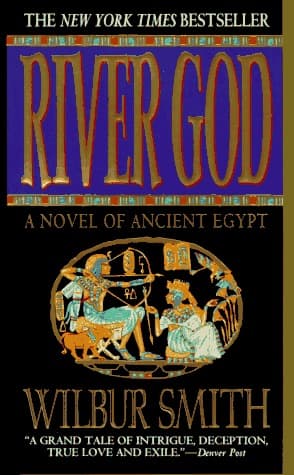
Wilbur Smith (1993)
Genre
Thriller / Fantasy / Historical Fiction / Mystery / Romance
Reading Time
15-20 hours (approx. 664 pages)
Key Themes
See below
Sign in to track this book
In ancient Egypt, a warrior's quest to reunite a divided land becomes entangled with his forbidden love for a lady destined for a king, forcing him to defy fate for the ultimate prize.
The story begins with Taita, a brilliant and multi-talented eunuch slave, serving the young Princess Lostris. Taita, a skilled scribe, physician, architect, and artist, records the events of their lives. Lostris is a spirited and beautiful girl, and Taita is deeply devoted to her. They spend their early years in the palace, where Taita educates Lostris and observes the political actions of Pharaoh Mamose VIII and his Vizier, Nembet. Taita also introduces Lostris to Tanus, a brave and honorable young warrior, who quickly captures Lostris's heart, despite their social differences. Their forbidden love begins to grow under Taita's watchful eye, setting the stage for future conflicts and loyalties.
Tanus, a skilled and courageous warrior, distinguishes himself during a royal hunt when he saves Pharaoh Mamose VIII from a charging lion. This act of bravery earns him the Pharaoh's gratitude and a promotion, allowing him more access to the royal court, and to Lostris. Taita, initially concerned about their forbidden love, sees the genuine affection between Tanus and Lostris and subtly helps their meetings. However, the Pharaoh, unaware of their secret romance, has already declared that Lostris will marry the powerful and ambitious Lord Intef, a cruel and corrupt nobleman who poses a significant threat to Tanus and Egypt's stability. This declaration casts a shadow over their developing love.
Lostris is forced to marry Lord Intef in a grand ceremony, a union that deeply saddens her and Tanus. Taita, always loyal, stays by Lostris's side, providing comfort and a way for her to secretly communicate with Tanus. Egypt's political situation darkens as the Hyksos invaders, led by the ruthless Salitis, begin their march, conquering the northern territories. Pharaoh Mamose VIII, increasingly frail and indecisive, struggles to unite his generals against the approaching enemy. Tanus, despite his heartbreak, dedicates himself to defending Egypt, rising through the military ranks and showing his strategic skill in skirmishes against the Hyksos, becoming a symbol of hope for the struggling kingdom.
Pharaoh Mamose VIII, weakened by illness and the ongoing war, dies, leaving a power vacuum and a fragmented kingdom. Before his death, he names his young son, Nemus, as his successor, with Lostris as regent. As the Hyksos conquer Memphis, Lostris, following a prophecy and Taita's strategic advice, plans a daring exodus of loyal Egyptians and their most valuable treasures south along the Nile. Tanus, leading the remaining loyal forces, provides a crucial rearguard, fighting desperate battles to protect the fleeing convoy. Taita, with his knowledge and ingenuity, manages the logistics of this massive undertaking, ensuring the survival of their people and the royal lineage, as they seek refuge in the difficult lands beyond the First Cataract.
In the harsh but secure lands of southern Egypt, beyond the Hyksos' reach, Lostris and her people establish a new settlement. Life is challenging, but Taita's resourcefulness and Tanus's leadership ensure their survival. During this period, Lostris gives birth to a son, Memnon. While officially declared Intef's son, Taita knows the truth: Memnon is Tanus's son, conceived during a secret meeting before the exodus. This secret is closely guarded, important for the boy's safety and future claim to the throne. Taita dedicates himself to raising Memnon, teaching him the virtues of a true king, while Tanus continues to lead the military, preparing for the day they can reclaim Egypt from the Hyksos.
Realizing the need for resources and ancient knowledge to reclaim Egypt, Taita undertakes dangerous solo missions into Hyksos-occupied territory. He uses his disguise and cunning to infiltrate enemy camps, gather intelligence, and recover sacred artifacts and texts that were stolen during the invasion. These expeditions are full of danger, forcing Taita to use all his skills as a spy, warrior, and magician. He often encounters Lord Intef, who has allied himself with the Hyksos, and manages to outwit him. Taita's successful recovery of these treasures not only boosts the morale of their exiled people but also provides crucial tactical advantages and spiritual guidance for their eventual return.
As Memnon grows, Taita meticulously trains him in all aspects of kingship, warfare, and statecraft, preparing him to lead Egypt. Tanus, meanwhile, rebuilds and trains a strong new Egyptian army from the loyalists who followed Lostris into exile. He teaches them discipline, advanced tactics, and a fierce loyalty to the exiled royal house. Taita also helps the military effort, designing innovative weapons and siege engines. The bond between Taita, Tanus, Lostris, and Memnon strengthens, forming the core of the resistance. They carefully plan their strategy for retaking Egypt, knowing the odds are against them, but driven by a shared dream of liberation.
The time for reclamation finally arrives. Tanus, leading the renewed Egyptian army, begins a series of strategic campaigns, slowly pushing northwards. Their first major objective is Thebes, which has fallen under the control of Lord Intef, who rules as a puppet for the Hyksos. The battle for Thebes is fierce, showing the superior training and morale of Tanus's forces. Taita's strategic insights and engineering skill are invaluable in overcoming the city's defenses. During the battle, Tanus confronts Intef, leading to a dramatic showdown where Intef is defeated and killed, avenging the wrongs committed against Lostris and the royal family. This victory is a significant turning point, boosting the morale of the Egyptian people.
With Thebes secured, the Egyptian army continues its push north, liberating more cities and provinces from Hyksos control. Tanus, always at the forefront, leads his troops with courage and tactical brilliance. However, during a crucial siege, Tanus sustains a mortal wound while protecting Lostris and Memnon from a collapsing wall. Despite Taita's desperate attempts to save him, Tanus's injuries are too severe. In his dying moments, he and Lostris share a farewell, their love lasting to the very end. His sacrifice inspires the army and Memnon to fully embrace his destiny as the future Pharaoh, vowing to complete his father's mission.
Following Tanus's death, Memnon, now a young man, becomes king, fulfilling the prophecy and the hopes of his people. With Taita as his loyal advisor and mentor, Memnon proves to be a wise, just, and powerful Pharaoh. He successfully drives out the remaining Hyksos invaders, uniting the Two Lands once more. Taita dedicates his remaining years to serving Memnon, helping him rebuild Egypt, restore its temples, and begin a new era of peace and prosperity. Lostris, though grieving Tanus, finds solace in her son's reign and Egypt's stability. Taita continues to record their history, ensuring that the legacy of those who fought for Egypt's freedom will never be forgotten, finding his own fulfillment in the service of his beloved Lostris and her lineage.
The Protagonist
Taita transforms from a devoted, observant slave to a crucial leader and strategist, ultimately becoming the architect of Egypt's restoration and a surrogate father figure.
The Protagonist
Lostris evolves from a pampered princess to a resilient leader and a devoted mother, enduring hardship and heartbreak while maintaining her dignity and purpose.
The Protagonist
Tanus rises from a common soldier to a legendary general, proving his worth through courage and sacrifice, ultimately giving his life for the future of Egypt and his family.
The Supporting
Memnon grows from a child of exile to a wise and powerful Pharaoh, fulfilling the prophecy and his parents' legacy by uniting Egypt.
The Antagonist
Intef's ambition and cruelty lead to his downfall and eventual death at the hands of Tanus.
The Supporting
Mamose's reign ends in the collapse of his kingdom, paving the way for the new leadership.
The Antagonist
Salitis successfully conquers Egypt, but his reign is ultimately challenged and overthrown by Memnon.
The Supporting
Rasfer remains a steadfast and loyal warrior, supporting Tanus and the royal family until the end.
The novel explores the lasting power of love, both romantic and platonic, and the sacrifices made for it. The forbidden love between Lostris and Tanus drives much of the story, leading to daring acts and heartbreaking decisions. Taita's unconditional love for Lostris motivates his lifelong devotion and countless acts of ingenuity and self-preservation for her and her lineage. Tanus's ultimate sacrifice for Lostris and Memnon shows the depth of this theme, showing how love can inspire heroism and shape destinies, even in the face of great challenges and personal loss.
“My love for Lostris was the very air that I breathed, the blood that flowed in my veins, the reason for my being.”
Loyalty is a central part of the story, shown in Taita's unwavering devotion to Lostris, Tanus's commitment to Egypt and the royal house, and the soldiers' dedication to their commanders. Despite chaos and betrayal, characters like Taita and Tanus consistently put their duty to their people and their chosen family above personal gain or safety. This theme is especially clear during the exodus, where many choose to follow Lostris into exile, showing their steadfast loyalty in uncertain and dangerous times. It highlights the strength of community bonds and the importance of honor in a crisis.
“Though a slave, my loyalty to the Lady Lostris was stronger than any oath sworn by a free man.”
The story shows the human spirit's ability to endure and rebuild after devastation. The entire Egyptian civilization is forced into exile and faces near annihilation by the Hyksos. However, guided by Taita and led by Lostris and Tanus, they not only survive but carefully plan and execute a campaign to reclaim their homeland. This theme is embodied in the difficult journey south, the establishment of a new settlement, and the eventual resurgence of a united Egypt under Memnon, showing that even from defeat, a stronger future can emerge.
“From the ashes of defeat, we would forge a new kingdom, stronger and more glorious than before.”
The novel explores different forms of power and leadership. Pharaoh Mamose VIII's weak and indecisive rule leads to Egypt's downfall, contrasting sharply with Lostris's strong, compassionate leadership and Tanus's strategic military skill. Taita uses a different kind of power—that of intellect, knowledge, and subtle manipulation—which proves more effective than brute force or inherited authority. Memnon's rise, guided by Taita, signifies the transition to a new, enlightened form of kingship, based on wisdom, justice, and the welfare of the people, rather than just birthright or tyranny.
“True power lies not in the crown, but in the wisdom and courage of the heart.”
First-person perspective through the eyes of the primary chronicler.
The entire story is told from the first-person perspective of Taita, the eunuch slave. This device allows for an intimate and highly detailed account of events, filtered through Taita's unique blend of observation, intelligence, and personal devotion. His role as a scribe means he is actively recording the history as it unfolds, giving the narrative an authentic, almost historical document feel. It also allows the author to explore Taita's inner thoughts, complex emotions, and his unparalleled access to the private lives of the royal family, providing insights that no other character could offer.
Foreshadowing and divine guidance for the future of Egypt.
Prophecies, often relayed through Taita's interpretations of ancient texts or mystical visions, serve to foreshadow key events and guide the protagonists' actions. The prophecy of a new pharaoh uniting the Two Lands after a period of darkness provides hope and direction during their exile. It imbues their struggle with a sense of divine purpose, motivating them to endure hardships and make sacrifices. The prophecies also add an element of destiny to the narrative, suggesting that certain events are preordained, even as characters exercise their free will.
A grand-scale journey and metaphor for survival and rebirth.
The forced exodus of Lostris and her loyal followers south along the Nile is a major plot device. It serves as a physical journey that tests the characters' endurance and leadership, forcing them to adapt to harsh new environments. Metaphorically, it represents the death of the old Egypt and the painful birthing process of a new one. This epic journey allows for the development of new military strategies, the training of a new generation, and the forging of stronger bonds among the survivors, laying the groundwork for their eventual return and reclamation of their homeland.
A hidden truth that dictates the future of the kingdom.
The secret that Memnon is the son of Tanus, not Lord Intef, is a crucial plot device. This secret is closely guarded by Taita and Lostris, as revealing it too early would endanger Memnon and undermine his claim to the throne. It creates dramatic tension and provides a powerful motivation for Taita to protect Memnon and ensure his ascent. This hidden truth underpins the entire narrative of reclaiming the throne, tying the personal love story of Lostris and Tanus directly to the political destiny of Egypt.
“As a boy, I had been taught that the gods were just and that the world was orderly. As a man, I knew that the gods were capricious and the world was chaos.”
— Taita reflecting on his life experiences and the nature of the world.
“The river is a living god, and like all gods, it demands sacrifice.”
— Taita observing the Nile and its power over the land and people.
“Love is a dangerous thing, even more so when it is forbidden.”
— Taita's internal thoughts regarding his deep affection for Lostris, which is socially unacceptable.
“A king without a queen is only half a ruler, and a queen without a king is a ship without a rudder.”
— A wise observation on the necessity of a strong partnership in leadership.
“The desert, like a beautiful woman, can lure you to your doom with its silent promise of peace.”
— Taita's description of the deceptive beauty and danger of the desert.
“There are some wounds that even time cannot heal, only hide.”
— Taita contemplating the lasting pain of past traumas and losses.
“To truly know a man, you must see him in his hour of greatest triumph and his moment of deepest despair.”
— A philosophical insight into human character and its revelation under extreme circumstances.
“Gold is a curse, a magnet for greed, and a destroyer of men's souls.”
— Taita's cynical view of wealth and its corrupting influence.
“The greatest magic lies not in spells and potions, but in the power of a determined heart.”
— Taita reflecting on the true source of strength and accomplishment.
“Even the mightiest pharaoh is but a servant of the gods and the river.”
— A reminder of the ultimate powers that govern even the most powerful rulers.
“Memory is a fickle mistress, sometimes a comfort, often a torment.”
— Taita's musings on the dual nature of remembering past events.
“A good general understands the terrain, but a great general understands the hearts of his men.”
— Taita's insight into effective military leadership.
“The stars are the eyes of the gods, watching our every folly and our every triumph.”
— A poetic and spiritual view of the night sky and divine observation.
“To build something grand, you must first dream it in the grandest terms.”
— Taita's philosophy on ambition and the realization of great projects.
Ready to see how well you understood this book? Take our interactive quiz with 10 questions.

Biography coming soon.







