“There are times, Mr. Adams, when a man must choose between what is easy and what is right. And the right path is seldom the easy one.”
— A conversation with John Adams as he grapples with the escalating tensions.

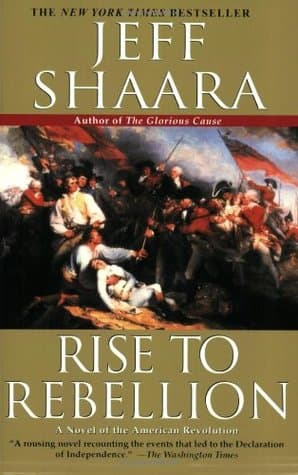
Jeff Shaara (2001)
Genre
Historical Fiction
Reading Time
6 hrs 1 min
Key Themes
See below
Sign in to track this book
Idealistic lawyer John Adams, audacious Ben Franklin, and dashing George Washington start a revolution against British tyranny, turning colonial grievances into a fight for American independence.
In March 1770, tensions in Boston increase between British soldiers and colonists. A confrontation near the Custom House turns deadly when British soldiers, under Captain Thomas Preston, fire into a crowd, killing five colonists. This event, called the Boston Massacre, shocks the colonies. Despite anti-British sentiment, John Adams, a lawyer committed to the rule of law, agrees to defend Captain Preston and his men. He believes every man deserves a fair trial, regardless of public opinion. Adams's careful preparation and defense, with Josiah Quincy Jr., lead to the acquittal of most soldiers and reduced charges for two, a verdict that, though unpopular with some, upholds the colonial legal system.
After the Boston Massacre, British attempts to assert authority through taxation and control continue to inflame colonial resentment. The Townshend Acts are repealed, but a tax on tea remains, a symbolic assertion of Parliament's right to tax the colonies. In London, Benjamin Franklin, serving as a colonial agent, tries to bridge the growing divide but faces increasing hostility from British officials. The British East India Company, facing financial ruin, gets a monopoly on tea sales in the colonies through the Tea Act of 1773, further undercutting colonial merchants and reinforcing the idea of taxation without representation. This act causes widespread anger across the colonies.
In December 1773, three ships with East India Company tea arrive in Boston Harbor. Samuel Adams and other Sons of Liberty leaders organize a protest. When Governor Thomas Hutchinson refuses to allow the ships to leave without unloading their cargo, a group of colonists, disguised as Mohawk Indians, board the ships. They smash 342 chests of tea and dump them into the harbor. This act of defiance, known as the Boston Tea Party, sends a clear message to the British government about the colonists' opposition to tyranny and taxation without consent, escalating the crisis.
In response to the Boston Tea Party, the British Parliament passes a series of punitive measures known as the Coercive Acts (or Intolerable Acts in the colonies) in 1774. These acts close Boston Harbor, revoke Massachusetts's charter, and allow British officials accused of crimes to be tried in Britain. General Thomas Gage is appointed military governor of Massachusetts. The severity of these acts unites the colonies in outrage. In September 1774, delegates from twelve colonies meet in Philadelphia for the First Continental Congress. Figures like John Adams, George Washington, Patrick Henry, and Samuel Adams debate responses, agreeing to an economic boycott of British goods and petitioning King George III for redress of grievances, while also preparing for potential conflict.
In April 1775, General Thomas Gage, following orders from London, sends British troops from Boston to seize colonial military supplies stored in Concord and to arrest Patriot leaders Samuel Adams and John Hancock in Lexington. Colonial intelligence, including riders like Paul Revere and William Dawes, warns the local militias, known as Minutemen. At Lexington Green, a skirmish happens, causing casualties on both sides and marking the 'shot heard 'round the world.' The British go to Concord, where they find most of the supplies removed. On their return march to Boston, the British regulars face harassment and ambush from colonial militiamen, suffering heavy losses.
After the bloodshed at Lexington and Concord, the Second Continental Congress meets in May 1775 in Philadelphia. The delegates, including new arrivals like Thomas Jefferson, face the urgent task of organizing a unified response to the escalating conflict. While some still hope for reconciliation, the reality of war is clear. Recognizing the need for strong military leadership, John Adams nominates George Washington of Virginia to be the Commander-in-Chief of the new Continental Army. Washington, with his military experience from the French and Indian War and his imposing presence, accepts the challenge, signaling a shift from protest to organized armed resistance.
In June 1775, with British forces besieged in Boston, colonial militiamen under Colonel William Prescott fortify Breed's Hill (mistakenly known as Bunker Hill) overlooking Boston Harbor. General Gage, needing to break the siege, orders a frontal assault on the colonial positions. The British launch three waves of attacks up the hill, facing fire from the colonists, who are famously ordered not to shoot 'until you see the whites of their eyes.' Although the colonists eventually run out of ammunition and are forced to retreat, the British suffer immense casualties, showing the determination and fighting capability of the colonial forces and giving them a morale boost despite the tactical loss.
In July 1775, George Washington arrives in Cambridge, Massachusetts, to take command of the colonial forces surrounding Boston. He immediately faces the task of transforming militia units into a professional army. Washington works to establish discipline, procure supplies, and organize the troops. He implements training and begins planning strategies to dislodge the British from Boston. The siege continues, with both sides preparing for further engagements, and Washington's leadership instills unity and purpose in the Continental Army.
Even as fighting increases, many in the Continental Congress still hope for a peaceful resolution. In July 1775, they draft the Olive Branch Petition, a direct appeal to King George III asserting colonial loyalty and pleading for the repeal of the Intolerable Acts and an end to hostilities. However, the petition arrives in London shortly after news of Bunker Hill and is rejected by the King, who views the colonists as rebels. This rejection, with his declaration of the colonies in a state of rebellion, ends any remaining hopes for reconciliation and strengthens the American resolve for independence.
As 1775 ends and early 1776 begins, the sentiment for independence grows stronger across the colonies. Thomas Paine's pamphlet, 'Common Sense,' published in January 1776, electrifies public opinion, articulating clear arguments for separation from British rule in plain language. Delegates in Congress, like Richard Henry Lee, begin to openly advocate for a declaration of independence. John Adams works behind the scenes, persuading delegates and preparing for a formal break. The events of the preceding years, from the Boston Massacre to Bunker Hill and the King's rejection of the Olive Branch Petition, have set the colonies on a path toward declaring themselves a free and independent nation.
The Protagonist
Adams evolves from a staunch defender of British law into a leading voice for American independence, recognizing that British tyranny has made reconciliation impossible.
The Protagonist
Washington transitions from a respected delegate to the indispensable military commander, shouldering the immense burden of leadership and unifying the diverse colonial forces.
The Supporting
Franklin's hope for reconciliation with Britain is shattered by his experiences in London, transforming him into a firm advocate for American independence.
The Antagonist
King George III remains unyielding in his belief in absolute parliamentary authority, inadvertently driving the colonies to rebellion through his refusal to compromise.
The Supporting
Gage struggles to enforce British authority and prevent open war, ultimately failing as his actions inadvertently spark the first battles of the Revolution.
The Supporting
Samuel Adams consistently advocates for direct action and independence, solidifying his role as a leading firebrand of the Revolution.
The Supporting
Abigail Adams remains a steadfast supporter and intellectual partner to John, adapting to the hardships of war and offering insightful commentary from the home front.
The Supporting
Warren transitions from a prominent Patriot organizer to a military leader, ultimately sacrificing his life at Bunker Hill for the cause of liberty.
The Mentioned
Hutchinson remains steadfastly loyal to the Crown, leading to his eventual exile and solidifying his role as a symbol of British oppression.
The Supporting
Lee consistently argues for independence, culminating in his historic resolution calling for separation from Britain.
This theme explores the conflict between adhering to legal principles and the arbitrary use of power. John Adams's defense of the British soldiers after the Boston Massacre shows his commitment to the rule of law, even when unpopular. This contrasts with King George III's and Parliament's actions, such as the Intolerable Acts, which colonists see as tyrannical abuses of power, violating their rights and undermining the laws they claim to uphold. The colonists' struggle is a fight to preserve legal order against what they see as lawless oppression.
“Facts are stubborn things; and whatever may be our wishes, our inclinations, or the dictates of our passions, they cannot alter the state of facts and evidence.”
The novel traces how separate colonies, initially British, gradually form a new American identity through shared grievances and common cause. From the local outrage of the Boston Massacre to the unified response of the First and Second Continental Congresses, the narrative shows the slow shift from being British subjects to a collective 'Americans.' Events like the Boston Tea Party and the Intolerable Acts, while meant to punish individual colonies, inadvertently unite them against a common oppressor, creating a sense of shared destiny that goes beyond individual colonial interests.
“We must all hang together, or assuredly we shall all hang separately.”
The narrative emphasizes how rhetoric, legal arguments, and published works are as important as military actions in starting and sustaining the revolution. John Adams's legal arguments, Samuel Adams's speeches, and Benjamin Franklin's diplomatic appeals all shape public opinion and challenge British authority. Later, Thomas Paine's 'Common Sense' becomes a force, articulating the case for independence in clear, accessible language that resonates with common people. The revolution is fought not just with muskets, but with ideas and persuasive communication.
“A pen is certainly an excellent instrument to fix a man's attention and to inflame his ambition.”
This theme explores the personal and collective sacrifices made by individuals and the demands of leadership during a time of crisis. Characters like John Adams sacrifice personal comfort and reputation, risking treason for their principles. George Washington, despite initial reluctance, accepts the burden of commanding an untrained army against a global superpower, showing the personal cost of leadership. The narrative also highlights the ultimate sacrifice, as seen in the death of Joseph Warren at Bunker Hill, which strengthens the revolutionary spirit and shows the high stakes involved in the fight for liberty.
“I will raise a thousand men, subsist them at my own expense, and march with them, at their head, for the relief of Boston.”
The story is told through the viewpoints of several key historical figures.
Shaara employs a shifting third-person perspective, allowing the reader to experience events through the eyes of John Adams, George Washington, Benjamin Franklin, and General Thomas Gage, among others. This device provides a comprehensive and nuanced understanding of the escalating conflict, showing the motivations and dilemmas on both sides. It allows for intimate character development and offers insights into the political machinations in London, the legal battles in Boston, and the military strategies of the British and colonial forces, enriching the historical context and humanizing the figures involved.
A series of events progressively builds tension towards inevitable conflict.
The novel is structured around a clear progression of events, each leading to a heightened state of conflict. It begins with the Boston Massacre, a singular act of violence, and systematically moves through the Boston Tea Party, the Intolerable Acts, and finally to the armed clashes at Lexington, Concord, and Bunker Hill. This device effectively illustrates how each British action and colonial reaction serves to further alienate the two sides, making reconciliation increasingly impossible and driving the narrative inexorably towards full-scale war and the eventual call for independence.
Subtle hints and character insights suggest future developments and the gravity of current events.
While remaining true to the historical timeline, the narrative often includes moments where characters reflect on the potential consequences of their actions or observations that hint at the larger historical significance of an event. For instance, early discussions about colonial rights and British authority often carry an underlying tension that suggests the eventual break. This device helps build suspense and reminds the reader of the immense stakes involved, framing the immediate events within the broader context of a developing revolution and the birth of a nation, even if the characters themselves don't fully grasp the future.
“There are times, Mr. Adams, when a man must choose between what is easy and what is right. And the right path is seldom the easy one.”
— A conversation with John Adams as he grapples with the escalating tensions.
“Freedom is not given, Mr. Hancock. It is taken. And sometimes, it must be taken with force.”
— Samuel Adams speaking to John Hancock about the necessity of resistance.
“The very air of Boston is pregnant with rebellion. You can taste it, Mr. Gage, if you but open your mouth.”
— A British officer's observation to General Gage about the mood in Boston.
“We are not asking for revolution, but for the rights of Englishmen. If they deny us those, then what else is left?”
— John Adams's early thoughts on the colonial grievances.
“A single spark can ignite a conflagration. And the King, in his blindness, keeps striking flint against steel.”
— A character reflecting on the King's policies and their consequences.
“Fear is a powerful weapon, but it is also a brittle one. It breaks when men find something greater to believe in.”
— A Patriot musing on the nature of courage and fear.
“The law, Mr. Adams, is a tool. It can be used to build a house, or to tear one down. The choice is in the hand that wields it.”
— A discussion about the interpretation and application of British law.
“Loyalty, when it is blind, is merely servitude. True loyalty demands questioning, demands justice.”
— A character's internal struggle with loyalty to the Crown versus loyalty to principle.
“We are not just fighting for independence, but for the very idea that men can govern themselves.”
— A Patriot leader inspiring others with the grander vision of their struggle.
“The whispers of discontent are growing louder, Mr. Pitt. Soon, they will be shouts.”
— A British official warning William Pitt about the rising colonial unrest.
“To stand silent in the face of tyranny is to endorse it. We must speak, even if our voices tremble.”
— A character urging others to voice their opposition despite danger.
“History will judge us, not by our intentions, but by our actions. Let those actions be bold.”
— A leader emphasizing the importance of decisive action.
“The future is not written, Mr. Revere. It is forged by the hands of men who dare to dream.”
— Paul Revere's conversation about the uncertain but hopeful future.
“Every drop of blood spilled now, if it is spilled for a just cause, waters the tree of liberty.”
— A poignant reflection on the sacrifices made during the early conflicts.
“There comes a point, even for the most patient man, when the last straw breaks the camel's back. We are very near that point.”
— A character expressing the growing frustration and impending breaking point of the colonies.
Ready to see how well you understood this book? Take our interactive quiz with 10 questions.

Biography coming soon.







