“Heaven is a myth. God is a myth. We are only what we are. The universe is a great deal of nothing and a few things that come and go.”
— Jamie Morton reflects on Reverend Jacobs's evolving worldview.

Stephen King (2014)
Genre
Thriller / Fantasy / Mystery / Science Fiction
Reading Time
540 min
Key Themes
See below
Sign in to track this book
A small-town minister's intense connection with a young boy turns into a lifelong, devastating pact with cosmic horror after tragedy transforms him into a showman who uses dark electricity.
In 1962, six-year-old Jamie Morton, living in Harlow, Maine, meets Charles Jacobs, the new Methodist minister. Jacobs is charming, handsome, and quickly liked by the town. He brings energy to the church, and his wife, Patsy, is also admired. Jamie feels a special connection to Jacobs because they both like electricity. Jacobs, an amateur inventor, shows Jamie simple electrical experiments, building a strong bond. Jamie's family, especially his mother and older sister Claire, are also interested in the Reverend. Jacobs' presence influences the peaceful, small-town life, bringing wonder and hope to the community through his sermons and involvement.
Tragedy strikes the Jacobs family when Patsy and their young son, Morrie, die in a car accident caused by a drunk driver. The town is devastated. At their funeral, Reverend Jacobs gives a shocking 'Terrible Sermon,' rejecting God, calling religion a lie, and cursing heaven. His outburst upsets the whole congregation and town. Despite Jamie's mother trying to help, Jacobs is forced to leave Harlow in shame, his once-promising future as a minister gone. Jamie, deeply affected by losing his friend and the sudden departure of the minister, feels empty and confused.
Years pass, and Jamie Morton's life becomes difficult. He becomes a professional musician, playing guitar in bar bands, traveling across the country. By the mid-1980s, he has a severe heroin addiction, his life out of control. While performing in a small Colorado town, Jamie sees a poster for 'Silent Charles,' a stage magician making dazzling 'portraits in lightning' with electricity. Recognizing his old friend, Jamie attends the show. After the performance, he talks to Jacobs backstage. Jacobs, still interested in electricity, is now a showman. He helps Jamie stop using heroin with a mysterious 'secret electrical cure,' a process that leaves Jamie feeling changed but free of his addiction.
Jamie continues to see Jacobs over the next decades. Jacobs goes from a stage performer to a traveling faith healer, using 'secret electricity' to cure various illnesses, from blindness to paralysis. He charges high fees for these 'cures.' Jamie watches Jacobs' methods, which involve applying electrical currents to patients. While many say they are healed, Jamie notices unsettling side effects: some patients develop strange tics, others have periods of being unresponsive, and a few even die by suicide. Jamie grows more uneasy about the true nature of Jacobs' 'miracles' and the long-term results of his electrical treatments, suspecting something bad behind the cures.
Jacobs, now rich and powerful, tells Jamie his true, terrifying goal: he thinks he can use electricity to tap into the 'secret electricity' of the human soul and talk to the afterlife. He calls this achieving a 'second life.' He specifically wants to find Mary Fay, a woman he met as a faith healer who said she had a profound near-death experience. Jacobs thinks Mary Fay holds the key to understanding death and what comes after. He asks Jamie, who is uniquely sensitive to electricity, to help him with his most dangerous and ambitious experiment, promising to show the ultimate truth about existence.
Jamie, despite his worries and fear, feels a strange, almost magnetic pull to Jacobs, an inescapable bond. He travels to a remote, well-protected compound in the New Hampshire wilderness, where Jacobs has set up his lab. Jacobs has a team of assistants, including the now-old Mary Fay, who is in a wheelchair and seems fragile but clear-headed. The compound has large, custom-built electrical equipment. Jamie realizes that Jacobs' experiments have gone far beyond simple healing, into something unsettling and potentially disastrous. He feels trapped, used in Jacobs' quest for forbidden knowledge.
Jacobs begins his final, most powerful experiment, with Jamie and Mary Fay as key parts. Using a huge amount of electricity and many devices, Jacobs opens a portal, a tear in reality. It is not the heavenly afterlife he first sought, but something much older and more terrifying. Through the portal, they see a desolate, industrial place with grotesque, insect-like beings. These entities, called 'the Great Other,' are the true controllers of human suffering and the ultimate fate of souls after death. They are parasites, feeding on human despair and consciousness, making the afterlife a horrifying, endless servitude.
During the experiment, Mary Fay, who had a near-death experience before, acts as a channel. As the portal opens, she screams a warning to Jamie, describing the horrifying reality of 'the Great Other' and their parasitic nature. She reveals that human souls are not reborn or sent to a peaceful heaven, but are enslaved and tortured by these entities in a vast, desolate 'Negative Country.' The revelation destroys any hope of a good afterlife. The huge electrical surge and the opening of the portal cause a massive feedback loop, overwhelming the equipment and creating a disaster within the compound. Jamie sees the full, terrifying truth of Jacobs' discovery.
The experiment ends in a violent explosion of energy. Charles Jacobs, consumed by his ambition and the forces he released, is destroyed, his body disintegrated by the electrical power. Jamie, though badly hurt and mentally scarred by the horrific visions of the Great Other, miraculously lives through the disaster. He escapes the destroyed compound, leaving behind the ruins of Jacobs' life's work and the horrifying truth he found. The experience changes Jamie forever, haunted by the knowledge of the true nature of death and the afterlife, forever burdened by the vision of the 'Negative Country' and its monstrous inhabitants.
In the years after the incident, Jamie withdraws from the world, living a quiet, isolated life. He tries to understand the horrors he saw and what they mean for humanity. He carries the burden of knowing the truth about the afterlife, a truth so bleak and horrifying that he can never share it. He is tormented by Jacobs' final, chilling words, which hinted at the true purpose of the 'revival' – not salvation, but a horrifying awakening to eternal damnation. Jamie's life becomes a slow, painful wait for his own meeting with the 'Great Other,' living under the shadow of a truth no one else knows or could understand.
The Protagonist
Jamie transforms from an innocent boy into a heroin addict, is 'cured' by Jacobs, and ultimately becomes a survivor scarred by the true nature of death and the afterlife.
The Antagonist
Jacobs devolves from a devoted minister into an embittered blasphemer, then an electrical showman and faith healer, finally becoming a mad scientist consumed by his quest for the afterlife.
The Supporting
Claire remains a relatively stable character, serving as a grounding force for Jamie amidst his chaotic life and Jacobs' influence.
The Mentioned
Her character is static, serving as a tragic catalyst for Charles Jacobs' transformation.
The Supporting
Mary Fay's role evolves from a patient with a unique experience to a crucial, albeit unwilling, component in Jacobs' final, devastating experiment.
The Supporting
His character remains consistent, embodying the traditional paternal role.
The Supporting
She experiences a significant emotional blow with Jacobs' fall from grace, representing the town's shattered faith.
The Mentioned
His character is static, serving as a tragic catalyst for Charles Jacobs' transformation.
The novel explores the fragility of faith and the destructive power of doubt. Charles Jacobs begins as a charismatic minister, representing faith and hope. But his family's tragic death destroys his beliefs, leading to his offensive 'Terrible Sermon' and a life spent trying to prove God does not exist or is evil. This theme continues through Jamie's early admiration for Jacobs, his later doubt about Jacobs' 'cures,' and finally, the horrifying discovery of an afterlife without a kind God. The book suggests that sometimes, a 'revival' of faith can lead to a more terrifying truth.
“What if there is no God? What if there's only a great, dark, electric current, and we're all just sparks in it?”
Addiction is a theme, especially through Jamie Morton's struggles with heroin. His 'revival' from addiction, brought about by Charles Jacobs with an electrical cure, is an important moment. However, this 'cure' has a cost, suggesting that not all revivals are good. The theme also applies to Jacobs' own addiction – his strong desire for forbidden knowledge and his obsession with 'secret electricity' and the afterlife. Both men experience 'revival,' but Jamie's is physical with spiritual consequences, while Jacobs' is spiritual and intellectual with disastrous physical results, suggesting some 'cures' are worse than the illness.
“For every cure there is a price.”
The novel looks at the dangerous choice of seeking forbidden knowledge. Charles Jacobs' constant search to understand the afterlife, using electricity, pushes the limits of science and morality. His experiments, first presented as helpful 'cures,' slowly show their bad side effects and eventually reveal a horrifying truth. The story asks if some truths are better left unknown and if people can handle what happens when they look beyond what is known. The cost of Jacobs' knowledge is not only his own destruction but the eternal suffering of all humanity, as shown by 'the Great Other.'
“Some things are better left alone, Jamie. Some doors, once opened, can never be shut.”
This is the main theme of 'Revival.' The book starts with the common human fear of death and the hope for a peaceful afterlife, seen in Jacobs' early ministry. But this hope is systematically taken away as Jacobs' experiments lead to the discovery of the 'Negative Country' and 'the Great Other' – a horrifying, mechanical, and parasitic dimension where human souls are eternally enslaved. The novel questions traditional ideas of heaven and hell, replacing them with a vision of cosmic horror that changes the meaning of human existence and the ultimate fate of consciousness. It is a bleak and terrifying new definition of 'what comes next.'
“There is no heaven, no hell, no God, no Devil. Only the Great Other, and the Negative Country where they feed.”
A mysterious, quasi-supernatural electrical force that Jacobs believes connects to the afterlife.
The 'secret electricity' is a central plot device, evolving from a simple scientific curiosity in Jamie's childhood to Jacobs' obsessive tool for contacting the dead. Jacobs believes this force is the essence of life and consciousness, a hidden energy that pervades everything. He uses it for his 'portraits in lightning,' his 'cures' for addiction and illness, and ultimately, to open a portal to the afterlife. It serves as a pseudo-scientific explanation for the supernatural elements of the story, blurring the lines between science fiction and horror. The electricity itself becomes a character, a powerful, unpredictable force that ultimately consumes Jacobs.
Charles Jacobs' blasphemous funeral sermon, serving as the catalyst for his transformation.
The 'Terrible Sermon' is a pivotal plot device and a defining moment for Charles Jacobs. Delivered at the funeral of his wife and son, this sermon is a public denunciation of God, faith, and religious belief, a raw outpouring of grief and rage. It immediately alienates the town and leads to Jacobs' banishment, marking his definitive break from his former life as a minister. This event is the point of no return for Jacobs, setting him on his dark, obsessive path to disprove or redefine the afterlife. It also deeply impacts Jamie, who witnesses the shocking transformation of his beloved mentor.
The revealed horrifying dimension of the afterlife and its parasitic inhabitants.
The 'Negative Country' and 'the Great Other' are the ultimate reveals of the novel, functioning as the horrifying answer to Jacobs' quest for the afterlife. This is not a traditional heaven or hell but a desolate, industrial landscape inhabited by grotesque, insectoid entities that feed on human souls. This concept shatters all conventional religious beliefs and presents a cosmic horror that is far more terrifying than any traditional devil. It serves as the ultimate price of Jacobs' forbidden knowledge and the devastating truth that Jamie must live with, forever altering the meaning of death for the reader and the characters.
Jacobs' pact with unseen forces and Jamie's unwitting involvement in it.
The Faustian Bargain is a classic literary device employed throughout the novel. Charles Jacobs, driven by grief and a thirst for knowledge, makes a metaphorical pact to uncover the secrets of death, sacrificing his soul and sanity in the process. He offers 'cures' that come with a terrible price, exchanging physical healing for spiritual or mental damage. Jamie, in turn, enters his own, less conscious, Faustian bargain by accepting Jacobs' electrical 'cure' for his heroin addiction, becoming inextricably bound to Jacobs' dark quest. This device highlights the theme of the price of knowledge and the dangers of tampering with forces beyond human comprehension.
“Heaven is a myth. God is a myth. We are only what we are. The universe is a great deal of nothing and a few things that come and go.”
— Jamie Morton reflects on Reverend Jacobs's evolving worldview.
“You can't eat your cake and have it too, but you can certainly try to eat someone else's.”
— A cynical observation on human nature and desire.
“The past is a place where you can always go, but you can never stay.”
— Jamie's contemplation of his memories and the passage of time.
“Every addiction is a love affair, and every love affair is an addiction.”
— Jamie's thoughts on his own struggles and the nature of dependency.
“There's no such thing as a free lunch, and there's no such thing as a free miracle.”
— Reverend Jacobs's understanding of the cost of power and intervention.
“What is the greatest power in the universe? It is the power to give life, and the power to take it away.”
— A philosophical musing on the ultimate forces at play.
“The older you get, the more you realize that the world is full of things that can't be explained.”
— Jamie's growing awareness of the inexplicable as he ages.
“Sometimes the cure is worse than the disease.”
— A recurring theme as characters grapple with the side effects of extraordinary interventions.
“We're all just passing through, Jamie. Some of us just pass through a little faster than others.”
— A poignant reflection on mortality and the brevity of life.
“There are other worlds than these, and they are all around us.”
— An allusion to the vastness and strangeness of the cosmos, hinting at the horror to come.
“People don't change, Jamie. Not really. They just get better at hiding who they really are.”
— A cynical observation on human nature and the persistence of character.
“The world is a monster, and we are all just its playthings.”
— A dark and fatalistic view of humanity's place in the universe.
“Electricity is the secret of life. And death.”
— Reverend Jacobs's growing obsession with the power of electricity.
“Sometimes, when you look into the abyss, the abyss looks back into you.”
— A classic philosophical quote that perfectly encapsulates the terrifying climax of the novel.
Ready to see how well you understood this book? Take our interactive quiz with 10 questions.
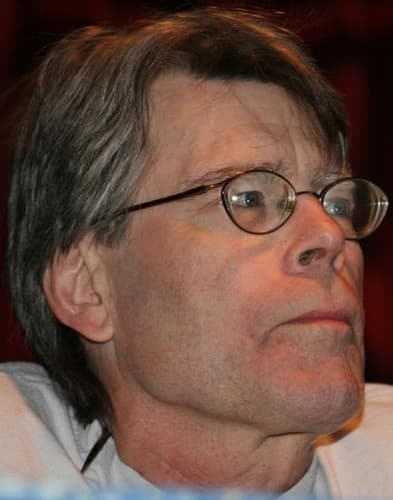
Stephen Edwin King is an American author of horror, supernatural fiction, suspense, crime, science-fiction, and fantasy novels. Described as the "King of Horror", his books have sold more than 350 million copies as of 2006, and many have been adapted into films, television series, miniseries, and comic books. King has published over 65 novels/novellas, including seven under the pen name Richard Bachman, and five non-fiction books. He has also written approximately 200 short stories, most of which have been published in book collections.







