“This is how it feels to be Anakin Skywalker, forever.”
— Anakin reflects on his identity and destiny as he embraces the dark side.

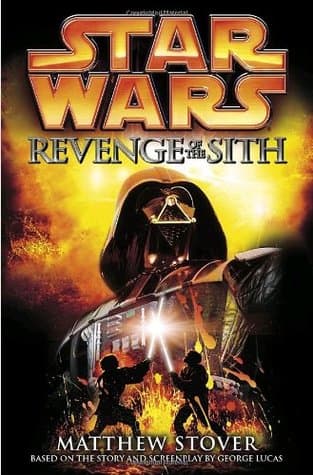
Matthew Woodring Stover (2005)
Genre
Fantasy / Science Fiction
Reading Time
9-10 hours
Key Themes
See below
Sign in to track this book
As the Republic falls to civil war and a manipulative leader, Anakin Skywalker's fear for his secret love pushes him to a decision that creates Darth Vader and plunges the galaxy into darkness.
The novel opens during the Battle of Coruscant, where Jedi Generals Anakin Skywalker and Obi-Wan Kenobi lead a Republic attack to save Chancellor Palpatine from Separatist commander General Grievous. Their starfighters fly through the space battle, boarding Grievous's flagship, the *Invisible Hand*. After navigating traps and droids, they confront Grievous, who holds Palpatine captive. Grievous tries to flee, but Anakin and Obi-Wan fight Count Dooku. Anakin, using dark side power and Palpatine's encouragement, disarms Dooku and then kills him despite Obi-Wan's hesitation. Palpatine calls this necessary. They crash-land the damaged Separatist cruiser on Coruscant, seen as heroes.
Back on Coruscant, Anakin reunites with his secret wife, Senator Padmé Amidala, who says she is pregnant. This news makes Anakin's nightmares and visions of Padmé dying in childbirth worse, like when he lost his mother, Shmi Skywalker. He tells Palpatine, who uses Anakin's fears, suggesting the Jedi are too strict to help him. Meanwhile, the Jedi Council, concerned about Palpatine's power, tells Anakin to spy on the Chancellor. This makes Anakin feel distrusted and used by the Jedi. He feels stuck between his loyalty to Palpatine, who seems to understand him, and his duty to the Jedi, who seem uncaring.
Chancellor Palpatine, as part of his plan, makes Anakin Skywalker his personal representative to the Jedi Council. The Council, especially Mace Windu and Yoda, are uneasy with this, seeing it as Palpatine trying to control them. They let Anakin join the Council but deny him the rank of Master. This decision deeply hurts and angers Anakin. He sees it as a personal insult and more proof of the Council's distrust. This rejection, along with Palpatine's constant reassurance and promises of power, pushes Anakin closer to the Chancellor, making him more open to Palpatine's dark influence.
With Separatist forces still a threat, the Jedi Council learns General Grievous is on the planet Utapau. Obi-Wan Kenobi is sent to lead a Republic attack and eliminate the droid general. This mission takes Obi-Wan away from Coruscant, isolating Anakin and removing a key calming influence. Obi-Wan, with Clone Troopers, travels to Utapau, where he finds Grievous's hidden base. He prepares for a direct fight, knowing Grievous's defeat will help end the war.
As Anakin continues to spy on Palpatine, the Chancellor starts to reveal his true nature, talking about the dark side and the story of Darth Plagueis the Wise, a Sith Lord who could prevent death. Desperate to save Padmé, Anakin sees hope in Palpatine's words. However, Palpatine eventually reveals himself as the Sith Lord Darth Sidious. Shocked, Anakin reports this to Mace Windu, who gathers Kit Fisto, Agen Kolar, and Saesee Tiin to confront the Chancellor. Anakin is told to stay at the Jedi Temple, a command that fills him with worry and a feeling of being left out.
Mace Windu and his Jedi Masters confront Palpatine in his office. A lightsaber duel quickly kills the other Jedi. Windu, a master, eventually disarms Palpatine and corners him. As Windu prepares to strike, Anakin arrives, torn between the Jedi and his need to save Padmé, believing Palpatine is the only one who can help. Palpatine pretends to be weak, begging for his life, and Anakin, fearing losing his only hope, cuts off Windu's hand. This betrayal allows Palpatine to use Force lightning, killing Windu and pushing Anakin to the dark side. Anakin then pledges himself to Palpatine, becoming Darth Vader.
After Anakin's fall, Darth Sidious issues Order 66, a secret command in the clone troopers' genetics, making all Jedi traitors. Across the galaxy, clone commanders turn on their Jedi Generals, killing them. Darth Vader, now in his new identity, leads the 501st Legion to the Jedi Temple on Coruscant, where he kills Jedi Masters, Knights, and younglings. This attack destroys the Jedi Order, leaving few survivors. The Republic becomes the Galactic Empire, with Sidious, now Emperor Palpatine, in charge.
On Utapau, Obi-Wan Kenobi fights General Grievous in a long battle. Obi-Wan chases Grievous across the planet, confronting him directly. After a lightsaber duel, Grievous escapes and tries to flee in his starfighter. Obi-Wan, riding a Boga, catches him and disables his ship. In a final struggle, Obi-Wan uses the Force to open Grievous's chest plates and blasts his internal organs with a blaster, killing the Separatist commander. However, his victory is immediately overshadowed by his clone troopers, who turn on him under Order 66. Obi-Wan barely escapes, realizing the galaxy has changed.
After sensing the disturbance in the Force from Order 66 and the Jedi Temple massacre, Yoda returns to Coruscant with Obi-Wan. They learn the truth of Anakin's betrayal and the Jedi's fall. Yoda decides to confront Emperor Palpatine. Their duel in the Senate Rotunda is a clash of light and dark, shaking the building. Despite Yoda's power, Palpatine's dark side abilities are too great. Yoda cannot defeat the Emperor and retreats, acknowledging the Jedi's time has passed and a new era of darkness has begun. He goes into exile on Dagobah.
Obi-Wan, heartbroken by Anakin's fall, confronts Padmé, who refuses to believe Anakin is evil. She travels to Mustafar, where Darth Vader is killing Separatist leaders. Obi-Wan secretly follows her. When Vader sees Obi-Wan emerge from Padmé's ship, he thinks she has betrayed him, and in a rage, Force-chokes her unconscious. Obi-Wan and Vader fight a brutal, emotional lightsaber duel among the volcanoes of Mustafar. The battle is long and destructive, ending with Obi-Wan gaining the high ground. Despite his pleas for Anakin to surrender, Vader attempts a reckless jump, and Obi-Wan, with sadness, cuts off Vader's legs and left arm, leaving him to burn on the lava banks.
Obi-Wan rescues the injured Padmé and takes her to a medical facility on Polis Massa. Despite the droids' efforts, Padmé is dying, not from physical injuries, but from a "broken heart" and the loss of Anakin. Before her death, she gives birth to twins, Luke and Leia. She uses her last breath to tell Obi-Wan there is still good in Anakin. Meanwhile, Palpatine arrives on Mustafar to retrieve the burned, barely living Vader, bringing him to Coruscant where he is put into his life-support suit, becoming the mechanized Darth Vader. The galaxy thinks the children are lost, but Obi-Wan, Yoda, and Bail Organa plan to hide them.
To protect Luke and Leia from the new Galactic Empire and their father, Darth Vader, Obi-Wan, Yoda, and Senator Bail Organa decide to separate the twins. Leia is adopted by Senator Organa and his wife, Queen Breha, on Alderaan, to be raised as a princess. Luke is taken to Tatooine by Obi-Wan, who entrusts him to Anakin's step-family, Owen and Beru Lars, and watches over him from afar in exile. With the Jedi Order shattered, the Republic fallen, and the Empire rising, these two children represent the last hope for the galaxy, hidden from their father and the Emperor's power.
The Protagonist/Antagonist
Anakin transforms from a conflicted Jedi Knight into the ruthless Sith Lord Darth Vader, driven by fear and a desperate attempt to save his loved ones, ultimately losing everything in the process.
The Supporting
Obi-Wan evolves from a respected Jedi General to a heartbroken survivor, forced into exile to protect the future of the galaxy after the fall of his former apprentice.
The Antagonist
Palpatine successfully transitions from a seemingly benevolent Chancellor to the tyrannical Emperor, achieving his centuries-long Sith goal of galactic domination and the destruction of the Jedi.
The Supporting
Padmé, a beacon of hope for democracy, experiences profound joy and devastating heartbreak, ultimately dying of a broken heart after Anakin's betrayal, but not before giving birth to the galaxy's future hope.
The Supporting
Yoda, initially a guiding force for the Jedi, faces the ultimate defeat in his battle against Sidious, leading him to accept the fall of the Order and retreat into exile, preserving the knowledge for future generations.
The Supporting
Mace Windu, a formidable guardian of the Jedi Order, attempts to neutralize the Sith threat but is tragically betrayed, becoming a martyr whose death catalyzes Anakin's full descent into the dark side.
The Supporting
Grievous serves as a dangerous military leader who is ultimately hunted down and defeated by Obi-Wan Kenobi, marking a critical turning point in the Clone Wars before the Empire's rise.
The Supporting
Bail Organa transitions from a concerned Senator to a pivotal figure in the nascent rebellion, taking on the responsibility of raising Leia and safeguarding the future of the galaxy.
The Supporting
R2-D2 remains a steadfast and observant companion, witnessing the rise and fall of Anakin and carrying the secrets of the Skywalker family forward.
The Supporting
C-3PO, a witness to the tragedy of the Skywalker family, has his memory wiped to protect the secrets of the nascent Empire, reflecting the galaxy's forced forgetting of its past.
The novel shows how fear, especially Anakin's fear of losing Padmé and his mother, leads to the dark side. Palpatine uses Anakin's anxieties, convincing him that the Jedi's emotional detachment prevents solutions. Anakin's nightmares of Padmé's death, like his inability to save his mother, make him seek forbidden power. This leads him to accept Darth Sidious's promises of immortality and control, sacrificing his identity and morality. His wish to save her only causes her death and his own spiritual ruin.
“"Fear is the path to the dark side. Fear leads to anger. Anger leads to hate. Hate leads to suffering."”
Palpatine's manipulation is a main theme, showing his plan to dismantle the Republic and destroy the Jedi. He plays both sides of the Clone Wars, uses propaganda against the Jedi, and grooms Anakin Skywalker. He acts as Anakin's sympathetic mentor, contrasting himself with the 'cold' Jedi, and encourages Anakin's resentment and ambition. His deception is so complete that even the wisest Jedi struggle to find his true identity until it is almost too late. This shows the dangers of unchecked power and how easily trust can be used.
“"I have waited a long time for this moment, my little green friend."”
The novel clearly shows the slow breakdown of democratic institutions in the Republic, ending with its change into the Galactic Empire. Palpatine's increasing emergency powers, the public's willingness to trade liberty for safety, and the Jedi's inability to adapt to politics all contribute to this fall. The Senate, once a symbol of democracy, becomes a tool for Palpatine's totalitarian goals. This theme warns how a seemingly good leader, claiming to protect people, can slowly remove freedom and create an authoritarian rule.
“"So this is how liberty dies... with thunderous applause."”
Revenge of the Sith is full of tragedy and sacrifice. Anakin's fall is a personal tragedy, driven by his love for Padmé but leading to his destruction and the death of his loved ones. Obi-Wan's duel with Vader is a sacrifice of his emotional well-being to uphold Jedi principles. The Jedi Order sacrifices its existence in an effort to protect the Republic. Padmé's death, a 'broken heart' for a lost love, shows the emotional cost of the war and Anakin's choices. The story acts as a tragedy, where good intentions lead to suffering and loss.
“"You were the Chosen One! It was said that you would destroy the Sith, not join them! Bring balance to the Force, not leave it in darkness!"”
Anakin's main conflict is between his Jedi duty of emotional detachment and his personal desires: his love for Padmé and his fear of losing her. The Jedi Code demands he suppress these attachments, while Palpatine encourages him to embrace them. This internal struggle tears Anakin apart, making him feel the Jedi are holding him back from his potential and protecting those he cares about. His choice to prioritize saving Padmé, even at the cost of his duty, directly leads to his fall. This shows the destructive power of unchecked personal desire when it conflicts with a moral framework.
“"Attachment is forbidden. Possession is forbidden. Compassion, which I would define as unconditional love, is essential to a Jedi's life. So you might say, that we are encouraged to love."”
A galactic prophecy that foreshadows Anakin's destiny to bring balance to the Force.
The prophecy of the Chosen One, believed to be Anakin Skywalker, who would destroy the Sith and bring balance to the Force, serves as a powerful narrative device. It creates a sense of destiny and importance around Anakin, while also adding tragic irony. The Jedi interpret it as the destruction of the Sith, but Anakin's journey shows that 'balance' can be achieved through a cataclysmic event that nearly annihilates both sides, paving the way for a new beginning. This prophecy drives much of the Jedi's hope and concern for Anakin, and its apparent fulfillment through his fall complicates its meaning, setting up the events of the original trilogy.
Anakin's premonitions of Padmé's death, mirroring his mother's, act as a catalyst for his fear.
Anakin's repeated nightmares and Force visions of Padmé dying in childbirth are a crucial plot device. They tap into his deepest fear – the inability to save those he loves, a trauma stemming from his mother's death. These visions are not just a psychological element but a direct instigator of his actions. They make him desperate, driving him into Palpatine's manipulative embrace as he seeks a way to defy fate. This device effectively ratchets up the emotional stakes and provides a clear, personal motivation for Anakin's turn to the dark side, making his betrayal more understandable, if still tragic.
Obi-Wan's tactical advantage in his duel with Vader, symbolizing moral and strategic superiority.
The 'high ground' motif during Obi-Wan and Vader's duel on Mustafar is more than just a physical advantage; it symbolizes Obi-Wan's moral and strategic superiority. Obi-Wan's position of 'high ground' represents his adherence to Jedi principles and his calculated approach, while Vader's impulsive, rage-fueled leap signifies his recklessness and the dark side's destructive nature. This seemingly simple tactical decision becomes iconic, highlighting the finality of their confrontation and the complete abandonment of reason by the newly christened Sith Lord, leading to his devastating dismemberment and transformation into the full cyborg Darth Vader.
A pre-programmed command to exterminate the Jedi, serving as the ultimate betrayal.
Order 66 is a shocking and devastating plot device that swiftly and brutally eliminates the Jedi Order. It functions as the ultimate betrayal, as the clone troopers, who fought alongside the Jedi for years, turn on them without hesitation due to a secret bio-chip. This device allows Palpatine to consolidate power rapidly, removing the primary obstacle to his reign. It highlights the insidious nature of his long-term planning and the vulnerability of trust. The suddenness and scale of the purge underscore the overwhelming power of the Sith's deception and the swiftness with which an established order can be overthrown.
Anakin and Padmé's forbidden relationship and the resulting children, Luke and Leia.
The secret marriage between Anakin and Padmé, and Padmé's subsequent pregnancy, are fundamental plot devices driving Anakin's emotional turmoil and Palpatine's manipulation. The secrecy itself forces Anakin to live a double life, creating internal conflict and isolating him from the Jedi. The pregnancy directly triggers his visions of Padmé's death, making him desperate for power to save her. Ultimately, the birth of Luke and Leia, though initially overshadowed by tragedy, serves as the ultimate 'new hope' for the galaxy, providing the lineage for future heroes and ensuring the Skywalker saga continues, even after Anakin's fall.
“This is how it feels to be Anakin Skywalker, forever.”
— Anakin reflects on his identity and destiny as he embraces the dark side.
“The dark is generous, and it is patient, and it always wins.”
— Opening line of the novel, setting a foreboding tone for the story.
“Do not try to stop me. I will do what I must.”
— Obi-Wan Kenobi confronting Anakin on Mustafar.
“You were the Chosen One! It was said that you would destroy the Sith, not join them!”
— Obi-Wan's anguished cry to Anakin after their duel.
“I have brought peace, freedom, justice, and security to my new Empire.”
— Anakin, now Darth Vader, declaring his vision to Obi-Wan.
“The shatterpoint is in the Chancellor's office.”
— Mace Windu sensing a critical moment in the Force related to Palpatine.
“Love won't save you, Padmé. Only my new powers can do that.”
— Anakin trying to justify his turn to the dark side to save Padmé.
“So this is how liberty dies... with thunderous applause.”
— Padmé Amidala witnessing the Senate grant Palpatine emergency powers.
“You have allowed this dark lord to twist your mind until now... until now you have become the very thing you swore to destroy.”
— Obi-Wan accusing Anakin of hypocrisy in embracing the Sith.
“The Force is with me, and I am one with the Force.”
— A Jedi mantra reflecting oneness with the Force, often in meditation or battle.
“I am not afraid anymore. The Sith have taken everything from me. Now I will take everything from them.”
— A character (like a Jedi or rebel) vowing revenge against the Sith.
“In the end, there is only the Force.”
— A philosophical reflection on the ultimate nature of existence in the Star Wars universe.
“You were my brother, Anakin! I loved you.”
— Obi-Wan's emotional farewell to Anakin after their duel.
“The galaxy is a living thing, and the Force is its breath.”
— A description of the interconnectedness of all things through the Force.
Ready to see how well you understood this book? Take our interactive quiz with 10 questions.
Biography coming soon.







