“The past is a stubborn thing. It resists change, even when the future screams for it.”
— Sarah reflects on the difficulty of altering historical events.

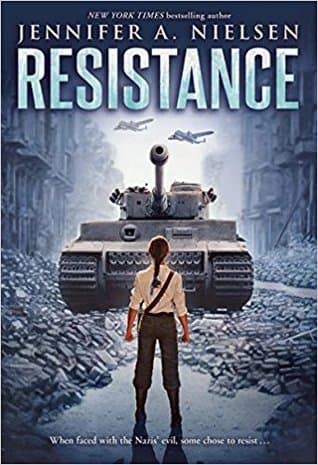
Jennifer A. Nielsen (2018)
Genre
Historical Fiction / Science Fiction / Romance
Reading Time
800 min
Key Themes
See below
Sign in to track this book
A Jewish teenager with forged papers risks everything as a courier in Nazi-occupied Poland, smuggling hope and lives between ghettos, then joins the desperate Warsaw Ghetto Uprising.
The story begins with Chaya Lindner, a Jewish teenager, living in the Krakow Ghetto under Nazi rule. Her family is broken; her younger sister, Sara, was taken during a 'resettlement,' and her brother, Akiva, disappeared looking for food. Her parents are sad and withdrawn. Chaya, though, wants to fight back. With her fair hair and fake Aryan papers, she takes on the dangerous job of a courier for the Jewish resistance, traveling outside the ghetto to smuggle food, information, and children to safer places. This work connects her with resistance members and shows her the harshness of the Nazi regime.
Chaya's courier work leads her to officially join a small, secret resistance group in Krakow, led by Zayde, who is practical and careful. The group includes Esther, a quiet but clever girl, and Mendel, who is strong and protective. Their missions involve smuggling supplies, making fake documents, and gathering information on German movements. Chaya's ability to look like a Gentile outside the ghetto makes her very useful. She quickly learns about secret work, including codes, meeting spots, and the constant danger from the Gestapo or Polish collaborators. The group is united by their shared desperation and commitment to fighting the Nazis.
The Krakow group, including Chaya, plans to derail a German supply train carrying ammunition, hoping to hurt the Nazi war effort and get weapons. The plan is carefully made, but during the operation, German soldiers ambush them. The mission turns chaotic and violent. Several group members are killed or captured, and Chaya has to run alone, barely escaping. The resistance network in Krakow is destroyed, and Chaya feels alone and without hope, thinking she is the only one left from her group. This failure makes her question her purpose and if their resistance helps.
After days of hiding and avoiding capture, Chaya is found by Esther, who she thought died in the train attack. Esther says she also survived and was told to find Chaya. Esther also brings news: a much larger, more organized Jewish resistance movement is forming in the Warsaw Ghetto, preparing for a full uprising. They need experienced fighters and couriers like Chaya. This news gives Chaya hope and purpose, changing her focus from surviving alone to a group, strategic fight. She agrees to go to Warsaw, knowing the great danger but also the chance for a meaningful stand.
Chaya and Esther start a dangerous trip to Warsaw, traveling through forests and using fake documents and help from sympathetic Poles, all while avoiding German patrols. The trip is full of close calls and constant fear. When they arrive in the Warsaw Ghetto, they are shocked by the suffering and the many people trapped inside. They are taken to the hidden headquarters of the Jewish Combat Organization (ŻOB), where Chaya meets leaders like Mordechai Anielewicz and Yitzchak Zuckerman. Chaya is impressed by their organization and the fighters' resolve.
In Warsaw, Chaya is assigned to a unit and starts training with other young Jewish fighters. She learns how to use weapons, make Molotov cocktails, and plan for urban warfare. The mood is tense but full of purpose. Chaya works closely with new friends, including Shira, who is brave and spirited, and forms strong bonds with them. She also continues her courier work, smuggling weapons and supplies into the ghetto, which is increasingly under siege. The resistance knows their chances of winning are small, but they want to fight for dignity and save as many lives as possible, even if it means dying with honor.
The Germans launch a big 'action' in January 1943, planning to send thousands more Jews from the ghetto to extermination camps. This starts the ŻOB's first organized armed resistance. Chaya and her unit fight, throwing Molotov cocktails and firing their few weapons at the German soldiers. The resistance fighters cause some casualties and temporarily stop the deportations, but the Germans still take many Jews. However, this act of defiance sends a strong message to both the Germans and the ghetto residents: the Jews of Warsaw will not die quietly. Chaya experiences the reality of direct combat.
After the January action, the Germans leave for a few months, but everyone in the ghetto knows this is a calm before the storm. The resistance prepares more, building bunkers, gathering weapons, and training. Chaya helps with these efforts, using her knowledge of the ghetto and her courage. She sees the despair and strength of the ghetto residents, many of whom decide to join the fight or hide in the resistance's bunker system. Rumors of the Germans' final destruction of the ghetto spread, and a sense of grim determination settles over the fighters. Passover, April 19, 1943, is thought to be the start of the final German attack.
On April 19, 1943, German forces, led by Jürgen Stroop, begin their final destruction of the Warsaw Ghetto. Chaya and her fellow fighters are ready. As German tanks and soldiers enter, they are met with strong resistance from the ŻOB and ŻZW (Jewish Military Union) fighters, who ambush them from rooftops, windows, and bunkers. Chaya fights in intense street battles, throwing grenades and Molotov cocktails, showing great bravery. The initial German advance is surprisingly stopped, and the resistance holds its ground for several days, shocking the Germans and inspiring those hiding in the ghetto. Chaya fights alongside Esther, Shira, and others, seeing both heroic acts and terrible losses.
Despite their first successes, the Jewish resistance is greatly outnumbered and outgunned. The Germans systematically burn down the ghetto, block by block, using flamethrowers and explosives to force out fighters and civilians from bunkers. Chaya and her unit have to retreat deeper into the tunnels and sewers. Conditions become worse, with less food, water, and ammunition. Many friends are lost in the fighting or die in the burning buildings. Chaya keeps fighting, driven by her resolve and the memory of her family, trying to save others and hurt the enemy.
As the uprising ends, with the ghetto in ruins, Chaya, Esther, and a small group of surviving fighters, including Shira, are among the last to escape through the sewer system. The journey through the dark, foul-smelling tunnels is terrifying and hard, with constant danger of being found. They eventually come out outside the ghetto walls, helped by Polish resistance contacts. Though they survived the immediate danger, the future is unknown. The uprising has been crushed, and the Jewish community of Warsaw is almost completely destroyed. Chaya carries the heavy burden of loss but also the pride of having fought with honor, determined to continue the resistance in any way she can, now committed to telling the story of those who resisted.
The Protagonist
Chaya evolves from a scared but determined courier to a hardened and respected resistance fighter, carrying the weight of loss but finding strength in collective action and the fight for dignity.
The Supporting
Esther grows from a quiet operative to a survivor who steadfastly supports Chaya, demonstrating unwavering courage and resilience.
The Supporting
Zayde remains a steadfast leader, guiding his cell through perilous missions until the group is tragically dispersed.
The Supporting
Mendel serves as a brave and protective fighter, demonstrating physical courage and loyalty until the cell's tragic end.
The Supporting
Mordechai leads the ŻOB with conviction, inspiring his fighters to make a stand for dignity and honor against overwhelming odds.
The Supporting
Yitzchak provides crucial strategic leadership and logistical support for the Warsaw Ghetto Uprising.
The Supporting
Shira develops into a brave fighter, providing camaraderie and support to Chaya throughout the uprising.
The Antagonist
Stroop carries out his mission of ruthless extermination, embodying the systemic evil of the Nazi regime.
A main theme of the novel is the spirit of resistance against great oppression. Chaya's journey, from smuggling food in Krakow to fighting in the Warsaw Ghetto Uprising, shows the many ways defiance can happen. The book shows that resisting is necessary, not just for survival, but for dignity and honor, even when winning is not possible. The decision of ŻOB leaders like Mordechai Anielewicz to fight to the death, rather than be led passively to slaughter, is a clear example of this theme. It explores the courage needed to stand up against a powerful enemy.
“"We will not go meekly to our deaths. We will fight, and we will die with honor."”
The story balances hope and despair when facing terrible events. Chaya's early hope to find her brother pushes her first resistance efforts, but she often feels despair after losses, like the destroyed Krakow group. The news of the Warsaw Uprising renews her hope, giving her a new purpose. The book shows how hope can motivate, even when it is scarce, allowing people to endure and fight. The widespread despair among many ghetto inhabitants shows the psychological toll of the Holocaust.
“"Hope was a dangerous thing in the ghetto, but it was also the only thing that kept us alive."”
Chaya's identity changes throughout the story. Her ability to 'pass' as Aryan outside the ghetto shows how identity can be fluid and dangerous under persecution. Within the resistance, she finds a new sense of belonging and purpose, becoming a fighter for her people. The shared Jewish identity, targeted for extermination, becomes a unifying force for the resistance members. Their fight is not just for survival, but to keep their identity and heritage against those who want to erase it.
“"Outside the ghetto, I was no one. Inside, I was Chaya, a fighter. And that was enough."”
The loss of Chaya's immediate family—her sister taken, her brother missing, her parents broken—drives her actions. The resistance group, in both Krakow and Warsaw, becomes a family, offering friendship, protection, and a shared purpose. This theme shows how people find family in community during extreme crisis, relying on each other for emotional support and strength. The bond between Chaya, Esther, and Shira shows this, how strong connections can form even when death is near, showing the human need for connection.
“"We were not just fighting for ourselves. We were fighting for everyone we had lost, and for the hope of everyone who might yet live."”
A recurring plot device that drives Chaya's early character development and plot progression.
Chaya's role as a courier, using forged papers and her appearance to move between ghettos and outside areas, serves as a crucial plot device. It allows the narrative to span different locations (Krakow, Warsaw, and the Polish countryside) and introduces Chaya to various facets of the resistance and the horrors of the occupation. These missions are inherently high-stakes, creating constant tension and opportunities for close calls, which build Chaya's skills and resolve. They also provide a window into the broader scope of the resistance network and the civilian suffering outside the main ghetto narratives.
A narrative turning point that shifts the protagonist's focus and introduces a larger conflict.
The disastrous train derailment mission and the subsequent shattering of Chaya's Krakow resistance cell is a significant plot device. It serves as a narrative low point, leaving Chaya isolated and despairing. However, this despair is precisely what makes Esther's reappearance and the message of the Warsaw Uprising so impactful. It forces Chaya out of her previous, smaller-scale resistance efforts and propels her into the much larger, more organized, and ultimately more desperate fight in Warsaw, expanding the scope of the story and raising the stakes considerably. It highlights the brutal reality of resistance losses.
The oppressive and ultimately defiant setting functions as a living entity in the narrative.
The Warsaw Ghetto itself acts as more than just a backdrop; it is a character in its own right. Its escalating horrors—starvation, disease, deportations, and eventual destruction—drive the plot and characters' motivations. The ghetto's physical layout, with its walls, crowded streets, and later its elaborate bunker systems and sewer networks, dictates the parameters of the resistance's actions and survival. Its eventual transformation into a battleground for the uprising symbolizes the ultimate act of defiance against dehumanization, making the setting integral to the story's emotional and historical impact.
Incorporating real historical individuals to lend authenticity and gravity to the fictional narrative.
The inclusion of real historical figures like Mordechai Anielewicz and Yitzchak Zuckerman as leaders of the ŻOB is a powerful plot device. It grounds the fictional story in historical reality, lending authenticity and gravity to Chaya's experiences. These figures represent the actual leadership and courage of the Warsaw Ghetto Uprising, making the events feel more real and impactful. Their presence allows the narrative to convey the true spirit and strategy of the historical resistance, connecting Chaya's personal journey to the broader, documented struggle.
“The past is a stubborn thing. It resists change, even when the future screams for it.”
— Sarah reflects on the difficulty of altering historical events.
“Love, even across centuries, can be a force as powerful as any weapon.”
— Sarah contemplates her feelings for Michael and the impact on her mission.
“Sometimes, the greatest act of rebellion is simply to remember.”
— A Resistance member explains the importance of preserving true history.
“Every choice carves a new path, and every path leads to a different destiny.”
— Sarah considers the multitude of possibilities stemming from her actions.
“Hope is a fragile thing, easily crushed, but impossible to truly extinguish.”
— Amidst despair, a character expresses enduring optimism.
“To save the future, sometimes you have to break the past.”
— Sarah grapples with the ethical dilemmas of altering history.
“The truth is not always what you want to hear, but it's always what you need to know.”
— A mentor advises Sarah on facing harsh realities.
“Even in the darkest times, humanity finds a way to shine.”
— Observing acts of kindness during a period of oppression.
“A whisper can start a revolution if it falls on the right ears.”
— Discussing the power of subtle acts of defiance.
“The future is not written; it is forged by the hands of those who dare to fight for it.”
— A rallying cry for action against an oppressive regime.
“Sometimes, the greatest dangers aren't the ones you can see, but the ones that hide in plain sight.”
— Sarah discovers a hidden threat within her own ranks.
“History judges us not by our intentions, but by our actions.”
— A character reflects on accountability and the impact of choices.
“The heart remembers what the mind tries to forget.”
— Sarah struggles with memories and emotions tied to her past and present.
“Freedom is not a gift; it's a battle fought anew with every generation.”
— A Resistance leader emphasizes the ongoing struggle for liberty.
Ready to see how well you understood this book? Take our interactive quiz with 10 questions.

Biography coming soon.







