“The past is a foreign country; they do things differently there.”
— A general reflection on the nature of revisiting past events and decisions, particularly poignant given the protagonist's unique situation.

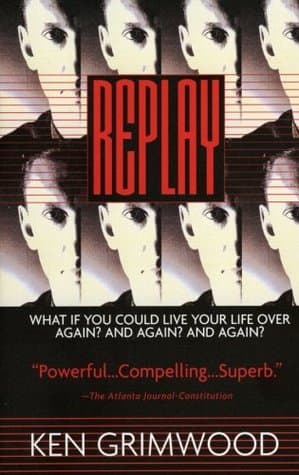
Ken Grimwood (1986)
Genre
Fantasy / Science Fiction / Romance
Reading Time
315 min
Key Themes
See below
Sign in to track this book
A middle-aged man unexpectedly relives his life from age eighteen, retaining all his future memories, only to discover that death at 43 is merely the prelude to an endless cycle of replays, each offering new choices but never true escape.
Jeff Winston, 43, lives a mundane life in 1988. He dies from a heart attack at his desk. He abruptly wakes up as his 18-year-old self in his college dorm room in the fall of 1963, remembering his previous 25 years. Jeff quickly realizes he has a chance to relive his life. With knowledge of the future, he decides to make different choices. He avoids his first marriage to Linda, places strategic bets on sports events, and invests in successful future companies like IBM and Xerox, quickly becoming wealthy. He also tries to save people from future tragedies, like the Kennedy assassination, but his efforts fail against the fixed past.
In his first replay, Jeff uses his knowledge to become very wealthy. He invests in stocks, buys property, and writes successful screenplays based on future movie plots. He tries to form meaningful relationships, but his inability to share his secret creates a barrier. He marries a woman named Anne, but the relationship is strained by his emotional distance and the vast, unshared knowledge he carries. Despite his material success, Jeff feels isolated and lonely. He realizes that wealth alone does not guarantee happiness and that his past memories, while providing advantages, also prevent him from fully experiencing the present moment.
Just as in his original life, Jeff dies of a heart attack at exactly 43 years old, no matter his physical condition or lifestyle. He wakes up again as his 18-year-old self in 1963, with memories of all previous replays now added to his knowledge. This cycle of death and rebirth at 43 becomes the main mystery and challenge of his existence. With each replay, Jeff tries different approaches: he lives a life of pleasure, attempts to change major historical events, and even tries to live a 'normal' life, but the outcome stays the same. He begins to suspect he is not alone in this phenomenon, as some events seem to subtly shift.
During one of his replays, Jeff hears a news report about a woman named Pamela Phillips, who died at 43 and then 'disappeared' from her life. Recognizing the pattern, Jeff finds her. He discovers Pamela is also an 18-year-old replayer, having experienced the same cycle of death and rebirth at 43. They are instantly drawn to each other, finding comfort and understanding in their shared, unusual situation. They quickly fall in love, realizing they are the only two people who can truly understand each other's experience. Their shared secret allows for a deep level of closeness and connection.
Jeff and Pamela decide to live their replays together, exploring different parts of life. They marry, have children, pursue various careers, and travel the world, making the most of their unique situation. They try to find others like them, placing coded advertisements, but find no success. As they continue through multiple replays, a terrifying pattern appears: the length of each replay begins to shorten. Instead of living until 43, they might only get 20 years, then 10, then even shorter periods, until their time together becomes fleeting moments, constantly fearing the next inevitable death and rebirth.
The shortening replays make Jeff and Pamela more desperate. They have less and less time to live full lives, raise children, or achieve long-term goals. They experience the heartbreak of having children and then losing them to the reset, repeatedly. They try to find a scientific or metaphysical explanation for their condition, consulting various experts and researching anomalies, but no one can offer answers. The pressure of their impending, ever-closer deaths and the loss of their shared future affects their emotional and mental well-being, leading to arguments and despair.
During one particularly short replay, the stress of their situation causes Jeff and Pamela to separate, each trying to cope with the impending end alone. Jeff, in his despair, considers ending his life to trigger the replay faster, but hesitates. Pamela, equally distraught, tries to live a solitary life. However, they soon realize that their greatest comfort and reason for living is each other. They reunite, reaffirming their commitment to face whatever comes next together, no matter how brief their remaining time. This reunion strengthens their bond and renews their determination to find a way out or at least to cherish every moment.
The replays become so brief that Jeff and Pamela barely have time to find each other before they die again. In one of the shortest replays, they are together for only a few days. A new, terrifying symptom appears: their memories of previous replays begin to fade, becoming fragmented and hazy. This gradual loss of their shared history threatens to erase their unique connection and the very essence of their repeated lives. They realize that if they lose their memories, they will lose each other and the meaning of their journey. This makes their current, fleeting moments even more precious and urgent.
In what appears to be their final replay, Jeff and Pamela meet again, but their memories are almost entirely gone. They recognize each other on an instinctual, emotional level, a deep sense of familiarity and love that goes beyond the loss of specific details. They share a poignant moment, a final connection before the cycle seemingly breaks. Jeff dies one last time, not knowing if he will replay again. He wakes up in 1963, but this time, he has no memories of any previous replays or his original life. He is truly 18 again, with a blank slate, ready to live his life for the very first time, unaware of the extraordinary journey he has just completed.
The Protagonist
Jeff evolves from a man seeking personal gain and avoiding pain to someone who values love, connection, and the present moment above all else, even as his memories fade.
The Co-Protagonist
Pamela transforms from an isolated replayer to someone whose identity and happiness are inextricably linked to her shared life with Jeff, cherishing every fleeting moment.
The Supporting
Linda's character remains static, serving primarily as a catalyst for Jeff's initial replays.
The Supporting
Anne's arc is limited to her relationship with Jeff, showcasing the impossibility of a truly connected life for him without a fellow replayer.
The Mentioned
Their existence is cyclical, representing the repeated joy and profound loss experienced by Jeff and Pamela.
The Supporting
Larry's character remains static, serving as an initial anchor for Jeff in his first replay.
The main theme is Jeff's (and later Pamela's) search for happiness and meaning in a life that repeatedly resets. Initially, Jeff thinks wealth and avoiding past mistakes will bring contentment, but he quickly learns that material success leads to isolation. His journey becomes a search for real connection and love, ending with his relationship with Pamela. The book explores whether happiness can be found in repeated lives or if it is tied to life's finite nature, suggesting that love and shared experience provide the deepest meaning.
“"The greatest gift was to share it, even if 'it' was only a moment."”
Love, especially the deep connection between Jeff and Pamela, is the ultimate answer to the existential loneliness of their condition. Their shared secret and understanding allow for a level of closeness impossible with anyone else. Their relationship goes beyond repeated deaths and shortening replays, becoming their main reason to continue. The book suggests that even if everything else is lost — wealth, children, memories — the love between two people can endure and give purpose.
“"They were the only two people in the entire world who could truly understand each other."”
The novel constantly questions the linear nature of time and the amount of free will. While Jeff can change personal choices and outcomes, major historical events (like the Kennedy assassination) stay fixed, suggesting a predetermined element to history. The repeated cycle of death at 43 and rebirth at 18 implies a cosmic mechanism beyond their control. As the replays shorten and memories fade, the characters wonder if their choices truly matter or if they are just players in a larger, fixed loop, making their eventual loss of memory a final act of liberation from this burden.
“"The past was a river, and he was a stone, unable to divert its current."”
Memory is central to Jeff and Pamela's identities as replayers. Their knowledge of the future and past replays defines who they are and influences their choices. The gradual fading of these memories in later replays is a terrifying loss, threatening to erase their unique experiences and their connection to each other. This theme shows how memory shapes identity and the deep impact of losing one's personal history, suggesting that even when explicit memories are gone, a deeper, emotional recognition can remain.
“"To lose the memory was to lose the life itself, all the lives."”
Jeff and Pamela experience deep and repeated grief. They lose their children repeatedly with each reset, and constantly face the impending loss of their shared life together as the replays shorten. This constant cycle of loss forces them to confront the temporary nature of existence and to find ways to cope with enduring sorrow. Their ability to love and reconnect despite this perpetual heartbreak shows the resilience of the human spirit, but the emotional toll is immense, showing the tragic aspect of their 'gift.'
“"Every time they had a child, they knew they would lose it again. It was the cruelest part of their gift."”
The central mechanism of dying at 43 and waking at 18 with memories intact.
The replay cycle is the core fantastical element of the novel. It dictates the narrative structure, with Jeff (and later Pamela) reliving their lives from 1963 multiple times. This device allows for exploration of 'what if' scenarios, character development across different lifetimes, and the existential questions of fate versus free will. The shortening duration of the replays adds escalating tension and urgency, driving the characters' desperation to find an explanation or a permanent escape. It's the engine of the plot and the source of both opportunity and profound suffering.
The protagonist's memory of future events and cultural shifts.
Jeff's (and Pamela's) retention of future knowledge from 1988 into their 1963 rebirth is a key plot device. It enables them to accumulate wealth through investments and gambling, avoid personal mistakes, and attempt to alter historical events. This device creates dramatic irony, as the characters know what's to come but often struggle with the ethical implications and the limitations of their power. It also serves to highlight the cultural and technological changes over a 25-year period, grounding the fantastical element in recognizable historical context.
The gradual reduction in the length of each replay.
The shortening of the replays, from 25 years down to mere days, is a critical device for building suspense and increasing the emotional stakes. It introduces a ticking clock element, forcing Jeff and Pamela to make increasingly desperate choices and to prioritize their time together. This device creates a sense of urgency and impending doom, transforming their 'gift' into a curse and pushing them towards a climax where their very existence and memories are threatened. It amplifies the themes of loss, the transient nature of life, and the preciousness of every moment.
The gradual loss of memories from previous replays.
As the replays become extremely short, Jeff and Pamela begin to lose their memories of past lives. This device represents the ultimate threat to their unique connection and their identities. It heightens the emotional impact of their final encounters, as they struggle to remember who they are and what they've shared. The fading memories underscore the fragility of identity and the importance of shared history, while also offering a potential resolution to their cycle by allowing them to eventually live a 'first' life without the burden of past knowledge.
“The past is a foreign country; they do things differently there.”
— A general reflection on the nature of revisiting past events and decisions, particularly poignant given the protagonist's unique situation.
“He knew that life was a series of choices, each one leading to an irreversible future.”
— Larry's realization about the weight of his decisions in each new 'replay' of his life.
“The greatest gift of all was the chance to correct your mistakes.”
— Larry's initial joy and sense of opportunity upon realizing he could relive his life and alter past errors.
“Love, he discovered, was not just a feeling, but a series of shared experiences, repeated and reinforced over time.”
— Larry's evolving understanding of love as he repeatedly reconnects with Pamela in different timelines.
“Every time you replay, you lose a little bit of the innocence of the first time.”
— A somber reflection on the diminishing novelty and increasing burden of each subsequent replay.
“He was a man out of time, not just once, but many times over.”
— Describing Larry's unique and increasingly isolated existence as he relives decades repeatedly.
“The universe was not a fixed thing, but a fluid, ever-changing tapestry.”
— Larry's growing understanding of the mutable nature of reality through his replays.
“There was a finite number of replays, a ticking clock he couldn't stop.”
— The revelation that the replays are not infinite, adding a sense of urgency and dread.
“What if the point wasn't to change things, but to experience them?”
— A shift in Larry's perspective, moving from trying to perfect his life to appreciating the journey itself.
“Happiness was fleeting, but memory, even altered memory, was eternal.”
— A thought on the lasting impact of experiences, even when the details might change with each replay.
“The more he knew, the less he understood.”
— Larry's paradoxical journey of gaining knowledge about his past lives while the grander meaning remains elusive.
“He found himself constantly searching for the unrepeatable moment, the one that truly mattered.”
— Larry's quest to find a unique and ultimately fulfilling experience amidst the repetition.
“Sometimes, the hardest thing to do was to let go of what could have been.”
— A reflection on the difficulty of moving forward, especially with the constant temptation to 'replay' and change the past.
“The greatest freedom was not the ability to change the past, but the choice to live fully in the present.”
— A profound realization Larry comes to about true liberation from the cycle of replays.
Ready to see how well you understood this book? Take our interactive quiz with 10 questions.

Biography coming soon.







