“The only way to be truly free is to be willing to risk everything.”
— Nova reflects on her motivations as a vigilante and the sacrifices required for her cause.

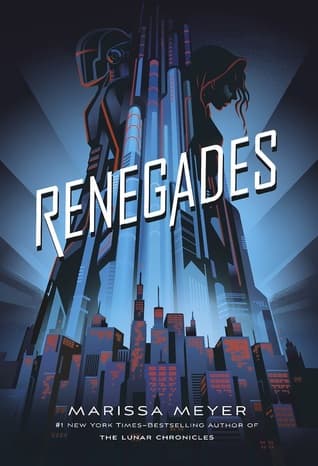
Marissa Meyer (2017)
Genre
Fantasy / Science Fiction / Young Adult / Romance
Reading Time
927 min
Key Themes
See below
Sign in to track this book
In a city rebuilt by superpowered heroes, a vengeful assassin with the power to steal sleep infiltrates their ranks, only to find herself drawn to the artistic prodigy son of her sworn enemies, who champions the very justice she seeks to dismantle.
Ten-year-old Nova Artino, also known as Insomnia, attends a secret meeting of Anarchists with her family. They are trying to make peace with the Renegades. An unknown attacker ambushes the meeting, killing Nova's parents and infant sister, Evie. Nova, who can put people to sleep with a touch, is the only survivor. Her uncle, Ace Anarchy, the Anarchist leader, rescues her. This event, plus the Renegades' late arrival and perceived failure to protect her family, makes Nova hate the Renegades and want revenge. This solidifies her loyalty to the Anarchist cause.
Years later, Nova, now the skilled Anarchist Nightmare, infiltrates the Renegades' Centennial Parade. Her mission is to kill Captain Chromium, the Renegades' leader. She uses her sleep power and combat skills to get close to him. However, Adrian Everhart, a young Renegade known as Sketch or The Sentinel, stops her. Adrian brings his drawings to life. His quick actions save Captain Chromium, forcing Nova to leave. Her failure, combined with the public display of Renegade power, makes her even more determined to dismantle their organization.
After her failed attempt, Nova plans to infiltrate the Renegades. She creates a civilian identity, Nova Artino. She publicly 'rescues' children from a burning building, using her powers secretly. This act gets the attention of the Renegades, especially Adrian, who is impressed by her bravery. She is then invited to try out for the Renegade organization. This gives her access to their headquarters and resources. It provides the perfect chance to gather information and execute her plan to expose their weaknesses and take them down, all while keeping her secret identity as Nightmare.
Nova passes the Renegade trials and joins Adrian Everhart's team, which includes Ruby Tucker (Red Assassin) and Oscar Silva (Smokescreen). Her first mission is to find and disable the Renegades' most powerful weapon, the 'Helmet,' which she thinks could be used for mass control. As she works with Adrian, she learns more about the Renegades. Meanwhile, Adrian, still thinking about the vigilante who saved Captain Chromium at the parade, tries to find 'The Sentinel' – his own secret identity, which he uses to fight crime outside the Renegade system. He does not know that Nova is Nightmare.
Nova's team investigates museum heists, which she thinks are linked to the Anarchists. During their investigation, she finds that the Anarchists are trying to steal a specific artifact, the 'Mirror of Disintegration,' believing it to be the Renegades' most powerful weapon. Nova uses this chance to subtly help the Anarchists while keeping her Renegade cover. She struggles with the moral issues of her double life. She forms real connections with Adrian and his team, even as she works to undermine their organization. This internal conflict starts to challenge her beliefs about justice and revenge.
Nova learns that the Anarchists, led by her uncle Ace Anarchy, plan to use the stolen Mirror of Disintegration to expose the Renegades' weaknesses and cause chaos. During an encounter with Phobia, another Anarchist who can manifest people's fears, Nova realizes that Phobia is her long-lost sister, Evie. Nova thought Evie died during the ambush years ago. This discovery deeply affects Nova. It makes her consider that her uncle Ace may have lied about Evie's death and the truth about her family's demise. The emotional impact of this discovery complicates her mission and her loyalty.
The Renegades, given clues by Nova, arrive at the museum during the Anarchists' heist. A large battle starts between the two groups. Nova, caught in the middle, must navigate the conflict, protecting her Anarchist allies while keeping her Renegade disguise. She struggles with the realization that the 'Mirror' is not the ultimate weapon she thought, but a device that projects illusions. During the chaos, Adrian, as The Sentinel, appears. This further complicates Nova's efforts to keep her identities separate. The battle forces Nova to make quick decisions that blur her loyalties.
After the museum battle, Nova confronts Ace Anarchy about Evie's survival and her identity as Phobia. Ace reveals that he found Evie alive after the ambush. Instead of letting her be taken by the Renegades, he raised her as an Anarchist, manipulating both sisters to serve his cause. He admits to orchestrating events to fuel Nova's hatred for the Renegades, including lying about Evie's death. This revelation shatters Nova's beliefs. It makes her question everything she thought she knew about her past, her family, and her mission. She realizes she has been a pawn in Ace's plan.
Following the museum incident, Nova is questioned by the Renegade Council about her actions and loyalties. Some of her movements during the battle raised concerns. Despite her efforts to maintain her cover, Adrian, who is observant, starts to suspect Nova's true identity and her connection to Nightmare. He notices inconsistencies and clues that hint at her double life. This growing suspicion puts Nova under pressure. She realizes her time within the Renegade organization is uncertain and her secret could be exposed, risking her life and her mission.
In a moment, Nova accidentally discovers Adrian's secret identity as The Sentinel when she sees him using his artistic powers in a way only The Sentinel could. This discovery deeply affects Nova. She realizes that the person she cares for is also the masked vigilante she has been fighting. The shared secret creates a new dynamic between them, blurring the lines of hero and villain. This adds emotional complexity to their relationship. The book ends with Nova thinking about this discovery and the future of her mission, knowing that the boy she loves is also the hero she is sworn to destroy.
The Protagonist/Antagonist
From a revenge-driven Anarchist spy, Nova begins to question her loyalties and the true nature of good and evil as she forms genuine connections with the Renegades.
The Protagonist
Adrian's unwavering belief in justice is tested as he grapples with the complexities of good and evil, and his perception of Nova.
The Antagonist
His arc is one of sustained manipulation and revelation, as his true intentions and survival are unveiled.
The Supporting
Ruby remains a steadfast and loyal friend, her character arc focusing on her unwavering compassion in the face of conflict.
The Supporting
Oscar's arc involves his gradual acceptance and trust in Nova, despite his initial reservations.
The Supporting
His arc is largely static, serving as a symbol of Renegade authority and a target for Nova's vengeance.
The Supporting
His character serves to uphold the Renegade ideal and provide a stable family foundation for Adrian.
The Supporting
Her arc involves her shocking revelation and her role as a pawn in Ace's larger scheme, complicating Nova's mission.
The Mentioned
Her story is a catalyst for Adrian's motivation, with her unresolved murder driving his quest for justice.
The central theme explores the line between seeking justice and pursuing vengeance. Nova wants to avenge her family, believing the Renegades caused their deaths. She sees this as 'justice' for the oppressed. Adrian believes in upholding justice through order but also secretly seeks vengeance for his mother's death as The Sentinel. The story challenges the characters, and the reader, to determine if their actions are for the greater good or fueled by personal revenge, especially as Nova sees the nuances of the Renegades' mission and Adrian uncovers the complexities of vigilante justice.
“One person’s villain is another person’s hero.”
Identity is important, with almost every major character having a secret persona. Nova is Insomnia/Nightmare to the Anarchists, and Nova Artino to the Renegades. Adrian is Sketch to the Renegades, and The Sentinel in secret. This theme looks at how individuals create different selves to handle conflicting loyalties, societal expectations, and personal desires. It explores the psychological cost of maintaining these dual identities, the fear of exposure, and how these masks shape or distort their true selves. The blurring lines between their public and private personas show the contradictions in their missions.
“Secrets were a part of life. Everyone had them. But Nova’s life was built on them.”
The book breaks down traditional ideas of good and evil, challenging the simple morality often found in superhero stories. The Renegades, though champions of order, have flaws and secrets. Their methods can seem authoritarian. The Anarchists, labeled 'villains,' have understandable reasons, fighting against what they see as a suppressive regime. Nova's journey, in particular, makes her question her beliefs as she sees the humanity of the Renegades and the manipulative tactics of the Anarchists. It shows that 'good' and 'evil' are often matters of perspective and power.
“There were no good guys and bad guys. Only people with different perspectives.”
Family ties and loyalty are central. Nova's motivation comes from losing her family and her loyalty to her uncle, Ace Anarchy, who raised her. However, the discovery that her sister Evie is alive and that Ace manipulated both of them shatters her understanding of family loyalty. Adrian is also driven by the memory of his biological mother and his loyalty to his adopted Renegade fathers. The theme explores the strong bonds of family, how they can be exploited, and the difficult choices characters make when their loyalties are divided between blood, ideology, and new connections.
“Family was a bond. It was a loyalty. And it was a weapon.”
The story examines power and control, especially in a society run by prodigies. The Renegades represent an established power structure that controls prodigy abilities for order. The Anarchists rebel against this control, advocating for individual freedom and the right to use powers without restriction. The story questions whether absolute power corrupts and whether order at the cost of freedom is just. Characters like Ace Anarchy and Captain Chromium embody different ideas about using power and its impact on society.
“Everyone wants power. But not everyone knows what to do with it.”
A core narrative device driving the plot and character development.
Secret identities are fundamental to the narrative, with Nova operating as Insomnia/Nightmare and Nova Artino, and Adrian as Sketch and The Sentinel. This device creates constant tension, internal conflict, and dramatic irony. It allows characters to explore different facets of their personalities and loyalties, while also serving as a major obstacle to their relationships and goals. The threat of exposure is a continuous source of suspense, shaping their interactions and choices, and ultimately leading to pivotal revelations.
The narrative presents the conflict from both 'hero' and 'villain' viewpoints.
The story is primarily told from Nova's perspective, an Anarchist, but also incorporates Adrian's perspective, a Renegade. This dual perspective allows the author to explore the complexities of the conflict, demonstrating that neither side is entirely 'good' or 'evil.' It forces the reader to empathize with characters on both sides, challenging preconceived notions and highlighting the subjective nature of justice. This device is crucial for the theme of good vs. evil, as it shows the motivations and justifications behind each faction's actions.
Adrian's alter ego, a vigilante who operates outside the Renegade system.
The Sentinel is Adrian's secret identity, a masked vigilante who uses his artistic powers to fight crime independently of the Renegades. This device serves multiple purposes: it highlights Adrian's personal quest for justice for his mother, it creates a parallel to Nova's own secret identity, and it allows Adrian to act on his impulses without the constraints of Renegade protocol. The Sentinel's existence also adds another layer of complexity to the 'hero' narrative, as he is technically breaking Renegade laws while trying to uphold justice, mirroring Nova's own morally ambiguous actions.
The foundational event that shapes Nova's entire character and motivations.
Nova's traumatic childhood experience – witnessing the murder of her family and being 'abandoned' by the Renegades – is the catalyst for her entire character arc. This device provides a clear, powerful motivation for her hatred of the Renegades and her dedication to the Anarchist cause. It explains her deep-seated desire for vengeance and her inability to trust. The ongoing impact of this trauma shapes her decisions, her emotional responses, and the internal conflict she experiences as she navigates her double life.
An object that drives the plot, though its true nature is different than perceived.
The 'Helmet' and later the 'Mirror of Disintegration' serve as MacGuffins, initially believed by Nova and the Anarchists to be the Renegades' ultimate weapon. Nova's mission revolves around finding and neutralizing this perceived threat. However, the true nature of the 'Mirror' as an illusion-projecting device, rather than a weapon of mass destruction, reveals a misdirection that complicates the Anarchists' plans and challenges Nova's understanding of Renegade power. This device propels the plot forward while also serving to expose further layers of deception and misunderstanding between the factions.
“The only way to be truly free is to be willing to risk everything.”
— Nova reflects on her motivations as a vigilante and the sacrifices required for her cause.
“Sometimes the villain is the hero of their own story.”
— Adrian contemplates the blurred lines between good and evil in their world.
“Love is the most dangerous weapon of all.”
— A moment of vulnerability between Nova and Adrian as their relationship develops.
“Power doesn't corrupt people; people corrupt power.”
— Discussion among the Renegades about the responsibilities that come with abilities.
“In a world of superheroes, the greatest superpower is hope.”
— Adrian tries to inspire his team during a difficult mission.
“The past is a ghost that haunts us, but the future is a blank page we can write.”
— Nova struggles with her traumatic history and the possibility of change.
“Trust is a fragile thing—easy to break, hard to rebuild.”
— Reflection on the strained alliances between characters with conflicting loyalties.
“We are all products of our choices, not our circumstances.”
— A character argues for personal agency despite difficult backgrounds.
“The line between justice and vengeance is thinner than you think.”
— Debate about the appropriate response to wrongdoing in their society.
“Fear is a cage, but courage is the key.”
— A character overcomes personal doubts to take decisive action.
“Sometimes the quietest voices speak the loudest truths.”
— Observation about underestimated characters making significant impacts.
“In the darkness, even the smallest light can guide you home.”
— Metaphorical reflection during a moment of despair or loss.
“Family isn't always blood; it's who you choose to fight for.”
— Characters redefine their bonds beyond traditional relationships.
“The greatest battles are fought within ourselves.”
— Internal conflict as characters grapple with their identities and morals.
Ready to see how well you understood this book? Take our interactive quiz with 10 questions.

Biography coming soon.







