“Grandma, like a red sorghum stalk, had her head sliced off by the Japanese.”
— A stark and violent image used to describe the death of the narrator's grandmother.

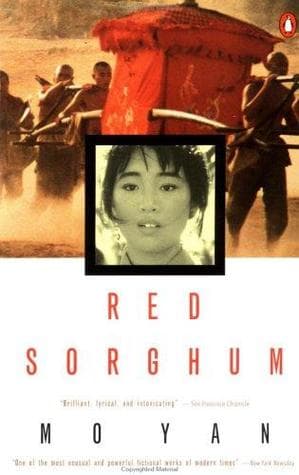
Mo Yan (1988)
Genre
Historical Fiction
Reading Time
9-12 hours
Key Themes
See below
Sign in to track this book
In Shandong's crimson fields, a family's story unfolds with grand myths and harsh realities as they fight Japanese invaders and their own conflicts, forever staining the sorghum with blood and legend.
The narrator, 'Grandson,' begins by telling the story of his grandmother, Dai Fenglian, a beautiful young woman sold by her family to be the third wife of Li Zhaohua, the owner of the 'Eighteen Li' sorghum wine distillery who has leprosy. On the way to her new home in a sedan chair, a bandit called 'Commander Yu' (who will become the narrator's grandfather) ambushes the group. Instead of robbing them, Yu carries Dai Fenglian into the sorghum fields, where they have a passionate encounter. This act of defiance and growing desire sets the stage for the difficult relationship that will define much of the family's history, linking their personal lives with the violent land of Gaomi County.
After her arranged marriage and meeting with Yu, Dai Fenglian goes back to the distillery. Soon after, Li Zhaohua, her husband, is found murdered, his body hurt. The details of his death are unclear, hinted to be from his disease, a local conflict, or perhaps arranged by Yu or someone with him. With Li Zhaohua gone, Dai Fenglian, despite being young and a woman, takes over running the 'Eighteen Li' distillery. She is a smart and able businesswoman, quickly earning respect from the workers and becoming a strong figure in the local community.
After Li Zhaohua's death, Commander Yu, now a local bandit leader, returns to the 'Eighteen Li' distillery. He is a powerful and influential figure, leading a group of loyal followers. He openly pursues Dai Fenglian, who, despite initial resistance and social concerns, is drawn to his raw charm and strength. Their relationship deepens, and Yu becomes her partner, both personally and in running the distillery. Their union, born from violence and passion, starts the narrator's paternal line, linking the family's fate with the unstable political situation of Gaomi County.
Under Dai Fenglian's good management and Yu's protection, the 'Eighteen Li' distillery thrives. The red sorghum wine they make becomes famous across Gaomi County for its high quality and strong kick. This wine, made from the same sorghum that covers the land and sees the family's dramas, becomes a strong symbol in the story. It represents the land's richness, the people's strength, and the intoxicating, often violent, spirit of the region. Making and drinking this wine is part of daily life, celebrating joy and sorrow, and giving courage to those who fight for their homeland.
The peaceful life at the 'Eighteen Li' distillery ends with the Japanese Imperial Army's arrival. The invasion changes local fights and banditry into a full-scale war for survival. The Japanese soldiers are shown as cruel and brutal, committing terrible acts against the local people, including rape, torture, and mass killings. Their presence brings widespread fear and forces the people of Gaomi County, including Dai Fenglian, Commander Yu, and their growing family, to face an enemy far worse than any internal conflict they had before.
Commander Yu, driven by his fierce independence and deep hatred for the invaders, organizes his bandit followers and local villagers into a resistance force. Their first big fight with the Japanese happens when a Japanese convoy is ambushed. This first skirmish, though small compared to later battles, is important. It marks Yu's change from a local bandit to a patriotic resistance fighter, and it shows the raw courage and resourcefulness of the Gaomi people. Despite being outmatched in weapons, Yu's men cause casualties, raising their spirits and showing their intent to fight for their homeland.
Tragedy strikes the family when Dai Fenglian, the narrator's grandmother, dies during a Japanese ambush. She is caught in the fighting or targeted by the invaders, her death a brutal result of the war. Her death is a terrible blow to Commander Yu, who loved her deeply, and to the whole family. Her death strengthens Yu's resolve, turning his personal grief into a burning desire for revenge against the Japanese. This loss deeply affects the narrator's father and shapes later events, showing the great personal cost of the war and the fragility of life in occupied China.
In response to the resistance, the Japanese carry out a terrible massacre in the sorghum fields, brutally killing and hurting many villagers and resistance fighters, including some of Yu's close friends. The scene is shown with graphic detail, stressing the invaders' cruelty and the great suffering inflicted on the Chinese people. This event is a major turning point, pushing Commander Yu and his remaining forces to their limit. The massacre sparks a furious desire for revenge, setting the stage for a desperate and bloody counterattack by the Chinese resistance.
Driven by grief and a desire for revenge after the sorghum field massacre and Dai Fenglian's death, Commander Yu plans a risky, almost suicidal attack on a Japanese convoy at a bridge. He gathers his remaining men, including the narrator's father, and plans a strategy using explosives and a desperate charge. The battle is chaotic and bloody, with many deaths on both sides. Yu's men fight with incredible fierceness and self-sacrifice, fueled by their hatred and commitment to their homeland. This battle, though costly, is a symbolic victory, showing the strong spirit of the Chinese resistance.
Years later, the narrator, now an adult, returns to Gaomi County and thinks about his family's difficult history and the land. He sees the unchanging cycles of the red sorghum, which continues to grow tall and strong, symbolizing the people's enduring spirit despite the war's scars. He tells of his grandfather's eventual fate, fighting not only the Japanese but also other Chinese groups, showing the complex and often brutal political situation. The story ends with a feeling of both tragedy and continuity, as the narrator recognizes his family's deep roots in this violent yet beautiful land, forever marked by the 'red sorghum' that witnessed their struggles.
The Protagonist
The narrator's arc is one of discovery and understanding, piecing together his family's past to comprehend his present.
The Protagonist
From a powerless bride, she becomes a powerful matriarch and businesswoman, ultimately sacrificing her life for her homeland.
The Protagonist
He evolves from a lawless bandit to a patriotic resistance leader, fighting with unwavering courage against invaders and other factions.
The Supporting
As a child, he endures the horrors of war, becoming a survivor who carries the memory of his parents' sacrifices.
The Supporting
His life ends tragically and mysteriously, freeing Dai Fenglian to forge her own path.
The Supporting
He remains a loyal and steady presence, enduring the war and upholding the distillery's legacy.
The Antagonist
They arrive as an unstoppable force but face unexpected, fierce resistance from the local population.
The novel shows the terrible impact of war on people and communities, especially the Sino-Japanese War. Mo Yan directly describes violence, torture, and death, showing the senselessness and dehumanizing effects of conflict. Scenes like the sorghum field massacre and the bridge battle highlight the extreme sacrifices and suffering of the Chinese people. Yet, among the brutality, there is an underlying absurdity, often seen in the chaotic and sometimes disorganized nature of the resistance, and the pure randomness of who lives and who dies.
“The Japanese, like a pack of starving wolves, gnawed at China's flesh, but China, like a mighty lion, would not be devoured.”
At the story's center is the fierce and unusual love between Dai Fenglian and Commander Yu. Their relationship, born from an ambush and fueled by raw desire, goes against social norms and forms the genetic and emotional foundation of the narrator's family. Their passion is as wild and untamed as the sorghum fields themselves, providing a sharp contrast to the violence around them. This theme explores how love can grow in the most unlikely and dangerous situations, acting as both a force for life and a source of deep sorrow.
“In the sorghum fields, love and death were brothers, walking hand in hand.”
The red sorghum fields of Gaomi County are more than just a place; they are a living character, tied to the people's identity and fate. The land provides food (the wine), shelter, and a battlefield. Its growth and harvest cycles reflect the Chinese people's strength and enduring spirit. The characters, especially Commander Yu, have a deep, almost primal connection to the soil, fighting not just for their lives but for their ancestral land. The sorghum itself sees all the triumphs and tragedies, its redness symbolizing both blood and life.
“The red sorghum, like the blood of our ancestors, flowed through the veins of this land.”
The novel is built as a series of fragmented memories and stories told by the narrator, who tries to put together his family's history. This shows how subjective and often mythical memory is, especially when dealing with traumatic events. The narrator's voice moves between personal memory, imagined scenes, and historical accounts, blurring the lines between fact and legend. This theme explores how history is passed down, understood, and changed through generations, and how storytelling itself becomes a way to keep identity and make sense of a chaotic past.
“History is a river, and our memories are but scattered pebbles on its banks.”
The story jumps backward and forward in time, often without clear transitions.
The novel employs a highly non-linear narrative structure, constantly shifting between different time periods, often within the same chapter or even paragraph. This mirrors the narrator's fragmented memory and creates a dreamlike, almost mythological quality to the storytelling. It allows Mo Yan to reveal events out of chronological order, building suspense and offering different perspectives on key moments. This device emphasizes that history is not a straight line but a complex web of interconnected events and personal recollections, creating a rich, multi-layered tapestry of the past.
The sorghum plant and its wine symbolize life, death, passion, and the land.
The red sorghum is perhaps the most pervasive and powerful symbol in the novel. Its color evokes both the fertile soil and the blood spilled on it. It represents life and sustenance (through the wine), but also death and the raw, untamed nature of the land. The sorghum fields serve as a setting for passionate encounters, brutal massacres, and acts of resistance. The wine made from it embodies the spirit of the people – potent, intoxicating, and deeply rooted in the land. The sorghum's resilience and cyclical growth parallel the enduring spirit of the Chinese people despite immense suffering.
The narrator recounts events he couldn't have witnessed, blurring history and myth.
The story is told from the first-person perspective of the 'Grandson,' but his narration frequently transcends the limits of a typical first-person account. He describes scenes in vivid detail that occurred long before his birth, often with an omniscient understanding of characters' thoughts and motivations. This creates a unique narrative voice that blends personal memory, ancestral legend, and historical account. It allows the narrator to act as a kind of historical shaman, conjuring the past and imbuing it with a mythical, larger-than-life quality, emphasizing that the stories of his ancestors are as real and impactful as his own lived experience.
Blending the beautiful with the horrifying, the mundane with the mythical.
Mo Yan extensively uses grotesque realism, a literary style that combines elements of the fantastic, the macabre, and the darkly humorous with realistic descriptions of life. This is evident in the vivid, often unsettling descriptions of violence, dismemberment, and death, juxtaposed with the sensual beauty of the sorghum fields and the passionate love story. The exaggerated and often shocking imagery serves to highlight the brutality of war and human nature, while also imbuing the narrative with a mythical, almost folkloric quality. This device challenges the reader to confront the horrific without sanitizing it, making the violence both visceral and symbolically resonant.
“Grandma, like a red sorghum stalk, had her head sliced off by the Japanese.”
— A stark and violent image used to describe the death of the narrator's grandmother.
“The sorghum, tall and thick, was a sea of red, a symbol of life and death, of fertility and destruction.”
— Describing the omnipresent sorghum fields and their symbolic significance.
“My Grandpa, the bandit, the hero, the lover, was just a man caught in the currents of history.”
— Reflecting on the complex and often contradictory nature of the grandfather's character.
“In that era of famine and war, life was cheap, cheaper than a handful of sorghum seeds.”
— Highlighting the extreme conditions and devaluation of human life during the period.
“The blood of the dead fertilized the land, and the sorghum grew even taller, even redder.”
— A recurring motif linking violence and death to the natural cycle of the land.
“He who dares to live, dares to die. He who dares to love, dares to kill.”
— A philosophical statement about the extremities of human emotion and action.
“The smell of blood mingled with the sweet scent of sorghum wine, a heady perfume of life and death.”
— Evoking the sensory experience of the battlefield and the region's cultural elements.
“We were a people who fought for our land, for our women, for our sorghum wine.”
— A declaration of the motivations and values of the local people.
“History is not a straight line, but a tangled web of desires, accidents, and blood.”
— A commentary on the unpredictable and often chaotic nature of historical events.
“The sun, a giant red disc, bled into the horizon, just like the blood of our ancestors stained the land.”
— A vivid visual metaphor connecting the natural landscape to ancestral sacrifice.
“To be a man in those times was to be a beast, a lover, a killer, all at once.”
— Reflecting on the complex and often brutal demands of masculinity during wartime.
“Even in the darkest times, there was always the glimmer of hope, the promise of new sorghum.”
— A sentiment of resilience and the enduring cycle of life amidst devastation.
“The memory of the sorghum fields, swaying in the wind, was etched into the very soul of the land and its people.”
— Emphasizing the deep and lasting connection between the landscape and collective memory.
“Our lives were like the sorghum stalks, bending but not breaking, always reaching for the sun.”
— A metaphor for the enduring spirit and resilience of the people.
Ready to see how well you understood this book? Take our interactive quiz with 10 questions.

Biography coming soon.







