“Red sky at morning, sailors take warning. Red sky at night, sailors delight.”
— The old adage that gives the book its title, often repeated by the narrator.

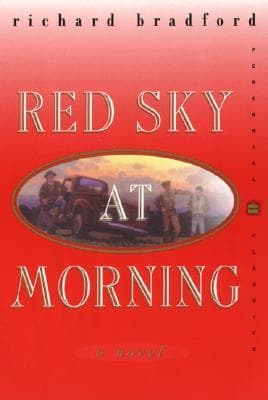
Richard Bradford (1920)
Genre
Historical Fiction / Young Adult
Reading Time
250 min
Key Themes
See below
Sign in to track this book
In 1944 New Mexico, a young boy grows up during WWII, learning about family, friendship, and independence under an amber sky.
The story begins with seventeen-year-old Joshua 'Josh' Phipps and his mother, Mary, leaving their comfortable home in Mobile, Alabama. Josh's father, Frank Phipps, an architect, decides to enlist in the Navy after the attack on Pearl Harbor. Josh is initially resentful and confused by this decision. Frank believes it is his duty to serve, leaving his family behind. They move to Fairhope, a smaller, more rural town on Mobile Bay, where they will live in the family's old, somewhat run-down summer house. This sudden change takes Josh away from his familiar life, friends, and the girl he liked, moving him into an unfamiliar place and a more modest life with his mother.
When they arrive in Fairhope, Josh finds a town very different from Mobile. Their summer house, 'The Pillars,' needs repairs, and the general atmosphere is simple and rustic, a strong contrast to his previous life. He quickly meets several of the town's unique characters. There is Steenie, a smart, independent girl who works at the local library and becomes important in his new life. He also meets 'Jimbob' Buel, a loud and somewhat rough local boy who at first does not get along with Josh. Fairhope's slower pace and close community are a culture shock for Josh, who feels out of place and misses his old life and his father's return.
Josh's first interactions in Fairhope are full of misunderstandings. He tries to impress Steenie with his city sophistication, but she sees through it immediately. His first major conflict is with Jimbob Buel, who questions Josh's perceived arrogance. A fight happens, showing Josh's inexperience with rough rural life. Despite their initial dislike, this fight leads to a gradual respect and eventual friendship between Josh and Jimbob. Josh also starts working at the local general store. This job further involves him in Fairhope's daily life and social scene, making him let go of some of his old ideas.
With his father away, Josh feels more responsible for his mother and himself. Money is tighter than they are used to, and Josh's earnings from the general store become important. He also takes on the role of 'man of the house,' which means dealing with household repairs and other practical matters he had never thought about before. His mother, Mary, supports him but also struggles with her own worries about Frank's safety and adjusting to their new life. This time forces Josh to grow up quickly, moving past his sheltered pre-war adolescence and facing the realities of adult life and the sacrifices war demands.
As summer goes on, Josh's friendships with Steenie and Jimbob change significantly. Steenie, with her intelligence, independence, and strong sense of self, challenges Josh's assumptions and broadens his perspective. She introduces him to books and ideas, and their talks become a source of intellectual stimulation and emotional connection. Jimbob, despite his tough exterior, proves to be a loyal friend and teaches Josh about practical rural life. He shows Josh about fishing, hunting, and the unspoken rules of their community. These friendships help Josh connect his past life in Mobile with his present in Fairhope, showing him the value of different people and experiences.
Letters from Frank Phipps arrive regularly, sharing details of his life in the Navy. While these letters offer some comfort to Mary and Josh, they also show the growing distance, both physical and emotional, between Frank and his family. Josh notices a change in his father's tone, a new seriousness shaped by his experiences. The letters serve as a constant reminder of the war overseas and the uncertainty of their situation. For Josh, the letters confirm that his father is no longer just the architect he knew, but a man deeply changed by the global conflict, adding another layer to Josh's own growth.
A major hurricane threatens the Gulf Coast, bringing urgency and fear to Fairhope. This natural disaster tests Josh and the community. He works with Jimbob and other townspeople to secure homes and prepare for the storm. During the hurricane, Josh shows courage and resourcefulness he did not know he had, helping his mother and others. The shared experience of facing the storm strengthens his bond with Fairhope residents and reinforces his growing sense of belonging. It is a moment where his city upbringing gives way to a practical, resilient spirit.
Amidst the ongoing war and his personal adjustments, Josh experiences a significant personal loss that affects him deeply. This event, which could be the death of a minor character or a serious injury, makes him confront how fragile life is and the reality of grief. While specific details are not given, this tragedy helps him grow emotionally. It shows how loss was common during wartime, even in a seemingly peaceful town, and deepens Josh's understanding of human suffering. He learns to rely on his friends and community for support, realizing the strength found in shared sorrow.
Frank Phipps finally returns home on leave, a moment Josh and Mary have looked forward to. However, the reunion is not entirely as expected. Frank is a changed man, hardened by his Navy experiences. He is quieter, more distant, and the easygoing father Josh remembered seems to have been replaced by someone more serious and tired. Josh, too, has matured, and the dynamic between father and son has shifted. There is a subtle tension as both try to reconnect after their separate wartime experiences. This visit highlights the lasting impact of the war on individuals and families.
Frank's leave ends, and he must return to duty. This second farewell is different from the first. Josh now understands his father's deep sacrifices and immense courage. While there is still sadness, there is also a deeper respect and a more mature understanding between them. Josh has accepted his father's decision and the reality of their separation. He is no longer just a boy resenting his father's absence, but a young man who has taken on his own responsibilities and found his place in the world, even without his father. The red sky at morning, a symbol of warning and beauty, reflects the complex feelings of this moment.
By the end of the summer, Josh is fully part of the Fairhope community. He has found true friends in Steenie and Jimbob, a sense of purpose in his work, and a new appreciation for the town's simple, honest life. He no longer feels like an outsider but a contributing member. He understands the value of community, strength, and the quiet dignity of everyday life. While the war continues, Josh has found a way to grow personally amidst global conflict. He looks forward to his future, whether it involves college or other plans, with confidence gained from his experiences in Fairhope.
The Protagonist
Josh transforms from a resentful, naive city boy into a mature, responsible young man who finds his place and purpose in a new community.
The Supporting
Frank's arc is seen through his family's perspective; he leaves as a civilian and returns a changed, war-hardened man.
The Supporting
Mary adapts from a city housewife to a resilient woman managing a household during wartime, demonstrating quiet strength.
The Supporting
Steenie remains a steady, insightful presence, acting as a catalyst for Josh's personal growth without significantly changing herself.
The Supporting
Jimbob evolves from an initial antagonist to a loyal, steadfast friend, demonstrating the power of understanding beyond first impressions.
The Supporting
Mr. Buel remains a consistent, moral compass for the community and for Josh.
The Supporting
Mrs. Buel remains a constant source of warmth and domestic stability for Josh and her family.
The Supporting
Mr. Ransome remains a consistent, practical figure, providing a stable work environment for Josh.
The novel's main theme is Josh's journey from a privileged, somewhat naive city boy to a responsible, understanding young man. His father's enlistment forces him into an unfamiliar place where he must take on adult duties, earn money, and handle complex social interactions. Scenes like his first fight with Jimbob, his job at the general store, and his efforts during the hurricane all contribute to his quick growth, removing his youthful illusions and building a stronger character. He learns to value different things and to find his own place.
““He had left Mobile a boy, resentful and confused. He was leaving Fairhope a young man, still confused, perhaps, but with a new sense of purpose and belonging.””
While the war is fought overseas, its effects are deeply felt by those at home. Frank Phipps's enlistment starts the entire story, moving his family and forcing them into a new, more difficult life. Constant worry for Frank's safety, financial stress, and a general feeling of uncertainty fill the story. The war changes people, as seen in Frank's return, and reshapes communities, as Fairhope comes together. It shows the sacrifices made by families, not just soldiers, and how global conflict reaches even the most remote parts of life.
““The war was a distant thunder, but its echoes reached even to Fairhope, shaking their lives and reshaping their futures.””
At first, Josh feels like an outsider in Fairhope, missing his old life. However, through shared experiences, challenges, and forming real friendships, he slowly accepts the close-knit community. The townspeople, despite their unique qualities, show strength, loyalty, and strong mutual support, especially during the hurricane. This theme highlights the importance of human connection and how finding one's place in a community can provide stability and meaning, even in chaotic times. His friendships with Steenie and Jimbob are key to his integration.
““He realized then that belonging wasn't about where you were born, but where you found the people who saw you, truly saw you.””
The novel explores different kinds of loss: the loss of a comfortable past, the absence of a father, and potentially the loss of life. Josh experiences the grief of separation and the anxiety of the unknown. However, alongside loss, the theme of strength stands out. Characters adapt to new situations, face hardships like the hurricane with courage, and find strength in each other. Josh's ability to cope with his father's changed demeanor and his own personal losses shows his growing resilience, highlighting people's ability to endure and find hope even in difficult times.
““The world might be tearing itself apart, but here, in this small corner, life found a way to mend and grow.””
Fairhope, Alabama, acts as a crucible for Josh's transformation.
The small, rural town of Fairhope is more than just a backdrop; it functions almost as a character itself. Its rustic simplicity, close-knit community, and natural environment (especially Mobile Bay and the threat of hurricanes) provide the stark contrast to Josh's previous urban life. The town's unique rhythms, its eccentric inhabitants, and the demands of its way of life force Josh out of his comfort zone and into a process of self-discovery. Without Fairhope, Josh's maturation would not be as profound or as challenging.
Correspondence from Frank Phipps bridges the physical distance and reveals war's impact.
Frank Phipps's letters from the Navy serve as a crucial plot device. They are the primary link between the family and the war front, keeping Frank's presence alive in the narrative despite his physical absence. These letters provide updates, offer reassurance, but also subtly reveal the changes happening within Frank due to his experiences. They intensify the family's anxieties and provide a tangible reminder of the war's ongoing impact, fueling Josh's internal conflict and his desire for his father's return, while also foreshadowing Frank's eventual transformation.
A natural disaster serves as a powerful test and catalyst for community bonding.
The hurricane that threatens Fairhope is a significant plot device, acting as an external conflict that mirrors and intensifies the internal struggles of the characters. It forces Josh to confront real danger, demanding resourcefulness and courage he didn't know he possessed. More importantly, it brings the entire community together, dissolving social barriers and fostering a strong sense of unity and mutual reliance. The shared experience of weathering the storm accelerates Josh's integration into Fairhope and solidifies his bonds with its residents, proving his worth not as an outsider, but as a member of the community.
“Red sky at morning, sailors take warning. Red sky at night, sailors delight.”
— The old adage that gives the book its title, often repeated by the narrator.
“I was seventeen years old, and already I had experienced the loss of my father, the upheaval of my home, and the bewildering beauty of a woman much older than myself.”
— The narrator, Josh, reflecting on his rapid maturation and experiences after his father's death.
“The thing about women, I was beginning to learn, was that they were never simple. They were like a good book, full of twists and turns and unexpected chapters.”
— Josh's internal monologue about the complexities of women, particularly reflecting on Steenie and Marcia.
“It was a summer of learning, of growing, of making mistakes and trying to understand the world.”
— A summary statement about the pivotal summer Josh spends in Corrales, New Mexico.
“Corrales was a place where time moved differently, slower, like the dust motes dancing in the sunbeams.”
— Josh's description of the sleepy, rural New Mexico town where he is sent to live.
“My father always said that a man's character was forged in adversity, and I was certainly getting my share of forging.”
— Josh reflecting on his father's wisdom as he faces new challenges in Corrales.
“There's a certain kind of loneliness that comes from being in a new place, even if it's beautiful.”
— Josh's feelings of isolation despite the picturesque surroundings of New Mexico.
“Sometimes the most important lessons aren't taught in school, but in the quiet moments of life.”
— Josh's realization about the value of his practical and emotional experiences during the summer.
“You can't go back, not really. But you can carry what you learned with you.”
— Josh's understanding that his past experiences shape who he is, even if he can't relive them.
“The desert had a way of stripping things down to their essentials, showing you what was truly important.”
— Josh's observation about the transformative power of the New Mexico landscape.
“It wasn't just about surviving; it was about living, truly living, for the first time.”
— Josh's realization that his time in Corrales was more than just a temporary exile.
“Some truths are like wild horses; they can't be tamed, only respected from a distance.”
— A metaphorical reflection on the untameable nature of certain realities or emotions.
“The past is a story we tell ourselves, but the future is a story we write.”
— Josh contemplating the distinction between memory and agency in shaping his life.
“New Mexico was a land of harsh beauty, where life and death danced a constant, intricate ballet.”
— Josh's vivid description of the unique environment and its cycles.
Ready to see how well you understood this book? Take our interactive quiz with 10 questions.







