“The sea is like a great, beautiful, dangerous lady. You must respect her, or she will swallow you whole.”
— Pietro's father warning him about the sea.

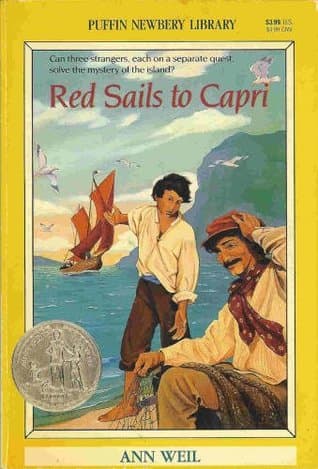
Ann Weil (1953)
Genre
Children's / Historical Fiction / Mystery / Young Adult
Reading Time
160 min
Key Themes
See below
Sign in to track this book
When a red-sailed ship brings three strangers to his family's Capri inn, fourteen-year-old Michele is drawn into a quest for beauty, adventure, and a mystery that will change his island home.
Fourteen-year-old Michele, a diligent and observant boy living on Capri, is immediately drawn to a red-sailed boat entering the harbor. This event is unusual for the quiet island, and Michele senses it means change. The boat carries three gentlemen: Mr. Amos, an American looking for beauty; Mr. Williams, an Englishman seeking adventure; and the most mysterious, Mr. Davidson, a Scotsman whose goal is 'something difficult to explain.' They all book rooms at Michele's family inn, exciting Michele and the islanders, who are not used to such grand visitors.
The three guests quickly become a source of great interest for the people of Capri. Mr. Amos spends his days sketching the island's scenery, calling it beautiful. Mr. Williams goes on daring trips, climbing cliffs and exploring caves, always looking for thrills. Mr. Davidson, however, is the most puzzling; he spends hours looking at the sea, often alone, and seems to be in deep thought, sometimes making vague comments. Their unusual activities and unclear goals lead to much talk among the villagers, who try to guess why they are visiting the secluded island.
At first, Michele views the visitors with a mix of awe and suspicion, especially given their odd habits. However, his curiosity and intelligence lead him to watch them closely. He listens to their talks, watches their movements, and tries to understand why they are there. Michele often finds himself with them, whether serving them at the inn or seeing them during their daily trips. He begins to feel a connection to Mr. Davidson, in particular, sensing a deeper meaning behind the Scotsman's quiet observations and thoughtful manner, which Michele himself shares.
As the strangers settle in, the old legend of the Blue Grotto, a sea cave known for its glowing blue water but with a rumored inaccessible entrance, comes up in conversations. The islanders have long believed it to be a magical, almost mythical place. Michele notices that the three visitors, especially Mr. Davidson, show a particular interest in this legend. They start asking detailed questions about its location, local stories, and any attempts to enter it. This focus on the Grotto further makes Michele believe their visit is connected to something more than simple tourism, suggesting a hidden agenda.
While exploring an abandoned fisherman's hut, Michele finds an old, worn map. It is a crude but detailed drawing of the coast, with markings that seem to show an unusual way to the Blue Grotto. This discovery excites Michele, as it links to the mystery. He realizes the map could be the key to finding the Grotto, a secret many islanders, including his own family, have always thought impossible to uncover. He decides to keep the map hidden for a time, thinking about its meaning and how best to use this new information.
After much thought, Michele decides to tell Mr. Davidson, sensing that the Scotsman is the most likely to understand and value his discovery. He shows the old fisherman's map, carefully explaining where he found it and what he thinks it means. Mr. Davidson, known for being reserved, shows real excitement and surprise. He immediately sees the map's potential to guide them to the Blue Grotto's entrance, confirming Michele's instincts about the visitors' true purpose and building trust and a shared adventure between them.
With the map, Michele, Mr. Davidson, and the adventurous Mr. Williams set out in a small boat to find the Grotto's hidden entrance. Mr. Amos, happy with his art, chooses not to join. The trip is difficult, as the map is old and the sea around Capri is unpredictable. They navigate strong currents and narrow passages, using Michele's knowledge of the coast and Mr. Williams's daring spirit. The journey tests their determination and teamwork, with Michele guiding them through familiar waters, searching for the exact spot on the old map.
After hours of searching, they finally find a small, almost invisible opening under a rocky overhang, exactly where the fisherman's map suggested. It is a submerged entrance, only passable at low tide and in calm waters. Michele, small and brave, volunteers to go first. He dives into the dark water. A few tense moments later, he reappears inside the Blue Grotto, its waters glowing with an ethereal light. The others follow, amazed by the beauty of the legendary cave, which had been hidden for so long.
Inside the Blue Grotto, surrounded by its blue light, Mr. Davidson finally explains his 'something difficult to explain.' He is a scientist, and his goal was to find a place where a specific light phenomenon could be observed and studied—a phenomenon he believed would confirm a scientific theory about light refraction through water. The Blue Grotto, with its unique underwater opening and light conditions, is the perfect natural laboratory. His discovery is not just personal but has important scientific meaning, changing how natural light is understood.
The discovery of the Blue Grotto's accessible entrance and Mr. Davidson's scientific findings bring great attention to Capri. News of the Grotto's beauty and its scientific importance spreads quickly, attracting scholars, artists, and tourists from around the world. The quiet fishing island changes, experiencing a boom in visitors and new wealth. Michele's inn thrives, and the islanders embrace their role as guardians of this natural wonder. The red-sailed boat, which once brought mystery, ultimately brought a future of excitement and opportunity to Capri.
Michele, once an innkeeper's son, becomes a local hero and a key part of Capri's change. His courage, intelligence, and sharp observation were important to the discovery. He earns respect from his family and the islanders, and his view of the world expands beyond Capri. He continues to help guide visitors to the Grotto, sharing its history and the story of its rediscovery. The adventure has matured him, giving him a sense of purpose and a deeper appreciation for his home, knowing he played an important part in shaping its future.
The Protagonist
Michele transforms from a quiet, observant boy into a courageous and respected figure, playing a pivotal role in his island's future.
The Supporting
Initially a man of mystery, Mr. Davidson's true scientific purpose is revealed, leading to a significant discovery.
The Supporting
Mr. Williams fulfills his desire for adventure by participating in the Blue Grotto's discovery, contributing his physical courage.
The Supporting
Mr. Amos finds the beauty he seeks in Capri, his role primarily being an observer and appreciator of the island's aesthetic.
The Supporting
They witness Capri's transformation and adapt their inn and lives to the island's newfound fame and prosperity.
The Supporting
The islanders collectively experience a shift from a secluded community to a celebrated and prosperous destination, adapting to new opportunities.
The novel explores the human desire to explore and understand the unknown. The arrival of the red-sailed boat itself marks the unfamiliar entering the quiet life of Capri. Each of the three strangers is driven by a quest for something beyond the ordinary—beauty, adventure, or scientific truth. Michele, too, is drawn into the mystery, his curiosity overcoming any initial fear. The Blue Grotto, a legendary and inaccessible place, symbolizes the unknown, its appeal powerful enough to unite different people in a common goal. Its discovery satisfies a deep human need for exploration and revelation, changing both the individuals and the island.
“What they brought with them was a mystery and adventure that would change Michele's life - and all of Capri - forever.”
Michele's character shows that keen observation and an inquisitive mind can lead to discoveries. He does not just watch events; he actively observes, listens, and puts together clues, from the strangers' odd habits to the old fisherman's map. His initial curiosity about the red-sailed boat grows into a determined search for the truth behind the visitors' mission. It is Michele's sharp eyes that spot the important map and his courage to share his insights with Mr. Davidson that leads to the Blue Grotto's rediscovery. The story highlights how paying attention to details and asking questions can lead to extraordinary results.
“The minute he saw the boat with the red sails moving into the harbor, Michele knew that something exciting was going to happen.”
The three strangers represent distinct but connected ways of understanding the world: Mr. Amos seeks beauty (art), Mr. Williams seeks adventure (experience), and Mr. Davidson seeks scientific truth (knowledge). The novel shows how these different pursuits can come together to reveal a deeper, more complete picture of reality. The Blue Grotto itself is not just a scientific wonder but also a place of great beauty and requires an adventurous spirit to reach. This theme suggests that true discovery often happens when different viewpoints and motivations combine, enriching the human experience. The Grotto satisfies all three quests, showing their connection.
“They all said they were searching - one for beauty, one for adventure, and one for 'something difficult to explain.'”
Capri, a small island with a rich history, is the setting for a story of change. The arrival of the red-sailed boat and the discovery of the Blue Grotto change the island's quiet, predictable life. The islanders, initially rooted in their customs and legends, must adapt to new fame, tourism, and wealth. While the change brings economic benefits, it also means the end of a secluded era. The story explores the tension between keeping traditions and embracing progress, showing how one event can push a community into a new, unforeseen future.
“What they brought with them was a mystery and adventure that would change Michele's life - and all of Capri - forever.”
A visual symbol of impending change and the arrival of the unknown.
The red-sailed boat serves as the initial catalyst and a powerful symbol in the narrative. Its unusual appearance in the tranquil Capri harbor immediately signals that something out of the ordinary is about to happen. It represents the external force that disrupts the island's routine and introduces the element of mystery and adventure. Its vibrant color stands out against the blue sea, marking it as a harbinger of the exciting, and eventually transformative, events that will unfold.
A legendary, seemingly inaccessible sea cave, representing the ultimate mystery and goal.
The Blue Grotto functions as the central MacGuffin and the ultimate destination of the strangers' quest. For the islanders, it's a mythical place, beautiful but unattainable. For the strangers, it's the specific site that holds the key to their individual pursuits. Its legendary status creates intrigue, and its hidden entrance provides the central challenge of the plot. The Grotto's ethereal beauty and scientific significance make it a worthy prize, giving tangible meaning to the characters' abstract quests.
A crucial physical clue that unlocks the mystery of the Blue Grotto's entrance.
The old fisherman's map acts as a critical plot device, moving the narrative from speculation to concrete action. Discovered by Michele, it provides the tangible evidence and specific directions needed to locate the Blue Grotto's hidden entrance. Without this map, the strangers' quest might have remained unsolved. It highlights Michele's role as an active participant and problem-solver, not just an observer, and serves as a bridge between ancient local knowledge and modern exploration.
“The sea is like a great, beautiful, dangerous lady. You must respect her, or she will swallow you whole.”
— Pietro's father warning him about the sea.
“Sometimes the most important things are hidden right in front of your eyes.”
— Pietro reflecting on the mystery.
“A good story is like a warm fire on a cold night. It chases away the shadows.”
— Pietro's grandmother talking about storytelling.
“Fear is a poor captain for any voyage.”
— A wise old fisherman offering advice to Pietro.
“The island has its secrets, just like an old woman has her memories. You must be patient to uncover them.”
— An old woman speaking to Pietro about Capri.
“It's not what you see, but what you understand that truly matters.”
— Pietro's internal thought while trying to solve a puzzle.
“Even the smallest wave can change the course of a great ship.”
— A metaphor used by a character to explain the impact of small actions.
“The truth, like a pearl, often lies hidden beneath layers of sand and water.”
— Pietro's realization about the elusive nature of the truth.
“There are some things the heart knows even before the mind can grasp them.”
— A character speaking about intuition and feelings.
“Adventure isn't always found in faraway lands; sometimes it waits right outside your door.”
— Pietro's realization about his own journey.
“To truly see a place, you must listen to its whispers.”
— A character advising Pietro to pay attention to the environment.
“Courage is not the absence of fear, but the triumph over it.”
— Pietro facing a challenging situation.
“Every journey, no matter how small, begins with a single step and a curious heart.”
— Pietro setting out on his quest.
“The past is like an anchor; it holds you in place unless you choose to lift it.”
— A character reflecting on moving forward.
Ready to see how well you understood this book? Take our interactive quiz with 10 questions.

Dan Gemeinhart
4.5

Kate O'Hearn
4.4

Jeanne Birdsall
4.4

Jen Wang
4.4

Wendelin Van Draanen
4.3

John Marsden
4.3

Chris Van Allsburg
4.3

Jennifer A. Nielsen
4.2