“Rapunzel, Rapunzel, let down your hair, that I may climb thy golden stair.”
— The witch's famous summons to Rapunzel in the tower.

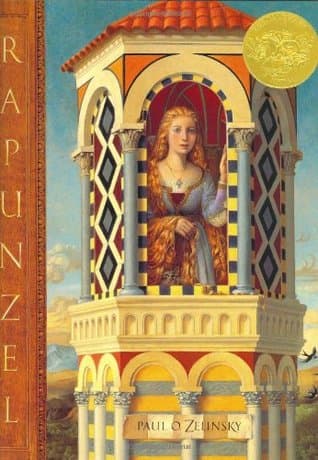
Paul O. Zelinsky (1997)
Genre
Fantasy / Children's / Creativity / Romance
Reading Time
15 min
Key Themes
See below
Sign in to track this book
In a lush, possessive world of esoteric beauty, Rapunzel's golden hair becomes a gilded cage, forcing her and her prince to brave the wilderness for true self-reliance and the bitter-sweet dawn of adulthood.
A husband and wife, living peacefully, discover the wife is pregnant. During her pregnancy, the wife develops an overwhelming craving for the rapunzel growing in the magnificent, walled garden of a powerful sorceress named Dame Gothel. The husband, fearing Dame Gothel's wrath, initially forbids her from entering. However, the wife's craving becomes so intense that she begins to waste away. Out of desperation, the husband scales the wall one night to gather some rapunzel for his wife. He is caught by the formidable Dame Gothel, who angrily confronts him about his theft. The husband pleads for his wife's life, explaining her condition and intense desire for the herb.
Dame Gothel, after hearing the husband's desperate plea, agrees to let him take all the rapunzel he wishes for his wife. However, her generosity comes with a terrible price. She demands that in return for the rapunzel, the couple must give her the child their wife is expecting. Overwhelmed by fear and the immediate need to save his wife, the husband reluctantly agrees to the sorceress's condition. He takes the rapunzel back to his wife, who quickly recovers her health and spirits. The couple, however, live with the heavy secret and the dread of their impending promise to Dame Gothel.
When the baby girl is born, she is exceptionally beautiful, with long, golden hair. True to her word, Dame Gothel appears shortly after the birth to claim the child. The distraught parents are powerless to stop her as Dame Gothel takes the infant away. The sorceress names the child Rapunzel, after the herb that led to her acquisition. Dame Gothel raises Rapunzel in an isolated, opulent tower deep within a forest, which has no doors or stairs, only a single window high up. Rapunzel grows up in complete solitude, knowing no one but Dame Gothel, who visits her regularly.
As Rapunzel grows older, her golden hair grows incredibly long, thick, and strong, reaching far beyond the tower window. This is the only means of access to her chamber. Whenever Dame Gothel wishes to visit Rapunzel, she stands at the base of the tower and calls out, 'Rapunzel, Rapunzel, let down your hair!' Rapunzel, hearing her name, would unbraid her hair, wrap it around a hook by the window, and let the long braid cascade down the side of the tower. Dame Gothel would then climb up the hair, hand over hand, to reach Rapunzel inside. This routine continues for many years, keeping Rapunzel completely isolated from the outside world.
Years pass, and Rapunzel, now a young woman, fills her solitary life by singing to herself. Her voice is beautiful and carries through the forest. One day, a young prince is riding through the woods when he hears her enchanting song. Intrigued, he follows the sound until he discovers the mysterious tower with no visible entrance. He hides himself and watches, perplexed, wondering how anyone could enter or leave. He returns day after day, captivated by the voice, until he eventually witnesses Dame Gothel's unique method of entry: calling for Rapunzel to let down her hair.
The clever prince, having observed Dame Gothel's method, waits until she has departed. Then, he steps out from his hiding place and calls out, 'Rapunzel, Rapunzel, let down your hair!' Rapunzel, mistaking his voice for Dame Gothel's, lets down her golden braid. The prince climbs up and enters her chamber. Initially frightened by the sight of a man, Rapunzel is soon comforted by the prince's gentle demeanor and kind words. They quickly fall in love, and the prince begins to visit her every evening, bringing her gifts and spending hours talking to her, awakening her to the world beyond the tower.
One day, during a visit from Dame Gothel, Rapunzel innocently remarks, 'Dame Gothel, how is it that you are so much heavier to pull up than the young prince?' Her words immediately alert Dame Gothel to the prince's visits and Rapunzel's betrayal. Enraged by this discovery, Dame Gothel, feeling her possessive hold over Rapunzel threatened, becomes furious. She accuses Rapunzel of disloyalty and immediately takes drastic action to prevent any further contact between Rapunzel and the outside world, specifically the prince. Her anger is absolute and without mercy.
In a fit of rage, Dame Gothel seizes a pair of shears and cruelly cuts off Rapunzel's beautiful golden hair, severing her connection to the outside world. She then magically banishes Rapunzel to a desolate wilderness, leaving her alone and vulnerable. When the prince arrives that evening, calling for Rapunzel, Dame Gothel lowers the severed braid down the tower. As the prince climbs, he is met not by Rapunzel, but by the terrifying sorceress. Dame Gothel reveals her deception and, in her fury, pushes the prince from the tower. He falls into a thorny bush below, and the thorns pierce his eyes, blinding him.
Blinded and heartbroken, the prince stumbles aimlessly through the forest, consumed by grief and despair over the loss of his beloved Rapunzel. He survives on roots and berries, his only solace the faint memory of her voice. Meanwhile, Rapunzel, alone in the barren wilderness, discovers she is pregnant with the prince's children. Despite her harsh circumstances, she gives birth to twins, a boy and a girl, and raises them in the desolate area, finding strength and purpose in their presence. She longs for the day she might be reunited with her prince.
After many years of wandering, the blind prince eventually stumbles into the part of the wilderness where Rapunzel and her children live. He hears a familiar, beautiful singing voice – Rapunzel's. Drawn by the sound, he follows it until he finds her. Rapunzel, upon recognizing her beloved prince, rushes to him, weeping tears of joy and sorrow. As her tears fall onto his blinded eyes, a miracle occurs: his sight is instantly restored. Overjoyed, they embrace, and the prince meets his children for the first time. They return to his kingdom, where they are welcomed, marry, and live happily ever after.
The Protagonist
From an isolated, passive captive, Rapunzel evolves into a resilient mother who finds love, endures hardship, and ultimately achieves freedom and family.
The Antagonist
Dame Gothel remains a static character, driven by possessiveness, ultimately losing her hold on Rapunzel due to her own cruelty.
The Supporting
From a curious and romantic suitor, he endures great suffering and blindness, ultimately finding his beloved and his sight, becoming a steadfast husband and father.
The Supporting
He makes a life-altering choice out of love and fear, leading to the loss of his daughter.
The Supporting
Her craving initiates the story's central conflict, leading to the loss of her child.
The Mentioned
They are born in hardship and become a symbol of hope and reunion for their parents.
The central conflict of the story is driven by Dame Gothel's possessive and controlling 'love' for Rapunzel, which traps her in an isolated tower. This contrasts sharply with the genuine, liberating love shared between Rapunzel and the Prince. Dame Gothel's possessiveness shows as an inability to allow Rapunzel to grow and experience the world, leading to her cruel acts of cutting Rapunzel's hair and blinding the prince. True love, as depicted by Rapunzel and the Prince, involves sacrifice, endurance, and ultimately, liberation and mutual growth, symbolized by their reunion and the restoration of sight.
“For the sorceress loved Rapunzel fiercely, but with a fierce and jealous love. She wanted Rapunzel all to herself, always.”
Rapunzel's physical confinement in the tower is a strong symbol of her emotional and experiential isolation. The tower, though beautiful inside, represents a gilded cage that stifles her development. Her long hair, while a means of access for Dame Gothel, also symbolizes her entrapment. Freedom is achieved not just by escaping the tower, but by enduring the hardships of the wilderness, where Rapunzel learns self-reliance and independence. Her eventual reunion with the prince and their life together signifies a complete liberation from both physical and emotional constraints, ending in a life of self-determination.
“And when the child was twelve years old, the sorceress shut her in a tower in the middle of a great forest.”
The story traces Rapunzel's journey from an innocent, naive girl to a resilient, self-reliant woman and mother. Her confinement prevents natural maturation, but her encounters with the prince awaken her to love and the outside world. The harsh experience in the wilderness, after being cast out by Dame Gothel, forces her to develop inner strength, resourcefulness, and maternal instincts, changing her. The prince also undergoes a journey of maturation, enduring blindness and hardship, which deepens his character and love. Their reunion marks the end of their individual journeys of growth into adulthood.
“But in that desolate place, Rapunzel learned to survive, and in time, she gave birth to a boy and a girl.”
The entire plot starts with the desperate choice of Rapunzel's father to steal rapunzel from Dame Gothel's garden to save his wife. This act, born of love and desperation, leads to the terrible bargain of giving up their firstborn child. This theme highlights how even well-intentioned or desperate decisions can have long-lasting consequences, affecting not only the individuals involved but also future generations. The sorrow and separation experienced by Rapunzel and her biological parents stem directly from this initial, desperate choice, showing the weight of such decisions.
“And the husband, terrified, promised her anything she wanted, if only she would not harm his wife.”
A multi-faceted symbol of confinement, connection, and identity.
Rapunzel's extraordinarily long, golden hair serves as the primary plot device for entry and exit from the tower. It is both a tool of her confinement, used by Dame Gothel, and later, the means by which the prince gains access to her. Symbolically, it represents Rapunzel's unique beauty, her connection to the outside world (however limited), and her identity. When Dame Gothel cuts her hair, it is a brutal act of severing Rapunzel's connection to her love and her agency, marking her banishment. Its absence forces Rapunzel to find new means of survival and self-reliance.
A symbol of isolation, possessiveness, and a gilded cage.
The tower is the central setting for Rapunzel's early life and serves as a powerful symbol of her isolation and Dame Gothel's possessiveness. Lacking doors or stairs, it physically embodies her confinement. Zelinsky's depiction of the tower as one of 'esoteric beauty' and 'physical luxury' on the inside emphasizes that confinement isn't always desolate but can be a comfortable prison, making the struggle for freedom more about psychological and emotional liberation than physical hardship initially. It highlights the deceptive nature of comfort without freedom.
A device for discovery, connection, and expression.
Rapunzel's beautiful singing voice is the initial catalyst for the prince's discovery of her. It serves as her only means of expression and connection to the outside world from within her confinement. The sound of her voice draws the prince to the tower, initiating their relationship. Later, in the wilderness, her singing again leads the blind prince to her, enabling their reunion. It symbolizes her innate spirit, her longing, and her enduring identity, acting as a beacon of hope and a means of communication beyond physical barriers.
A setting for hardship, self-discovery, and transformation.
The wilderness where Rapunzel is banished, and where the blind prince wanders, serves as a crucial setting for their individual transformations. It is a place of hardship and suffering, contrasting sharply with the luxurious confinement of the tower. For Rapunzel, it is where she learns self-reliance, resilience, and becomes a mother, shedding her innocence. For the prince, it is a journey of endurance and unwavering hope. This harsh environment strips them of their former lives, forcing them to grow and find inner strength, ultimately leading to a more profound and earned happiness.
“Rapunzel, Rapunzel, let down your hair, that I may climb thy golden stair.”
— The witch's famous summons to Rapunzel in the tower.
“The witch had built a tower in the middle of a great forest, and it had neither door nor staircase, but only a tiny window at the very top.”
— Description of Rapunzel's isolated prison.
“For two long years, the prince wandered through the forest, weeping and singing, 'Rapunzel, Rapunzel, let down your hair!'”
— The prince's despair and search after being blinded.
“She was so beautiful that the prince was enchanted, and he felt that he must speak to her.”
— The prince's first sight of Rapunzel in the tower.
“The witch, when she heard of this, was terribly angry, for she knew that Rapunzel must have betrayed her.”
— The witch discovers Rapunzel's secret meetings with the prince.
“It was her tears, two of which fell upon his eyes, that restored his sight.”
— Rapunzel's tears heal the blinded prince.
“He knew that he could not climb up to her, for the tower was too high and smooth.”
— The prince's initial realization of the tower's inaccessibility.
“And when the witch had gone, Rapunzel let down her hair, and the prince climbed up to her.”
— The prince's first successful ascent to the tower.
“They lived happily ever after, and were much beloved by all.”
— The traditional happy ending of the fairy tale.
“The prince, in his despair, threw himself from the tower, but he did not die.”
— The prince's fall from the tower after being confronted by the witch.
“He wandered blind through the forest, eating only roots and berries, until at last he heard a voice that he knew.”
— The prince's arduous journey while blind, leading to Rapunzel's voice.
“The witch then took Rapunzel far into a desolate wilderness, where she left her to live in misery.”
— Rapunzel's banishment by the furious witch.
“She had long, beautiful hair, as fine as spun gold.”
— Description of Rapunzel's most distinctive feature.
“And so, after many years, they found each other again, and were filled with joy.”
— The reunion of Rapunzel and the prince after their long separation.
Ready to see how well you understood this book? Take our interactive quiz with 10 questions.

Biography coming soon.







