“She had to fight the urge to run, to keep digging, to find the truth, no matter how ugly.”
— Eve Dallas investigating a particularly gruesome crime scene.

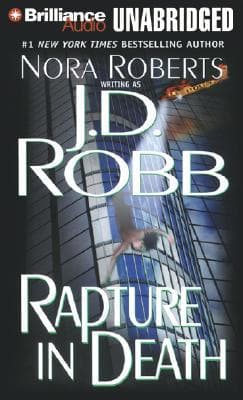
Genre
Thriller / Mystery / Science Fiction / Romance
Reading Time
9 min
Key Themes
See below
Sign in to track this book
In a future New York, Lieutenant Eve Dallas finds a plot where a virtual reality game, made for pleasure, is used as a weapon to cause ecstatic suicides, leaving smiling bodies.
The novel starts with Lieutenant Eve Dallas at a suicide scene. The victim is Dr. Harrison Garrett, a brilliant engineer known for his virtual reality work. He appears to have shot himself, but Eve senses something is off. Despite clear evidence, Garrett's serene smile in his last moments seems unnatural for someone taking their own life. She notices the clean apartment and no signs of struggle, which, with his professional standing and no obvious distress, makes her suspect it is not a simple suicide.
Soon after Dr. Garrett's death, two more people die in what are officially called suicides: Julian Cross, a flashy defense attorney, and Senator Anthony DeBlass, a powerful politician. Like Garrett, both men are found dead by their own hand, each with a calm, almost joyful look. The shared unsettling smiles, along with the victims' different backgrounds and no clear reason for suicide, convinces Eve that a serial killer is at work. She links the cases, seeing a pattern where others only see separate tragedies.
Eve's instincts are proven right when autopsies are done by Dr. Charlotte Mira, a profiler, and Dr. Morris, the medical examiner. While all three officially died from self-inflicted gunshots, advanced forensic analysis reveals a key detail: small, precise burn marks on the victims' brains, specifically in the limbic system, which controls emotions and pleasure. This finding changes the investigation from suicide to murder, confirming Eve's suspicions and pointing to a sophisticated, technological killing method that leaves no external trace.
Eve tells her husband, Roarke, a billionaire with a mysterious past and deep knowledge of new technology, including virtual reality. Roarke, worried about Eve's safety and the nature of the murders, immediately helps. His expertise in the tech world, especially advanced VR, is very useful. He starts analyzing data, looking for any device or method that could cause such specific brain damage and make someone kill themselves. His involvement adds a personal urgency to the case for Eve.
With the discovery of the brain burns, Eve and her team, including Detective Peabody, focus on technologies capable of such precision. Roarke quickly suggests advanced virtual reality systems, especially those that connect directly with neural pathways for better immersion. The victims' backgrounds – a VR engineer, a lawyer in tech cases, and a politician with ties to defense contracts – all suggest a link to the cutting-edge, and sometimes unregulated, world of virtual reality. This leads Eve to explore the darker side of VR, where the lines between pleasure and pain, reality and illusion, can blur.
Through forensic analysis and Roarke's inside knowledge, they narrow the possible weapon down to a highly advanced, experimental virtual reality device called 'Rapture.' This device, made to give extreme pleasure and joy directly to the brain, can overstimulate pleasure centers to the point of causing permanent damage and psychological manipulation. Roarke's contacts reveal that such technology, while mostly experimental, could exist in secret groups, able to be used as a weapon by someone with the right knowledge and access.
Eve concludes that the killer is not just causing brain damage, but using the Rapture device to make victims feel intense pleasure and joy, making them believe they are experiencing ultimate bliss. In this altered state, the killer subtly makes them take their own lives, leaving them with that serene smile. The method's brilliance and horror lie in its ability to turn a person's deepest desires against them, making their death seem like a final, joyful act rather than a forced murder, effectively hiding the killer's tracks.
As the investigation continues, Eve and Roarke look for individuals with the technical skill to create and use the Rapture device, and a reason to target these specific victims. They examine the victims' past professional and personal connections, searching for shared enemies or rivals in the high-stakes world of advanced technology. The killer is identified as Dr. Deena MacGuire, a brilliant but unstable scientist who felt wronged by the victims in various professional ways, especially concerning the development and recognition of the Rapture technology itself.
Eve tracks Dr. MacGuire to her hidden lab, where the killer tries to use the Rapture device on Eve, aiming to turn the detective's own mind against her. A tense fight follows, with Eve fighting for her life and against the device's psychological control. Roarke arrives to help, using his tech knowledge to help Eve counter MacGuire's attacks. With quick thinking and strong will, Eve resists the device's effects and arrests Dr. MacGuire, ending the 'Rapture' murders and getting justice for the victims.
After Dr. MacGuire's capture, Eve thinks about the chilling implications of the Rapture device and the dark side of technology. The case affects her deeply, showing how easily even good technologies can be used for harm. She deals with the idea of a murder weapon that leaves no physical trace and preys on the mind itself. The experience strengthens her commitment to justice and her understanding of the relationship between humans and the quickly changing future world, a world Roarke navigates easily.
The Protagonist
Eve further confronts the psychological manipulation of murder, solidifying her trust in her instincts and deepening her bond with Roarke.
The Supporting
Roarke further integrates his vast technological knowledge and resources into Eve's world, becoming an indispensable partner in her investigations.
The Supporting
Peabody continues to mature as a detective, gaining more confidence and demonstrating her investigative prowess under Eve's mentorship.
The Supporting
Dr. Mira continues to provide critical psychological insights, helping Eve navigate the complex motivations behind technologically advanced murder.
The Supporting
Dr. Morris's detailed forensic work becomes crucial in identifying the unique technological signature of the murders.
The Antagonist
Dr. MacGuire's descent into vengeful madness culminates in her using her genius to commit technologically advanced murders, leading to her capture.
The Mentioned
His death serves as the catalyst for Eve's investigation into the Rapture murders.
The Mentioned
His death confirms the pattern of the 'Rapture' murders, pushing Eve to look beyond simple suicide.
The Mentioned
His death solidifies the pattern and scale of the 'Rapture' murders, indicating a killer with high-level access and targets.
The novel shows how advanced technology, especially virtual reality, can be turned from a tool for improvement and pleasure into a weapon. The 'Rapture' device, made for extreme joy, becomes a way to psychologically manipulate victims into killing themselves. This theme is key to the plot, as Eve and Roarke must understand the technology's potential for both good and evil to solve the murders. It highlights the ethical problems in fast technological progress and the responsibility that comes with creating powerful tools, as seen in Dr. MacGuire's misuse of her invention.
“''It was designed to give ultimate pleasure, Eve. But in the wrong hands, it could give the ultimate death.''”
A main theme is the psychological manipulation used by the killer, Dr. Deena MacGuire. She does not physically force her victims but uses the Rapture device to create a state of joyful bliss, effectively 'brainwashing' them into suicide. This raises questions about free will and how easily the human mind can be influenced, especially when pleasure is the bait. Eve herself experiences this manipulation during the climax, showing the power of the killer's method and the subtle nature of control that works by twisting a person's deepest desires.
“''She didn't make them do it, Eve. She made them want to.''”
The novel compares Eve's search for justice with Dr. MacGuire's desire for revenge. MacGuire believes she was wronged and seeks to punish those she thinks stole her ideas or blocked her work, using her scientific skill for deadly retribution. Eve, however, is driven by a deep need to protect the innocent and ensure criminals are held responsible, regardless of their personal reasons. This conflict highlights the difference between personal revenge and the fair application of law, and how perceived wrongs do not excuse murder.
“''Vengeance is a poison. Justice is the cure.''”
Given virtual reality's central role, the theme of blurred lines between reality and illusion is important. The Rapture device creates an experience so real and pleasurable that victims lose touch with their actual situation, believing they are in a state of ultimate bliss. This psychological state is then used for murder. The story explores how technology can create convincing alternate realities, and the dangers when individuals, or society, struggle to tell the difference between what is real and what is a manufactured experience. This challenges Eve's own view of what makes a 'real' crime scene.
“''How do you fight a killer who makes you believe you're in paradise even as you die?'”
A fictional, advanced virtual reality device capable of inducing extreme pleasure and manipulating the brain.
The Rapture device serves as the central murder weapon and a key plot device. It is a highly advanced, experimental virtual reality system designed to stimulate the brain's pleasure centers directly, creating unparalleled euphoric experiences. Its existence and capabilities drive the entire mystery, as Eve and Roarke must understand its technology to identify the killer's method. It functions as both a technological marvel and a terrifying instrument of death, representing the novel's core theme of technology's dual nature. Its ability to leave no conventional forensic trace makes the murders particularly challenging to solve.
The consistent, unnervingly peaceful expression found on the faces of all the victims.
The serene smile on the faces of the victims is a crucial plot device that immediately signals to Eve that these are not ordinary suicides. It acts as a signature of the killer and a constant source of unease for Eve, pushing her to look beyond the obvious. This detail is what initially sets the investigation in motion and ultimately leads to the discovery of the Rapture device's unique method of manipulation. It's a visual manifestation of the killer's psychological control, making the deaths appear peaceful while masking their violent nature.
Roarke's vast knowledge of cutting-edge technology, particularly virtual reality, and his extensive resources.
Roarke's expertise in advanced technology, especially in the realm of virtual reality and clandestine inventions, is a vital plot device. Without his insider knowledge and access to specialized equipment and information, Eve would struggle to comprehend the nature of the Rapture device and track down its creator. He acts as a deus ex machina for technological solutions, providing explanations, resources, and even direct assistance in combating the killer's high-tech attacks. His role allows the plot to delve deeply into the speculative science fiction elements of the story.
The discovery of small, precise burn marks on the limbic system of the victims' brains.
The forensic anomaly of the brain burns, discovered by Dr. Morris and Dr. Mira, is a critical turning point in the plot. It immediately shifts the investigation from suicides to homicides and provides the first concrete evidence of a technological weapon. This detail guides Eve and Roarke towards investigating advanced neural interface technologies, specifically the Rapture device. It's the scientific proof that validates Eve's intuition and allows the team to understand the physical mechanism of death, moving the plot from a psychological mystery to a technologically driven one.
“She had to fight the urge to run, to keep digging, to find the truth, no matter how ugly.”
— Eve Dallas investigating a particularly gruesome crime scene.
“The dead whispered secrets, and it was her job to listen.”
— Eve reflecting on her role as a homicide detective.
“Love didn't make you weak. It made you vulnerable. And vulnerability was a strength she was still learning to embrace.”
— Eve contemplating her relationship with Roarke.
“Sometimes, the monster was the one you least suspected. Sometimes, the monster was the one who looked just like everyone else.”
— Eve considering the nature of evil in her cases.
“Roarke was her anchor, her safe harbor in the storm. And sometimes, he was the storm himself.”
— Eve's complex feelings about Roarke's personality.
“Justice wasn't about revenge. It was about balance. And sometimes, the scales were tipped by the smallest of details.”
— Eve's philosophy on achieving justice.
“The city never slept, and neither did its demons.”
— Eve's observation of futuristic New York's constant struggles.
“Every victim had a story, even if they couldn't tell it themselves.”
— Eve emphasizing the importance of giving a voice to the deceased.
“She didn't need a cape to be a hero. Just a badge, a brain, and a healthy dose of stubbornness.”
— Eve's internal monologue about her dedication to her job.
“Money didn't buy happiness, but it certainly could buy a lot of trouble.”
— Roarke's cynical perspective on wealth and its consequences.
“The past was a ghost, always lurking, always ready to reach out and grab you.”
— Eve's personal struggles with her traumatic past.
“Sometimes, the only way to heal was to face the pain head-on.”
— Eve's journey of confronting her inner demons.
“Even in the darkest places, there was always a flicker of hope, if you knew where to look.”
— Eve's enduring optimism despite the horrors she witnesses.
Ready to see how well you understood this book? Take our interactive quiz with 10 questions.

Biography coming soon.







