“The greatest trick the devil ever pulled was convincing the world he didn't exist. The greatest trick the zombie ever pulled was convincing the world it did.”
— A reflection on the perception of zombies vs. their true nature in the world.

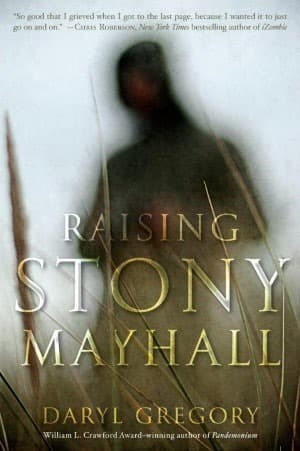
Daryl Gregory (2011)
Genre
Fantasy / Science Fiction
Reading Time
10-12 hours
Key Themes
See below
Sign in to track this book
After the first zombie outbreak, a family risks everything to raise a growing, sentient undead boy, who later discovers he is not alone.
In 1968, after the first zombie outbreak, Wanda Mayhall, a pragmatic woman, drives her three young daughters, Jenny, Jill, and Judy, through a severe snowstorm in rural Iowa. They find a car wreck and discover the frozen body of a teenage mother. Clutched in her arms is a baby, seemingly dead. As Wanda prepares to leave, the baby's eyes open, and he stirs. Overcoming her initial terror and the societal panic about 'zombies,' Wanda decides to take the infant home, naming him Stony, and commits to raising him as her own, keeping his unique condition a secret.
Stony Mayhall's childhood is one of careful concealment within the Mayhall household. Wanda and her daughters, especially Jenny, protect his secret. Despite his undead state, Stony slowly grows and develops, though at an unusual pace and with peculiar needs. He does not breathe, his heart does not beat, and he is resilient to injury. The family teaches him to mimic life, to hold his breath around others, and to hide his true nature. He learns to speak, read, and interact, developing a deep bond with his adoptive family, especially Jenny, who becomes his closest confidante and protector. His existence is a constant source of fear and love for the Mayhalls, who risk everything to keep him safe from a world that would destroy him.
Years pass, and Stony, now a young man, has largely mastered appearing human. However, his secret is violently exposed during a tragic incident. While protecting Jenny from her abusive boyfriend, Rex, Stony uses his unnatural strength, inadvertently killing Rex. The confrontation reveals his true, unliving nature to others, specifically Rex's friends. The local sheriff, a family friend who had long suspected something was wrong, is called. Realizing the danger he poses to his family and the certainty of his capture if he stays, Stony decides to flee. This escape marks the end of his sheltered life and the beginning of his journey into the wider, hostile world.
After fleeing Iowa, Stony becomes a drifter, constantly moving to avoid detection. He experiences the harsh realities of a world still paranoid about 'zombies' and the 'living dead.' During his travels, he eventually meets other individuals like himself—people who are 'undead' but sentient and growing. He learns that he is not unique and that there is a network of 'living dead' individuals. This encounter is a turning point, offering him a sense of belonging and the first real hope of understanding his own existence. He learns about the 'First Wave' and the broader implications of his condition, beginning to question the official narratives of the zombie outbreaks.
Stony finds his way to a hidden sanctuary for the living dead, a community of 'First Wave' individuals who have survived and evaded human authorities. Here, he meets others who share his condition, including individuals who have lived for decades in secret. He learns about Dr. Arland, a brilliant but controversial scientist who researched the 'living dead' phenomenon. Dr. Arland, unlike most, saw them not as monsters but as a new form of life. Stony also discovers that Arland had been working on a 'cure' or, more accurately, a way to stabilize and understand their condition, and that his research has been suppressed or stolen.
Meanwhile, Stony's adoptive sister, Jill Mayhall, has become a CDC agent specializing in 'zombie' outbreaks and tracking the living dead. Driven by fear and a desire to protect humanity, she is a leading figure in the government's efforts to contain and eradicate the 'First Wave.' Unbeknownst to her, the 'threat' she hunts is her adoptive brother. Her career is a direct consequence of her childhood trauma and the secret she carried, creating an irony and a looming conflict as her path inevitably converges with Stony's. She is a dedicated, if somewhat rigid, professional, committed to her mission.
Stony, now part of the living dead community, joins others in their quest to find Dr. Arland's complete research. They believe Arland's work holds the key to understanding their existence, potentially offering a way for them to coexist with humanity or even find a 'cure' for the accelerated decay that some of them experience. This search leads them through various clandestine operations, dodging government surveillance and encountering both sympathetic and hostile humans. The group faces numerous dangers, highlighting the constant threat under which the living dead live, and the desperation for answers that drives their actions.
The narrative ends in a dramatic confrontation where Stony's group, pursuing Arland's research, crosses paths with Jill and her CDC team. This leads to a shocking revelation for Jill: the 'living dead' she has been hunting is her own brother. The emotional impact is immense, forcing Jill to confront her deeply ingrained beliefs and the painful secret she had suppressed for decades. Stony, in turn, faces the sister who has dedicated her life to his destruction. This encounter forces both characters, and the reader, to question the definitions of life, humanity, and family, and the ethical implications of their respective missions.
Through recovered research and personal testimonies, the full truth about the 'First Wave' is revealed. It is revealed that the 'living dead' are not simply reanimated corpses but a new evolutionary step, a different form of life. Dr. Arland's research was not about a 'cure' in the traditional sense, but about understanding and integrating them into society, or at least ensuring their survival. The government, fearing the unknown and driven by panic, suppressed this information and demonized the 'First Wave,' leading to decades of persecution. The revelation forces a re-evaluation of everything the characters, particularly Jill, believed to be true.
After the revelations, the Mayhall family, now reunited in their understanding of Stony, attempts to forge a path forward. Jill struggles with her loyalty to her family versus her duty as a CDC agent. The broader conflict between humanity and the 'First Wave' remains unresolved, but the personal reconciliation within the Mayhall family offers hope. Stony, with the support of his family and his living dead community, begins to advocate for a more peaceful coexistence, using the rediscovered research to bridge the gap. The ending suggests a fragile, uncertain future, but one where understanding and acceptance are possible, even for the 'living dead.'
The Protagonist
From a hidden, protected child, Stony evolves into a leader and advocate for his kind, seeking peace and understanding between the living and the living dead.
The Supporting
Wanda remains a steadfast anchor for her family, demonstrating unwavering love and resilience in the face of extraordinary circumstances.
The Supporting
Jenny matures from a protective sister into a steadfast ally, continuing to champion Stony's cause and well-being even after he leaves.
The Antagonist/Supporting
Jill transforms from a staunch antagonist of the living dead to a conflicted individual grappling with the truth about her brother and her mission.
The Mentioned/Supporting
Though largely unseen, Arland's influence guides the living dead's quest for understanding and acceptance, posthumously shaping their future.
The Mentioned
Rex's brief but impactful appearance serves as a plot device to propel Stony's narrative forward.
The Supporting
Judy grows up as a witness to the family's secret, developing her own understanding and acceptance of Stony's condition.
The novel challenges definitions of 'alive' and 'human.' Stony, though 'dead' by scientific metrics, shows emotions, growth, and a capacity for love, loyalty, and empathy that often surpasses that of living characters. The 'First Wave' living dead community functions with intelligence and social structures, making readers question if biological functions are the sole determinants of life. The fear and prejudice directed at Stony highlight humanity's struggle to accept anything outside its narrow self-definition, even if that 'other' demonstrates more humanity than many 'living' people. This theme is central to Stony's internal conflict and the external conflict with society.
“'He was cold, blue, not breathing, no pulse. But then his eyes opened and looked up at Wanda — and he began to move.'”
A pervasive theme is humanity's fear and prejudice against anything perceived as 'other' or a threat to its established order. The 'living dead' are immediately demonized and hunted, not because of malicious actions, but simply because they exist outside the norm. This mirrors historical and societal fears of marginalized groups. Jill's journey as a CDC agent perfectly shows this, as she dedicates her life to eradicating a 'threat' that turns out to be her own brother. The novel explores how fear can blind people to truth and compassion, leading to systemic persecution and violence against those who are different.
“'They would destroy him. The authorities. The scientists. Anyone who found out. Because he was an abomination, a monster, a zombie.'”
At its heart, the novel is about the power of family and unconditional love. Wanda's initial decision to adopt Stony, and the Mayhall family's decades-long commitment to protecting him, demonstrates a selfless love that defies societal norms and personal danger. The bond between Stony and Jenny, in particular, is a powerful example of acceptance and loyalty. This love provides Stony with his humanity and gives him a reason to survive and seek understanding. It contrasts sharply with the outside world's hostility, suggesting that true family is forged not by blood, but by shared commitment and affection.
“'He was her son. Not by blood, not by birth, but by the fierce, protective love that had claimed him the moment his cold eyes had opened.'”
The burden of secrecy deeply impacts the Mayhall family and Stony's development. For decades, they live a double life, constantly fearing exposure and the severe consequences that would follow. This secrecy shapes Stony's identity, forcing him to learn to mimic human behavior and suppress his true nature. It also creates psychological strain on the family, particularly Jenny and Wanda, who carry the heaviest weight of the secret. The eventual exposure of Stony's existence forces a crisis of identity for him and a moral reckoning for Jill, highlighting how hidden truths can both protect and imprison.
“'Every breath he didn't take, every beat his heart didn't make, was a secret they had to keep, a lie they had to live.'”
The initial, unexplained emergence of sentient living dead individuals.
The 'First Wave' refers to the initial, anomalous appearance of the living dead, including Stony, who are unique in their sentience and growth, distinguishing them from the mindless, decaying zombies of popular fiction. This phenomenon serves as the inciting incident and the core mystery of the novel. It establishes the unique rules of the world and the specific nature of Stony's condition, differentiating him from typical zombie narratives. It also creates a historical context of fear and misunderstanding that drives the plot's conflicts.
The suppressed scientific findings that offer understanding and hope for the living dead.
Dr. Arland's research acts as a MacGuffin and a source of exposition. It represents the potential for scientific understanding and a peaceful resolution between humans and the living dead. The quest to recover this research drives much of Stony's journey after he leaves the Mayhall home. Its suppression by the government highlights the theme of prejudice and the fear of knowledge, while its eventual recovery provides crucial information about the nature of the 'First Wave' and a path forward for coexistence.
The hidden existence of Stony Mayhall within his adoptive family.
This central secret is a powerful source of both internal and external conflict. Internally, it creates immense psychological pressure on the Mayhall family, shaping their lives and relationships. Externally, the constant threat of exposure provides suspense and drives many of the plot points, such as Stony's eventual flight. It also sets up the dramatic irony of Jill's career as a zombie hunter, unknowingly pursuing her own brother. The secret underscores themes of loyalty, sacrifice, and the definition of family.
“The greatest trick the devil ever pulled was convincing the world he didn't exist. The greatest trick the zombie ever pulled was convincing the world it did.”
— A reflection on the perception of zombies vs. their true nature in the world.
“It's not about being alive, it's about being present.”
— Stony's internal struggle and philosophy regarding his unique existence.
“Love, it turns out, is not just for the living.”
— A realization about the capacity for love among the 'living impaired'.
“He was a ghost in the machine, but the machine was his own body.”
— Describing Stony's unique connection and control over his reanimated body.
“The world had learned to fear the dead, but it had never learned to understand them.”
— A commentary on humanity's reaction to the zombie apocalypse.
“To be human is to be flawed, to be living impaired is to be... something else.”
— Stony pondering the differences between humans and living impaired individuals.
“Memory is a fragile thing, especially when you're not supposed to have any.”
— Stony reflecting on the unexpected persistence of his memories.
“Every day was a choice: to be a monster, or to be Stony.”
— Stony's constant internal battle against his more primal instincts.
“Family isn't just blood, it's what you make of it, even if some of that blood is... well, not quite circulating.”
— The unconventional nature of the Mayhall family and their bonds.
“The greatest miracles are often the ones no one believes in.”
— A thought on the extraordinary nature of Stony's existence and the world's disbelief.
“He didn't want to live forever. He just wanted to live.”
— Stony's desire for a meaningful existence, not just endless undeath.
“Sometimes, the only way to find yourself is to lose everything you thought you were.”
— Stony's journey of self-discovery after his transformation.
“The apocalypse wasn't the end of the world, just the end of the world as we knew it.”
— A perspective on the long-term changes and adaptations following the zombie outbreak.
“Compassion is a rare commodity, especially when faced with the unnatural.”
— Observations on human reactions to the 'living impaired'.
Ready to see how well you understood this book? Take our interactive quiz with 10 questions.

Daryl Gregory is a critically acclaimed author known for his imaginative and genre-bending fiction. His novel "Raising Stony Mayhall" was a finalist for the Stoker Award, showcasing his ability to blend horror, family drama, and speculative elements. Gregory's work often explores dark themes with a unique blend of wit and emotional depth.







