“He thought of the United States as a place where people's dreams were given a chance, a place where the human spirit could soar.”
— Reflecting on the American ideal at the turn of the century.

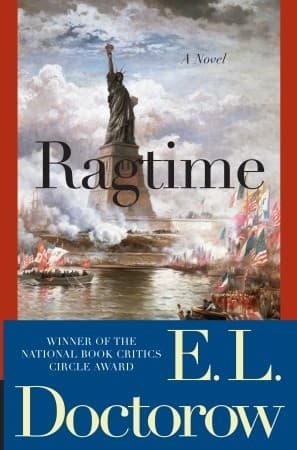
E.L. Doctorow (2004)
Genre
Literary Fiction / Historical Fiction
Reading Time
6-8 hours
Key Themes
See below
Sign in to track this book
In early 20th-century America, the lives of a wealthy New Rochelle family, a Harlem pianist, and an immigrant peddler intersect with historical figures like Houdini and Freud, exploring class, race, and the pursuit of justice.
The story begins in 1906, introducing an affluent, unnamed family in New Rochelle, New York: Father, Mother, Mother's Younger Brother, Grandfather, and the Boy. Their comfortable life is subtly changed by the new century. One Sunday, Harry Houdini crashes his car outside their home. Mother later finds a newborn black infant buried in their garden, leading to the discovery of the infant's mother, Sarah, a young black woman who will not speak. Mother, moved by compassion, insists on taking Sarah and the baby into their home, despite Father's initial discomfort and Younger Brother's interest.
Coalhouse Walker Jr., a skilled ragtime pianist, arrives at the family's home, saying he is Sarah's lover and the baby's father. He is a dignified man, driving a new Model T Ford, a sign of his success. He begins to court Sarah, playing his ragtime music for her, slowly breaking through her silence. They plan to marry. However, Coalhouse's Model T becomes a target for racial prejudice when a volunteer fire company in New Rochelle, led by Willie Conklin, blocks his path and defaces his car. This sparks Coalhouse's firm demand for justice.
Coalhouse Walker Jr. tries to use the legal system to have his car fixed and receive an apology from the firemen, especially Willie Conklin. He tries different ways, from filing police complaints to seeking legal advice, but meets with indifference, bureaucratic delays, and racial bias. The local authorities dismiss his claims, and the firemen refuse to cooperate, increasing Coalhouse's frustration and sense of injustice. The Family, especially Mother and Younger Brother, see his struggle and the systemic racism he faces, which starts to change their views on justice and society. Father, however, remains detached, focused on his business.
Desperate for justice for Coalhouse, Sarah tries to appeal to the Vice President, who is visiting New Rochelle. As she approaches his motorcade, guards brutally beat her, mistaking her for a threat. She dies from her injuries, leaving Coalhouse and their baby heartbroken. This event destroys Coalhouse's trust in the system and turns his search for justice into a quest for revenge. He withdraws, gathers a small group of followers, and begins a campaign of violence, targeting and burning down the fire stations responsible for his humiliation and Sarah's death. His actions shock the community.
Mother's Younger Brother, already feeling lost, finds himself drawn to Coalhouse's actions. He is a talented pyrotechnician, a skill he developed working for Father's company creating patriotic displays. Disillusioned with his conventional life and captivated by Coalhouse's rebellion against injustice, Younger Brother leaves his family and joins Coalhouse's gang. He becomes a part of their operations, using his expertise to create explosives for their attacks. His change shows the era's social unrest and the appeal of revolutionary ideas to those seeking meaning beyond the established order. His involvement further connects the Family to Coalhouse's growing conflict.
Coalhouse Walker Jr. and his followers, including Younger Brother, take over the J.P. Morgan Library in New York City. They hold the library's staff hostage, demanding the restoration of Coalhouse's car and the surrender of Willie Conklin. This act brings national attention to Coalhouse's situation and the racial injustices he experienced. Authorities, including Police Commissioner Rhinelander Waldo and later Booker T. Washington, try to negotiate with Coalhouse, but he stays firm in his demands. The siege becomes a small example of the larger societal tensions, with the establishment facing a desperate, radicalized individual seeking correction for deep wrongs.
During the siege, Booker T. Washington is brought in to mediate. He tries to convince Coalhouse to surrender, appealing to his sense of responsibility and the pointlessness of his violent path. Coalhouse, however, remains firm. Eventually, a deal is made: the car will be restored, and Willie Conklin will face justice, in exchange for the hostages' release. As Coalhouse leaves the library, having released the hostages and sent Younger Brother and the others to safety, authorities ambush and kill him. His death is a tragic end to his search for justice, leaving a lasting impact on all involved in his story.
The showgirl Evelyn Nesbit, still dealing with the aftermath of the Stanford White murder trial, moves through various relationships and experiences. She has an affair with Tateh, the Jewish immigrant silhouette artist, and later becomes involved with Emma Goldman, the anarchist. Nesbit eventually finds stability in Hollywood, where she becomes a consultant for silent films, using her past fame to her advantage. Her journey shows celebrity, exploitation, and the search for identity in a changing world, illustrating how public figures were both celebrated and consumed by the media and society of the era. Her path often crosses with other historical and fictional characters.
Tateh, a Jewish immigrant from Latvia, arrives in America with his young daughter, seeking a new life. He initially struggles as a street artist, creating silhouette portraits, facing poverty and anti-Semitism. After his wife leaves him and their daughter, he and the Girl travel west, working odd jobs and developing his artistic skills. His talent for visual storytelling leads him to the early film industry in Hollywood, where he reinvents himself as the Baron Ashkenazy. He becomes a director and producer of silent films, creating popular 'flickers' for children, achieving success and prosperity, a sharp contrast to his early struggles.
After the events with Coalhouse and Younger Brother, the original Family changes. Father dies on the Lusitania, a victim of World War I. Mother, having changed significantly, marries Tateh (now the Baron Ashkenazy) and moves to Hollywood, creating a new, blended family with her children, Tateh, and the Girl. The Boy and the Little Girl grow up together, representing a new generation. Mother's Younger Brother, having survived the Coalhouse affair, eventually finds his own purpose, though his ultimate fate is somewhat unclear, hinted at joining revolutionary causes abroad. The novel ends with this new family, symbolizing the merging of different American experiences and the nation's ongoing evolution.
The Protagonist/Supporting
Transforms from a sheltered, traditional wife into an independent, compassionate woman who embraces a new, unconventional family life.
The Supporting
Remains largely static in his traditional views, ultimately becoming an anachronism in the changing world and dying symbolically on the Lusitania.
The Protagonist/Supporting
Transforms from an aimless artist into a committed revolutionary, finding purpose in fighting against societal injustice.
The Protagonist
Begins as a hopeful, dignified man seeking conventional justice, but transforms into a radicalized figure driven to violence by profound racial injustice.
The Supporting
Moves from despair and silence to finding love and hope, only to be tragically killed, becoming a martyr for Coalhouse's cause.
The Protagonist/Supporting
Transforms from a struggling, impoverished immigrant artist into a wealthy and influential Hollywood film producer, achieving the American Dream.
The Supporting
Struggles with her scandalous past to find a new identity and purpose, eventually finding a niche in the burgeoning film industry.
The Supporting/Mentioned
Serves as a consistent voice of radical thought and a catalyst for others' political awakening.
The Supporting/Mentioned
Maintains his public persona as a master escape artist, a constant presence of the era's wonder.
The Mentioned
Remains a static symbol of unassailable wealth and power.
The novel examines different parts of the American Dream, from Tateh's success as an immigrant to Father's established prosperity. However, it also questions the dream's limits and hypocrisies, especially for African Americans like Coalhouse Walker Jr. His search for justice, a basic part of the dream, is denied because of his race, leading to deep disappointment and violence. The dream is shown to be available to some, like Tateh, who adapt to the new world, while others are hurt by its inequalities, as seen in Coalhouse's tragic end and Sarah's death. The theme asks who truly has access to the dream and at what cost.
“There were no Negroes in New Rochelle. There were no immigrants. The only Jews were the German Jews. But it was 1906, and the city was filling up with new arrivals.”
A main conflict is the difference between formal legal systems and true moral justice. Coalhouse Walker Jr. first seeks justice through legal channels after his car is damaged, but the law repeatedly fails him, corrupted by racial prejudice and indifference. This systemic failure pushes him to abandon legal means for a violent, revolutionary pursuit of his own justice. The novel suggests that when the law is unfair or applied inconsistently, people may turn to extralegal ways to right wrongs. Mother's changing understanding of justice, beyond Father's strict rules, further highlights this theme.
“He wanted his car restored to its original condition. He wanted an apology. He was a black man and he meant to have his rights.”
Doctorow mixes real historical figures (Houdini, Emma Goldman, J.P. Morgan, Evelyn Nesbit, Henry Ford) with fictional characters (the Family, Coalhouse, Tateh). This blurs the lines between history and fiction, suggesting that history is a form of storytelling and that ordinary lives are as important as famous ones. The historical figures often represent the era's forces, like industrialization, radicalism, and celebrity, while the fictional characters provide the emotional core and personal experience of these large historical changes. This blend creates a rich picture of America at the turn of the century, emphasizing how all lives are connected.
“There were no Negroes in New Rochelle. There were no immigrants. The only Jews were the German Jews. But it was 1906, and the city was filling up with new arrivals.”
The novel is set in a time of great social, technological, and cultural change—the 'ragtime' era between the turn of the century and World War I. It shows the shift from a more ordered, Victorian society (represented by Father) to a modern, industrialized, and diverse America. The rise of the automobile (Coalhouse's Model T), the start of cinema (Tateh's career), new music (ragtime), and visible social movements (anarchism, labor rights) all mark this rapid change. The characters' struggles and changes reflect the wider societal shifts, as traditional values are challenged by new ideas, technologies, and demographic changes, leading to both progress and conflict.
“The very air was charged with a new electricity. The world was spinning faster.”
Many characters in *Ragtime* change and redefine their identities. Tateh, the Jewish immigrant, leaves his past to become the successful film mogul Baron Ashkenazy. Evelyn Nesbit, despite her scandalous past, finds a new role in Hollywood. Mother changes from a traditional housewife to an independent woman who remarries and embraces a blended family. Even Mother's Younger Brother finds a new, radical identity. This theme shows how fluid identity was in a rapidly changing America, where people could shed old selves and create new ones, often in response to societal pressures, personal desires, or historical forces. The ability to reinvent oneself is presented as both a challenge and an opportunity.
“He began to think of himself as a man of the new century. A man of progress. A man of invention.”
A detached, all-knowing narrator who moves freely between characters and historical events.
The novel employs a highly omniscient, often detached, and somewhat ironic narrator. This narrator has access to the thoughts and feelings of all characters, both fictional and historical, and can seamlessly shift between their individual stories and broader historical contexts. The narrator's voice often adopts a slightly formal, almost journalistic tone, which contributes to the blurring of fact and fiction. This device allows Doctorow to weave together disparate narratives, provide historical background, and comment on the social and political landscape of the era, creating a panoramic view of early 20th-century America.
Integrating real historical personages into the fictional narrative as active participants.
Doctorow's use of historical figures like Harry Houdini, Emma Goldman, Evelyn Nesbit, and J.P. Morgan as characters who interact directly with the fictional protagonists is a defining plot device. These figures are not just mentioned; they drive plot points, influence other characters, and participate in the narrative's events. This device blurs the line between historical reality and fictional invention, inviting the reader to reconsider the nature of history and storytelling. It grounds the fictional family's experiences in a tangible historical context while simultaneously humanizing and reinterpreting the famous figures, making the past feel vibrant and immediate.
Multiple, initially separate narrative threads that eventually converge and influence each other.
The novel is structured around several distinct plotlines: the unnamed Family's domestic life, Coalhouse Walker Jr.'s quest for justice, and Tateh's immigrant journey, alongside the episodic appearances of historical figures. These plotlines initially unfold independently but gradually begin to intersect and influence one another. For example, Coalhouse's story directly impacts the Family, and Tateh's path crosses with Evelyn Nesbit and later Mother. This interweaving creates a rich tapestry of American life, demonstrating how individual destinies are interconnected and how seemingly disparate lives can converge during periods of significant social change, enhancing the novel's epic scope.
The Model T Ford as a symbol of modernity, social mobility, and racial injustice.
Coalhouse Walker Jr.'s brand-new Model T Ford is a potent symbol. It represents the dawn of the automotive age, technological progress, and the aspirations of social mobility. For Coalhouse, it is a symbol of his hard-earned success, dignity, and a claim to his place in modern America. However, its defacement by racist firemen transforms it into a symbol of racial injustice and the fragility of the American Dream for African Americans. The car becomes the catalyst for his entire tragic journey, highlighting how objects can carry profound social and political meaning, driving the central conflict of the novel.
“He thought of the United States as a place where people's dreams were given a chance, a place where the human spirit could soar.”
— Reflecting on the American ideal at the turn of the century.
“There were no Negroes. There were no Jews. There were no Irish. There were no Italians. There were no Poles. There were no Germans. There were no Swedes. There were no Chinese. There were only Americans.”
— Describing the melting pot ideology of the time, often in contrast to reality.
“The very air of the century seemed to crackle with the energy of invention.”
— Observing the technological and social changes of the early 20th century.
“Ragtime was a music that didn't just entertain, it spoke to something deep in the American soul.”
— Discussing the cultural significance and impact of ragtime music.
“The family was an invention of the Victorians, as was the child. For that matter, so was the adult.”
— A somewhat cynical observation on the social constructs of the era.
“He understood that the world was an engine, and that the engine ran on money.”
— A character's realization about the driving force of society.
“Every new machine was a dream come true, a promise of a better life.”
— Reflecting on the public's perception and hope invested in new technologies.
“There was a lot of money to be made in the new century, and a lot of ways to lose it.”
— Commenting on the financial opportunities and risks of the era.
“The past was like a foreign country; they did things differently there.”
— A classic quote emphasizing the distance between historical periods.
“He had a sense of the vast, intricate network of human desire and ambition that underlay the apparent order of things.”
— A character's growing understanding of societal complexities.
“The rich were different. They had more money.”
— A simple, yet profound observation on class distinctions.
“History was not a procession of illustrious people but a parade of nobodies.”
— Doctorow's perspective on the role of ordinary people in historical narratives.
“He believed in justice, which was, in the end, only a hope, like belief in God.”
— A character's disillusionment or realistic view of justice.
“The future was a dark, unreadable text, but the present was a series of bright, urgent moments.”
— Contrasting the uncertainty of the future with the immediacy of the present.
Ready to see how well you understood this book? Take our interactive quiz with 10 questions.

E.L. Doctorow was a celebrated American novelist known for his sweeping historical fiction that explored American identity and myth. His acclaimed works include "Ragtime," "The Book of Daniel," and "The March." Doctorow's writing often blended historical accuracy with fictional narratives, earning him numerous awards and critical recognition throughout his career.







