“It’s a funny thing, when you’re dead, how much you want to be alive.”
— Harry musing on mortality and his own life.

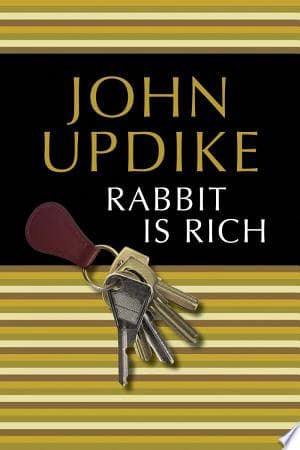
John Updike (2010)
Genre
Literary Fiction / Romance
Reading Time
12-15 hours (based on 544 pages)
Key Themes
See below
Sign in to track this book
In late 1970s America, a prosperous Harry 'Rabbit' Angstrom deals with his difficult son and past loves, trying to find a happiness that always feels just out of reach.
It is the summer of 1979, and Harry 'Rabbit' Angstrom, 46, leads sales at Springer Motors, a Toyota dealership in Brewer, Pennsylvania, inherited from his late father-in-law, Fred Springer. He lives comfortably with his wife, Janice, in a pleasant suburban home. Despite his new wealth, Rabbit feels a familiar restlessness. The world outside is troubled by gas shortages and inflation, but Rabbit's personal worries focus on his aging body, memories of past loves, and his son Nelson's upcoming return from college, which threatens their peace.
Nelson Angstrom, Rabbit and Janice's son, returns from Kent State after dropping out. His arrival immediately causes tension. Nelson is moody, critical, and feels he deserves a job at Springer Motors, even though he has no experience or interest in sales. Rabbit wants to help his son but also worries about Nelson's motives and his potential to undermine his own authority and comfort. Janice tries to keep the peace but often finds herself caught between her husband and son, making the family conflicts worse.
While at the dealership, Rabbit is surprised to see Ruth Leonard, his mistress from twenty years ago. She is heavier now, a widow, and lives in a trailer park, but her presence brings back a strong mix of nostalgia, guilt, and lingering attraction for Rabbit. He learns she has a daughter, Annabelle, who is about Nelson's age, leading Rabbit to suspect Annabelle might be his child. This encounter upsets Rabbit's stable life, forcing him to face his past decisions and their possible results.
Rabbit often goes to the local golf course, a place where he can think about his life, his regrets, and his current unhappiness. Here, he often meets other men, talking casually and sharing a sense of male friendship. He also feels drawn to younger women, like Thelma Harrison, the wife of his golfing partner and business associate, Ronnie Harrison. These flirtations, though mostly harmless, make Rabbit feel desired and alive, a brief escape from his marriage and family pressures, showing his ongoing struggle with faithfulness and aging.
Nelson continues to frustrate Rabbit and Janice. He demands a significant role in the dealership, pushing for changes and criticizing Rabbit's management. He also expects financial help, asking for money for a car and other things, despite having dropped out of college. Rabbit, though financially secure, resents Nelson's sense of entitlement and how his son seems to drain his resources and energy. Janice, caught in the middle, tries to calm Nelson while also seeing the truth in Rabbit's complaints, further complicating family dynamics.
To try and improve their marriage and escape home tensions, Rabbit and Janice take a vacation to the Caribbean. The trip offers a temporary break, letting them relax on the beach, enjoy each other's company, and briefly forget their worries about Nelson and the dealership. However, even in paradise, Rabbit's anxieties about aging, his past, and his marriage sometimes appear. The vacation shows their lasting bond, but also highlights the underlying problems that their daily lives in Brewer inevitably bring to the surface.
Thelma Harrison, Ronnie Harrison's wife, a woman Rabbit has flirted with for years, tells him she has deep feelings for him. This admission flatters and unsettles Rabbit, who has always kept their interactions light. Soon after, Thelma becomes seriously ill with lupus. Her illness makes Rabbit face mortality and the fragility of human connections. He visits her in the hospital, feeling a complex mix of pity, affection, and guilt, which further complicates his emotions and makes him think about his responsibilities and desires.
Annabelle, Ruth's daughter, starts working at the dealership. Her strong resemblance to Rabbit, especially her height and certain facial features, strengthens his belief that she is his biological child. This belief, though not confirmed, deeply affects Rabbit. He feels a fatherly connection to her and watches her with pride and regret, wondering about the life she might have had if he had stayed with Ruth. Her presence is a constant reminder of his past choices and the path not taken, adding another layer of complexity to his family life.
Nelson marries Pru, a woman he met at Kent State, and they soon have a child, Judy. This new family adds more responsibility and financial strain to the Angstrom household. Nelson continues to struggle with adulthood, finding it hard to commit to working at the dealership and often relying on his parents for money and advice. Rabbit watches Nelson's struggles with frustration and empathy, seeing echoes of his own youthful aimlessness, while Janice tries to support her son and his new family, often at her own expense.
With the economy changing and his own age advancing, Rabbit begins to seriously think about the future of Springer Motors. He considers how to best secure the dealership for Nelson, despite his son's clear lack of talent or interest in the business. This decision weighs heavily on Rabbit, as he wants to provide for his family but also fears Nelson will waste the legacy he has built. The internal struggle shows Rabbit's conflicting desires: to protect his own comfort and to fulfill his fatherly duties, even if it means giving up some personal freedom.
Thelma Harrison's condition worsens. Rabbit visits her in the hospital, seeing her decline, which deeply affects him. Her death is a significant loss, marking the end of a potential romantic connection and a sharp reminder of his own mortality and life's fleeting nature. Her passing forces Rabbit to confront the reality of aging and his own limits, adding a somber tone to his thoughts on life, love, and his choices.
Rabbit finds joy and comfort in his granddaughter, Judy, Nelson and Pru's child. He dotes on her, seeing her as a symbol of continuity and hope. However, the question of Annabelle's paternity remains, a quiet background to his contentment. He never definitively confirms whether Annabelle is his daughter, leaving the reader, and Rabbit himself, with an unresolved question. This uncertainty reflects Rabbit's tendency to avoid directly facing difficult truths, preferring to let some questions remain unanswered as he navigates his middle age.
The Protagonist
Rabbit transitions from a restless, successful businessman to a man grappling with the realities of aging, family legacy, and the consequences of his past, finding a degree of contentment but still marked by his characteristic ambivalence.
The Supporting
Janice grows more confident and assertive within her marriage and family, learning to navigate Rabbit's complexities while striving for domestic harmony.
The Supporting
Nelson attempts to establish his independence and secure a place in the family business, often clashing with Rabbit, while slowly confronting the responsibilities of marriage and fatherhood.
The Supporting
Ruth reappears in Rabbit's life, serving as a catalyst for his reflections on his past and the potential consequences of his actions.
The Supporting
Thelma moves from a flirtatious acquaintance to a woman who confesses her true feelings for Rabbit, ultimately succumbing to illness and death, serving as a poignant reminder of mortality.
The Supporting
Annabelle enters Rabbit's life as a potential daughter, remaining a silent, unresolved question mark about his past.
The Supporting
Pru marries Nelson, becomes a mother, and attempts to navigate the difficult Angstrom family dynamics, growing more aware of the challenges of her new life.
The Supporting
Ronnie remains a constant, supportive friend to Rabbit, providing a stable male friendship amidst Rabbit's personal turmoil.
Rabbit Angstrom has achieved a version of the American Dream: financial success, a nice home, and a stable family. However, this prosperity brings a new kind of disappointment rather than happiness. He feels an emptiness, a persistent restlessness, and questions the value of his material gains. The novel explores how the pursuit of external success often fails to satisfy deeper emotional needs, especially against the backdrop of declining national confidence in 1979, with gas lines and inflation. Rabbit's inner struggles show the emptiness that can come with outward achievement.
“He's rich, but he's not happy. He's rich, but he's still Rabbit, running.”
Middle age is a main concern for Rabbit. He notices his own physical decline, his body sagging, and his reflexes slowing with a mix of denial and dread. The illness and death of Thelma Harrison serve as strong reminders of mortality and life's fragility, forcing Rabbit to face his own finite existence. His longing for youth and his attempts to recapture it through flirtations show his struggle to accept aging. The theme explores how people deal with losing their youth and getting older.
“The years had not so much passed as accumulated, like dust on an unused piece of furniture.”
The difficult relationship between Rabbit and his son, Nelson, drives much of the story. Rabbit struggles with Nelson's entitlement, lack of drive, and criticism, while Nelson resents his father's perceived hypocrisy and control. This conflict highlights the challenges of parental expectations, the passing down of values, and the difficulty of bridging the generation gap. Rabbit's own past failures as a father are prominent, and he tries, imperfectly, to guide Nelson while also protecting his own interests, creating a complex dynamic of love, resentment, and misunderstanding.
“Having a son was like having a mirror held up to your own worst self, only younger and more defiant.”
Rabbit's past constantly affects his present. Ruth Leonard's reappearance and the suspicion that Annabelle is his daughter force him to confront the consequences of his youthful choices and infidelities. Memories of his athletic glory days, his affair with Ruth, and his brief relationship with Jill constantly surface, shaping his current views and desires. The novel shows how personal history is not easily left behind but remains an active force, influencing identity and relationships, and how unresolved issues from the past can continue to trouble and define a person.
“The past, he had learned, was not a place you left; it was a ghost that walked beside you.”
Rabbit's struggle with faithfulness remains a central idea. Despite his comfortable marriage to Janice, he is always drawn to other women, flirting and harboring deeper feelings for figures like Thelma Harrison. This theme explores the nature of desire, the challenges of marital commitment, and the human longing for newness and escape. Rabbit's inner conflict between his love for Janice and his restless urges highlights the complexities of human relationships and the often-unfulfilled desires that persist even in seemingly settled lives.
“He loved Janice, yes, but love was a house, and sometimes a man just wanted to walk out into the open air.”
Rabbit's continuous stream of consciousness reveals his inner turmoil.
Updike extensively uses Rabbit's internal monologue to provide deep insight into his thoughts, anxieties, and desires. This device allows the reader to experience Rabbit's subjective reality, his reflections on aging, his past, his family, and his constant yearning. It reveals his characteristic blend of self-pity, naive optimism, and keen observation, often without the filter of external dialogue, making him a complex and relatable character despite his flaws. It's a key tool for character development and thematic exploration.
Springer Motors symbolizes Rabbit's material success and the changing American landscape.
The Toyota dealership, Springer Motors, serves as a powerful symbol. It represents Rabbit's unexpected material success and his integration into the consumerist American Dream, a far cry from his earlier struggles. The brand itself, Toyota, symbolizes a shift in the American economy and the anxieties of the late 1970s. The dealership is also a stage for generational conflict with Nelson, and a place where Rabbit's past (through Ruth and Annabelle) literally drives into his present. It embodies both his achievement and the new pressures he faces.
A sanctuary and arena for male bonding and reflection.
The golf course acts as a recurring setting and a symbolic space for Rabbit. It is his escape, a place where he can engage in a familiar ritual, clear his head, and reflect on his life away from the demands of family and work. It's also an arena for male camaraderie and casual flirtation, providing a sense of freedom and youthful vitality that he increasingly lacks elsewhere. The game itself, with its ups and downs, mirrors the trajectory of Rabbit's life, full of unexpected successes and frustrating failures, but always with the hope of a good shot.
A lingering question that embodies Rabbit's unresolved past.
The ambiguity surrounding whether Annabelle is Rabbit's daughter is a crucial plot device. It is never definitively confirmed, leaving both Rabbit and the reader with a constant, unspoken question. This uncertainty perfectly encapsulates Rabbit's tendency to avoid direct confrontation with difficult truths and his enduring fascination with his past choices. It creates a subtle but powerful undercurrent of regret and what-ifs, highlighting the lasting impact of his actions without providing neat resolutions, mirroring the messy reality of life.
“It’s a funny thing, when you’re dead, how much you want to be alive.”
— Harry musing on mortality and his own life.
“The past, he thinks, is like the inside of an old refrigerator; it’s full of stuff you should have thrown out years ago.”
— Harry reflecting on his past decisions and relationships.
“Money, he thinks, is like cholesterol; it can be good or bad, depending on the kind.”
— Harry contemplating his newfound wealth and its implications.
“Marriage is a long conversation, interrupted by arguments.”
— Harry's cynical view on his relationship with Janice.
“He feels like a man who has climbed to the top of a mountain only to find there's another, higher mountain beyond it.”
— Harry's feeling of unfulfillment despite his financial success.
“The trick to happiness is not to want too much, but just enough.”
— A philosophical thought Harry has about contentment.
“People always think they know what you're thinking, but they never do.”
— Harry's internal monologue about being misunderstood.
“Every day is a gift, even the bad ones, because you're still in it.”
— Harry's resilient outlook on life despite its difficulties.
“He has a recurring dream of running, but he never gets anywhere.”
— A symbolic dream reflecting Harry's feeling of being stuck.
“There are times when you just want to vanish, to be nobody for a while.”
— Harry's desire for anonymity and escape from his responsibilities.
“The past isn't dead; it's not even past.”
— Harry reflecting on how his earlier life still influences him, echoing Faulkner.
“Love is a kind of remembering.”
— Harry's thoughts on the enduring nature of love and connection.
“You can't go home again, but you can always visit.”
— Harry's realization about the impossibility of recapturing the past, yet still engaging with it.
“Life is what happens when you’re busy making other plans.”
— Harry's realization about the unpredictable nature of existence, echoing John Lennon.
Ready to see how well you understood this book? Take our interactive quiz with 10 questions.

John Hoyer Updike was an American novelist, poet, short-story writer, art critic, and literary critic. One of only four writers to win the Pulitzer Prize for Fiction more than once, Updike published more than twenty novels, more than a dozen short-story collections, as well as poetry, art and literary criticism and children's books during his career.







