“I am as quick as a cricket.”
— The very first line, introducing the theme of comparing oneself to animals.

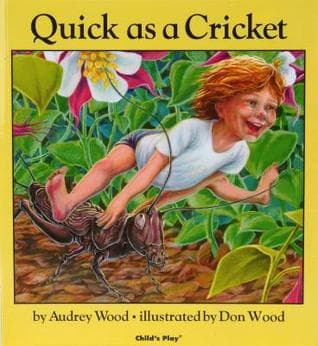
Audrey Wood (1982)
Genre
Children's
Reading Time
5 min
Key Themes
See below
Sign in to track this book
A child explores different animal traits, finding a reflection of his own varied personality in each one.
The story begins with a young, unnamed boy introducing himself. He immediately compares himself to an animal, saying, 'I'm as quick as a cricket.' This sets the pattern for the book, where the boy will link different animal traits to parts of his personality and physical state. The illustration shows a lively boy with a cricket, highlighting his energetic nature. This scene establishes the main idea of describing oneself through animal comparisons, inviting the reader into the boy's self-discovery.
After saying he is quick, the boy contrasts this with another part of himself: 'I'm as slow as a snail.' This shows he can see and accept different traits within himself. The illustration shows the boy moving slowly, perhaps a bit lazily, next to a snail, showing a calmer, less hurried side. This immediate pairing of quick and slow introduces the main idea of accepting complexity and balance in one's identity, showing that being one thing does not mean you cannot be its opposite.
The boy then looks at his feelings, saying, 'I'm as brave as a lion.' This comparison shows his moments of courage and confidence. The illustration shows the boy with a confident posture, perhaps playfully roaring, next to a lion. This scene highlights his ability to be fearless and strong, suggesting he feels capable and powerful in certain situations. It adds a sense of emotional strength to how he sees himself, going beyond just physical traits.
In contrast to his bravery, the boy admits, 'I'm as shy as a mouse.' This shows he understands and accepts vulnerability and being quiet. The image shows the boy peeking from behind something, perhaps a book, with a small, timid mouse nearby. This moment of shyness is presented not as a fault, but as another part of who he is. This pairing reinforces the idea that a person can have many different emotions and behaviors.
The boy then moves to physical traits, declaring, 'I'm as strong as a horse.' This comparison emphasizes his physical abilities and toughness. The illustration shows the boy flexing his muscles or doing something physical, perhaps lifting something, with a powerful horse in the background. This scene highlights his moments of physical skill and endurance, showing his ability to work hard and be robust, adding to the varied ways he describes himself.
After saying he is strong, the boy shows his vulnerable side, stating, 'I'm as weak as a kitten.' This honest admission shows he understands and accepts his limits. The illustration shows the boy looking tired or needing comfort, with a small, sleepy kitten nearby. This moment acknowledges that everyone has times of weakness or fragility, and it is a natural part of being human, not something to hide.
The boy explores his mental qualities, saying, 'I'm as clever as a fox' and 'I'm as wise as an owl.' These comparisons highlight his intelligence, cunning, and understanding. The illustrations likely show him with a thoughtful look, perhaps solving a puzzle or reading, with a sly fox and a thoughtful owl. These scenes show his sharp mind and deep insight, adding intellectual parts to his self-portrait and showing he values both quick thinking and careful judgment.
The boy looks at his emotional states further, stating, 'I'm as grumpy as a bear' and 'I'm as gentle as a lamb.' This shows he acknowledges both negative and positive feelings. The illustrations likely show him with a frown next to a growling bear, then with a soft, kind look next to a docile lamb. This pairing emphasizes the natural changes in moods and the ability to be both irritable and kind within one person.
The boy connects with the playful and physical sides of animals, declaring, 'I'm as wiggly as a pig' and 'I'm as wriggly as a fish.' These comparisons highlight his energetic and restless nature, especially when playing or feeling uncomfortable. The illustrations would show him squirming and moving, perhaps covered in mud like a pig, or playfully acting like a fish in water. These moments emphasize his youthful energy and physical expression.
The boy continues to express his energetic and active side by stating, 'I'm as zippy as a frog' and 'I'm as buzzy as a bee.' These comparisons show his moments of fast movement and constant activity. The illustrations show him leaping like a frog, and perhaps humming or flitting about like a bee. These descriptions reinforce his dynamic and lively personality, showing his ability for bursts of energy and a general sense of engagement with the world.
The boy thinks about his physical size, acknowledging both extremes: 'I'm as huge as a hippo' and 'I'm as tiny as a bug.' This shows how he sees himself in relation to the world, recognizing that he can feel big and small depending on the situation. The illustrations would show him comically large next to a hippo, then miniaturized beside a tiny insect. This highlights his understanding of perspective and how he fits into different scales of existence.
After showing many contrasting animal traits, the boy reaches a clear conclusion: 'All these things are me! All of them!' This moment marks his full acceptance of every trait described, whether quick or slow, brave or shy, strong or weak. The illustration typically shows the boy surrounded by all the animals he mentioned, smiling broadly and confidently. This statement is the emotional high point, celebrating his many-sided identity and the beauty of his complex self.
Building on his realization, the boy concludes, 'I'm a little bit of everything. And all of it is me!' This final statement confirms his understanding that his identity is not just one trait but a unique mix of all his seemingly opposite qualities. The illustration often shows the boy standing proudly, perhaps with a group of all the animals, showing a balanced integration. This ending reinforces the book's main message: self-acceptance comes from embracing one's whole, diverse self.
The Protagonist
The Boy moves from simply listing individual traits to fully integrating and accepting all his seemingly contradictory qualities as essential parts of his unique self.
The Mentioned
Static symbol.
The Mentioned
Static symbol.
The Mentioned
Static symbol.
The Mentioned
Static symbol.
The Mentioned
Static symbol.
The Mentioned
Static symbol.
The Mentioned
Static symbol.
The Mentioned
Static symbol.
The main theme is the young boy's journey to understand and accept his varied identity. By comparing himself to animals, he sees he is not just one thing, but a complex mix of traits like quick and slow, brave and shy, strong and weak. The book ends with his realization, 'All these things are me! All of them!' This theme encourages children to accept every part of who they are, promoting a good self-image by showing that it is normal to have many different qualities. The repeated structure reinforces that all these different aspects create a unique whole, as seen when he proudly says, 'I'm a little bit of everything. And all of it is me!'
“All these things are me! All of them! I'm a little bit of everything. And all of it is me!”
A key part of self-acceptance is embracing contradictory traits. The book shows this well by pairing opposite characteristics: 'I'm as quick as a cricket, I'm as slow as a snail.' 'I'm as brave as a lion, I'm as shy as a mouse.' These pairings show that a person can have many different behaviors and emotions at once, without one canceling out the other. This theme teaches that complexity is natural to identity and that it is not necessary to choose one extreme. It normalizes feeling different ways at different times, promoting a complete view of personality development.
“I'm as quick as a cricket, I'm as slow as a snail.”
The whole story is an exercise in self-awareness and looking inward. The boy actively notices his own feelings, actions, and physical states, then finds animal metaphors to describe them. This process of thinking about oneself is important for developing a strong sense of self. By naming each trait, he understands his inner world better. The book encourages young readers to do similar self-reflection, helping them describe their own experiences and fostering emotional intelligence. His repeated statements, 'I'm as [adjective] as a [animal],' are strong acts of self-identification.
“I'm as grumpy as a bear, I'm as gentle as a lamb.”
Ultimately, "Quick as a Cricket" celebrates individuality. By the end, the boy does not just accept his traits; he celebrates them as unique to him. The many different animal comparisons highlight the richness and distinctiveness of each person's character. The book conveys that being a 'little bit of everything' is not confusing, but rather what makes each person special and whole. This theme promotes confidence and self-esteem, showing that one's unique mix of qualities is something to be proud of, not something to hide to fit a single mold.
“I'm a little bit of everything. And all of it is me!”
Using animal characteristics to describe human traits.
The primary plot device is the extensive use of animal similes. For example, 'I'm as quick as a cricket,' 'I'm as brave as a lion,' and 'I'm as tiny as a bug.' This device allows the young protagonist to articulate complex feelings and physical states in a concrete, relatable, and imaginative way for a child audience. Each animal serves as a vivid metaphor for a specific trait, helping the boy (and the reader) conceptualize abstract concepts like shyness or strength. The consistent application of this device creates a rhythmic and memorable narrative structure.
Placing contrasting traits side-by-side to highlight complexity.
The book frequently employs the juxtaposition of opposite traits, often presented immediately after each other, such as 'quick as a cricket' followed by 'slow as a snail,' or 'strong as a horse' followed by 'weak as a kitten.' This device serves to emphasize the multifaceted nature of identity and the idea that contradictory qualities can coexist within one person. It visually and verbally reinforces the theme of embracing complexity, preventing the reader from pigeonholing the protagonist into a single characteristic and instead encouraging a holistic view of self.
The story is told directly from the boy's perspective.
The entire story is narrated in the first person ('I'm as quick as a cricket...'). This device creates an immediate and intimate connection between the protagonist and the reader. It allows for a direct insight into the boy's self-reflection and internal journey of discovery, making the process of self-awareness feel personal and authentic. The 'I' statements empower the boy to define himself on his own terms and invite young readers to consider their own 'I' statements.
Adding new elements to a repeating pattern.
The book uses a cumulative structure where each page introduces a new animal simile describing a different facet of the boy's personality. While each new comparison adds a distinct trait, the overarching pattern of 'I'm as [adjective] as a [animal]' repeats throughout. This cumulative effect builds a comprehensive portrait of the boy's identity, leading to the climactic realization that 'All these things are me!' The repetitive yet additive nature makes the book predictable enough for young children to follow while continuously expanding their understanding of the protagonist.
“I am as quick as a cricket.”
— The very first line, introducing the theme of comparing oneself to animals.
“I am as slow as a snail.”
— Contrasting the previous 'quick' with its opposite, showcasing the child's varied nature.
“I am as small as an ant.”
— Illustrating the child's physical size comparison.
“I am as large as a whale.”
— Directly contrasting the 'small' comparison, emphasizing a range of feelings and perceptions.
“I am as loud as a lion.”
— Describing the child's vocal expression.
“I am as quiet as a clam.”
— The opposite of being loud, showing the child's capacity for stillness.
“I am as tough as a rhino.”
— Expressing resilience or physical strength.
“I am as gentle as a lamb.”
— Contrasting 'tough' with a softer, more caring side.
“I am as brave as a tiger.”
— Illustrating courage or fearlessness.
“I am as shy as a snail.”
— Describing an emotional state, often linked to introversion.
“I am as grumpy as a bear.”
— Expressing a negative mood.
“I am as happy as a pup.”
— The contrasting positive mood, showing a full range of emotions.
“I am as kind as a cat.”
— Describing a positive personality trait.
“I am as friendly as a dog.”
— Another positive social trait, often associated with openness.
“And sometimes I'm all of these things at once.”
— The concluding thought, summarizing the complexity and multifaceted nature of the self.
Ready to see how well you understood this book? Take our interactive quiz with 10 questions.

Audrey Wood is a celebrated children's author, renowned for her imaginative and rhythmic picture books. Her most beloved works include 'The Napping House,' 'Quick as a Cricket,' and 'Heckedy Peg.' Wood's distinctive storytelling and engaging illustrations have earned her a place as a beloved figure in children's literature.
Dan Gemeinhart
4.5
Kate O'Hearn
4.4

Jeanne Birdsall
4.4

Jen Wang
4.4
Wendelin Van Draanen
4.3

John Marsden
4.3

Chris Van Allsburg
4.3
Jennifer A. Nielsen
4.2