“The past is a country we can never return to, even if we still live in it.”
— Rakhi reflects on her mother's past and her own.

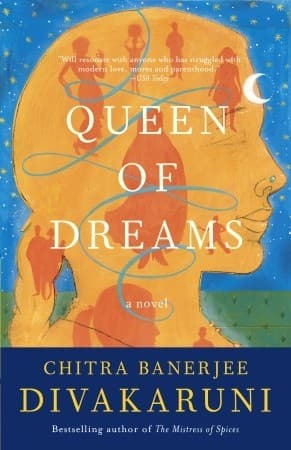
Chitra Banerjee Divakaruni (2004)
Genre
Literary Fiction / Fantasy / Romance
Reading Time
9 hours 45 min
Key Themes
See below
Sign in to track this book
A young painter navigates loss and self-discovery, uncovering her deceased mother's secret life as a dream-teller through hidden journals, all while dealing with love, cultural identity, and Berkeley.
Rakhi, a painter and single mother to Jona, lives in Berkeley, California. She co-owns a teahouse with her friend, Belle. Rakhi is in a creative slump, struggling with her art and co-parenting with her ex-husband, Sonny, a popular DJ. Her mother, a known dream-teller, is always present but emotionally distant, rarely speaking of her past in India. Rakhi feels a growing gap from her mother, who seems focused on her dream-telling clients and her own thoughts, leaving Rakhi feeling lost and wanting a deeper connection.
The story happens during a national tragedy—likely 9/11—which affects Rakhi's community and personal life. The event increases existing worries and biases, especially for the South Asian community in America. Rakhi feels more isolated and scared, and the tragedy shows her great need for her mother's comfort and wisdom. This shared trauma makes Rakhi feel more vulnerable and long for family connection.
After the national tragedy, Rakhi's mother dies in a car accident. This sudden loss shatters Rakhi's world, leaving her deep in grief and feeling incomplete. Her mother's absence, especially when Rakhi felt she needed her most, creates a void. The accident feels jarring because it is so ordinary and random, contrasting with her mother's mystical life, leaving Rakhi searching for meaning.
Amid her grief, Rakhi finds her mother's hidden dream journals. These journals are not just records of dreams told to clients, but also a personal account of her mother's inner life, experiences, and connection to dream-telling. As Rakhi reads these writings, she starts to piece together her mother's past, including her life in India and her sacrifices. The journals become a way to understand the woman her mother truly was, far more complex than Rakhi had known.
The journals show the often painful history of Rakhi's mother, especially her time as a young woman in India. Rakhi learns about her mother's arranged marriage, the difficulties she faced, and the powerful, sometimes heavy, nature of her inherited dream-telling gift. The journals detail how her mother came to use her abilities to guide and heal others, but also how they isolated her. This helps Rakhi understand her mother's emotional distance, realizing it was not a lack of love, but a result of her unique and demanding path.
The insights from her mother's journals make Rakhi look again at her relationship with her father, who has also been distant. As she talks with him, prompted by her new understanding of her mother's past, she uncovers more family history. Her father, previously quiet, begins to open up, sharing his views on their marriage and the life they built. This shared grief and the journal revelations create an unexpected link between Rakhi and her father, allowing them to connect more deeply.
As Rakhi explores her mother's world through the journals, she begins to face her own fears and creative block. The journals not only show her mother's past but also subtly challenge Rakhi to embrace her own artistic voice. She realizes that her mother's gift, though different from her own, was also a form of art and a way to understand the world. This journey helps Rakhi overcome her creative block, inspiring her to paint again with new purpose and a deeper understanding of her heritage and identity.
The changes in Rakhi, caused by her mother's death and the discoveries, also affect her relationship with Sonny, her ex-husband and Jona's father. As Rakhi grows, she starts to see Sonny differently, recognizing his lasting qualities and their shared history. The grief and self-discovery allow her to lower her guard and reconsider reconciliation or at least a deeper, more understanding connection. She realizes her emotional state has shifted, opening her heart to possibilities she had dismissed.
Towards the end, Rakhi starts to feel a connection to her mother's abilities. While she does not become a dream-teller in the same way, she begins to understand the deeper meaning and power of dreams, and perhaps even experiences subtle signs of her mother's gift within herself. This new sensitivity allows her to feel her mother's presence, not just in memory, but as a lasting legacy. She realizes her mother's wisdom has passed down, changing her own view of reality and her place in it.
By the end of the novel, Rakhi has changed a lot. She has grieved her mother, made up with her father, and found her artistic passion again. She understands her heritage and her mother's complex life better. The teahouse, her business with Belle, remains a stable part of her life. Rakhi comes out of her grief and self-discovery with a new sense of purpose and identity, ready to face the future, perhaps with Sonny, and with a richer understanding of herself and her family's history.
The Protagonist
Rakhi evolves from a creatively blocked and emotionally distant daughter into a woman who embraces her heritage, understands her mother's sacrifices, and finds her own artistic and personal voice.
The Supporting/Posthumous Catalyst
Her character is revealed posthumously, showing her journey from a young woman in India to a powerful dream-teller who made significant sacrifices for her gift and family.
The Supporting
Sonny's character remains largely consistent, serving as a steady presence and a potential romantic anchor for Rakhi as she navigates her personal changes.
The Supporting
Jona's arc is less pronounced, serving more as a catalyst for Rakhi's growth and a symbol of her commitment to the future.
The Supporting
Belle's character provides consistent support without a major personal arc, serving as a reliable anchor for Rakhi.
The Supporting
He moves from a distant figure to a more engaged and communicative father, fostering a deeper connection with Rakhi.
The Mentioned
They serve as background elements, illustrating the mother's role and the significance of dream-telling.
The novel looks at the complexities of identity for Indian-Americans, especially Rakhi's effort to balance her heritage with her modern American life. She feels 'between' two cultures, a feeling made worse by her mother's mysterious past and her father's silence. The national tragedy further highlights issues of being an outsider and belonging. By uncovering her mother's story, Rakhi begins to understand how her heritage shapes her, allowing her to form a more complete self that includes both her Indian roots and her American upbringing.
““I was a woman caught between worlds, an artist caught between canvases, a daughter caught between the stories my mother told and the ones she kept hidden.””
At its core, the book is about the intricate and often unspoken bond between mothers and daughters. Rakhi's relationship with her mother is central, marked by both love and emotional distance. Her mother's death forces Rakhi to truly 'see' her mother, not just as a parent, but as a complex woman with her own history, sacrifices, and gifts. The dream journals help Rakhi understand her mother's legacy, both the mystical gift of dream-telling and the strength of her spirit, which Rakhi eventually inherits through her art and understanding.
““Perhaps this was how mothers passed on their wisdom: not through words, but through the silent, potent language of their lives, left for their daughters to decipher.””
The novel deeply explores grief, especially the impact of sudden loss. Rakhi's mother's death, coming after a period of national trauma, throws her into raw and confusing grief. Going through her mother's things, especially the dream journals, becomes a key part of her healing. This discovery helps Rakhi move through her grief by understanding, rather than just mourning, her mother. It shows that healing is not about forgetting, but about integrating the past and finding new meaning.
““Grief was a language I was just learning, a tongue that twisted and turned, finding words where there had only been silence.””
Dreams are a central idea and plot device, representing a path to deeper truths, ancestral knowledge, and the subconscious. Rakhi's mother's gift of dream-telling highlights the cultural importance of dreams as more than just subconscious activity, but as messages and guidance. The dream journals themselves are a form of storytelling, allowing the past to speak to the present. Rakhi's own art is a form of storytelling, and through her mother's legacy, she learns to interpret and convey meaning, much like her mother interpreted dreams, bridging the gap between the seen and unseen worlds.
““Dreams are not just shadows; they are whispers from the soul, echoes from the past, and maps to the future.””
Rakhi is a painter experiencing a creative dry spell at the start of the novel. Her struggle with her art mirrors her emotional and identity struggles. As she reads her mother's dream journals and uncovers her family's history, Rakhi finds new inspiration. Her mother's dream-telling, a form of intuitive interpretation and storytelling, influences Rakhi's understanding of her own artistic process. Creating art becomes a way for Rakhi to process her grief, integrate her heritage, and express her evolving understanding of herself and the world, breaking through her block.
““Perhaps art, like dreams, was a way of making sense of the chaos, of finding patterns in the invisible threads that connected us all.””
A collection of Rakhi's mother's writings that reveal her past and the nature of her gift.
The dream journals are the central plot device. Discovered after her mother's death, they serve as a posthumous voice for Rakhi's mother, unveiling her hidden past, her life in India, her arranged marriage, and the origins and burdens of her dream-telling gift. These journals are not just a narrative tool for exposition but also act as a catalyst for Rakhi's emotional and psychological journey. They enable Rakhi to connect with her mother on a deeper level than she ever could in life, prompting her self-discovery and understanding of her own heritage.
A background event that intensifies the narrative's emotional stakes and themes of identity.
While not explicitly named, the 'national tragedy' serves as a crucial backdrop, amplifying the novel's themes of fear, xenophobia, and the search for identity in a fractured world. It underscores the vulnerability of the South Asian community and heightens Rakhi's personal anxieties. This external crisis creates a somber and urgent atmosphere, making Rakhi's personal loss and her journey of discovery feel more poignant and necessary. It highlights the political and social dimensions of her personal struggles, intertwining the individual experience with broader societal events.
A physical setting that symbolizes community, tradition, and Rakhi's creative and business ventures.
The teahouse, co-owned by Rakhi and Belle, serves as a significant setting. It represents a space of community, comfort, and cultural exchange, offering a tangible link to tradition while existing in a modern American context. For Rakhi, it's not just a business but a place where she grounds herself amidst her artistic and personal struggles. It symbolizes her practical responsibilities and her connection to her friend, offering a counterpoint to the more mystical and introspective aspects of her life, and a place where different worlds can intersect.
A symbol of Rakhi's inner state, creativity, and connection to her heritage.
Rakhi's painting is a powerful symbol throughout the novel. Her creative block at the beginning reflects her emotional stagnation and her inability to connect with her deepest self. As she uncovers her mother's story and begins to understand her heritage, her artistic inspiration returns. Painting becomes her primary mode of expression and a way to process her experiences, much like her mother's dream-telling was her form of interpretation. Her art evolves to reflect her newfound understanding of her identity and her acceptance of her mother's legacy.
“The past is a country we can never return to, even if we still live in it.”
— Rakhi reflects on her mother's past and her own.
“Dreams are not just the stories we tell ourselves at night, but the stories we live in the day.”
— Sanjjana's philosophy on dreams, central to her role as a dream-teller.
“Sometimes the greatest love is not in holding on, but in letting go.”
— Rakhi struggles with her feelings for her estranged husband, Chris.
“A secret is a living thing. It grows in the dark, and sometimes it consumes the one who keeps it.”
— Sanjjana warns Rakhi about the burden of hidden truths.
“We are all made of stories. Some we tell, some we keep hidden, some we don't even know we carry.”
— Rakhi begins to understand the complex narratives that shape her family.
“The hardest journeys are often the ones we make inside ourselves.”
— Rakhi's internal struggle to come to terms with her mother's legacy.
“To truly see someone, you must look beyond what they show you, into the dreams they hide.”
— Sanjjana's insight into human nature and the power of dreams.
“Grief is a house with many rooms. You can stay in one for a long time, but eventually, you must move through them all.”
— Rakhi's process of mourning her mother and processing her loss.
“Magic isn't something you find; it's something you make, with your will and your belief.”
— Sanjjana imparts wisdom about the nature of her unique abilities.
“Sometimes, the most ordinary lives hold the most extraordinary secrets.”
— Rakhi discovers the hidden depths of her mother's seemingly mundane existence.
“Fear is a fog that blinds us to what is truly possible.”
— Rakhi faces her own anxieties and doubts about her future.
“Love is not a single thread, but a tapestry woven from many colors, some bright, some dark, all necessary.”
— Rakhi contemplates the complexities of her relationships.
“The world is full of echoes, if only we learn to listen.”
— Sanjjana's metaphorical way of describing the interconnectedness of past and present.
“To truly live, one must sometimes step into the unknown, even if it frightens you.”
— Rakhi makes a pivotal decision about her future, embracing uncertainty.
Ready to see how well you understood this book? Take our interactive quiz with 10 questions.

Chitra Banerjee Divakaruni is an Indian-American author celebrated for her evocative novels that explore the lives of women and the intersection of cultures. Her notable works include 'The Palace of Illusions,' a reimagining of the Mahabharata, and 'The Mistress of Spices.' Divakaruni's writing often blends mythology, history, and magical realism to create rich, immersive narratives.