“Every time I ever got in trouble, it was because I was trying to do something that looked like what somebody else was doing.”
— Queen's reflection on her life choices and the challenges of identity.


Alex Haley (1983)
Genre
Historical Fiction
Reading Time
1200 min
Key Themes
See below
Sign in to track this book
Queen, the daughter of a slave woman and a white owner, defies expectations, creating a multigenerational story of identity and strength in a changing America.
The story begins with the birth of Queen, a light-skinned girl, on the Henning plantation in Alabama, around the 1840s. Her mother is Easter, a dark-skinned slave, and her father is James Jackson Henning, the white plantation owner. Queen's unusual parents immediately set her apart; society sees her as neither fully white nor fully black. James Henning, despite owning slaves, shows a surprising amount of affection and protection toward Queen, often bringing her into the main house and treating her with a kindness not given to other enslaved children. This special treatment, however, separates Queen from both the white family, who dislike her presence, and the other slaves, who view her with suspicion and envy.
As Queen grows, her identity problems worsen. Her white half-sister, Lizzie, teaches her to read and write, skills forbidden to most slaves. This education, while a benefit, further isolates her. She is too light-skinned and educated to be fully accepted by the black community, yet too black to ever truly be part of the white world, despite her father's family. Her relationship with Lizzie is full of jealousy and anger, as Lizzie constantly reminds Queen of her lower status. Queen's mother, Easter, tries to give her a sense of pride and strength, but Queen often feels lost, caught between two worlds with no real home in either.
The American Civil War starts, causing great disruption on the Henning plantation. James Henning leaves to fight for the Confederacy, leaving the plantation to his wife and Lizzie. The war's end brings freedom, supposedly freeing Queen and the other slaves. However, freedom turns out to be a complex and often harsh reality. Many former slaves, including Queen and Easter, stay on the plantation at first, unsure where to go or how to survive in a society still deeply prejudiced against them. The economic and social structures of the South are broken, creating an unstable environment where opportunities are few and danger is always present.
After the war, Queen decides to leave the Henning plantation, looking for a new life away from her past. She travels through the Reconstruction-era South, meeting both kind and cruel people. Her light skin often lets her 'pass' as white, a dangerous but sometimes necessary way to survive. She works various jobs, experiences the harshness of sharecropping, and sees the struggles of newly freed people trying to build their lives. This time is marked by a constant search for belonging and a stable life, as Queen deals with the promise of freedom versus widespread racism and economic hardship.
Queen meets and falls deeply in love with Daguerre, a white photographer. Their relationship is strong and real, giving Queen a brief sense of acceptance and happiness she had long wanted. Daguerre, despite his own social standing, sees Queen for who she is, not just her race. However, their interracial love is forbidden and dangerous in the post-Civil War South. They face constant threats of violence and social exclusion. In the end, societal pressures and the brutal realities of racial prejudice tear them apart, leaving Queen heartbroken and more disappointed with the idea of true equality and acceptance.
After the heartbreak with Daguerre, Queen eventually marries a black man named Alec Haley, a strong and moral man who works as a lumberman. This marriage gives Queen a sense of stability and belonging she had not known before. Despite the scars of her past, Queen dedicates herself to building a family and a home. Alec is a loving and supportive husband, and together they face the challenges of raising children in a racially segregated and economically struggling South. Their marriage marks the start of the Haley family line that Alex Haley, the author, would later trace.
Queen and Alec raise several children, including Simon, who would become Alex Haley's father. Queen, using her own experiences of being marginalized and her father's secret education, is determined to give her children a strong sense of self-worth and resilience. She teaches them the importance of education and hard work, emphasizing that they must aim for more than society expects of them. Despite the widespread racism and limited opportunities in their community, Queen works hard to provide for her family, making sure they have the best possible chance to succeed and escape poverty and oppression.
The Haley family endures significant difficulties, including money problems and the constant threat of racial violence and discrimination. They experience the rise of Jim Crow laws, which further cemented racial segregation and inequality. Despite these challenges, Queen's strength and determination, along with Alec's steady nature, keep the family together. They celebrate small victories, such as their children's educational achievements and their ability to maintain their dignity despite adversity. Queen's journey shows the lasting spirit of African Americans during a difficult time in American history.
As Queen ages, her experiences and wisdom continue to shape her family. Her children and grandchildren hear stories of her unusual upbringing, her white father, and her struggles for identity and acceptance. These stories become a main part of the Haley family's oral history, providing a rich picture of their heritage. Queen's strength, her refusal to be limited by society, and her constant love for her family leave a lasting mark. Her life connects the era of slavery with the growing hopes of African Americans in the 20th century, influencing her grandson, Alex Haley, deeply.
The story ends with Alex Haley's own thoughts on his grandmother, Queen. He puts her story together through family stories, historical research, and his deep understanding of his family's origins. Haley recognizes the great impact Queen's life had on him and his family, seeing her as a central figure in his ancestry. Her struggles and successes, her mixed heritage, and her journey from slavery to a respected matriarch of a black family, provide the basis for his own identity and his later work, especially 'Roots,' which looked at his mother's side of the family. Queen's story is presented as a historical account and a personal example of the strength of the human spirit.
The Protagonist
From a confused and isolated biracial child, Queen evolves into a strong, resilient matriarch who finds her identity and purpose in building a loving family.
The Supporting
Easter remains a constant, loving, and protective maternal figure, embodying the strength and endurance of enslaved women.
The Supporting
Henning remains a fixed character, embodying the morally ambiguous role of a slave owner who shows selective kindness to his biracial daughter.
The Antagonist/Supporting
Lizzie remains a bitter and prejudiced character, never overcoming her resentment towards Queen.
The Supporting
Daguerre's hope for a life with Queen is tragically broken by the insurmountable racial barriers of his time.
The Supporting
Alec remains a steadfast and loving partner, providing a stable foundation for Queen and their family.
The Supporting
Simon moves from childhood under Queen's guidance to becoming an educated man, embodying the family's upward trajectory.
The Narrator/Mentioned
Alex Haley's arc is one of discovery and understanding as he reconstructs and honors his grandmother's story.
The novel deeply explores identity, especially for Queen, who is biracial in a society focused on race. She is 'too white' for the black community and 'too black' for the white community, leaving her in a constant state of uncertainty. Her struggle to find a place where she is fully accepted is central to her journey, from the Henning plantation to her marriage with Alec Haley. This theme is clearly shown when she tries to 'pass' for white, highlighting how fluid and dangerous racial identity was in the Reconstruction South.
“She was neither fish nor fowl, not wholly white, not wholly black, and that was a terrible thing to be in a world that insisted on one or the other.”
The book carefully details the lasting effects of slavery and the difficult time of Reconstruction on people and families. It shows how freedom, while giving liberty, did not remove the deep-seated racism, economic hardship, and social instability that continued to trouble African Americans. Queen's experiences with sharecropping, Jim Crow laws, and the constant threat of violence show the challenges of building a life in a society still actively trying to oppress black people. The story highlights how the trauma and injustices of slavery continued to affect generations.
“Freedom had come, but it had not brought with it the promised land, only a new set of chains, invisible but no less binding.”
Queen's life shows the great strength of the human spirit when facing huge difficulties. Despite deep personal losses, systemic racism, and constant struggles to survive, Queen never gives up. Her determination to educate herself, to find love, and to build a strong family against all odds shows an unyielding will to keep going. This theme is especially clear in her efforts to instill pride and ambition in her children, ensuring that her family would rise above society's limitations.
“She had learned that life, no matter how hard, was for living, and that a spirit unbroken was the greatest treasure a person could possess.”
At its core, the novel celebrates family and the great importance of knowing one's ancestry. Alex Haley's search to uncover Queen's story emphasizes that individual lives are closely linked to the generations before them. Queen's journey, her choices, and her sacrifices directly shape the lives of her descendants, including the author himself. The book stresses how family stories, passed down orally, are a vital part of cultural identity and historical memory, connecting the past to the present.
“A people's history is not just in books, but in the blood, in the stories, in the very fiber of their being.”
The passing down of stories through generations.
The entire novel is framed by Alex Haley's reconstruction of his grandmother's story, largely based on fragmented family lore and oral histories passed down through his father's side of the family. This device emphasizes the importance of storytelling in preserving cultural memory and personal identity, particularly for African Americans whose written history was often suppressed. Haley pieces together the narrative, highlighting how these spoken accounts fill the gaps in official records and provide a more intimate, human perspective on history.
The author's voice guiding the historical narrative.
While the main body of the story is told in a third-person limited perspective focusing on Queen, Alex Haley's presence as the author and narrator is an ever-present, guiding force. This device adds a layer of authenticity and personal investment to the historical fiction. Haley's implied first-person voice, especially in the book's introductory and concluding sections, reinforces the idea that this is a deeply personal quest to understand his own roots, blending historical research with familial love and respect. It grounds the epic saga in a tangible, personal connection.
Queen's light complexion as a symbol of her liminal status.
Queen's light skin, a direct result of her biracial parentage, serves as a powerful symbol throughout the novel. It represents her liminal existence, caught between two worlds. While it sometimes affords her certain privileges or the ability to 'pass' for white, it more often isolates her, making her an outsider to both black and white communities. Her skin color is a constant reminder of her complex identity, the violence of slavery, and the arbitrary nature of racial divisions, highlighting the social construction of race and its devastating impact on individuals.
“Every time I ever got in trouble, it was because I was trying to do something that looked like what somebody else was doing.”
— Queen's reflection on her life choices and the challenges of identity.
“You can't pick your kin, but you can pick your friends.”
— A piece of wisdom shared with Queen about the importance of chosen relationships.
“Some things a person just knows, deep down, without being told.”
— Queen's internal realization about certain truths in her life.
“The past ain't never really past. It's always right there, breathing down your neck.”
— Queen grappling with the enduring impact of her past experiences.
“Freedom ain't just a word, it's a feeling, and it's something you got to fight for every single day.”
— Queen's understanding of the continuous struggle for personal freedom.
“A person can have a whole lot of different mothers in their life, not just the one who birthed them.”
— Queen reflecting on the various maternal figures who influenced her.
“You got to make your own way in this world, 'cause nobody else is gonna do it for you.”
— A piece of advice given to Queen about self-reliance.
“Love ain't always easy, and sometimes it hurts more than it helps.”
— Queen's painful experiences with love and relationships.
“Every scar tells a story, and some stories are too hard to tell out loud.”
— Queen's unspoken burdens and the lasting marks of her past.
“You can run from where you been, but you can't run from who you are.”
— Queen confronting her own identity and origins despite her attempts to escape them.
“Sometimes the strongest thing a person can do is just keep on breathing.”
— Queen's resilience in the face of overwhelming hardship.
“The world ain't always fair, but you still got to try to make your own little corner of it fair for yourself.”
— Queen's philosophy on finding justice and peace in an unjust world.
“Silence can speak louder than any words, if you just listen close enough.”
— Queen's understanding of unspoken communication and hidden meanings.
“A dream deferred is a dream still waiting, but it needs tending to, or it might just wither away.”
— Queen's contemplation on the nature of dreams and aspirations over time.
Ready to see how well you understood this book? Take our interactive quiz with 10 questions.
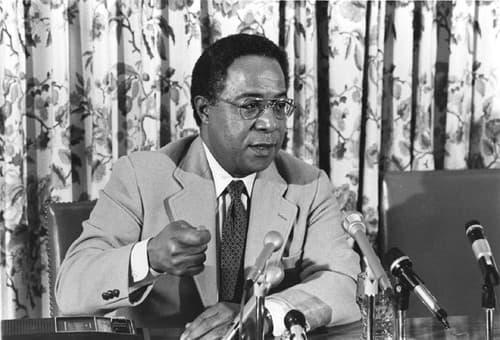
Alex Haley was an American writer and author, best known for his 1976 novel "Roots: The Saga of an American Family." This epic work traced his family history from Africa to slavery and freedom in the United States, becoming a cultural phenomenon and inspiring a television miniseries. He also co-authored "The Autobiography of Malcolm X" and wrote the novel "Queen." Haley received a special Pulitzer Prize citation for "Roots."







