“There are some things in this world that are not for sale.”
— Abraham Cady reflecting on principles amidst various pressures.

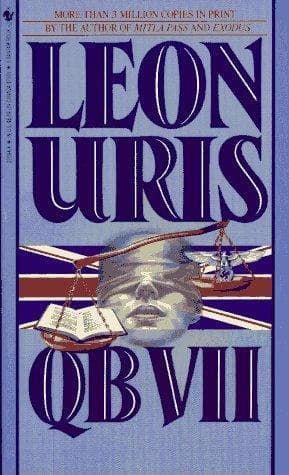
Leon Uris (1970)
Genre
Historical Fiction / Mystery
Reading Time
12-15 hours
Key Themes
See below
Sign in to track this book
In London's Queen's Bench, a celebrated author faces a libel suit from a renowned surgeon, forcing both men to confront the horrors of a concentration camp and the shifting nature of truth and memory.
The story opens with the libel trial in Queen's Bench Courtroom Number Seven, London. Sir Adam Kelno, a Polish-born surgeon living in England, is suing American author Abraham Cady for defamation. Cady's bestseller, 'The Holocaust', describes the atrocities of the Jadwiga concentration camp and names Kelno as a sadistic inmate-doctor who performed brutal experiments on prisoners. Cady, a Jew whose family died in the Holocaust, used his book to expose the horrors he found during his research. Kelno denies Cady's accusations, saying his reputation has been ruined, which sets up a tense legal battle that will uncover dark chapters of World War II.
The story goes back to Abraham Cady's childhood. Born in poverty in the Jewish ghetto of Warsaw, he experiences increasing antisemitism before World War II. His parents, seeing the danger, send young Abraham to America just before the Nazi invasion. He grows up in an orphanage, haunted by his family's unknown fate. After the war, Cady dedicates himself to finding answers, eventually learning that his entire family died in the Jadwiga concentration camp. This discovery fuels his lifelong focus on the Holocaust and becomes the main reason for his writing career, especially 'The Holocaust'.
The story also looks at Sir Adam Kelno's past. Born into a wealthy and influential Polish Catholic family, Kelno has a privileged upbringing. He becomes a doctor, distinguishing himself as a brilliant and ambitious student. His pre-war life is marked by academic success and a comfortable social standing, seemingly untouched by the rising political tensions and anti-Jewish sentiment that would soon engulf Europe. This contrast with Cady's early life highlights the different paths and experiences that would lead them to QB VII.
The trial then focuses on the Jadwiga concentration camp. As Cady's legal team presents evidence, testimonies from survivors and historical documents show a gruesome picture of the camp's atrocities. Witnesses recount the brutal conditions, widespread torture, and unspeakable medical experiments performed on prisoners. Here, the first direct accusations against Kelno emerge, not just from Cady's book but from survivor testimonies identifying him as a doctor involved in these experiments. Kelno, through his barrister, denies these claims, stating he was merely a prisoner-doctor forced to provide basic care under duress.
The book details Abraham Cady's research for 'The Holocaust'. He travels widely, interviewing many survivors, reviewing archives, and going through documentation. His investigation leads him to multiple independent accounts that confirm Kelno's involvement in the experiments at Jadwiga. Cady feels a moral duty to expose the truth, believing that justice for the victims requires naming those responsible. His confrontation with Kelno's past is not driven by personal revenge, but by a commitment to historical accuracy and the memory of those who died.
Sir Adam Kelno's defense team, led by a barrister, uses several strategies. They try to show Cady as a sensationalist author seeking fame and fortune, willing to make up evidence. They question the reliability of Cady's witnesses, pointing out possible memory lapses or biases of Holocaust survivors. Kelno testifies, maintaining his innocence and presenting himself as a victim of circumstances, forced to work in the camp to survive, always trying to reduce suffering within his power. He claims any involvement in experiments was under duress and that he never willingly participated in atrocities.
As the trial continues, several key witnesses appear, their testimonies proving important. One witness is a former nurse from Jadwiga who worked with Kelno, giving details about his participation in medical experiments. Another is a former prisoner who personally experienced Kelno's procedures. These testimonies, often delivered with emotion and vivid recall, begin to weaken Kelno's defense. Their accounts are not just stories; they often match documents and other survivor statements, creating a compelling, though horrific, picture of Kelno's actions at Jadwiga.
A significant theme explored during the trial is the moral dilemma faced by individuals, especially those with professional skills, who found themselves in concentration camps. The court considers how much control a prisoner-doctor like Kelno truly had, and where the line between forced compliance and active collaboration lies. The defense argues that survival often required impossible choices, while the prosecution says that certain actions crossed an unforgivable moral line, regardless of the circumstances. This debate highlights the profound and often unanswerable questions about human behavior under extreme pressure.
After weeks of testimony and deliberation, the jury delivers a nuanced verdict. They find that Abraham Cady's accusations against Sir Adam Kelno regarding his involvement in medical experiments at Jadwiga are largely true. However, they also find Cady guilty of libel on a technicality, awarding Kelno a tiny sum in damages, which is effectively a moral victory for Cady. The verdict is a symbolic triumph for historical truth and the victims of the Holocaust, confirming the authenticity of Cady's research and the seriousness of Kelno's past actions, despite the legal technicality.
Following the trial, Abraham Cady reflects on the personal and professional toll it has taken. Despite the legal victory, the experience has been emotionally exhausting, forcing him to relive the horrors of the Holocaust and confront the depths of human depravity. Yet, he feels confirmed, believing that the trial served its purpose: to bring the truth about Kelno and Jadwiga to light and to ensure that such atrocities are never forgotten. Cady reaffirms his commitment to writing and bearing witness, understanding that his work is not just about history, but about preventing future genocides.
Sir Adam Kelno's life is shattered by the trial's outcome. Despite the technical victory, the public exposure of his wartime activities and the jury's moral judgment have ruined his reputation and career. The esteemed surgeon is now an outcast, his achievements overshadowed by the dark stain of Jadwiga. He faces social rejection and professional ruin, living with the permanent mark of his past. The trial, while legally complex, was a powerful form of public accountability, showing that even decades later, the truth about the Holocaust could emerge and demand reckoning.
The Protagonist
From a traumatized orphan seeking answers, Cady evolves into a powerful voice for historical truth, culminating in his public vindication through the trial.
The Antagonist
Kelno's meticulously constructed life and reputation are systematically dismantled as his wartime actions are exposed, leading to his public disgrace.
The Supporting
Shawcross grows in his conviction for Cady's cause, successfully navigating a challenging legal battle to secure a moral victory.
The Supporting
Taylor skillfully defends Kelno, but ultimately cannot overcome the weight of truth presented by Cady's team, leading to a complex verdict.
The Supporting
Judge Croom upholds the integrity of the court throughout the challenging and high-stakes trial.
The Supporting
Markheim bravely steps forward to provide critical testimony, contributing significantly to the exposure of Kelno's past.
The Supporting
Stanislaus's testimony offers a nuanced view of the challenges faced by prisoner-doctors, enriching the court's understanding.
The main theme is Abraham Cady's search for the truth about the Holocaust, specifically Sir Adam Kelno's role in the Jadwiga concentration camp. Cady's personal trauma drives his dedication, making his work a mission of historical accuracy and moral accountability. The trial itself becomes a way to pursue this, as legal arguments dissect historical facts and survivor testimonies, seeking justice for the victims. The nuanced verdict, while legally acknowledging libel, is a moral affirmation of Cady's truth, showing that truth, even decades later, can prevail.
““The truth is not always beautiful, nor are the acts of men, but it is the truth, and it must be told.””
The novel explores the nature of evil, especially in the Holocaust. It examines not only overt acts of cruelty but also subtle forms of complicity and ethical compromises made under extreme pressure. Sir Adam Kelno's character makes the reader confront how a respected professional could participate in atrocities, blurring the lines between victim and perpetrator. The trial looks into the moral ambiguities of survival in concentration camps, questioning when self-preservation crosses into active collaboration with evil, highlighting the complex and often uncomfortable grey areas of human behavior during wartime.
““There is a line, a thin, wavering line, between what one must do to survive and what one must not do to remain human.””
The book addresses the importance of remembering historical events, especially the Holocaust, and the dangers of historical revisionism. Kelno's libel suit is an attempt to rewrite his past and erase inconvenient truths, challenging Cady's researched account. The trial becomes a battleground for memory, where survivor testimonies clash with Kelno's denials, emphasizing the fragility of historical truth and the ongoing fight against forgetting. Cady's work and the trial underscore the moral need to bear witness and ensure that past atrocities are never minimized or denied, thus serving as a warning against future genocides.
““If we forget, we are condemned to repeat.””
Leon Uris, through Abraham Cady, champions the power of storytelling and literature to bear witness, educate, and seek justice. Cady's book, 'The Holocaust', is not just a historical account; it is a moral act, designed to inform the world and ensure that victims are not forgotten. The novel shows how a single book can start a legal and moral reckoning, bringing long-buried truths to light. It highlights the author's responsibility to history and humanity, asserting that literature can be a force for change and accountability.
““A book can be a weapon, a testament, a scream across the centuries.””
Alternating between the courtroom drama and the characters' pasts.
The novel skillfully employs flashbacks to interweave the present-day courtroom drama with the detailed backstories of both Abraham Cady and Sir Adam Kelno. This parallel narrative structure allows the reader to understand the motivations and experiences that led each man to QB VII. By presenting their contrasting upbringings and wartime experiences, the device builds tension, provides crucial context for the accusations, and deepens the thematic exploration of truth, memory, and complicity, making the trial's stakes more profound.
The trial setting reflects broader societal and historical conflicts.
Queen's Bench Courtroom Number Seven serves as more than just a legal venue; it functions as a microcosm where the profound historical and moral conflicts of the Holocaust are re-examined. The legal proceedings, with their rules of evidence and cross-examination, force a meticulous dissection of events, bringing to light individual testimonies and historical documents that represent the larger struggle for truth and justice. The courtroom becomes a stage where the past directly confronts the present, forcing society to grapple with its collective memory and accountability.
Characters present their subjective versions of historical events.
While the overall narrative aims for truth, the portrayal of the past by key characters, particularly Sir Adam Kelno, introduces an element of the unreliable narrator. Kelno's testimony, where he consistently denies or downplays his involvement in atrocities, forces the court and the reader to critically evaluate his version of events against the evidence presented by Cady's witnesses. This device highlights the subjective nature of memory, the human capacity for self-deception, and the deliberate obfuscation of truth, making the search for objective reality a central challenge of the trial.
A legal judgment that carries profound moral implications beyond its technicality.
The verdict in QB VII, where Kelno technically wins a libel case but is awarded a minuscule sum, effectively a moral victory for Cady, serves as a powerful symbolic device. It underscores the idea that legal truth and moral truth are not always identical. The jury's decision, while adhering to legal definitions of libel, unequivocally affirms the substantial truth of Cady's accusations regarding Kelno's wartime actions. This symbolic verdict elevates the trial beyond a mere legal dispute, transforming it into a definitive public declaration of historical fact and moral accountability.
“There are some things in this world that are not for sale.”
— Abraham Cady reflecting on principles amidst various pressures.
“Justice is a machine that, once set in motion, is difficult to stop.”
— The narrative's contemplation on the legal process and its relentless nature.
“The past is a foreign country; they do things differently there.”
— A broader reflection on the historical context and changing moral landscapes, particularly regarding the Holocaust.
“A man's reputation is his most valuable possession.”
— Dr. Adam Kelno's perspective on his public image and the accusations against him.
“The truth, like murder, will out.”
— The underlying belief that facts, however suppressed, will eventually surface.
“Courage is not the absence of fear, but rather the judgment that something else is more important than fear.”
— Characters facing difficult choices and the moral imperative to act despite personal danger.
“The greatest evil is not done by evil men, but by good men who do nothing.”
— A recurring theme regarding complicity and the responsibility to confront injustice.
“Memory is a weapon, and sometimes it's the only one you have.”
— Survivors of the Holocaust using their experiences to fight for justice.
“To forget is to forgive, and some things should never be forgiven.”
— The unwavering stance of those seeking accountability for wartime atrocities.
“The law is a blunt instrument, but sometimes it's the only one that works.”
— The limitations and necessities of legal recourse in complex moral cases.
“History is written by the victors, but truth has a way of being rewritten by the survivors.”
— The struggle to present the authentic narrative of the Holocaust against revisionist attempts.
“There comes a time when silence is betrayal.”
— The moral imperative to speak out against injustice, particularly concerning historical crimes.
“The price of freedom is eternal vigilance.”
— The ongoing need to protect liberties and prevent the resurgence of ideologies that lead to atrocities.
“A man must live with his conscience, even if no one else does.”
— Abraham Cady's personal struggle and commitment to his moral compass.
Ready to see how well you understood this book? Take our interactive quiz with 10 questions.
Biography coming soon.







