“There are no gods left, Kael. None that will answer.”
— Tamas to Kael as they discuss the lack of divine intervention.

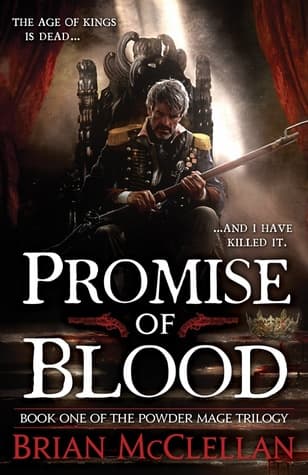
Brian McClellan (2013)
Genre
Fantasy
Reading Time
12-15 hours
Key Themes
See below
Sign in to track this book
In a world where gunpowder mages clash with ancient gods, a coup leader's revolution unravels as his estranged son and a blackmailed detective uncover a divine conspiracy threatening to shatter their nation.
Field Marshal Tamas, leader of the Royal Adran Army, stages a coup against King Manhouch IX. He executes the king, his royal family, and much of the aristocracy. This act, meant to end corruption and feed the starving, immediately throws Adro into chaos. Tamas's son, Taniel Two-shot, a powerful Powder Mage, helps clear the royal palace. However, internal groups, including a newly strong Church, worker's unions, and a nervous public, challenge the coup's success. The neighboring Nine Nations prepare for war, seeing the regicide as aggression. Tamas struggles to establish a new government amid the bloodshed and political maneuvering.
Adamat, a retired police inspector, is called back to service by Tamas. His first task is to investigate the disappearance of the royal treasury, money and artifacts that vanished during the coup. Adamat's investigation quickly uncovers a deeper conspiracy, suggesting not all is as it seems after the coup. He discovers a secret society called the 'Privileged,' powerful mages who seem to work against Tamas's new regime. Adamat's loyalty to Tamas is tested when a mysterious figure blackmails him, threatening his family. This forces him to keep certain findings secret while trying to uncover the truth of the missing funds and the opposition.
Taniel Two-shot, Tamas's son and a Powder Mage, struggles with the coup's aftermath and his difficult relationship with his father. He is haunted by past events, especially the death of his fiancée, which he blames on his father. Taniel's main mission is to hunt down and eliminate the remaining Privileged, powerful mages who were part of the King's guard and now threaten Tamas's new government. He faces several Privileged, including the ruthless Lord Clareview. During these fights, Taniel's marksmanship and powder mage abilities are tested. He begins to suspect a larger, more organized force behind the Privileged resistance than he first thought.
Nila, a young laundress in the Adran capital, finds her life changed by vivid and disturbing visions. These visions, often involving ancient gods and prophecies, lead her to a mysterious, powerful man named Ka-poel. Ka-poel appears to be a mute savage but has a connection to the supernatural. Ka-poel becomes Nila's protector as Nila's abilities develop, revealing her to be a 'bone-eye,' someone who can see and interact with the spirit world. Nila's journey introduces the idea of ancient gods reawakening and their possible involvement in Adro's political turmoil, suggesting the conflict is more than a mortal power struggle.
After King Manhouch's execution, the neighboring Nine Nations, led by Delv, declare war on Adro. They see Tamas's coup as an unforgivable act and a threat to monarchies. Tamas, already dealing with internal dissent and economic problems, must prepare Adro for a full invasion. The war adds pressure to his stretched resources and forces difficult strategic decisions, showing the precarious state of his new government. The conflict with the Nine Nations also distracts him, potentially allowing other threats to gain power within Adro.
As Adamat investigates, he uncovers evidence that the missing royal funds and the Privileged's actions are part of an older plan. He learns about the 'Kresimir,' an ancient god thought dead, and realizes the coup is being manipulated to awaken Kresimir. The blackmailer, a powerful Privileged working for Kresimir, forces Adamat to betray Tamas by giving crucial information. Adamat's discovery raises the stakes from a political struggle to a battle against a divine entity, threatening Adro and its people.
Taniel hunts Lord Clareview, a dangerous Privileged. Their conflict ends in a brutal fight where Taniel's powder mage abilities are pushed to their limits. During the battle, Clareview reveals parts of the larger conspiracy, hinting at Kresimir's reawakening and manipulation by unseen forces. Taniel, despite his personal issues, understands the seriousness of the situation and the threat to Adro. This encounter strengthens his resolve to fight not just for his father's regime, but for his nation's survival against an ancient and terrifying enemy.
Tamas, focused on the military threat, gathers Adro's remaining forces for a defense against the invading armies of the Nine Nations. He makes strategic decisions, sacrificing territories to consolidate defenses around the capital. Despite his military skill, Tamas is isolated, facing betrayal from within his ranks and struggling to control various factions. He remains largely unaware of the Kresimir conspiracy, believing the main threat is political and military, which leaves him open to the ancient god's plans and its followers.
The conspiracy ends in a ritual to fully awaken Kresimir. The missing royal funds and artifacts are key to this ritual, acting as conduits for the god's power. Adamat, now understanding the plot, tries to warn Tamas, but the Privileged and his compromised position hinder him. The ritual, performed by powerful Privileged mages, succeeds, and Kresimir begins to manifest, showing immense power. This event marks a turning point, as the threat moves from a human conspiracy to a direct fight with a divine entity.
The final battle sees Tamas's forces fighting the invading Nine Nations while trying to stop the awakened Kresimir. Taniel, using his powder mage abilities, fights with skill against the Privileged and Kresimir's growing influence. Nila, guided by Ka-poel, plays a role, using her bone-eye abilities to understand and counter Kresimir's power. Adamat, despite his earlier compromises, works to expose the truth and help Tamas. The battle is chaotic and devastating, with mortal and divine powers clashing, and Adro's fate hanging in the balance as Tamas and his allies try to defeat Kresimir and repel the invaders.
In the climax, a sacrifice is made to defeat Kresimir, though its exact nature and success are somewhat unclear. The defeat of the ancient god comes at a cost, leaving Adro devastated and its leadership changed. Tamas, having faced both invasion and divine threats, must rebuild his nation. The war with the Nine Nations is not fully resolved, and the power vacuum left by Kresimir's defeat creates new opportunities and dangers. The ending sets the stage for future conflicts, with the world altered by the reawakening of gods and the power of powder mages.
The Protagonist
Tamas begins as a confident revolutionary but is quickly overwhelmed by the unforeseen consequences of his coup, forcing him to adapt to internal and external threats, ultimately realizing the fight is against something far greater than kings.
The Protagonist
Taniel starts as a self-destructive, embittered soldier but gradually finds purpose in fighting the true threats to Adro, beginning to reconcile with his father and accepting his role as a hero.
The Supporting
Adamat is forced out of retirement and into a morally compromising position, navigating blackmail and uncovering a divine conspiracy, ultimately choosing loyalty to Adro over self-preservation.
The Supporting
Nila transforms from a frightened, ordinary girl into a crucial conduit for divine understanding, embracing her unique abilities to aid in the fight against Kresimir.
The Supporting
Ka-poel acts as a catalyst and protector, guiding Nila and aiding Taniel, her unwavering loyalty and ancient knowledge proving vital against divine threats.
The Antagonist
Clareview serves as a relentless antagonist, his pursuit of power leading him to become a key instrument in Kresimir's reawakening, ultimately meeting his end at Taniel's hands.
The Antagonist
Kresimir begins as a mythical entity, slowly manifesting through the manipulation of mortals and rituals, culminating in his partial reawakening as a direct threat to Adro.
The Supporting
Vlora remains a steadfast and crucial military leader, providing unwavering support to Tamas amidst the escalating chaos and divine threats.
The novel explores the cost and unforeseen results of political change. Tamas's coup, meant to free Adro from corruption, instead brings civil war, economic instability, and external conflict. The 'Age of Kings' ends, but the new 'Age of the People' begins in fire and chaos, showing that overthrowing an old order often creates more problems than it solves. The executions, power struggles, and constant threat of war show that revolution rarely leads to immediate peace.
“The Age of Kings is dead... and I have killed it. It's a bloody business overthrowing a king.”
The book examines how power, whether political, magical, or divine, corrupts and is sought. The old monarchy was corrupt, but Tamas's new regime immediately faces challenges from the Church, worker's unions, and ambitious individuals, all seeking influence. The Privileged, with their magical power, use it for their own ends and to serve the awakening Kresimir. This theme suggests that power is a dangerous force, regardless of who wields it, and that its pursuit often leads to morally ambiguous choices and betrayal. Adamat's investigation constantly reveals deceit and self-interest.
“Power is like a cannon. Dangerous, loud, and you're better off not being in front of it.”
Initially, Adro seems to be a world where magic and technology coexist, with a strong sense of scientific reason. Educated men like Tamas and Adamat dismiss old legends about gods. However, the story gradually shows that ancient gods are real and actively manipulating events. Nila's journey as a 'bone-eye' challenges the rational worldview, forcing characters to confront the reality of divine intervention. This theme explores the tension between modern skepticism and ancient belief, asserting that some truths are beyond human understanding and scientific explanation.
“Gods were just stories, nursery rhymes to keep the children in line. No modern, educated man believed in them.”
The strained relationship between Field Marshal Tamas and his son, Taniel, forms an emotional core of the novel. Their shared magical abilities and military skill are clear, but personal tragedies and Tamas's single-minded devotion to his cause have created a deep rift. Taniel blames his father for his fiancée's death, leading to resentment and self-destructive behavior. Despite their separation, a deep, unspoken bond of love and respect exists, appearing during moments of extreme danger. Their journey explores forgiveness, duty, and the burden of legacy.
“He hated his father. He loved his father. He didn't know which was stronger.”
The novel is full of shifting loyalties and betrayal. Tamas's coup is an act of betrayal against the king, but he then faces betrayal from supposed allies, the Church, and individuals like Adamat who are forced into compromise. Adamat's blackmail forces him to choose between loyalty to Tamas and his family's safety. The Privileged's devotion to Kresimir, even as they manipulate and sacrifice others, highlights the dark side of loyalty. This theme shows the precariousness of trust in a world undergoing radical change and divine intervention.
“Loyalty was a strange thing. Sometimes it meant doing the right thing. Sometimes it meant doing the dirty thing.”
Individuals who can metabolize gunpowder, granting them enhanced senses, strength, and control over bullets.
Powder Mages are a unique magical class in Adro, able to draw energy from ingesting gunpowder. This grants them superhuman speed, strength, heightened senses (allowing them to 'see' for miles), and the ability to telekinetically guide bullets after they're fired. They are integral to Adran warfare, acting as elite soldiers and marksmen. Tamas and Taniel are both powerful Powder Mages, and their abilities are crucial in battles, allowing them to turn the tide against both mortal armies and magical threats. Their power is limited by their access to gunpowder, making supply lines critical.
Powerful mages who wield elemental and other forms of magic, often serving the old aristocracy or ancient gods.
Privileged Mages are another class of magic-users, distinct from Powder Mages. They manipulate elemental forces (fire, earth, air, water) and possess other potent magical abilities, such as mind control or creating illusions. They were historically tied to the monarchy and are often seen as more 'refined' but also more dangerous than Powder Mages. They form the core of the resistance against Tamas and are the primary agents of Kresimir's reawakening. Their power is immense, often requiring specialized training and rituals, and they pose a significant threat to the Powder Mages and the new regime.
Individuals with the rare ability to see and interact with the spirit world and ancient gods.
Bone-Eyes are a rare and ancient type of seer, exemplified by Nila. They possess the unique ability to perceive and communicate with spirits, ghosts, and even ancient gods. This power allows them to understand divine machinations and prophecies, often serving as conduits for supernatural forces. While not directly combative like Powder Mages or Privileged, their ability to perceive the true nature of the divine threat (Kresimir) makes them invaluable. Their visions and interactions with the spirit world provide crucial exposition and guide the plot towards the larger, cosmic conflict.
A symbol of the revolution's brutality and its promise of swift, egalitarian justice.
The guillotine is a potent symbol throughout the novel, representing the swift, brutal, and supposedly egalitarian justice of Tamas's revolution. It is prominently featured in the opening scenes, as King Manhouch and the aristocracy are publicly executed. While intended to symbolize a clean break from the old regime and a new era of fairness, its presence also highlights the inherent violence and bloodshed of the coup. It serves as a constant reminder of the revolution's unforgiving nature and the high stakes involved for anyone who opposes the new order, whether royalist or revolutionary.
“There are no gods left, Kael. None that will answer.”
— Tamas to Kael as they discuss the lack of divine intervention.
“Power is a funny thing. You only know how much you have when you try to use it.”
— Adamat reflecting on the nature of influence and authority.
“The greatest trick the Devil ever pulled was convincing the world he didn't exist. The greatest trick a Privileged ever pulled was convincing the world he was human.”
— A thought from Adamat regarding the hidden nature of the Privileged.
“A revolution is not a dinner party, or writing an essay, or painting a picture, or doing embroidery; it cannot be so refined, so leisurely and gentle, so temperate, kind, courteous, restrained and magnanimous.”
— Tamas's internal monologue on the brutal reality of the coup.
“Sometimes, the only way to save a man's life is to take it.”
— Tamas justifying harsh decisions for the greater good.
“You can't have a revolution without breaking a few eggs. Or a few thousand heads.”
— A cynical observation about the cost of political upheaval.
“The gods are dead, and we have killed them.”
— A variation of the common phrase, applied to the current state of affairs.
“War is a numbers game. And sometimes, you just don't have enough numbers.”
— Field Marshal Tamas contemplating the grim realities of battle.
“Hope is a dangerous thing, but it’s the only thing that keeps us going.”
— An internal thought from Taniel during a difficult situation.
“A man who cannot control his anger is a man who cannot control himself. And a man who cannot control himself is a danger to everyone around him.”
— Adamat's assessment of a volatile individual.
“The world doesn't care about your intentions. It cares about your results.”
— Tamas giving a pragmatic lesson in leadership.
“There’s always a bigger fish, Adamat. Always.”
— A warning about underestimating opponents or the scale of a problem.
“Magic is a tool, Kael. Like a hammer or a sword. It can build, or it can destroy.”
— Tamas explaining the neutrality of magic to Kael.
Ready to see how well you understood this book? Take our interactive quiz with 10 questions.

Brian McClellan is a fantasy author known for his Powder Mage series, including "Promise of Blood" and "The Autumn Republic." His work often blends magic with military themes and has been praised for its intricate world-building and fast-paced action. McClellan holds an MFA in Creative Writing.







