“I’m a murderer, not a liar. I have my standards.”
— Jorg Ancrath's self-assessment, highlighting his dark morality.

Mark Lawrence (2011)
Genre
Fantasy / Science Fiction / Young Adult
Reading Time
600 min
Key Themes
See below
Sign in to track this book
Haunted by a brutal past, the charming yet ruthless Prince Jorg leads a band of outlaws through a post-apocalyptic world, carving a bloody path to his father's throne while confronting the monstrous horrors that shaped him.
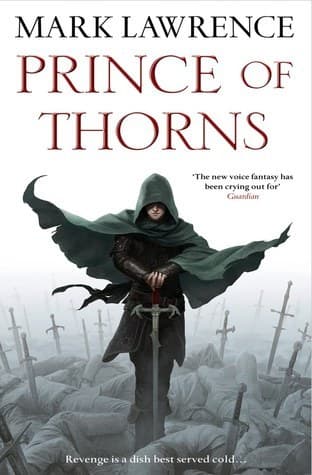
The story begins with Jorg Ancrath, a fourteen-year-old prince and leader of a brutal outlaw band, leading his men through the Silent King's ruined lands. Their immediate goal is the wealthy city of Vyene, which they plan to raid. On the way, they find a small village, which Jorg orders burned after they take what they want. His men, including Makin, Kent, and Sirs, are a mixed group of murderers and thugs, loyal to Jorg despite his youth and often cruel nature. Jorg often thinks about his past, hinting at a traumatic event involving thorns and the deaths of his mother and younger brother, William. His ruthlessness and calculated violence are clear from the start.
Jorg's plan to take Vyene is carefully brutal. He uses deception and overwhelming force, setting fires to draw out the city's defenders, then ambushing them. The attack is chaotic and bloody, showing Jorg's strategic mind and his complete disregard for human life. He takes part in the killing, driven by cold ambition. During the raid, he meets the city's leader, Duke Orrin, and executes him without hesitation. The successful attack on Vyene solidifies Jorg's reputation among his men and in the wider land as a terrifying force, a 'Prince of Thorns' who leaves only destruction.
Mixed with the present story are vivid, unsettling flashbacks to Jorg's childhood. These show the traumatic event that shaped him: at age nine, he, his mother, and his younger brother, William, were ambushed by an unknown attacker (later revealed as Count Renar). Jorg was thrown into a huge, dense thorn bush, where he stayed trapped for four days, watching his mother and brother die slowly. The thorns wounded him badly, and the experience gave him dark power and an unyielding will to survive. It changed his view of pain and morality forever.
After the raid on Vyene, Jorg and his men continue their journey, facing various dangers of the broken empire. They find a necromancer, a powerful dark magic user who controls the dead. Jorg, having his own ability to 'master' the dead and influence the living, confronts the necromancer. Through this meeting, he learns more about the growing threat of the Dead King, a legendary figure gathering an undead army, possibly aiming to conquer the entire empire. This reveals a larger threat to Jorg's world, beyond the small fights of lords and outlaws.
After months of raiding, Jorg makes the unexpected choice to return to his ancestral home, Castle Ancrath, his father King Olidan's seat. This decision stems from a desire for revenge against his father, whom he blames for his mother's death and his own suffering, and a deep ambition to claim his birthright. His men are cautious, knowing Ancrath's strong defenses and King Olidan's power. Jorg, however, is determined, seeing it as the next logical step in his rise to power. His return sets the stage for a confrontation with his past and his family.
As Jorg and his brotherhood near Ancrath, King Olidan's soldiers ambush them at a strategic crossroads. The battle is fierce and desperate, with Jorg's smaller, more agile group fighting against a larger number of trained soldiers. Several of Jorg's men die, and the brotherhood scatters. Jorg himself is almost captured but escapes using his fighting skills and his chilling ability to manipulate enemy minds. This ambush shows the danger of directly confronting his father and tests his remaining men's loyalty and resilience.
After the ambush, Jorg, always planning, begins to gather new allies and manipulate old ones. He meets Lord Red Kent, a powerful and feared bandit leader, and through intimidation, charm, and strategic deals, brings Kent and his forces under his control. Jorg's ability to inspire fear and loyalty, even in hardened criminals, is clear. He also uses his knowledge of local lords and their rivalries to cause trouble, weakening his father's position. However, these alliances are always unstable, built on shifting self-interest and possible betrayal.
Jorg and his larger forces lay siege to Castle Ancrath. Knowing a direct attack would fail, Jorg uses psychological warfare and infiltration. He uses his ability to control the dead to scare the castle's defenders and exploits hidden tunnels and weak points in the defenses. The siege is long and brutal, with heavy losses on both sides. Jorg's resolve is absolute, fueled by his strong desire for revenge against Olidan and his ambition to claim the throne, no matter the cost in lives, including his own men.
Jorg finally breaks through Ancrath's inner defenses and confronts his father, King Olidan. The confrontation is full of years of resentment and unspoken truths. Jorg reveals he knows about Olidan's involvement in the ambush that killed his mother and brother, accusing his father of planning it to remove his mother and secure his own power. Olidan, a cold and calculating ruler, admits his role, confirming Jorg's worst suspicions. This climactic meeting is a battle of wills and words, where Jorg's past trauma and present ambition meet his father's ruthless practicality.
After a fierce and devastating struggle, Jorg defeats his father. The exact details of Olidan's death are somewhat unclear, suggesting Jorg's direct involvement. With Ancrath secured, Jorg, still only fourteen, claims the throne. However, his victory is not complete. The Dead King, who has been quietly gaining power across the empire, is a greater threat than ever. Jorg's new position as king comes with the immediate task of defending his kingdom against an existential threat, showing that his journey for power has just begun and even greater challenges await.
The Protagonist
Jorg transforms from a wandering outlaw driven by personal revenge to a king burdened by the responsibility of defending his realm against a greater threat, though his core ruthlessness remains.
The Supporting
Makin remains a steadfast and loyal companion, witnessing Jorg's brutal ascent and adapting to his increasingly dangerous ambitions.
The Antagonist
Olidan remains a formidable, unchanging antagonist, ultimately succumbing to Jorg's relentless ambition and revenge.
The Supporting
Renar serves as a recurring symbol of Jorg's trauma and a direct target for his quest for revenge, eventually facing Jorg's wrath.
The Supporting
Kent remains a loyal but untamed force within Jorg's brotherhood, reflecting the constant threat of internal and external violence.
The Supporting
Sirs consistently demonstrates his unwavering loyalty and deadly efficiency, remaining a steadfast, if silent, asset to Jorg.
The Supporting
Gog remains a constant, unwavering presence, demonstrating loyalty and physical prowess throughout Jorg's journey.
The Mentioned
The Necromancer serves as a temporary antagonist and a herald for the larger threat of the Dead King, expanding the scope of the world.
The Antagonist
The Dead King's influence grows throughout the novel, establishing him as the ultimate, overarching antagonist for future conflicts.
Jorg's entire journey is driven by his childhood trauma: being trapped in a thorn bush and seeing his mother and brother murdered. This trauma appears as a strong desire for revenge against his father, King Olidan, and Count Renar. His ruthlessness, his ability to control fear, and his disregard for life are all direct results of this past. Flashbacks clearly show the origins of his psychological wounds, explaining his cruelty and his constant pursuit of power as a way to avoid ever being a victim again. His actions are not just for power, but a twisted form of justice for his lost innocence.
“Before the thorns taught me their sharp lessons and bled weakness from me I had but one brother, and I loved him well. But those days are gone and what is left of them lies in my mother's tomb.”
The novel explores different types of leadership through Jorg. Despite his youth and lack of morals, he earns strong loyalty from his outlaw band, showing that power can come from charisma, fear, and clever strategy, not just traditional authority. Jorg's leadership is practical and brutal; he motivates his men through shared violence and the promise of rewards, but also through his undeniable cunning and vision. He constantly manipulates those around him, whether his own men or rival lords, to reach his goals. The book questions what truly makes a leader and shows the dark paths one might take to gain and keep power in a broken world.
“A man's reach should exceed his grasp, or what's a heaven for?”
Prince of Thorns thrives on moral ambiguity. Jorg is clearly a villain in many ways—a murderer, a raider, and a manipulator—yet the story is told from his view, allowing readers to understand, if not agree with, his motives. The world itself is a brutal, post-apocalyptic place where survival often requires morally questionable acts. The novel avoids simple good and evil, showing a world where characters operate in shades of gray. While Jorg does terrible things, there are hints of his inner struggle and the lasting effects of his past. This leaves open the question of whether redemption is possible for him, or if he even wants it.
“I was nine when I saw my mother and brother die. I was ten when I killed my first man. Not a soldier, just a man. I was a prince.”
The 'Broken Empire' setting is key to the novel's themes. It is a world scarred by a past, vaguely technological disaster (implied 'Builders' and ancient machines), now returned to a feudal, violent state. This post-apocalyptic background explains the lawlessness, widespread banditry, and constant struggle for survival. The 'brokenness' of the empire reflects the brokenness of its characters, especially Jorg. The ruins of a technologically advanced past constantly remind them of a lost age, and the current barbarity is a sign of societal collapse, where traditional morality has been lost.
“The Builders built too well, and their ruins stand as an insult to our petty efforts.”
Interspersed memories of Jorg's traumatic past.
Flashbacks are a crucial device used to reveal Jorg's backstory and the origins of his ruthless personality. They are not linear but appear as vivid, often disturbing, snippets of memory, particularly focusing on the thorn bush incident and the deaths of his mother and brother. These flashbacks provide essential context for Jorg's present-day actions, explaining his motivations, his unique abilities, and the depth of his trauma. They build suspense and empathy (or at least understanding) for a character who otherwise appears purely villainous, slowly uncovering the layers of his psychological damage.
The story is told entirely from Jorg's perspective, colored by his biases.
The entire novel is narrated by Jorg Ancrath in the first person. This device immerses the reader directly into his twisted mind, allowing insight into his thoughts, motivations, and internal struggles, even as he commits horrific acts. However, Jorg is an unreliable narrator; his perspective is colored by his trauma, his ambition, and his inherent ruthlessness. He often rationalizes his actions or presents them in a way that serves his self-image. This narrative choice forces the reader to constantly question his version of events and his true nature, adding depth and moral complexity to the story.
Jorg's innate ability to influence the dead and the living.
Jorg possesses a unique, unexplained ability to 'master' the dead, making them obey his commands, and to exert a powerful, almost hypnotic influence over the living. This supernatural element is a significant plot device, giving Jorg an edge in battles and allowing him to achieve feats that would be impossible for an ordinary human. It also ties into his traumatic experience in the thorn bush, suggesting a dark gift born from suffering. This ability not only enhances his power but also hints at the darker magical forces at play in the world, particularly the rising threat of the Dead King, establishing a larger magical conflict.
A post-apocalyptic world with remnants of a lost, advanced civilization.
The 'Broken Empire' is more than just a backdrop; it's a foundational plot device. The world is a post-apocalyptic landscape, littered with the ruins and forgotten technologies of a highly advanced past civilization (the 'Builders'). This setting justifies the pervasive violence, the lack of centralized authority, and the brutal nature of survival. The remnants of advanced tech (like 'fire-oil' and 'shapers') hint at a lost golden age and add a layer of science fiction to the fantasy. This brokenness underscores the moral decay and desperate struggles of the characters, particularly Jorg, whose ambition thrives in such a chaotic environment.
“I’m a murderer, not a liar. I have my standards.”
— Jorg Ancrath's self-assessment, highlighting his dark morality.
“It’s a long road to get from a place where you have a father to a place where you have a dead father, but it’s a road we all walk.”
— Jorg reflecting on the universal experience of loss and the death of a parent.
“I have to admit that I have a certain fondness for the things that have gone wrong.”
— Jorg's cynical view and his attraction to chaos and destruction.
“I was born to a world of blood and fire. I was born to a world of violence. I was born to a world of pain.”
— Jorg describing his harsh upbringing and the world he inhabits.
“The dead can’t hurt you. It’s the living you have to worry about.”
— Jorg's pragmatic and hardened perspective on danger.
“The truth is a weak thing, easily broken by a lie.”
— Jorg's understanding of the fragility of truth and the power of deception.
“Revenge is a dish best served cold, but it’s also a dish best served bloody.”
— Jorg's brutal take on the concept of revenge.
“There are no heroes in my story. Only survivors.”
— Jorg's self-deprecating and realistic view of himself and his companions.
“Sometimes a man needs to know when to let go, when to stop fighting, and when to just let the world burn.”
— Jorg contemplating surrender or embracing destruction.
“Hope is a mistake. If you can stop yourself from hoping, you can stop yourself from being hurt.”
— Jorg's cynical view on hope as a source of pain.
“Power is a funny thing. It can make a man believe he's a god, and it can make a god believe he's a man.”
— Jorg's observation on the corrupting and transformative nature of power.
“I’m not a monster. I’m just a boy who’s done monstrous things.”
— Jorg's internal conflict and his attempt to rationalize his actions.
“The greatest trick the devil ever pulled was convincing the world he didn't exist. The second greatest was convincing me I wasn't him.”
— Jorg's dark humor and self-awareness of his own villainous nature.
“Sometimes you have to burn a bridge to keep the rats from following you.”
— Jorg's ruthless approach to severing ties and eliminating threats.
Ready to see how well you understood this book? Take our interactive quiz with 10 questions.
Biography coming soon.







