“The Americans are here. Can't you smell them?”
— Siam, the lioness, first sensing the presence of American forces during the invasion.

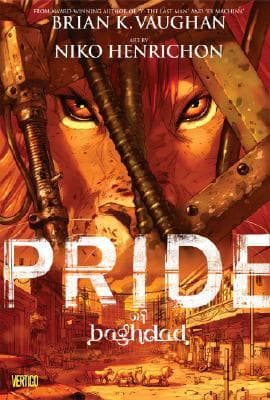
Brian K. Vaughan (2006)
Genre
Fantasy / Historical Fiction / Young Adult
Reading Time
90 min
Key Themes
See below
Sign in to track this book
During the 2003 Iraq War, a group of lions escapes the Baghdad zoo. They find that freedom in a war-torn city means a brutal fight for survival.
In spring 2003, during the American invasion of Iraq, four lions are in the Baghdad Zoo: Zill, the old male; Safa, his mate; Ali, their cub; and Noor, the young lioness. A bombing raid breaks their enclosure, letting them escape. Zill, born in captivity, is overwhelmed by the outside world. Safa, who remembers the wild, feels fear and excitement. Ali is curious and playful, while Noor is careful and practical. They move through the immediate chaos, seeing bombed buildings and hearing distant war sounds. Their first freedom is marked by confusion and a need for food.
As the lions move through the city, they see various animals, some dead, some terrified. They find a turtle, which Noor quickly kills for food. Zill is uncomfortable, as he has never hunted. Safa tries to teach Ali about the city's dangers, warning him about humans and their weapons. The lions start to have different views: Zill wonders if their freedom is real or just a different cage. Safa accepts her wild instincts. Ali sees it as an adventure, and Noor focuses on survival and food. Their talk shows the book's main ideas about freedom.
Hungry, the lions successfully hunt a gazelle near a river. But their win is short-lived. A group of wild dogs, city survivors, immediately challenge them for the kill. The lions are large but less experienced at defending territory and hunting. Zill, at first unsure, has to assert himself, but the meeting is tense and almost leads to a fight. This incident shows their weakness and the hard learning they face in their 'free' state. It shows that leaving a cage does not automatically give them the skills to survive in a harsh environment.
The lions find a temporary safe place in a bombed garden, a small green area among the destruction. Here, Ali finds an abandoned kitten and tries to befriend it, showing his innocent nature. The other lions are wary of the kitten, seeing it as a possible threat or prey. This brief peaceful moment is soon broken by nearby human prayer sounds and distant tank rumbling. The lions watch a small group of Iraqi civilians, including children, living their lives among the ruins. This reminds them that the human conflict is still active around them, and their freedom is connected to this larger war.
The lions find a large, golden lion statue, likely from Saddam Hussein's time. Zill is at first impressed, thinking it is a powerful, old ancestor. Safa, however, quickly calls it an empty symbol, a 'false god' made by humans to show their power. She reminds Zill that real strength comes from inside and from nature, not from man-made idols. This meeting comments on authority, propaganda, and the superficiality of man-made symbols compared to the raw reality of nature.
Feeling held back by Zill's hesitation to hunt and his thoughts, Noor decides to hunt alone, prioritizing her survival. She finds an orphaned Iraqi boy, alone and crying in the rubble. She first thinks of him as prey but is struck by his weakness and their shared experience of loss. She leaves him unharmed, a moment of unexpected kindness. Meanwhile, Zill, Safa, and Ali continue their journey, seeing more human suffering around them, the destructive effects of war on civilians.
The remaining lions meet a traumatized bear from the zoo, hiding in the ruins, broken by his experiences. The bear tells of the bombings and his fear of the outside world, missing his comfortable cage. His despair sharply contrasts with Safa's acceptance of freedom. Zill tries to comfort him, but the bear's fear is absolute. This meeting increases the philosophical conflict within the pride: Safa insists that even harsh freedom is better than a gilded cage, while Zill struggles with the difficult realities of their liberation and the pain it brings.
As morning comes, the lions, tired and weak, are in an open area. A group of American soldiers on patrol sees them. The soldiers, surprised and fearing danger, open fire. Safa, driven to protect her cub, charges the soldiers, hoping to scare them. Zill, despite his earlier doubts, joins her, roaring. Ali, caught in the shooting, is terrified. The soldiers, seeing the lions as a direct threat, continue to shoot. This leads to a tragic and unavoidable fight.
In the ensuing chaos, Zill, Safa, and Ali are all shot and killed by the American soldiers. The soldiers, relieved at first, express sadness about killing the animals. The scene is shown as tragically unavoidable, showing the unintended harm of war and nature's inability to survive human conflict. Their brief journey of freedom ends violently, raising a question about whether their freedom was worth the cost.
The story returns to Noor, shown alone, having survived the night away from the pride. She is seen walking through the desolate area. Her future is unclear, but she is clearly alone. The story ends without saying what happens to her. Her survival, separate from the rest of the pride's tragic end, highlights the book's main, unanswered question: Was their escape and brief taste of freedom true liberation, or just a different, harsher confinement leading to death? Noor's uncertain future makes the reader think about freedom and survival in a war-torn world.
The Protagonist
From a hesitant, philosophical captive, Zill attempts to lead his pride in the wild but ultimately succumbs to the harsh realities and violence of their newfound freedom.
The Protagonist
Safa fully embraces her wild instincts and the harsh freedom of the outside world, fiercely protecting her family until her tragic end.
The Protagonist
Ali's innocent wonder at the outside world is tragically cut short by the violence of war, never fully understanding the meaning of his freedom.
The Supporting
Noor prioritizes her own survival and leaves the pride, her fate left open to interpretation, representing a different path to 'freedom'.
The Mentioned
His brief appearance serves as a poignant symbol of human suffering, remaining static in his vulnerability.
The Supporting
The bear remains traumatized and fearful, serving as a static representation of the psychological damage of war and forced freedom.
The Supporting
They serve as an external obstacle, forcing the lions to confront the brutal realities of their new environment, remaining a constant, dangerous presence.
The Antagonist
They act as the catalyst for the pride's demise, remaining a force of human conflict and collateral damage.
This is the main theme, seen through the different views of the lions. Zill wonders if their escape is true freedom or just a trade for a harsher cage. Safa fully accepts the wild. The traumatized bear prefers his old cage, showing that 'freedom' can be scary. The book consistently asks if freedom is a state, a choice, or a burden, especially when it involves violence and responsibility. It questions the idea of 'given' freedom versus 'earned' self-determination.
“What good is freedom if we don't know what to do with it?”
The story shows how the Iraq War affects animals as well as humans. The bombed zoo, lack of food, constant war sounds, and the lions' deaths by soldiers all show that war's destruction goes beyond its intended targets. The lions' fight to survive in ruined Baghdad acts as a strong symbol for innocent lives caught in human conflict, showing the universal suffering caused by violence.
“The humans are fighting their war, but we animals are the ones paying the price.”
The characters show this theme. Safa uses her basic instincts and old memories of the wild, while Zill, born in captivity, overthinks and struggles with basic survival skills. Ali is guided by innocent curiosity, and Noor by practical self-preservation. The lions' early struggles to hunt and move, compared to the experienced wild dogs, show that instinct and learned experience are key for survival. Captivity can dull these vital skills, making 'freedom' dangerous.
“You can't think your way through the wild, Zill. You have to feel it.”
This theme is directly addressed when the lions see the golden lion statue. Zill is impressed by its size, seeing it as a symbol of old strength. Safa, however, calls it an empty, man-made 'false god' made to show human authority and control. This comments on the superficiality of power symbols, especially those from oppressive governments, and contrasts them with the true, often brutal, power of nature and self-determination.
“That's not a lion, Zill. That's a human's idea of a lion. A false god.”
The lions' whole journey is a fight for survival. They must learn to hunt, find shelter, and move through a dangerous, unknown city. Their success varies: Noor quickly learns to hunt, Safa uses memory, while Zill struggles. The fight with the wild dogs shows their lack of adaptation. The theme questions if adaptation is possible for creatures so far from their natural state, and if the cost of adapting (losing innocence, facing violence) is too high.
“We're not in a cage anymore. We have to learn to hunt, or we die.”
Attributing human thoughts and speech to the animal characters.
The story uses anthropomorphism extensively, allowing the lions to speak, reason, and engage in philosophical debates about freedom, captivity, and their place in the world. This device enables the authors to explore complex human themes through the lens of animal experiences, making the abstract concepts of war and liberation more accessible and emotionally resonant. It allows the reader to empathize with the animals' plight and understand their differing perspectives on their newfound 'freedom' without losing sight of their animalistic instincts and behaviors.
The lions' journey as a symbolic representation of the Iraqi people's experience of 'liberation'.
The entire narrative functions as an allegory for the 2003 invasion of Iraq and its aftermath. The lions' escape from the zoo symbolizes the 'liberation' of the Iraqi people from Saddam Hussein's regime. Their subsequent struggle, confusion, and ultimate demise at the hands of the 'liberators' (American soldiers) allegorically question the true meaning and cost of that liberation. The different lions represent various viewpoints within a population grappling with sudden, imposed freedom and the violence that often accompanies it.
A physical object representing false power and human constructs.
The golden lion statue encountered by the pride serves as a potent symbol. It represents the artificial, often oppressive, power structures created by humans (like Saddam Hussein's regime). Zill's initial awe and Safa's dismissive reaction highlight the contrast between perceived, man-made power and the raw, natural power of the wild. It underscores the theme that true strength and freedom are not found in gilded idols or imposed authority, but in self-determination and the natural order, however harsh it may be.
The lions' 'freedom' leading directly to their violent deaths.
The narrative is steeped in tragic irony. The lions escape their cages, believing they are finally free, only for this freedom to expose them to greater dangers and ultimately lead to their deaths at the hands of the very forces that 'liberated' them. The irony lies in the fact that their 'liberation' was not a path to a better life but a direct route to their demise, questioning whether it was truly better to die free than to live in captivity, and highlighting the devastating, unintended consequences of intervention.
Using a factual event as the foundation for a fictional narrative.
The graphic novel is explicitly framed as being 'based on a true story' – the real-life escape of lions from the Baghdad Zoo during the 2003 invasion. This framing device lends a layer of gravitas and realism to the fantastical elements of anthropomorphism. It grounds the allegorical narrative in a historical event, making the themes of war, liberation, and animal suffering more poignant and impactful for the reader, encouraging reflection on the real-world consequences beyond the fictionalized animal perspectives.
“The Americans are here. Can't you smell them?”
— Siam, the lioness, first sensing the presence of American forces during the invasion.
“Freedom. It's a funny thing. You spend your whole life dreaming of it, and then when you finally get it, you don't know what to do with it.”
— Zill, the male lion, reflecting on their escape from the zoo.
“Humans. They build these elaborate cages, and then they wonder why we don't appreciate their 'gifts.'”
— Siam expressing her disdain for humanity's actions.
“We're not just animals, Zill. We're symbols. We're the pride of Baghdad.”
— Siam reminding Zill of their significance beyond mere survival.
“What's the point of being free if you're just going to starve?”
— Noor, the cub, voicing a practical concern about their new freedom.
“The world outside is a beautiful, terrible place.”
— Siam describing the world beyond the zoo walls to the cubs.
“Sometimes, the greatest cage is the one you build for yourself.”
— Siam's philosophical observation about internal limitations.
“We were safe. We were fed. We were loved. And we hated every minute of it.”
— Siam reflecting on their life in the zoo before the bombing.
“It's not about what they did to us, it's about what we do now.”
— Zill trying to inspire the pride to move forward despite their past.
“This isn't freedom. This is chaos.”
— Noor's reaction to the destruction and lawlessness outside the zoo.
“They say every animal has a purpose. What's ours?”
— Ali, the older cub, questioning their role in the new world.
“The scent of fear is stronger than any perfume.”
— Siam observing the reactions of humans during the conflict.
“Some things are worth fighting for, even if you know you'll lose.”
— Siam's determination in the face of overwhelming odds.
“Home isn't a place. It's the ones you're with.”
— Siam trying to comfort the cubs as they wander through the destroyed city.
Ready to see how well you understood this book? Take our interactive quiz with 10 questions.

Brian K. Vaughan is a critically acclaimed American comic book writer, celebrated for his work on the Eisner Award-winning "Saga," the Hugo Award-winning "Y: The Last Man," and the acclaimed "Pride of Baghdad." His writing is known for its ambitious storytelling, complex characters, and genre-bending narratives, earning him a significant reputation in the comic book industry.







