“The truth is a funny thing. No one ever wants to hear it, until it's too late.”
— Rusty contemplating the nature of truth and its reception.

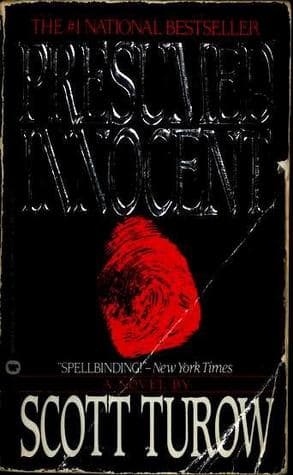
Scott Turow (1987)
Genre
Thriller / Mystery
Reading Time
561 min
Key Themes
See below
Sign in to track this book
After a prosecutor's affair ends in his colleague's murder, he faces trial, fighting to prove his innocence against a relentless system and his own hidden truths.
Rusty Sabich, chief deputy prosecuting attorney, is called to investigate the murder of his colleague, Carolyn Polhemus. Carolyn, an ambitious assistant prosecuting attorney, is found dead in her apartment, raped and strangled. Rusty, despite his recent affair with her, approaches the case professionally, leading the initial investigation with Detective Lipranzer. He knows his past relationship with Carolyn could complicate things, but he focuses on gathering evidence and interviewing suspects, including Raymond Horgan, the Prosecuting Attorney, and Nico Della Guardia, Horgan's political rival. Pressure grows as media attention increases and the political implications become clear.
As the investigation continues, inconsistencies and suspicious details emerge, all seemingly pointing to Rusty. Key evidence, like a glass with Rusty's fingerprints found in Carolyn's apartment and a hair matching his on the victim, is discovered. It's also revealed that Rusty was the last person to speak with Carolyn by phone before her death. Nico Della Guardia, now the acting Prosecuting Attorney after Horgan's election loss, uses this information. Driven by political ambition and a desire for a high-profile conviction, Della Guardia, with his assistant Tommy Molto, arranges Rusty's arrest for Carolyn's murder. Rusty is shocked, realizing his life is about to change forever.
Rusty is formally charged with first-degree murder. The bail hearing becomes a public spectacle, with Della Guardia and Molto portraying Rusty as a cold-blooded killer. Rusty's wife, Barbara, supports him, though their marriage is strained by the affair's revelations. Rusty's friend and mentor, Raymond Horgan, now out of office, offers support and helps Rusty get a strong defense attorney, Sandy Stern. Stern, known for his careful and strategic approach, immediately challenges the prosecution's story, pointing out the circumstantial evidence and the political reasons behind the charges. The media frenzy makes it hard for Rusty to escape public scrutiny, making him feel more isolated.
Sandy Stern, with help from Detective Lipranzer, thoroughly investigates the case, dissecting every piece of evidence from the prosecution. Stern focuses on showing the weaknesses in Della Guardia's case, especially the lack of direct evidence and the reliance on circumstantial links. He suspects the prosecution might have tampered with evidence or hidden important information. During pre-trial hearings, Stern challenges the evidence's chain of custody and questions the forensic analysis's integrity. He also uncovers the political animosity between Della Guardia and Horgan, suggesting Rusty is just a pawn in their power struggle. Rusty, meanwhile, tries to remember every detail of Carolyn and their affair that might help his defense.
The murder trial begins, presided over by Judge Lyttle. Della Guardia and Molto present their case, trying to portray Rusty as a jealous and obsessive lover who murdered Carolyn after she rejected him. They present the physical evidence, including fingerprints and hair, as undeniable proof. Witnesses testify about Rusty's affair with Carolyn, his possessiveness, and his emotional state after their breakup. The prosecution's story focuses on motive, opportunity, and the circumstantial evidence linking Rusty to the crime scene. Rusty endures the public humiliation of hearing intimate details of his affair discussed in court, while Barbara remains composed, her pain visible. The accusations weigh heavily on Rusty, who feels increasingly alone and misunderstood.
Sandy Stern begins his cross-examination, systematically taking apart the prosecution's case. He exposes inconsistencies in witness testimonies, challenges the forensic evidence's validity, and highlights the lack of a clear, direct link between Rusty and the murder. Stern suggests other suspects, including Nico Della Guardia himself, who had a tense professional relationship with Carolyn, and even Raymond Horgan, who might have had reasons to silence her. He implies the evidence against Rusty was either planted or misinterpreted. Stern's careful approach begins to create doubt in the jury's minds, making them consider other theories beyond the prosecution's seemingly simple story. Rusty, though still under immense pressure, feels a glimmer of hope as his attorney fights for his innocence.
As the trial continues, Stern uncovers more about Carolyn Polhemus's complex and manipulative character. It's revealed that Carolyn had multiple affairs, often using her charm and ambition to advance her career. She had also been involved with other powerful men in the legal community, including Judge Lyttle and Raymond Horgan, before her relationship with Rusty. Stern suggests that Carolyn's web of relationships and her ambition could have created many enemies, any of whom might have had a reason to kill her. This revelation shifts the focus from Rusty's alleged jealousy to Carolyn's own actions and the possible consequences of her manipulative behavior, further weakening the prosecution's sole focus on Rusty.
During the trial, Judge Lyttle's increasing hostility towards Rusty and his defense becomes clear. Stern, through his investigation, uncovers a past affair between Judge Lyttle and Carolyn Polhemus. This revelation explains the judge's bias and his attempts to hinder Stern's defense. Stern skillfully uses this information, subtly implying the judge's conflict of interest and further eroding the court proceedings' credibility with the jury. Despite the judge's bias, Stern's efforts to expose the truth and cast doubt on the prosecution's case work. The jury, after long deliberations, returns a 'not guilty' verdict, acquitting Rusty Sabich of Carolyn Polhemus's murder. Rusty is relieved, but the emotional scars remain.
Rusty is free, but his life is changed. His career is ruined, his reputation damaged, and his marriage to Barbara is deeply fractured by the public exposure of his affair. He tries to move on, but the question of who killed Carolyn Polhemus still haunts him. The acquittal, while a victory, does not bring closure. Rusty struggles with the emotional aftermath of the trial, the betrayal he felt from some colleagues, and the lingering shadow of suspicion. He returns to a quiet life, trying to rebuild his shattered existence with his family, though trust between him and Barbara is severely damaged.
Years after the trial, a devastating truth is revealed. Barbara Sabich, Rusty's wife, confesses to him that she murdered Carolyn Polhemus. Driven by jealousy and rage over Rusty's affair, Barbara had gone to Carolyn's apartment to confront her. The confrontation escalated into a violent struggle, ending with Barbara strangling Carolyn and staging the scene to implicate Rusty, using knowledge from his work as a prosecutor. The confession is a shattering blow to Rusty, who had endured so much believing he was innocent, only to discover his wife was the killer. The revelation adds a layer of tragic irony to the ordeal, showing the destructive power of betrayal and obsession within his own home.
The Protagonist
Rusty transforms from a respected, albeit flawed, prosecutor into a pariah fighting for his freedom, ultimately discovering a devastating truth about his own family.
The Victim/Catalyst
Carolyn's character is revealed posthumously, evolving from a simple victim to a complex, manipulative figure whose actions had far-reaching consequences.
The Supporting/Antagonist
Barbara's character shifts from a sympathetic, wronged wife to the shocking perpetrator of the crime, revealing the destructive power of jealousy and betrayal.
The Supporting
Stern remains consistently steadfast, serving as the unwavering voice of reason and legal expertise throughout Rusty's ordeal.
The Supporting
Horgan transitions from a position of power to a supportive, advisory role, demonstrating loyalty despite his own professional setbacks.
The Antagonist
Della Guardia rises to power by prosecuting Rusty, but his ambition and questionable ethics are ultimately exposed during the trial.
The Supporting Antagonist
Molto remains a steadfast, aggressive prosecutor, committed to Della Guardia's agenda, even when the case against Rusty falters.
The Supporting
Lipranzer's initial neutrality evolves into a subtle, ethical support for Rusty, highlighting his commitment to truth over political expediency.
The Supporting Antagonist
Judge Lyttle's character arc exposes the hidden personal biases that can compromise the integrity of the judicial process.
The novel shows how the pursuit of power and ambition can corrupt individuals and institutions, especially in the legal system. Nico Della Guardia's relentless pursuit of Rusty Sabich is driven by his desire for political advancement, causing him to manipulate evidence and ignore other theories. Carolyn Polhemus herself used her ambition and charm to advance her career, engaging in multiple affairs for influence. Even Judge Lyttle's past affair with Carolyn compromises his fairness, showing how personal interests can distort justice. This theme is central to understanding many characters' actions and the flaws in the Kindle County justice system.
“What is it about this place, this office, this whole damn county? It eats people alive.”
Betrayal is a common theme, appearing on many levels. Rusty's affair with Carolyn is a betrayal of his wife, Barbara, and their marriage. This personal betrayal starts a chain of events that leads to his public humiliation and legal ordeal. The most shocking betrayal, however, comes from Barbara, who not only kills Carolyn but also carefully frames her husband, letting him suffer through a murder trial for a crime she committed. This ultimate act of betrayal devastates Rusty, shattering his view of his family and the trust he placed in those closest to him, leaving him with deep emotional scars.
“The truth is a thing of the heart, and if you cannot find it there, you will not find it anywhere.”
The novel constantly questions the nature of truth and whether the legal system can deliver true justice. Despite the long trial, the 'truth' of Carolyn's murder remains hidden for much of the story, with different characters offering their own versions of events. The legal process, as shown, is not always about finding objective truth but about building a convincing story. Rusty's acquittal, while a legal victory, does not immediately reveal the real killer, leaving him and the reader with doubts. The final confession shows how official verdicts can differ from actual events, demonstrating the difficulties in achieving absolute justice.
“Justice is not a thing. It is a process. And it is not always just.”
Obsession drives many characters to destructive ends. Rusty's attraction to Carolyn Polhemus leads him to betray his wife and family, making him the main suspect in her murder. Carolyn's obsession with power and career advancement fuels her manipulative behavior and complex relationships, ultimately contributing to her death. Most importantly, Barbara's obsessive jealousy over Rusty's affair consumes her, leading her to commit murder and frame her own husband. This theme shows how uncontrolled desires and strong emotions can lead individuals to commit terrible acts and destroy lives.
“I loved her. And I hated her. It was the same thing.”
The story is told from Rusty Sabich's subjective and often self-serving perspective.
The novel is narrated in the first person by Rusty Sabich, making him an unreliable narrator. While he recounts events with detail, his perspective is inherently biased, shaped by his guilt over the affair, his fear of conviction, and his attempts to rationalize his actions. He withholds certain details, either consciously or subconsciously, and his interpretations of other characters' motives are filtered through his own experiences. This device creates suspense and forces the reader to question Rusty's honesty, both with himself and the audience, until the final shocking revelation. It highlights the subjective nature of truth and memory, especially under duress.
Misleading clues and suspects divert attention from the true killer.
Throughout the investigation and trial, the narrative introduces several red herrings to mislead the reader and Rusty himself. Evidence is presented that points to Rusty, but also suggests the involvement of other characters like Nico Della Guardia, Raymond Horgan, or even Judge Lyttle, all of whom had reasons to dislike or be involved with Carolyn. These false leads create intricate layers of suspicion and keep the reader guessing about the true killer's identity, making the final revelation all the more impactful. The meticulous construction of these misleading clues serves to highlight the complexity of the judicial process and the ease with which one can be falsely accused.
Rusty's memories and thoughts provide crucial background and emotional depth.
The narrative frequently employs flashbacks and extensive internal monologues from Rusty Sabich. Flashbacks detail his passionate affair with Carolyn Polhemus, revealing the intensity of their relationship and the emotional turmoil it caused him. His internal monologues offer deep insight into his fears, guilt, and legal strategies, as he grapples with the accusations and tries to recall every detail that might prove his innocence. These devices not only provide essential backstory and character development but also deepen the psychological suspense, allowing the reader to experience Rusty's deteriorating mental state and his desperate search for answers.
The trial itself acts as a central stage for uncovering truths and lies.
The courtroom serves as the primary setting for much of the novel, transforming the legal proceedings into a highly dramatic and suspenseful arena. The trial is not merely a procedural event but a battle of wits, strategies, and narratives between the prosecution and the defense. Through the cross-examinations, witness testimonies, and legal arguments, the novel dissects the characters, their motivations, and the intricate details of Carolyn's life and death. This device allows for the slow revelation of information, the exposure of corruption, and the exploration of legal ethics, keeping the reader engaged in the intellectual and emotional stakes of the justice system.
“The truth is a funny thing. No one ever wants to hear it, until it's too late.”
— Rusty contemplating the nature of truth and its reception.
“Until you have been in a courtroom, until you have seen a man's life hanging in the balance, you don't know what justice is.”
— Rusty reflecting on the intensity and gravity of court proceedings.
“We are all presumed innocent until proven guilty. But in the court of public opinion, the verdict is often rendered before the trial even begins.”
— Rusty's internal monologue about the impact of public perception.
“The law is a weapon, and like all weapons, it can be used for good or ill.”
— Rusty considering the dual nature of legal power.
“There are no accidents in life, only incidents that have not yet been explained.”
— A philosophical observation made by a character, hinting at underlying causes.
“Love, like a crime, leaves traces. And sometimes, the traces are all that's left.”
— Rusty's thoughts on the enduring impact of relationships, even after they end.
“Every man has his breaking point. The trick is to find it before he does.”
— A cynical insight into interrogation tactics or psychological manipulation.
“The past is never dead. It's not even past.”
— Rusty grappling with how past events continue to influence the present.
“We live in a world where facts are negotiable, and truth is a matter of perspective.”
— A reflection on the subjective nature of reality in legal and personal contexts.
“A man's reputation is like a house of cards. One strong gust, and it's gone.”
— Rusty's concerns about his reputation being destroyed during the trial.
“The only thing worse than being guilty is being innocent and no one believing you.”
— A poignant thought from Rusty about the despair of wrongful accusation.
“In the end, all we have are our choices. And the consequences of those choices.”
— A concluding reflection on agency and responsibility.
“Justice is not about truth. It's about procedure.”
— A cynical but realistic observation about the legal system's focus.
“The hardest part of a lie is not telling it, but remembering it.”
— A character's insight into the complexities and pitfalls of deception.
Ready to see how well you understood this book? Take our interactive quiz with 10 questions.

Biography coming soon.







