“I am the Dream King, I can make you a world, or unmake you a world.”
— Morpheus asserting his power to Alex Burgess after being freed.

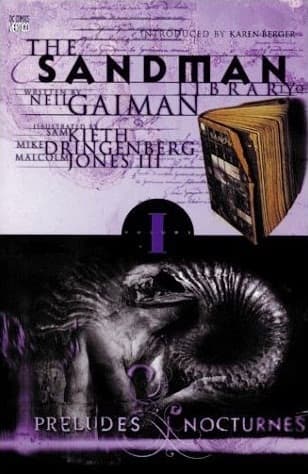
Neil Gaiman (1991)
Genre
Fantasy
Reading Time
120 min
Key Themes
See below
Sign in to track this book
After seventy years of magical imprisonment, the personification of Dreams, Morpheus, embarks on a surreal and dangerous quest across mythical places and the waking world to reclaim his lost artifacts, encountering Lucifer, John Constantine, and his cheerful sister, Death, along the way.
In 1916, Roderick Burgess, the 'Magus' of the Order of Ancient Mysteries, tries to capture Death for immortality. Instead, he catches Dream (Morpheus), who was weakened and outside his realm. Burgess takes Dream's ruby, helm, and sand pouch. Dream is held in a magical glass sphere in the Order's manor, his power slowly draining and his realm falling apart. Over decades, Burgess grows old and bitter, failing to get any wishes from Dream. His son, Alex Burgess, takes over the watch. In 1988, an elderly Alex becomes careless, and Dream, seizing a moment of weakness, escapes his prison, leaving the manor in ruins.
After his escape, Dream returns to the Dreaming, his realm, to find it in decay. His castle is crumbling, his librarian Lucien is a wreck, and many subjects, including the nightmares Brute and Glob, have left their posts, leaving human dreams in chaos. He discovers that his three tools—his ruby, helm, and sand pouch—are gone, scattered across the waking world. Without these artifacts, his power is diminished, and he cannot fully restore his realm or fulfill his duties. He consults the Fates (or Hecate), who confirm where his stolen items are, starting him on a dangerous journey.
Dream's search for his sand pouch leads him to London, where he enlists the help of Johanna Constantine, a cynical occult detective. Johanna, at first unwilling, reveals she gave the sand pouch to her former lover, Rachel, who has since become a severe heroin addict, using the sand for hallucinations. Dream confronts Rachel, whose mind is a chaotic mess of dreams and nightmares, and retrieves his pouch. However, the sand pouch is now sentient and corrupted by Rachel's addiction. Dream must then confront Choronzon, a powerful demon who claims ownership of the pouch, defeating him in a battle of wits and identity in Hell.
Following the Fates' guidance, Dream journeys to Hell, believing his helm is there. He travels the desolate landscape, encountering various damned souls and demons, including Etrigan. He learns that his helm is now with Choronzon, a demon he previously outwitted. To reclaim it, Dream must engage in a 'challenge'—a duel of wits and imagination—against Choronzon, with the demon as his champion. Dream defeats Choronzon by creating a concept that negates all of Choronzon's terrifying forms: 'Hope.' This victory angers Lucifer Morningstar, the ruler of Hell, who feels humiliated by Dream's success on his own turf, but Lucifer reluctantly allows Dream to leave with his helm.
After retrieving his helm, Dream focuses on finding his ruby. He learns that Alex Burgess sold it to Ethel Cripps, Roderick Burgess's former mistress, who then gave it to her son, John Dee. John Dee, a former supervillain known as Doctor Destiny, used the ruby's power to manipulate dreams, eventually becoming completely insane and incarcerated in Arkham Asylum. The ruby, still powerful, has been warped by Dee's madness, making it a dangerous and unpredictable artifact. Dream begins to track Dee, knowing that retrieving the ruby will be a difficult and potentially catastrophic task, given Dee's mental state and the ruby's corrupted power.
John Dee escapes Arkham Asylum and seeks refuge in a small, isolated diner. He uses the Dreamstone (Dream's ruby), which he has shaped into a more potent form, to torment the diner's patrons and staff. Over 24 hours, Dee manipulates their dreams and desires, stripping away their inhibitions and forcing them to act out their darkest impulses, leading to escalating violence, sexual depravity, and eventually, murder. The diner becomes a microcosm of human depravity, a living nightmare where reality is twisted by Dee's madness and the ruby's power. Dream arrives outside, unable to directly intervene due to the ruby's barrier.
Dream enters the diner to confront John Dee. Dee, now powerful with the ruby, engages Dream in a direct conflict, using the ruby to bend reality and attack Dream with his own nightmares. Dee believes he can destroy Dream by shattering the ruby, which he thinks is the source of Dream's power. However, the ruby is merely a focus for Dream's power, and when Dee shatters it, the raw power returns directly to Dream, restoring him to his full strength. Dee is left a broken, powerless man. Dream, now fully empowered, returns Dee to Arkham Asylum, leaving him in a state of perpetual dreaming, a mercy compared to his previous madness.
After reclaiming his power and restoring his realm, Dream feels a deep sense of melancholy and purposelessness. He is visited by his older sister, Death, a cheerful, pragmatic, and upbeat goth girl. She takes him on her daily rounds, collecting the souls of the recently deceased. Through their conversations and observations, Death reminds Dream of the importance of his role and the beauty and fragility of human life and dreams. She helps him to see that his purpose is not merely to exist but to interact with and shape the dreams of humanity. Her presence offers him a much-needed sense of perspective and solace, lifting his spirits and helping him to understand his place in the universe.
The Protagonist
Dream begins as a weakened, vengeful entity seeking his lost power, and through his journey, he regains his strength and, with the help of Death, a renewed sense of purpose and understanding of his place in the universe.
The Supporting
Death serves as a catalyst for Dream's emotional recovery, reminding him of his purpose and the beauty of existence, without undergoing a personal arc herself in this volume.
The Antagonist (initial)
Burgess's arc is one of decline and failure, as his initial triumph of capturing Dream leads to a long, fruitless wait for power and an eventual ignominious end.
The Antagonist
Dee's arc is one of escalating madness and destruction, culminating in his confrontation with Dream, which leaves him powerless but in a state of peaceful, if catatonic, dreaming.
The Supporting
Johanna primarily serves to facilitate Dream's retrieval of his sand pouch, experiencing no significant personal arc in this volume.
The Supporting/Antagonist
Lucifer's brief appearance establishes his character and his simmering resentment, setting the stage for future conflicts.
The Supporting
Lucien's primary role is to inform Dream of the state of the Dreaming upon his return, and he remains a constant, loyal presence.
The series explores the basic connection between dreams and waking reality. Dream's imprisonment directly affects the waking world, causing sleeping sicknesses and the spread of nightmares. John Dee's use of the Dreamstone in '24 Hours' shows how dreams, when twisted, can shatter reality and expose humanity's darkest impulses. The story suggests that dreams are not just escapism but a vital part of existence, influencing consciousness and shaping the world.
“I am the King of Dreams, Morpheus, Lord of the Dreaming. You are in my power.”
Dream's long absence has catastrophic results for both the Dreaming and the waking world. His quest to reclaim his tools comes from a deep sense of responsibility to restore balance. Roderick Burgess's irresponsible act of capturing Dream leads to decades of suffering, not just for Dream but for his own family and the world. John Dee's misuse of the ruby in '24 Hours' highlights the dire results of unchecked power and madness, showing how one individual's actions can cause widespread torment.
“I will tell you what your power is, Dream of the Endless. You are a dream. Nothing more. You are a story.”
Dream, as an immortal entity, grapples with the weight of his eternal existence and his role. His initial melancholy after regaining his power in 'The Sound of Her Wings' comes from a momentary loss of purpose, questioning the meaning of his endless duties. Death, his sister, provides a crucial counterpoint, showing him that even for the Endless, purpose is found in connection and engagement with the cycle of life and death, and that even the most ancient beings must find meaning in their existence. This theme explores the existential challenges faced by beings who transcend mortal concerns.
“You are the Lord of Dreams. You are the King of Nightmares. You are the Shaper. You are Morpheus. And you are needed.”
Dream's journey is not just about retrieving physical objects but about rediscovering himself after his long imprisonment. The confrontation with Choronzon in Hell, where Dream must define himself against the demon's shifting forms, is a literal battle of identity. His interactions with other characters, especially Death, force him to reflect on who he is and what his role truly means. He starts as a weakened and vengeance-driven entity, but by the end, he has reclaimed his power and gained a deeper understanding of his own nature and the importance of his connections.
“I am hope.”
Three artifacts that serve as extensions and foci of Dream's power.
These three items are not merely tools; they are externalized aspects of Dream's being and power. Their loss weakens him significantly, both physically and metaphysically. The quest to retrieve them forms the central narrative drive of 'Preludes & Nocturnes'. Each sigil, when misused (like the sand pouch by Rachel or the ruby by John Dee), demonstrates the chaotic and dangerous potential of Dream's power when untethered from his control, highlighting their importance in maintaining order in the Dreaming and the waking world.
Dream's personal realm, a reflection of his state and the collective unconscious.
The Dreaming is both a physical place (Dream's castle, library, and landscapes) and a metaphysical concept, the source and repository of all dreams, nightmares, and stories. Its dilapidated state upon Dream's return mirrors his own weakened condition and the chaos that has spilled into the waking world. As Dream regains his power, the Dreaming slowly begins to heal, symbolizing his restoration and the reassertion of order in the universe. It functions as a barometer for Dream's health and influence.
Seven anthropomorphic personifications of fundamental forces of the universe.
The Endless are primordial beings who embody fundamental concepts like Dream, Death, Destiny, Despair, Desire, Delirium, and Destruction. While only Dream and Death are central to this volume, the introduction of the concept establishes a grander cosmic hierarchy and mythology. Their existence highlights the idea that these forces are eternal, powerful, and interconnected, shaping the fabric of reality. Their familial relationships add a human element to these otherwise abstract concepts, making them relatable despite their immense power.
“I am the Dream King, I can make you a world, or unmake you a world.”
— Morpheus asserting his power to Alex Burgess after being freed.
“You get what anybody gets - you get a lifetime.”
— Death's answer to a man asking what he gets at the moment of his demise.
“Dreams and nightmares are important, too, you know. They're as important as anything.”
— Morpheus explaining the significance of his realm and purpose.
“It's a dream, after all. What can it hurt?”
— A character rationalizing actions within a dream, unaware of its true nature.
“The price of getting what you want is getting what you once wanted.”
— A philosophical observation on the nature of desire and fulfillment.
“I find myself wondering, for the first time, what it would be like to be human.”
— Morpheus reflecting on humanity after his long imprisonment.
“The Endless are merely names and functions. We exist because we are needed.”
— Morpheus explaining the nature of his family, the Endless.
“What power would hell have if those imprisoned here would not be able to dream of heaven?”
— Lucifer Morningstar's challenge to Morpheus during their confrontation in Hell.
“To absent friends, lost loves, old gods, and the season of mists; and may each and every one of us always find our way back home.”
— A toast given by a character, embodying themes of loss and longing.
“There are no easy answers. Only choices.”
— A character contemplating a difficult situation and the path forward.
“Sometimes you wake up. Sometimes the fall kills you. And sometimes, when you fall, you fly.”
— A metaphorical reflection on the outcomes of taking risks or facing challenges.
“Dreams are not a luxury, but a necessity.”
— Morpheus emphasizing the vital role of his realm in the waking world.
“The waking world is not as solid as it thinks it is.”
— A subtle hint at the fluid boundaries between reality and the dreaming.
“Every person has a dream, a nightmare, and a hope.”
— A generalization about the universal aspects of the human psyche.
Ready to see how well you understood this book? Take our interactive quiz with 10 questions.
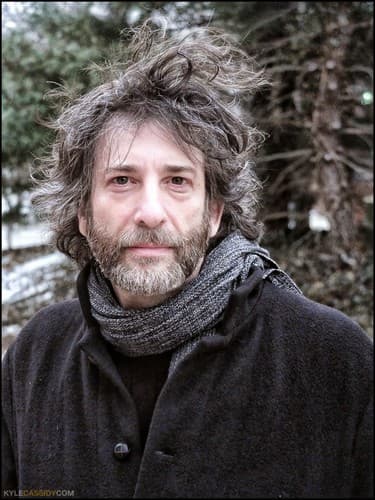
Neil Richard MacKinnon Gaiman is an English author of short fiction, novels, comic books, graphic novels, audio theatre, and a screenwriter. His works include the comic book series The Sandman and the novels Good Omens, Stardust, Anansi Boys, American Gods, Coraline, and The Graveyard Book. He has won numerous awards, including the Hugo, Nebula, and Bram Stoker awards, as well as the Newbery and Carnegie medals. He is the first author to win both the Newbery and the Carnegie medals for the same work, The Graveyard Book (2008). In 2013, The Ocean at the End of the Lane was voted Book of the Year in the British National Book Awards. It was later adapted into a critically acclaimed stage play at the Royal National Theatre in London.







