“Words are like seeds. Once you plant them, you can't take them back.”
— A teacher discussing the impact of online posts with students.

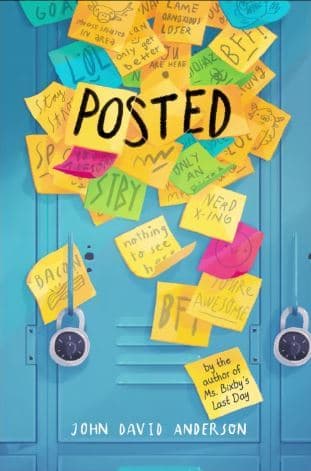
David Anderson, John David Anderson (2017)
Genre
Children's / Young Adult
Reading Time
360 min
Key Themes
See below
Sign in to track this book
When a middle school bans cell phones, a sticky note phenomenon erupts, transforming hallways into battlegrounds of kindness and cruelty, forcing a boy named Frost to navigate shifting friendships and the power of written words.
Branton Middle School bans cell phones, upsetting students, especially Frost and his friends: Deedee, Wolf, and Bench. These four, close and full of inside jokes, are cut off from their usual communication. Frustrated by the silence and inability to quickly share thoughts, Frost suggests using sticky notes to leave messages in secret spots around the school. The first notes are simple jokes and reminders. This becomes a fun and effective way for the friends to stay connected, starting a new trend that will soon affect the whole school.
A new student, Rose, arrives at Branton Middle School. She sits at Frost's lunch table, a spot usually just for him and his three best friends. Rose is quiet, observant, and seems mysterious. Her presence changes the comfortable dynamic of Frost, Deedee, Wolf, and Bench. Frost is curious about Rose, but his friends are less accepting, seeing her as an outsider. This initial tension sets up future conflicts as the friends deal with adding someone new to their group.
The sticky note idea, which started as a private way for Frost's group to talk, quickly spreads through Branton Middle School. Other students see the notes and start using them. Soon, hallways, lockers, and classrooms are covered with sticky notes. Many notes are positive, sharing compliments, jokes, or encouragement. But a darker side appears. Some students use the notes' anonymity to spread gossip, make mean remarks, and post bullying messages. The innocent game becomes a complex social space, showing the best and worst of middle school interactions and creating tension.
What began as a fun communication method becomes what students call the 'Sticky Note War.' Anonymous, mean notes start appearing, targeting individuals with cruel comments about their looks, intelligence, or social standing. The targets are deeply hurt, and the school becomes more tense. Frost and his friends, who started on the positive side, worry about the negative turn. Anonymity protects bullies, making it hard to find them. The emotional cost on students grows, creating suspicion and fear.
As Frost spends more time with Rose, he learns about her past. She transferred to Branton Middle School because she was severely bullied at her previous school, which made her withdrawn and careful. This helps Frost understand Rose's quiet nature and her hesitation to fully join Branton's social life. This shared vulnerability and understanding strengthen their bond, which starts to outweigh his relationships with his old friends. His empathy for Rose grows, making him more protective and sensitive to her feelings.
The growing closeness between Frost and Rose is noticed by Deedee, Wolf, and Bench. They feel left out and resent Rose joining their group. Their resentment shows in small ways, like excluding Rose from talks or making passive-aggressive comments. Rose, sensitive from past experiences, notices their unwelcoming attitude. Despite Frost's efforts to bridge the gap, his friends' reluctance to accept Rose makes her feel more isolated and unwelcome. This tension strains Frost's friendships and puts him in a hard spot, forcing him to choose between his old friends and his new connection.
During the 'Sticky Note War,' Frost learns a shocking truth: his friend, Bench, has been secretly posting some of the mean sticky notes. Bench's actions come from insecurity and a misguided attempt to be 'cool' or fit in with a different group. This discovery deeply hurts Frost, who always believed in his best friends' loyalty and kindness. The revelation creates a significant split in the group, shattering Frost's view of Bench and making the already strained dynamics, especially concerning Rose, more complicated.
Knowing what Bench did, Frost decides he cannot stay silent. He confronts Bench, expressing his hurt and disappointment. The confrontation is hard and emotional, leading to a heated argument. Bench, at first defensive, eventually admits his involvement, driven by peer pressure and a desire for attention. This painful reckoning exposes the weaknesses in their friendship and forces the group to face the results of their actions. The fallout leaves the friends shaken, questioning their bond and shared values.
Overwhelmed by the 'Sticky Note War,' the bullying, and the uncomfortable social dynamics, Rose decides to leave Branton Middle School. Her departure, though understandable, affects Frost deeply. He feels a sense of failure and regret, realizing he could not protect her or create a welcoming environment. Rose's leaving is a harsh wake-up call for Frost. It makes him examine his own actions, his friendships, and the effect of the sticky note trend. Her absence leaves a void and questions about what could have been.
After Rose leaves and Bench's actions are revealed, Frost, Deedee, Wolf, and Bench must face their broken friendship. They begin the slow process of reconciliation. Bench shows real remorse for his part in the bullying, and the others admit their part in allowing the negative atmosphere and isolating Rose. They learn about loyalty, empathy, and the power of words. Their friendship is changed, but they work to rebuild it on honesty and respect. The sticky note trend eventually fades, replaced by a more thoughtful approach to communication and understanding its impact.
The Protagonist
Frost evolves from a somewhat naive boy into a more mature and empathetic individual, learning to stand up for what's right even when it's difficult.
The Supporting
Rose attempts to find a new beginning but ultimately decides to leave when the environment becomes too reminiscent of her past trauma.
The Supporting
Deedee gradually learns to open her mind to new friendships and understand the impact of collective actions.
The Supporting
Wolf moves from passive acceptance to a more active understanding of his role in the social ecosystem.
The Supporting
Bench falls prey to negative influences but ultimately learns the importance of integrity and true friendship.
The Supporting
Mrs. Higgins consistently provides a supportive and guiding presence, offering wisdom and perspective to her students.
The Supporting
Principal Gable attempts to maintain order but struggles with the unpredictable nature of student communication.
The Mentioned
Marissa remains a static character, representing the ongoing challenge of social hierarchy and bullying.
This theme is central to the story, shown by the 'posting' of words on sticky notes. The book shows how words can connect, bring humor, and encourage (like the first notes between Frost and his friends). It also shows how they become weapons, causing emotional pain and social division (the 'Sticky Note War'). The notes' anonymity increases this power, letting cruelty grow. The story emphasizes that words, spoken or written, have lasting effects, impacting self-esteem, friendships, and the school environment, ultimately making Rose leave.
“Words are like a disease. They can make you sick, or they can make you well. They can kill you, or they can save your life.”
The novel examines middle school friendships and loyalty. Frost's bond with Deedee, Wolf, and Bench is tested by Rose's arrival and the 'Sticky Note War.' The theme explores challenges of adding new people to groups, the pain of perceived betrayal (Bench's actions), and hard choices to uphold morals over unquestioning loyalty. It shows that true friendship needs honesty, empathy, and courage to point out wrong behavior, even from close friends.
“It was hard to know what to do when your best friend was doing something you knew was wrong. Did being a good friend mean sticking up for them no matter what? Or did it mean telling them they were wrong?”
Characters in 'Posted' deal with their sense of self and belonging. Rose's identity struggles come from past bullying, making her careful and seeking a safe place. Bench's actions come from insecurity and wanting to be 'cool,' leading him to compromise his values for acceptance. Frost also navigates his identity, torn between old friends and his connection with Rose, questioning who he is and wants to be. The sticky notes themselves show students trying to define themselves and others.
“Sometimes it felt like everyone was wearing a costume, trying to be someone they weren't, just to fit in.”
The novel addresses bullying, especially through the anonymity of sticky notes. The cell phone ban, ironically, creates a new platform for anonymous harassment. The 'Sticky Note War' shows how anonymity empowers bullies, letting them inflict pain without immediate consequences. This theme explores the impact of bullying on victims like Rose and the moral compromises made by those who participate or allow it. It makes characters and readers face the responsibility that comes with communication, even when identities are hidden.
“The worst part was, you never knew who wrote them. It was like fighting ghosts.”
While the book starts with a cell phone ban, it is not anti-technology. Instead, it looks at communication's basic nature. The ban makes students find other ways to communicate, leading to sticky notes. This shows that the desire to communicate is natural, but the medium can change a message's impact. The story explores the pros and cons of instant, casual communication versus more thoughtful interaction. It suggests that while technology (or its absence) might change 'how,' the ethical responsibility of 'what' is communicated stays important, no matter the platform.
“It wasn't the phones that were the problem. It was the words.”
A physical manifestation of communication and its dual power.
The sticky notes are the central plot device, serving as a physical stand-in for digital communication. Initially, they are an innocent, creative solution to the cell phone ban, representing connection and camaraderie among Frost's friends. However, as the trend spreads, they transform into a symbol of both positive and negative communication, embodying the power of words to build up or tear down. Their anonymity allows for the escalation of bullying, making them a tangible representation of the 'Sticky Note War' and the moral dilemmas faced by the characters. They literally 'post' the narrative's central conflict throughout the school.
The inciting incident that creates the need for alternative communication.
The cell phone ban is the catalyst that sets the entire plot in motion. While seemingly a simple school policy, it inadvertently forces students to invent new ways to communicate, directly leading to the sticky note phenomenon. This device highlights how attempts to control behavior can have unforeseen consequences, and how the fundamental human need for connection will find an outlet. The ban isn't just a rule; it's the pivot point around which the entire social experiment of the sticky notes unfolds, creating the vacuum that the notes fill.
A character archetype used to disrupt established dynamics and introduce new perspectives.
Rose, as the new kid, functions as a classic literary device to introduce an external force that challenges the protagonist's world and reveals underlying tensions. Her arrival immediately disrupts Frost's tightly knit friend group, forcing them to confront their insularity and prejudices. Her past experiences with bullying make her particularly vulnerable to the 'Sticky Note War,' thus intensifying the stakes and providing a moral compass for Frost. Her character is crucial for exposing the flaws in the existing social structure and prompting the protagonist's growth and self-reflection.
A metaphorical framework to describe the escalating conflict.
The consistent use of the term 'Sticky Note War' by the students and narrator is a significant plot device. It frames the escalating conflict not merely as isolated incidents of bullying, but as a widespread, organized battle of words. This metaphor emphasizes the intensity, pervasiveness, and destructive nature of the anonymous notes, creating a sense of urgency and high stakes. It also highlights how seemingly small acts of meanness can collectively create an environment of fear and animosity, transforming an entire school into a battleground for social dominance.
“Words are like seeds. Once you plant them, you can't take them back.”
— A teacher discussing the impact of online posts with students.
“Sometimes the bravest thing you can do is hit delete.”
— A character deciding to remove a hurtful comment they posted.
“We're all just trying to find our place in the world, one post at a time.”
— Reflection on the social dynamics of middle school.
“A screen can hide a face, but it can't hide a heart.”
— A conversation about empathy in digital communication.
“Likes don't measure worth.”
— A reminder to a friend feeling insecure about online validation.
“The internet has a long memory, but forgiveness doesn't have to.”
— Discussing moving past online mistakes.
“Behind every username is a person with a story.”
— Encouraging perspective-taking in online interactions.
“Silence can be louder than a thousand comments.”
— Observing the power of not engaging in online drama.
“Friendship isn't about who comments first; it's about who shows up.”
— Comparing online and real-world connections.
“A post can travel the world in seconds, but an apology takes courage.”
— Reflecting on the speed of digital spread versus personal accountability.
“We're all editors of our own stories, even when we mess up the draft.”
— A metaphor for learning from mistakes in online behavior.
“The best filter isn't on your phone; it's in your heart.”
— Advice on thinking before posting.
“In a world of trends, be a friend.”
— A call to prioritize genuine relationships over online popularity.
Ready to see how well you understood this book? Take our interactive quiz with 10 questions.
David Anderson is a fiction author known for his works "Posted" and "Minion." His writing often explores contemporary themes within the fiction genre, engaging readers with relatable narratives and compelling characters. Anderson's contributions to fiction have established him as a voice within the literary community.
Biography coming soon.

Dan Gemeinhart
4.5

Kate O'Hearn
4.4

Jeanne Birdsall
4.4

Jen Wang
4.4

Wendelin Van Draanen
4.3

John Marsden
4.3

Chris Van Allsburg
4.3

Jennifer A. Nielsen
4.2