“She was a cop, and she was going to do her job. No matter how ugly it got, no matter how personal.”
— Eve Dallas's determination in the face of a disturbing case.

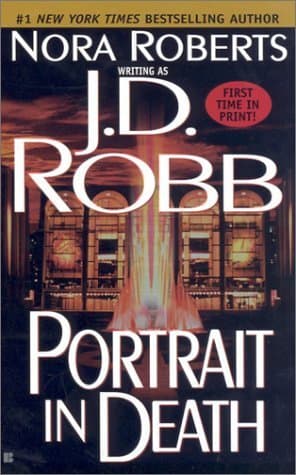
J.D. Robb (2003)
Genre
Thriller / Mystery / Science Fiction / Romance
Reading Time
290 min
Key Themes
See below
Sign in to track this book
In a futuristic New York, Lieutenant Eve Dallas hunts a killer who photographs his beautiful, murdered victims, forcing her to confront a terrifying artistic vision.
Lieutenant Eve Dallas is called to a crime scene after a reporter, Nadine Furst, receives a mysterious package with professional portraits of a woman, followed by an anonymous tip about a body in a Delancey Street dumpster. The victim is Cassandra "Cassie" Maxwell, a twenty-year-old student and aspiring dancer, not a model. The unsettling detail is that the portraits, showing Cassie in various poses, were taken after her death. Dr. Charlotte Mira, the police psychiatrist, notes the killer's careful nature and artistic drive. Roarke, Eve's husband, offers his resources and insights, recognizing the killer's need for control and perfection. The initial investigation focuses on Cassie's life, friends, and any connections to photography or modeling, which she always denied.
The investigation grows more intense with a second victim, Lisa Duncan, found like Cassie, with post-mortem glamour shots sent to the media. Lisa was also a young, lively woman with no ties to professional modeling. The killer's pattern becomes clear: he targets beautiful, innocent young women, murders them, and then stages elaborate photoshoots before disposing of their bodies. The photographs are always sent anonymously to the media, a perverse announcement of his 'art.' Eve, with Detectives Peabody and McNab, begins to build a profile of a highly intelligent, methodical killer with a dark artistic vision, driven by a need to 'capture' and 'own' his victims' beauty and innocence permanently. Roarke's access to high-tech surveillance and databases helps sift through leads.
Eve's team meticulously reconstructs the last days of Cassie Maxwell and Lisa Duncan. They interview friends, family, and acquaintances, looking for anyone who might have known both women, or who could provide insight into potential stalkers or unusual encounters. While both women were attractive and outgoing, there seemed to be no direct link between them. The killer's abduction method remains a mystery, as there are no signs of struggle at the disposal sites, suggesting the victims were either lured or overpowered elsewhere. Eve, frustrated by the lack of physical evidence at the dump sites and the killer's careful planning, focuses on the psychological aspect of the crimes, consulting with Dr. Mira to understand the killer's escalating obsession and what his next move might be.
The focus shifts to the specialized equipment used for the post-mortem photography, suggesting a killer with professional-level photographic skills. Eve and her team investigate photography studios and equipment suppliers, looking for anyone who might have purchased specific high-end gear. This leads them to Julian Cross, a talented but reclusive photographer known for his perfectionism and an unsettling history of intense, almost obsessive, relationships with his subjects. Cross's studio is meticulously organized, almost clinical, and he has a reputation for being difficult and controlling. While there's no direct evidence linking him to the murders, his psychological profile and artistic preferences align with the killer's methods, making him a prime suspect.
Through police work and Roarke's technological assistance, Eve uncovers more evidence linking Julian Cross to the victims. Cross had subtly stalked Cassie and Lisa, observing their routines and taking candid shots before their murders. His apartment reveals a hidden studio, complete with props and backdrops matching those in the post-mortem photographs. When confronted, Cross does not deny his actions but justifies them with a chilling artistic philosophy: he believes he is preserving their beauty and innocence at its peak, immortalizing them through his lens, preventing them from aging or fading. He sees himself as an artist, and his victims as his muses, whose deaths are necessary for the ultimate 'portrait.' His detachment and lack of remorse are disturbing to Eve, who is determined to stop him.
With Julian Cross identified as the killer, the police are on high alert. However, Cross, aware he is being hunted, makes his move. He abducts a third young woman, a student named Melanie, who had briefly interacted with him at a gallery opening. The team finds evidence of Melanie's abduction, confirming Cross's continued terror. Eve, driven by desperate urgency, knows that Melanie's time is running out. The pressure mounts as Eve and her team, including Peabody, McNab, and Summerset, work to track Cross's movements, using every available resource, including Roarke's network and surveillance capabilities, to find his location before Melanie becomes his next 'portrait.' The city is gripped by fear, and the media, led by Nadine Furst, provides constant updates, increasing the pressure on Dallas.
Roarke, using his technological skills and understanding of criminal psychology, deduces that Cross would likely have a more isolated, secure location for his 'artistic' endeavors, separate from his known studio. He focuses on properties with specific architectural features and remote access, eventually narrowing down a list of potential hidden locations. His search leads them to a secluded, abandoned warehouse on the outskirts of the city, which Cross has converted into a sophisticated, soundproofed studio. This studio has state-of-the-art photography gear, backdrops, and a darkroom, all designed to facilitate his macabre post-mortem photoshoots. The discovery provides a crucial lead, giving Eve a chance to intervene before it is too late for Melanie.
Eve and her team converge on the hidden warehouse. They breach the secured entrance and enter the elaborate studio, finding Julian Cross preparing Melanie for her 'portrait.' Melanie is terrified but alive. A tense standoff follows, with Cross, armed and delusional, trying to justify his actions to Eve. He sees her as an obstacle to his artistic vision, a threat to his perfect world. Eve, using her intellect and tactical training, disarms and subdues Cross after a brief but intense struggle. Melanie is rescued, traumatized but unharmed, thanks to the timely intervention. The scene is chaotic, filled with the macabre props and photographs that served as Cross's twisted artistic tools, a chilling display of his crimes.
Julian Cross is arrested and taken into custody, facing charges for the murders of Cassie Maxwell and Lisa Duncan, and the abduction of Melanie. The evidence against him is overwhelming, and his confession, though twisted by his artistic delusions, solidifies the case. The media, particularly Nadine Furst, reports extensively on the capture, praising Dallas and her team. Eve, though relieved by Melanie's rescue and Cross's apprehension, is deeply affected by the case. The killer's cold, artistic detachment from his victims and his perverse justification for murder leave a lasting impression. She finds comfort and support in Roarke, who helps her process the dark aspects of the human psyche she constantly encounters. The victims' families begin the long process of healing, knowing their daughters' killer has been brought to justice.
In the aftermath, Eve and Roarke discuss the nature of art and how it can be corrupted by dark obsession. Roarke, with his complex past and appreciation for beauty, grapples with Cross's twisted definition of art. Eve, while understanding the psychological reasons for Cross's actions, believes that true art does not require destruction or the violation of human life. They both acknowledge the thin line between passion and obsession, and how a creative drive can become a destructive force when unchecked by morality. The case reinforces Eve's commitment to justice and her role in protecting the innocent, even as it exposes her to the darkest corners of the human mind. The experience strengthens their bond as they navigate the complexities of life and death together.
The Protagonist
Eve confronts a killer whose artistic delusions challenge her understanding of humanity, reinforcing her commitment to justice while deepening her reliance on Roarke for emotional support.
The Supporting
Roarke uses his unique blend of resources and intuition to help Eve track a meticulous killer, demonstrating his unwavering support and deepening his understanding of the darker aspects of human nature.
The Antagonist
Cross escalates his 'artistic' murders, revealing his full, horrifying philosophy, before being captured by Eve Dallas.
The Supporting
Peabody continues to grow in her role as Eve's partner, contributing significantly to the investigation and demonstrating her increasing competence and dedication.
The Supporting
Dr. Mira provides critical insights into the killer's psychological makeup, helping Eve understand and anticipate his actions, while also supporting Eve's emotional well-being.
The Supporting
Nadine's reporting brings the killer's 'art' to public attention, highlighting the urgency of the case and subtly aiding the police investigation.
The Supporting
McNab's technical skills are crucial in tracking the killer's digital movements and identifying his hidden studio.
The Mentioned
Her murder initiates the investigation, revealing the killer's twisted artistic signature.
The Mentioned
Her murder confirms the serial nature of the crimes and deepens the mystery of the killer's motive.
The Mentioned
Her abduction and subsequent rescue provide the climax of the investigation, leading to the killer's capture.
The novel explores how artistic passion can become a destructive obsession, especially through Julian Cross. Cross believes his murders are 'art,' preserving beauty and innocence by 'capturing' his victims at their peak. This theme highlights the dangerous line between creative drive and pathological compulsion, where the pursuit of an aesthetic ideal justifies cruelty. Eve and Roarke often discuss this, grappling with how something meant to inspire can be twisted into an instrument of death, as seen in Cross's careful staging of his victims for post-mortem photographs.
“He didn't just kill them, Eve. He owned them. And he wanted to show the world his ownership, his art.”
A central theme is the targeting and violation of innocence. The killer, Julian Cross, specifically seeks out young, lively women, whom he sees as embodying untainted beauty and potential. He aims to 'freeze' this innocence, preventing it from being 'corrupted' by life and time, through murder and photography. This highlights the vulnerability of the innocent in a world where darkness can hide beneath ordinary appearances. Eve's strong protectiveness comes from her own lost innocence, making her particularly aware of the victims' vulnerability and determined to get justice for them.
“He took their youth, their vitality, and then he froze it. He stole their lives, then made them his immortal art.”
Eve Dallas, driven by her traumatic past, constantly balances seeking justice and succumbing to personal vengeance. While her desire to punish criminals is intense, she is bound by the law. This theme is explored as she confronts Julian Cross, whose actions provoke deep rage in her. Her internal struggle is to maintain her professionalism and ensure Cross faces legal consequences, rather than letting her personal feelings guide her actions. Roarke often grounds her, reminding her of the larger picture and the importance of due process, even as he shares her desire for the killer's downfall.
“It wasn't enough to catch him. She had to make him pay. Every ounce of her knew it down to her bones.”
Amidst the darkness of the crimes, human connection and support appear. Eve's relationships with Roarke, Peabody, and Dr. Mira are important for her resilience. Roarke provides unwavering emotional support and practical help, acting as her anchor. Peabody offers loyal partnership and a steady presence, while Dr. Mira provides psychological insight and a safe space for Eve's emotional processing. These connections show that even when facing profound evil, people can find strength and healing through mutual care and understanding, preventing isolation and burnout.
“He was her home, her harbor, her solid ground when the world tilted.”
The killer's unique and disturbing signature involves photographing his victims after death.
This is the central plot device. The discovery of professional-quality portraits of the victim, taken post-mortem, immediately establishes the killer's unique and chilling modus operandi. It sets him apart from conventional murderers, suggesting an artistic, meticulous, and deeply disturbed individual. This device drives the investigation by forcing Eve to consider the psychological aspects of the crime, the killer's motives, and his specific skills (photography, staging). It also acts as a perverse form of communication from the killer to the police and public, taunting them with his 'art' and underscoring his control over his victims, even in death.
The killer sends his 'art' and tips to a reporter, drawing the media into the crime.
The anonymous tip to reporter Nadine Furst, combined with the delivery of the post-mortem photos, is a crucial plot device. It not only alerts the police to the crime in an unusual way but also immediately involves the media. This involvement creates public awareness, fear, and pressure on the police to solve the case, intensifying the stakes for Eve Dallas. It also highlights the killer's desire for recognition and his need to display his 'art' to a wider audience, making the investigation a public spectacle and a race against time.
Roarke's vast resources and advanced technology aid the police investigation.
Roarke's immense wealth, global network, and access to cutting-edge technology serve as a powerful plot device. His ability to rapidly analyze data, trace digital footprints, and provide advanced surveillance capabilities significantly accelerates the investigation. This allows Eve to overcome logistical hurdles and access information that would be impossible for standard police procedure, such as identifying the killer's hidden studio. It highlights the blend of traditional police work with futuristic technology, a hallmark of the 'In Death' series, and underscores the strength of Eve and Roarke's partnership.
Dr. Mira's psychological insights help Eve understand the killer's motivations and anticipate his actions.
Dr. Charlotte Mira's role in providing psychological profiles of the killer is a key plot device. Her expertise allows Eve to delve beyond the physical evidence into the mind of the perpetrator. By analyzing the killer's choice of victims, his methods, and his 'artistic' signature, Mira helps Eve understand his motivations, predict his next moves, and ultimately narrow down the suspect pool. This device adds depth to the criminal investigation, grounding it in an understanding of human behavior and pathology, and providing crucial strategic guidance for Eve.
“She was a cop, and she was going to do her job. No matter how ugly it got, no matter how personal.”
— Eve Dallas's determination in the face of a disturbing case.
“Love wasn't a choice, not really. It was a need, a hunger, a primal urge that once awakened, demanded to be fed.”
— Eve reflecting on her feelings for Roarke.
“The dead speak, if you know how to listen.”
— Eve's philosophy on forensic investigation.
“There was a line, and she was always on the right side of it, even when her methods were unorthodox.”
— Peabody's internal thoughts about Eve's approach to justice.
“Some monsters were born, some were made. And some just chose to be.”
— Eve contemplating the nature of evil in a killer.
“He brought her light, and she brought him a reason to use it.”
— A description of the dynamic between Eve and Roarke.
“You don't get over something like this. You just learn to live with the holes.”
— Eve's grim understanding of grief and trauma.
“The city never slept, and neither did its demons.”
— Eve's view of New York City and its criminal underbelly.
“Sometimes the ugliest truths were the ones that needed to be uncovered the most.”
— Eve's commitment to finding the truth, no matter how painful.
“She was a woman who had fought her way out of hell, and she wasn't about to go back.”
— Eve's inner resolve, referencing her past.
“It wasn't about revenge, not really. It was about balance. About making things right.”
— Eve's motivation for pursuing justice.
“The quiet moments were the most dangerous. That's when the thoughts crept in.”
— Eve's struggle with her own past and internal demons.
“Money made the world go 'round, but power made it spin out of control.”
— A commentary on the corrupting influence of power.
“He saw the cracks, the scars, the darkness, and he loved her anyway.”
— Roarke's unconditional acceptance of Eve.
Ready to see how well you understood this book? Take our interactive quiz with 10 questions.

Biography coming soon.







