“The universe is a vast and indifferent place, and the sooner we accept that, the better.”
— Early philosophical musing on humanity's place in the cosmos.

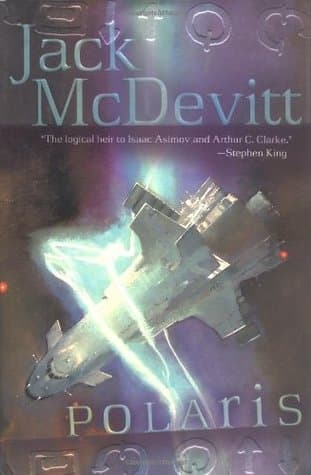
Jack McDevitt (2004)
Genre
Fantasy / Mystery / Science Fiction
Reading Time
450 min
Key Themes
See below
Sign in to track this book
A luxurious, long-lost starship reappears after sixty years, its crew vanished, drawing antiquities dealer Alex Benedict into a chilling, interstellar mystery.
Alex Benedict, a renowned antiquarian, attends an auction where artifacts from the long-lost luxury starship *Polaris* are being sold. The *Polaris* vanished over six centuries ago, its fate a lasting mystery. Alex is particularly drawn to personal effects belonging to the ship's last known passenger, Theresa Liju. Among these items are a datapad, a few trinkets, and a small, carved wooden bird. The items are remarkably well-preserved, hinting at the ship's unusual end. Alex outbids other collectors, including a representative from the powerful Galactic Empire, securing the intriguing lot and setting the stage for his investigation into the *Polaris*'s disappearance.
Returning to his base on Rimway, Alex, with his pilot and assistant Chase Kolpath, begins to examine the artifacts. The datapad offers little immediate insight, its encryption difficult to crack. They look into historical records, learning that the *Polaris* was a cutting-edge luxury vessel and that Theresa Liju was a relatively unremarkable passenger, a botanist on her way to a research expedition. Official records state that the *Polaris* simply disappeared mid-voyage, with no distress signals or debris ever found. The absence of any logical explanation only deepens Alex's interest, suggesting a more complex scenario than a simple malfunction or accident.
After weeks of effort, Chase finally manages to bypass the datapad's security. To their surprise, it contains little conventional data, but hidden within its core programming, Chase discovers an encrypted message. The message, once decoded, is a personal log entry from Theresa Liju, detailing her growing unease aboard the *Polaris*. She mentions strange occurrences, peculiar behavior from some crew and passengers, and a sense of being watched. She also alludes to a 'secret' and a 'plan' that she fears will put everyone in danger. This revelation shifts Alex's investigation from a historical curiosity to an active pursuit of a six-century-old conspiracy.
Alex examines the small wooden bird more closely, noticing a subtle seam he hadn't seen before. With careful manipulation, he discovers it's a miniature, sophisticated data storage device. Inside, he finds coordinates and a short, cryptic message from Theresa Liju, urging anyone who finds it to investigate 'the anomaly.' The coordinates point to a remote, uncharted region of space, far off the *Polaris*'s original flight path. This discovery confirms that Theresa was actively trying to leave behind clues, suggesting she anticipated the ship's disappearance and tried to expose what happened.
Convinced that the coordinates hold the key to the *Polaris*'s fate, Alex and Chase prepare their ship, the *Nostalgia*, for a long and dangerous journey into uncharted space. They face challenges, including navigating through unstable nebulae and evading space pirates. The journey is tense, as they know they are treading where no one has been for centuries, following a trail left by a woman who vanished without a trace. Their determination grows from the suspicion that powerful forces might have orchestrated the *Polaris*'s disappearance and would prefer its secrets remain buried.
After weeks of travel, the *Nostalgia* arrives at the designated coordinates. To their astonishment, they find the *Polaris* adrift in the void, perfectly intact and seemingly untouched by time. There are no signs of battle, no structural damage, and its internal systems are still partially active, drawing power from its fusion drive. However, as they board the derelict vessel, they find it completely deserted. There are no bodies, no signs of struggle, and no indication of where the hundreds of passengers and crew might have gone. The ship is a pristine ghost, deepening the mystery rather than solving it.
Exploring the *Polaris*, Alex and Chase discover a massive, sophisticated stasis field generator hidden deep within the ship's cargo bay, expertly concealed. This device can hold hundreds of individuals in suspended animation for indefinite periods. They realize that the passengers and crew were likely placed into stasis, not killed or evacuated. This discovery explains the ship's pristine condition and the lack of bodies. The question then becomes: who activated the stasis field, and why? And more importantly, where were the stasis pods, and the people within them, now?
Further investigation of the *Polaris*'s internal systems, particularly the ship's logs and Theresa Liju's quarters, yields more clues. They find hidden entries, masked within mundane maintenance reports, detailing Theresa's growing suspicion of a specific group of passengers and crew members. These individuals were part of a secretive organization known as the 'Resurrectionists,' a fringe group obsessed with preserving powerful or influential individuals for a future society. Theresa had stumbled upon their plot to hijack the *Polaris*, place its occupants in stasis, and then 'resurrect' them at a later, more opportune time, effectively stealing a population.
Alex and Chase piece together the Resurrectionists' elaborate plan. They intended to use the *Polaris* as a mobile stasis vault, filled with a cross-section of society—scientists, artists, leaders—to populate a new colony world, one they believed they had the right to shape. They saw themselves as saviors, preserving humanity's best for a future free from perceived societal decay. The *Polaris* was diverted to a hidden planet, where the stasis pods were to be unloaded. Theresa Liju's efforts to expose them led to her being targeted, but she managed to leave enough clues to expose their sinister intentions.
As Alex and Chase prepare to leave the *Polaris* with their newfound evidence, they are ambushed by a small, heavily armed ship. It's the Resurrectionists, who have been monitoring the *Polaris* for centuries, ensuring their secret remained safe. During the skirmish, Alex recognizes the markings on their ship as belonging to a clandestine branch of the Galactic Empire. This reveals a shocking truth: certain elements within the Empire were either complicit in the Resurrectionists' scheme or were actively protecting them, seeing potential benefit in their human 'resource.' The Empire had been covering up the *Polaris*'s disappearance for centuries.
Using their wits and Chase's piloting skills, Alex and Chase manage to outmaneuver the Resurrectionist ship, disabling it and escaping with the critical evidence from the *Polaris*. They transmit their findings to the Galactic Council, exposing the Resurrectionists' plot and the Empire's complicity. The revelation sends shockwaves across the galaxy. Investigations are launched, leading to arrests within the Empire and the eventual discovery of the hidden planet where the *Polaris*'s passengers and crew were being held in stasis. The hundreds of people from the *Polaris* are finally released, centuries after their abduction, thanks to Alex Benedict's relentless pursuit of the truth.
The Protagonist
Alex begins as a detached collector of history and evolves into an active participant in uncovering and righting a centuries-old injustice.
The Supporting
Chase's arc involves deepening her loyalty and trust in Alex, and growing in her own investigative capabilities.
The Mentioned
Her arc is complete before the story begins, but her actions set the entire narrative in motion.
The Antagonist
They remain committed to their ideology until their exposure and defeat.
The Antagonist
Their complicity is revealed and they face internal investigations and consequences.
The Supporting
Moves from skepticism to belief, and from upholding the status quo to seeking justice.
The Mentioned
No specific arc, serves a functional role.
The novel shows that truth, no matter how deeply buried or how long it takes, will eventually surface. Alex Benedict's career is built on this principle, and the disappearance of the *Polaris* is the ultimate test. Theresa Liju's foresight in leaving clues, even after six centuries, demonstrates the lasting human desire for justice and exposure. The revelation of the Resurrectionists' plot, and the Empire's complicity, shows that historical cover-ups, no matter how powerful the entities involved, are ultimately unsustainable. It suggests that history, if truly understood, can prevent future injustices.
“History does not forget, Alex. It merely waits for someone with the patience to listen.”
The Resurrectionists embody the dangers of ideological extremism. Their belief that they alone know what is 'best' for humanity leads them to commit heinous acts, including the abduction and forced stasis of hundreds of innocent people. They rationalize their actions as preservation, but it is, in reality, a form of control and a violation of individual autonomy. Their conviction in their own moral superiority allows them to disregard the rights and lives of others, showing how noble intentions, when taken to an extreme, can become tyrannical and destructive. This theme is a cautionary tale against groups who believe they have the right to dictate the future of others.
“They weren't trying to save humanity, Alex. They were trying to own it.”
The complicity of certain elements within the Galactic Empire in the *Polaris* cover-up raises questions about the morality of power and authority. The Empire, ostensibly a force for order and justice, is shown to be willing to protect a criminal enterprise for its own strategic gain. This demonstrates how institutional power can be corrupted, leading to the suppression of truth and the perpetuation of injustice. It forces readers to consider the accountability of those in positions of authority and the potential for their self-interest to override their ethical obligations. The novel suggests that even the most powerful entities are not immune to moral failings.
“The greatest lies are often told by those in the highest offices.”
Despite centuries and seemingly insurmountable odds, the human spirit of inquiry, perseverance, and hope ultimately succeeds. Theresa Liju's bravery in leaving clues, knowing she might never be rescued, shows this resilience. Alex Benedict's relentless pursuit of the truth, often putting himself in danger, reflects an unwavering belief in justice. Even the hundreds of passengers in stasis, though passive victims, represent humanity's lasting capacity for life and recovery, finally being awakened to a new future. The story confirms that even in the face of vast conspiracies and the passage of time, the drive for truth and freedom persists.
“Some secrets refuse to stay buried, no matter how deep the grave.”
The initial intriguing objects that drive the plot.
The artifacts from the *Polaris*, particularly Theresa Liju's datapad and the wooden bird, serve as the central MacGuffin. They are objects of desire and mystery that kickstart Alex Benedict's investigation. While their true significance is not immediately apparent, they provide the initial motivation for Alex to delve into the historical disappearance. As the story progresses, these seemingly mundane items reveal their hidden layers of information, transforming from mere curiosities into vital clues that directly lead to the truth.
Misleading explanations for the *Polaris*'s fate.
The long-standing official theories surrounding the *Polaris*'s disappearance – ranging from accidental malfunction to pirate attack – act as red herrings. These established narratives serve to obscure the true nature of the events and challenge Alex's initial assumptions. By presenting plausible but ultimately incorrect explanations, the novel builds suspense and highlights the difficulty of uncovering truth when powerful entities have an interest in maintaining a false narrative. Alex's process of eliminating these theories strengthens the impact of the actual revelation.
Information strategically concealed by a character to be discovered later.
Theresa Liju's hidden messages, both within her datapad's encryption and the miniature data storage in the wooden bird, are a crucial plot device. These carefully placed clues act as a breadcrumb trail, guiding Alex Benedict across centuries and vast distances. This device allows a character who is long dead to actively influence the plot, providing vital information and a sense of direct communication across time. It also highlights Theresa's intelligence and foresight, making her a posthumous protagonist in solving her own disappearance.
Advanced technology used to suspend life and time.
The advanced stasis field technology is a pivotal plot device. It provides the means by which the Resurrectionists were able to abduct and 'preserve' the hundreds of passengers and crew of the *Polaris* for centuries without physical harm. This technology explains the ship's pristine condition and the lack of bodies, adding a layer of scientific plausibility to the extraordinary events. It also creates a powerful moral dilemma, as the victims are not dead but merely 'on pause,' awaiting a forced resurrection, emphasizing the violation of their autonomy.
“The universe is a vast and indifferent place, and the sooner we accept that, the better.”
— Early philosophical musing on humanity's place in the cosmos.
“Sometimes the greatest mysteries are not out there among the stars, but right here, within ourselves.”
— A character reflecting on personal struggles amidst an interstellar mystery.
“The past is a stubborn thing. It clings to you, no matter how far you try to run.”
— Discussing the lingering effects of past events on current lives.
“Fear is a powerful motivator, but it's a terrible guide.”
— A warning given during a tense and dangerous situation.
“We search for answers, but often, the questions themselves are more profound.”
— A character contemplating the nature of their investigation.
“Even in the deepest void, there is always a flicker of light, if you know where to look.”
— Offering hope during a seemingly hopeless situation in space.
“The truth is rarely simple, and almost never convenient.”
— A detective-like observation about uncovering facts.
“Every journey, no matter how long, begins with a single step into the unknown.”
— Reflecting on the start of a perilous space voyage.
“The universe doesn't care about your plans. It has its own.”
— A character expressing frustration with unforeseen cosmic events.
“Sometimes, the most important thing you can do is just keep going.”
— An encouragement to persevere through difficult challenges.
“The silence of space can be deafening, especially when you're waiting for an answer.”
— Describing the tension of a long-range communication attempt.
“History is written by the survivors, but the stars remember everything.”
— A poetic reflection on the permanence of cosmic memory versus human records.
“We are all just specks of stardust, trying to make sense of the infinite.”
— A moment of existential contemplation.
Ready to see how well you understood this book? Take our interactive quiz with 10 questions.

Biography coming soon.







