“The world was a cruel place, and it didn't care for pretty dresses or good intentions.”
— Poison's early understanding of the harsh realities of her world.

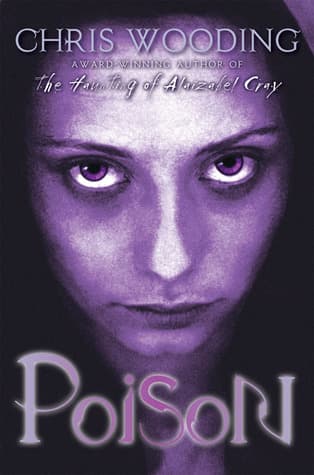
Chris Wooding (2003)
Genre
Thriller / Historical Fiction / Mystery / Young Adult / Romance
Reading Time
288 min
Key Themes
See below
Sign in to track this book
A headstrong girl named Poison enters a dangerous fae world of deadly stories, murderous plots, and dark romance to rescue her sister from the unpredictable Phaerie Lord, only to find a plot far worse than she imagined.
Poison, a spirited girl in a village near the Wilds, is with her younger sister, Peony, when a faerie appears at their window. The beautiful but evil faerie snatches Peony away. Poison's parents are devastated and feel guilty, but Poison refuses to accept her sister's loss. Driven by strong love and determination, she promises herself and her family: she will go into the dangerous faerie world and bring Peony back, no matter the risk or the dangers in the Wilds.
Determined, Poison leaves her village for the Wilds. Her journey quickly leads her to an old cottage where she meets Bram, a mysterious and seemingly cynical boy who appears to know more about the faerie realm than he admits. He first dismisses her quest as pointless, but a strange, talking cat named Doctor Mattias, who claims to be a scholar cursed into a cat, gives a cryptic warning about faerie dangers and their magic. This meeting gives Poison her first real, though unsettling, guidance on how to navigate the dangerous faerie lands and understand the Phaerie Lord.
Following Doctor Mattias's advice, Poison and Bram go to a strange village where people are obsessed with stories, making them part of their lives. Here, they learn that stories are not just entertainment; they can shape reality and control people. In this village, they meet a sinister man called the Storyteller, who seems to have too much influence over the villagers and knows unsettling things about their world. Poison starts to suspect that the Storyteller is more than he seems and might be connected to the Phaerie Lord, or at least to the complex web of faerie power.
Poison, always impulsive, falls into a faerie trap. Lured by a trick, she is almost captured by the evil creatures. However, Bram, despite his initial hesitation, shows surprising quickness and knowledge of faerie tactics, helping to fight off the attackers. Doctor Mattias, using his intelligence and knowledge of faerie weaknesses, also helps them escape. This incident strengthens the fragile alliance between the three, as Poison realizes she cannot face the faerie world's dangers alone, and Bram's true loyalty begins to show.
As they continue their journey, Doctor Mattias reveals more about the Phaerie Lord, describing him as a very powerful and cunning being who thrives on stories and desires. He explains that the Phaerie Lord does not just steal children; he collects desires and weaves them into his grand narratives, often with terrible results for mortals. Poison learns that bargaining with the Phaerie Lord means risking her very self, her memories, or even her soul. The doctor warns her that the Phaerie Lord's gifts always have a downside, and his promises come with hidden costs.
Their quest takes them to a magnificent, yet terrifying, faerie city, a place built on illusions and changing realities. The city is a mix of impossible architecture, enchanted markets, and tricky faerie folk who enjoy deceiving mortals. Here, Poison sees firsthand the insidious nature of faerie magic and how easily mortals can be caught by its glamour. They must navigate a maze of lies and half-truths, always wary of the faeries' attempts to mislead or capture them, as they search for the Phaerie Lord's stronghold and Peony.
In the faerie city's center, Bram's mysterious past comes out. He confesses that he is not fully human but has faerie blood, which explains his knowledge and resilience. At the same time, the Storyteller reveals his true identity: he is a powerful faerie, a high-ranking servant of the Phaerie Lord, and has been manipulating events from the start. His role was to guide (or mislead) Poison, ensuring she played her part in the Phaerie Lord's larger, more complex plan. This revelation shakes Poison, making her question everyone and everything she has encountered.
Poison, along with Bram and Doctor Mattias, finally reaches the Phaerie Lord's castle. The Phaerie Lord is not the monster she imagined, but a being of immense, almost childlike, power, obsessed with creating the 'perfect story.' He reveals that he did not just take Peony; he chose her, seeing in her a pure, untouched desire he wanted to include in his grand narrative. He explains that he intends to make Peony his Queen, to complete his ultimate story, and offers Poison a choice: join him and live forever in his fantastical world, or face his anger and lose Peony forever.
Desperate to save Peony, Poison tries to bargain with the Phaerie Lord. She offers him her own story, her memories, anything to free her sister. The Phaerie Lord, however, is not interested in a simple trade. He reveals that his true plan is far more sinister: he intends to replace Peony with a faerie changeling, allowing him to keep Peony's essence while sending a false version back to the human world. He wants to weave a story of loss and replacement, further showing his cruel control over human emotions and stories.
In a final confrontation, Poison realizes she cannot defeat the Phaerie Lord with force or traditional bargaining. Instead, she uses her own understanding of stories against him. She makes a selfless choice: she offers the Phaerie Lord not her story, but the *absence* of her story. She chooses to forget her quest, her love for Peony, and her very identity, believing that by denying him the satisfaction of her narrative, she can break his hold. This act of deep self-sacrifice creates a paradox that the Phaerie Lord, who thrives on stories, cannot understand or control.
Poison's sacrifice, her deliberate act of erasing her story, weakens the Phaerie Lord's power over her and Peony. Seizing the chance, Bram and Doctor Mattias help them escape the crumbling faerie castle. They return to the human world, but the cost is huge. Poison has indeed forgotten much of her quest and her relationship with Peony. While Peony is safe, their bond is fractured, and Poison carries a deep, unexplainable sense of loss and emptiness, showing the price of defying a being who controls stories.
Years pass. Poison lives a seemingly ordinary life in her village, having returned to her family. While she has no conscious memory of her journey or the faerie world, faint echoes and unexplained abilities sometimes appear, hinting at the powerful magic she once encountered. Peony, now grown, has some vague, unsettling memories of her time with the faeries, but cannot express them. Bram occasionally visits, a silent guardian, and Doctor Mattias, still a cat, remains a cryptic companion to Poison, a living reminder of a past she cannot fully recall but that shaped her permanently.
The Protagonist
Poison transforms from a determined but naive girl into a self-sacrificing heroine, losing her memories but gaining an inner strength and an understanding of the power of stories.
The Supporting
Bram evolves from a detached observer to a loyal companion, embracing his faerie heritage to protect Poison and ultimately finding his place between worlds.
The Supporting
Doctor Mattias remains largely static in his personality but finds purpose in guiding Poison, contributing his wisdom to a cause beyond his own curse.
The Antagonist
The Phaerie Lord's control is challenged by Poison's unconventional defiance, revealing the limits of his narrative power.
The Supporting
Peony is a catalyst for the plot and a victim of the faerie world, her return marking a bittersweet victory for Poison.
The Supporting
The Storyteller's true identity is revealed, exposing the depth of the Phaerie Lord's manipulation.
The Mentioned
Their role is primarily to establish the initial emotional stakes for Poison's quest.
The novel explores how stories shape reality, identity, and power. The Phaerie Lord's main goal is to create the 'perfect story,' using human lives as his material. Characters both manipulate and are manipulated by stories, and even Poison's final act of defiance involves going against the Phaerie Lord's story expectations. The villagers' obsession with stories and Doctor Mattias's knowledge of faerie lore show how stories can be both a source of magic and a dangerous weapon. Poison's final act of self-sacrifice, erasing her own story, strongly illustrates this theme.
““Stories are not just words, child. They are power. They are what makes the world turn. The Faerie Lord knows this better than anyone.””
Poison's steady love for her sister, Peony, drives the entire story. It pushes her to face unimaginable dangers and ultimately leads to her deep act of self-sacrifice. Her willingness to give up her memories and her very identity to save Peony highlights the limitless nature of familial love. This theme contrasts with the faeries' more selfish and transactional view of emotions, emphasizing the unique strength of human connection and sacrifice in a world of magic and manipulation.
““I will find her. I will bring her back. Whatever it takes.””
The faerie world's ability to manipulate memories and identities is a key concern. Poison's ultimate sacrifice involves erasing her own memories, which changes her identity. The Phaerie Lord's desire to control Peony's destiny and even replace her with a changeling speaks to how fragile selfhood is when faced with faerie magic. The lingering echoes of memory and the sense of loss Poison feels after her return emphasize how important memory is to who we are, and what it means to truly lose a part of oneself.
““The Faerie Lord collects desires, yes, but he also collects what makes you, you. Your memories, your dreams, your very self.””
The faerie world is always shown as incredibly beautiful yet inherently dangerous and cruel. The faeries themselves are alluring but evil, their gifts often coming with hidden, terrible costs. The city of lies, with its stunning illusions, perfectly shows this dual nature. This theme highlights that appearances can be misleading, and that real danger often hides behind an enchanted facade. It forces characters, and the reader, to question what is truly good or evil in a world where morality is often unclear.
““The faeries are beautiful, yes. But their beauty is a trap, a gilded cage designed to ensnare the unwary.””
Agreements with faeries that are always deceptive and carry hidden costs.
The faerie bargain is a classic folkloric trope used to drive conflict and reveal the insidious nature of faerie power. In 'Poison,' any agreement made with the faeries, especially the Phaerie Lord, is never straightforward. These bargains always come with unforeseen consequences, often involving the loss of memories, emotions, or even one's soul. It highlights the faeries' cunning and their ability to twist words and desires to their advantage, forcing characters to think carefully about the true cost of their wishes.
A character transformed by magic, providing knowledge and a moral compass.
Doctor Mattias, the talking cat, serves as the cursed companion. This device allows for the exposition of complex faerie lore and history without resorting to lengthy monologues from the protagonist. His cursed state provides him with unique insight and a personal understanding of the faeries' cruelty, making him a credible and sympathetic guide. His dry wit also adds moments of levity, balancing the story's darker elements, while his wisdom often steers Poison away from fatal mistakes.
Faerie magic's ability to create illusions and alter perceptions, making reality unreliable.
Faerie magic in 'Poison' is frequently depicted as illusionary and deceptive. The faeries can create convincing glamours, alter appearances, and even manipulate memories. This device creates a constant sense of unease and distrust, as characters (and the reader) can never be entirely sure what is real. It forces Poison to rely on her instincts and the advice of her companions, underscoring the dangers of the faerie world where nothing is as it seems, and truth is a constantly shifting concept.
A classic narrative structure that is deliberately altered to fit an anti-fairy tale.
While Poison embarks on a quest that initially mirrors the traditional 'Hero's Journey' – leaving home, facing trials, confronting an antagonist – the novel subverts its typical resolution. Instead of returning triumphant and unchanged, Poison's ultimate victory comes at a profound personal cost: the loss of her memories and a part of her identity. This subversion reinforces the 'anti-fairy tale' aspect, demonstrating that not all heroic quests end with an unblemished 'happily ever after,' and some sacrifices are irreversible, making the victory bittersweet.
“The world was a cruel place, and it didn't care for pretty dresses or good intentions.”
— Poison's early understanding of the harsh realities of her world.
“Sometimes the greatest poison isn't in a bottle, but in a lie.”
— A realization about the destructive nature of deceit.
“Fear was a constant companion, a shadow that clung to her heels, but she wouldn't let it be her master.”
— Poison's struggle with her anxieties and determination to overcome them.
“There were some things you couldn't outrun, no matter how fast you went. Your past was one of them.”
— Reflecting on the inescapable nature of one's history.
“Love, she was learning, wasn't always a soft, gentle thing. Sometimes it was sharp, painful, and utterly necessary.”
— Poison's evolving understanding of the complexities of love.
“The greatest mysteries weren't in ancient scrolls or forgotten tombs, but in the hearts of people.”
— A contemplation on human nature and its hidden depths.
“Hope was a dangerous thing, a flickering candle in the dark, but without it, there was only despair.”
— Considering the double-edged nature of hope.
“She had thought herself a pawn, but even pawns could become queens, given the right moves.”
— Poison's growing self-awareness and empowerment.
“Magic wasn't always grand spells and incantations; sometimes it was just the right word at the right time.”
— A broader definition of magic beyond traditional fantasy tropes.
“The truth was a weapon, and like any weapon, it could cut both ways.”
— Understanding the power and potential harm of truth.
“Even in the darkest places, a flicker of beauty could be found, if you only knew where to look.”
— Finding solace and beauty amidst hardship.
“To truly live, you had to be willing to bleed a little.”
— A metaphor for the sacrifices and struggles inherent in life.
“She was a story waiting to be written, and she would be the one to hold the pen.”
— Poison's determination to control her own narrative and future.
Ready to see how well you understood this book? Take our interactive quiz with 10 questions.

Chris Wooding is a prolific British author known for his engaging young adult fantasy and adventure novels. His notable works include the "Tales of the Ketty Jay" series, beginning with "Retribution," the "Mortal Engines"-esque "Storm Thief," and the dark fantasy "The Haunting of Alaizabel Cray." Wooding's writing is characterized by its fast-paced plots, vivid world-building, and compelling characters, earning him a dedicated readership.







