“I think I finally figured out the secret to being popular: You have to make sure you’re friends with the people who are going to be popular.”
— Tad's early musings on popularity dynamics.

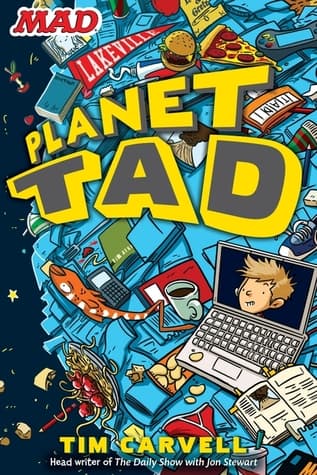
Tim Carvell (2012)
Genre
Children's / Young Adult
Reading Time
240 min
Key Themes
See below
Sign in to track this book
Armed with a blog and a strong desire for a mustache, seventh-grader Tad chronicles his hilariously disastrous attempts to navigate school, girls, and the perilous world of dog-nacho consumption.
Tad, an eager seventh-grader, starts a blog called 'Planet Tad' for his thoughts and experiences. His first posts mix everyday observations, like the dangers of feeding nachos to dogs, and his personal goals, such as growing a mustache and doing a skateboard kickflip. He introduces his best friend, Gil, and his crush, Brittany, setting up the main relationships. Tad's blog quickly becomes a record of his attempts to handle middle school social life, often with funny and honest self-awareness. He shares his struggles with school projects, his efforts to impress girls, and his general confusion about the world, setting a lighthearted and relatable mood for the book.
Wanting to be cool and get Brittany's attention, Tad tries several projects that go wrong. He tries to join the school band, even though he has no musical talent, hoping to catch Brittany's eye (she plays the flute). This leads to a bad audition and a quick exit from the music program. He also tries to master skateboarding, especially the kickflip, thinking it will boost his social status. His attempts are clumsy and often painful, but he keeps trying, writing about his scrapes and bruises on his blog. Tad's efforts show his optimism and his often-mistaken idea of what makes someone 'cool' in seventh grade, providing much of the book's humor.
Tad and Gil work together on a science fair project, which, as expected, goes off track. They first think about an ambitious potato battery experiment but soon realize their limits. They then switch to a project about how different music affects plant growth. This simple idea becomes complicated by their lack of scientific care and their tendency to get sidetracked. The project ends with a messy presentation where their plants are dead or don't respond, and their data is questionable. Despite their failure, the experience strengthens their friendship and gives Tad plenty of material for a funny blog post about the challenges of science and procrastination.
Tad's main crush, Brittany, remains a focus of his blog posts. He carefully looks at her every glance and interaction, often misunderstanding what she means. He tries to create situations where he might talk to her, like standing near her locker or joining clubs she is in. These attempts are usually awkward and don't work. He also sometimes thinks about other girls, like the mysterious 'Girl with the Bracelets,' showing his general confusion about the opposite sex. His blog becomes a place for his romantic worries, offering a funny and relatable look at adolescent crushes and the fear of rejection.
In another attempt to get closer to Brittany, Tad decides to try out for the school play, 'The Wizard of Oz.' He imagines himself as a lead, even though he has no acting experience. His audition is, as expected, a disaster. He forgets lines, sings off-key, and makes a fool of himself. He doesn't get a speaking role, but surprisingly, he is cast as a munchkin. While not the starring role he wanted, he finds some friendship with his fellow munchkins. The experience gives him a new view on school activities, even if it doesn't directly lead to Brittany noticing him.
Tad's parents often appear in his blog posts, usually as sources of mild frustration or amusement. He writes about their attempts to give him advice, their odd habits, and their general inability to understand seventh-grade life. He sometimes feels embarrassed by them, especially when they try to be 'cool' or get involved in his social life. Despite his occasional annoyance, there is an underlying affection in his observations. His blog entries about his parents offer a funny look at the generation gap and the common experience of teenagers dealing with their parents' well-meaning, but often awkward, actions.
Tad's younger sister, Clara, is a recurring character in his blog, often annoying him and providing humor. He often complains about her tendency to bother him, steal his things, or make his life harder. He writes about their arguments over the TV remote, her strange drawings, and her ability to get him into trouble. Despite his complaints, there are times when he grudgingly admits a certain affection or even respect for her cleverness. Their sibling rivalry is a relatable part of the book, showing the typical love-hate relationship between a middle schooler and his younger sister.
Tad's blog is a type of social media, and he often thinks about the unspoken rules and worries of online communication. He worries about who reads his blog, what they think, and if his posts are 'cool' enough. He deals with wanting comments and validation, and the fear of being misunderstood or mocked. He also observes how other kids use online platforms, sometimes with bad results. His experiences show the early stages of navigating online identity and the pressure of presenting oneself online, a theme that is even more relevant today.
Throughout the book, Tad's goal to do a perfect kickflip on his skateboard remains a consistent side story. He writes about his many attempts, his falls, and his slow progress. He buys new gear, watches online tutorials, and asks older kids for advice, all to learn this trick. While he doesn't become a master right away, his persistence shows his wider determination to overcome seventh-grade challenges. The kickflip becomes a symbol for his growth and his willingness to keep trying, even with repeated setbacks, showing his growing resilience.
Tad's blog posts often describe the difficult social situation that is a middle school dance. He writes about the careful preparations, the anxiety of asking someone to dance, and the general confusion of the dance floor. He often finds himself standing awkwardly with Gil, watching the more confident couples. His attempts to talk to Brittany at these events are usually clumsy, leading to funny misunderstandings. These scenes capture the common experience of adolescent social anxiety and the often-unmet expectations of a 'perfect' dance, making his blog relatable to many readers.
As seventh grade ends, Tad looks back at his journey. He thinks about his successes and failures, admitting he hasn't grown a mustache, isn't a skateboarding expert, and hasn't won Brittany's heart. However, he acknowledges that he has learned a lot, made new friends (and strengthened old ones), and survived the year. His blog posts become more thoughtful, showing a subtle but clear maturity. He realizes that while he didn't reach all his first goals, the experience of trying and writing about it was valuable, preparing him for the next part of his middle school life.
The Protagonist
Tad learns that while not all his ambitious goals are met, the journey of trying and the growth in self-awareness are more important than superficial achievements.
The Supporting
Gil remains a consistent and supportive friend, providing a foil to Tad's more idealistic nature.
The Supporting
Brittany remains a largely static figure, serving as the catalyst for Tad's romantic aspirations.
The Supporting
Clara remains a consistent, if irritating, presence in Tad's life, embodying the reality of sibling dynamics.
The Supporting
Her character remains consistent as a supportive, if sometimes cringeworthy, parent.
The Supporting
His character remains consistent as a supportive, if sometimes perplexing, parent.
The Mentioned
Remains a consistent, if peripheral, figure of authority.
The Mentioned
Her role is limited to a brief object of Tad's affection, highlighting his general romantic interests.
The book is about adolescent awkwardness. Tad's blog describes his daily struggles with social cues, romantic attempts, and self-consciousness. From his bad attempts to join the band to his clumsy efforts to talk to Brittany at school dances, every interaction is seen through the eyes of a seventh-grader trying to be 'cool' and navigate middle school. His self-deprecating humor and honest thoughts make the common experience of pre-teen discomfort relatable. This theme is central to Tad's journey.
“Here is the first thing I have learned about having a dog in your house: Don't feed them nachos. Not ever. Here is the second thing I have learned: Dogs are a lot like seventh graders. They want to be cool, but they don't know how.”
Tad's various efforts—growing a mustache, learning to skateboard, joining clubs—are all part of his search to define himself and find his place. He constantly worries about what others think of him and wants to be popular, especially to impress Brittany. His blog is a place for him to process these desires and think about his successes and failures in fitting in. While he doesn't achieve all his 'cool' goals, his journey shows the importance of self-acceptance and finding belonging through real friendships, rather than through surface achievements. His continued efforts, despite setbacks, show his will to create his own identity.
“I thought if I could do a kickflip, maybe people would notice me. Not just any people, though. Certain people. You know.”
Despite Tad's focus on crushes and popularity, the strong bond with his friend Gil is a consistent and comforting theme. Gil is always there for Tad, whether they are working on a bad science fair project, complaining about homework, or just hanging out. Their jokes and shared experiences provide a stable base for Tad amid his social worries. The book quietly emphasizes that while romantic interests may come and go, true friendship offers steady support and understanding, giving Tad a vital anchor as he deals with the challenges of seventh grade.
“Gil said that he thought my blog was pretty good. That's a nice thing for your best friend to say, even if he did say it right after I told him he could have my extra nachos.”
Tad's blog is a main theme, showing the power of self-expression and storytelling to process experiences. By writing about his daily life, thoughts, and feelings, Tad creates a story of his seventh-grade year. The blog lets him reflect, find humor in his struggles, and share his unique view with the world (or at least, whoever reads 'Planet Tad'). It is a personal outlet and a way to make sense of the chaos of adolescence, showing how writing can help with self-discovery and connection.
“I started this blog because I have a lot of important thoughts I want to share with the world. Also, because I heard that if you have a blog, girls will notice you more. We'll see about that part.”
The entire story is told through Tad's blog entries.
The most prominent plot device is the first-person blog narrative. The entire book is presented as a series of entries from Tad's 'Planet Tad' blog, complete with dates, titles, and sometimes even 'comments' from other characters. This device provides immediate access to Tad's unfiltered thoughts, anxieties, and humorous observations, making the reader privy to his internal world. It creates an intimate and authentic voice, allowing for a direct connection with the protagonist and enhancing the relatable awkwardness of his middle school experiences. The blog format also allows for episodic storytelling, with each entry serving as a mini-chapter.
Tad uses self-deprecating humor to navigate and process his embarrassing experiences.
Tad frequently employs humor, particularly self-deprecating humor, as a way to cope with the numerous embarrassing and awkward situations he finds himself in. His blog entries are filled with witty observations, exaggerated reactions to minor setbacks, and a general lightheartedness even when discussing his deepest anxieties (like failing to grow a mustache). This device makes Tad an endearing character and transforms potential moments of cringe into opportunities for laughter, allowing the reader to empathize with his struggles without dwelling on the negative aspects of adolescence.
Recurring jokes and situations that build comedic momentum.
The book utilizes several running gags to create comedic momentum and continuity. Examples include Tad's persistent (and unsuccessful) attempts to grow a mustache, his ongoing struggle to master the skateboard kickflip, and his repeated misinterpretations of Brittany's actions. These recurring elements provide familiar touchstones for the reader, building anticipation for the next iteration of the joke and reinforcing Tad's core aspirations and struggles. They highlight his endearing persistence and the often-slow progress of achieving adolescent goals.
“I think I finally figured out the secret to being popular: You have to make sure you’re friends with the people who are going to be popular.”
— Tad's early musings on popularity dynamics.
“My dad says that when he was a kid, they didn’t have video games. They just had to go outside and, like, stare at a tree. I guess that sounds boring.”
— Tad comparing his childhood to his father's.
“I tried to get a cool haircut today, but it just ended up looking like I fought a lawnmower and lost.”
— Tad's attempt at a new hairstyle goes wrong.
“Sometimes I feel like my life is just a series of awkward moments punctuated by snack breaks.”
— Tad reflecting on the general state of his life.
“I learned today that if you try to make your own volcano for the science fair, it’s probably going to explode in your face. Literally.”
— Tad's disastrous science fair project.
“Being a kid is basically just waiting for someone to tell you what to do next.”
— Tad's perspective on the lack of autonomy in childhood.
“My mom says I need to 'branch out' and 'try new things.' I tried a new kind of potato chip. Does that count?”
— Tad's interpretation of his mother's advice.
“I think the hardest part about being a human is remembering everyone’s name. Especially when there are so many of them.”
— Tad struggling with social conventions.
“My dad says that 'money doesn’t grow on trees.' But if it did, I bet I’d be really good at climbing those trees.”
— Tad's humorous take on his father's financial advice.
“I tried to impress a girl today by telling her I could hold my breath for a really long time. She just walked away.”
— Tad's failed attempt at impressing a crush.
“I don't understand why adults always ask what you want to be when you grow up. I want to be able to eat dessert whenever I want.”
— Tad's simple aspirations for adulthood.
“Sometimes I think my brain is just a giant filing cabinet, and all the files are labeled 'random thoughts about pizza.'”
— Tad reflecting on his thought process.
“My teacher said I need to 'read more.' So I read the ingredients list on a box of cereal. It was very informative.”
— Tad's literal interpretation of his teacher's advice.
Ready to see how well you understood this book? Take our interactive quiz with 10 questions.

Biography coming soon.
Dan Gemeinhart
4.5

Kate O'Hearn
4.4

Jeanne Birdsall
4.4

Jen Wang
4.4
Wendelin Van Draanen
4.3

John Marsden
4.3

Chris Van Allsburg
4.3
Jennifer A. Nielsen
4.2