“A lie keeps growing and growing until it's as plain as the nose on your face.”
— Pinocchio's nose grows longer after lying to the Blue Fairy.

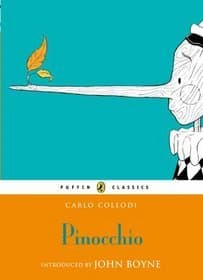
Carlo Collodi (1883)
Genre
Fantasy / Children's
Reading Time
260 min
Key Themes
See below
Sign in to track this book
A mischievous wooden puppet goes on many misadventures and learns that being human means having a selfless heart.
The story begins with Master Cherry, a carpenter, finding a piece of wood that speaks. Scared, he gives it to his friend Geppetto, a poor old carpenter who wants to make a puppet to earn money. Geppetto carves the puppet, naming him Pinocchio. Before he is even finished, Pinocchio's parts start to move and misbehave. Once complete, Pinocchio immediately runs into the street, causing trouble. Geppetto is arrested, and Pinocchio goes back to Geppetto's house. There, he meets the Talking Cricket, who tries to give him advice. Pinocchio, impatient, kills the Cricket with a hammer, showing his rebellious nature.
Geppetto is released from prison and, seeing Pinocchio has no clothes, makes him a paper suit, a bark hat, and bread shoes. Geppetto then sells his only coat to buy Pinocchio a school book, hoping he will get an education. On his way to school, Pinocchio hears music and is drawn to the Great Puppet Theatre, where he sells his book to buy a ticket. The puppets recognize him, causing a commotion. The Theatre Manager, Fire-Eater, first threatens to burn Pinocchio but, moved by his tears, lets him go and gives him five gold coins for Geppetto. On his way home, Pinocchio meets the Fox and the Cat, who trick him into believing he can multiply his coins in the 'Field of Miracles'.
Ignoring the Talking Cricket's ghost, Pinocchio follows the Fox and the Cat to the Red Lobster Inn. They eat at his expense, then leave him. Pinocchio continues alone towards the 'Field of Miracles' but two assassins (the Fox and the Cat in disguise) ambush him. They chase him through the woods, and Pinocchio eventually hides in a white house. A beautiful Fairy with Turquoise Hair appears, but Pinocchio is captured and hanged from a Great Oak. Just as he is about to die, the Fairy sends a falcon to cut him down and a poodle to carry him to her house, where she tries to save him with medicine.
The Fairy, a kind spirit, helps Pinocchio get well. She asks him about his gold coins, and Pinocchio, ashamed of being tricked, makes up lies. With each lie, his nose grows longer, which upsets him. The Fairy explains that lies have consequences and calls woodpeckers to peck his nose back to normal. She then tells him that if he is good, she will help him find Geppetto, and he can become a real boy. Pinocchio promises to be good and goes to the city of Catchfools to bury his coins in the 'Field of Miracles' with the Fox and the Cat.
Pinocchio, despite the Fairy's warning, again falls for the Fox and the Cat's trick. They convince him to bury his coins in the 'Field of Miracles' and then steal them when he is away. Pinocchio reports the theft to a judge, a gorilla, who, instead of helping, puts Pinocchio in prison for being foolish. After four months, Pinocchio is released during a general release of prisoners. He tries to return to the Fairy but finds her house gone and a tombstone saying she died of sadness. Pinocchio is very sad and, after more problems, arrives at the 'Land of the Busy Bees,' where he learns that honest work matters.
Pinocchio, sorry for what he did, starts to work hard. He earns money by carrying water and eventually finds the Fairy, now a young woman, living in a small house. She forgives him and promises that if he continues to be good, he will become a real boy. Pinocchio goes to school diligently and becomes a good student. However, he becomes friends with a boy named Lampwick, who convinces him to go to the Land of Toys, a place where children never have to study or work, only play. Pinocchio, wanting endless fun, stops his studies and his promise to the Fairy.
In the Land of Toys, Pinocchio and Lampwick play all the time. After five months of this carefree life, they wake up with donkey ears and then completely turn into donkeys. They learn that the Land of Toys is a trap where lazy children become donkeys and are sold. Pinocchio and Lampwick are sold to different owners. A circus owner buys Pinocchio and trains him to do tricks. During a show, Pinocchio falls and gets hurt, becoming lame and useless to the circus owner.
The circus owner decides to get rid of the lame donkey Pinocchio by selling him to a man who wants to skin him for a drum. The man throws Pinocchio into the sea to drown him first. In the water, fish start to eat Pinocchio's donkey skin, showing his wooden puppet form underneath. Pinocchio swims away, but the Terrible Dogfish, a giant shark, soon swallows him. Inside the belly of the beast, Pinocchio is surprised to find his father, Geppetto, who has been living there for two years after his boat sank while he looked for Pinocchio.
Pinocchio is very happy to find his father alive and plans their escape. They wait for the Dogfish to open its mouth (when it has asthma) and then swim out. A Tuna fish they met inside the Dogfish helps them. Tired, they reach shore, and Pinocchio finds a way to support his weak and sick father. He works constantly, doing odd jobs for a farmer, earning milk for Geppetto, and learning to weave baskets. He focuses completely on taking care of his father, showing great selflessness and responsibility.
Pinocchio keeps working hard, caring for Geppetto and saving money. One day, he meets the sick Talking Cricket (who he had killed before), which reminds him of his past mistakes and the good advice he ignored. He also gives away his small savings to help the Fairy, who is ill. His selfless actions and dedication to his father impress the Fairy. One morning, Pinocchio wakes up as a real boy, with flesh-and-blood skin. He finds Geppetto healthy again and their simple home changed into a comfortable one. Pinocchio is finally a real boy, having earned his humanity through love, sacrifice, and hard work.
The Protagonist
Transforms from a disobedient, selfish puppet into a responsible, caring, and ultimately real boy through trials and hard work.
The Supporting
Remains consistently loving and self-sacrificing, eventually being reunited with his transformed son.
The Supporting
Serves as a constant, guiding force in Pinocchio's life, eventually rewarding his transformation.
The Supporting
From being killed to returning as a ghost and later a frail old cricket, he consistently tries to guide Pinocchio.
The Antagonist
Remains a consistently villainous and unrepentant trickster throughout his appearances.
The Antagonist
Remains a consistently villainous and unrepentant trickster throughout his appearances.
The Supporting
His character arc is short, serving as a negative influence who suffers the consequences of his actions by being turned into a donkey.
The Supporting
Briefly appears to show a surprising moment of kindness and generosity.
The Antagonist
Serves as a plot device and a temporary prison for Geppetto and Pinocchio.
A main theme is what happens immediately when Pinocchio behaves badly. His nose grows with every lie, he is robbed after ignoring the Talking Cricket, and his laziness in the Land of Toys turns him into a donkey. These magical punishments are clear moral lessons. They show that actions, especially dishonest and rebellious ones, have real results. The story constantly shows that true freedom and happiness come from responsible choices, not from avoiding duties.
“Lies, my boy, are known in a moment. There are two kinds of lies, those with short legs and those with long noses. Yours, as it happens, have long noses.”
Pinocchio's journey shows that hard work and helping others are important. He is initially lazy and self-centered, and he suffers repeatedly because he wants easy pleasure. He starts to get better when he works hard for others, first by carrying water for the farmer and then by completely taking care of his sick father, Geppetto. Only through these acts of selfless work and sacrifice does he earn his humanity and become a real boy. This shows that true worth comes from contributing and caring for others.
“For the future, remember that you must always be good, and that you must always be ready to forgive, for thus you will be loved and esteemed by all.”
The main part of Pinocchio's story is his goal to become a 'real boy.' This is not just a physical change but a moral and spiritual one. He starts as a wooden puppet, without empathy, responsibility, or a conscience. Through his challenges, mistakes, and ultimately, his love and self-sacrifice for Geppetto, he develops qualities that define being human: kindness, honesty, hard work, and compassion. The book says that being 'real' is not about physical form, but about inner character and moral goodness.
“How ridiculous I was when I was a puppet! And how glad I am that I have become a real boy!”
Geppetto's constant love for Pinocchio is a strong force in the story. Geppetto gives up his coat, looks tirelessly for his son, and endures hardship for him. In return, Pinocchio's eventual change is greatly influenced by his growing sense of duty and love for his father. His dedication to caring for Geppetto when they are in need is what finally makes him a real boy. This shows how family love and responsibility work both ways.
“Poor Geppetto! How much I owe him! And I was always so bad to him!”
Animals and inanimate objects that speak and act like humans.
Collodi uses anthropomorphic animals (the Talking Cricket, Fox, Cat, Gorilla judge, Tuna, Donkey) and even Pinocchio himself, a talking puppet, to populate his world. This device allows for allegorical storytelling, where animal characters embody human vices (like the Fox and Cat's deceit) or virtues (like the Cricket's wisdom). It also makes the fantastical elements of the story more accessible and engaging for a children's audience, allowing for moral lessons to be delivered through relatable, albeit non-human, characters.
Sudden, often moral-based, changes in character form.
The story employs several magical transformations as direct consequences of character actions or as manifestations of internal change. Pinocchio's nose growing when he lies is the most iconic example, a direct visual representation of dishonesty. His transformation into a donkey in the Land of Toys is a literalization of the dangers of idleness and foolishness. Finally, his ultimate transformation into a real boy symbolizes his moral growth and earned humanity. These transformations serve as powerful visual metaphors for the story's ethical lessons.
Pinocchio's episodic travels and trials towards a goal.
Pinocchio's story is structured as an episodic journey, where he leaves home, encounters various challenges, makes mistakes, and learns lessons before returning. His overarching quest is to become a real boy, which he believes involves finding happiness and freedom, but ultimately learns requires moral development. Each episode, from the Puppet Theatre to the Land of Toys to the belly of the Dogfish, is a distinct trial that contributes to his growth, making the narrative a classic 'hero's journey' of self-discovery and transformation.
An externalized moral guide who advises the protagonist.
The Talking Cricket serves as Pinocchio's externalized conscience. He appears early in the story to offer wise advice and warnings, essentially articulating the moral high ground. Pinocchio's initial rejection and 'killing' of the Cricket symbolize his initial disregard for his own inner voice of reason. The Cricket's reappearance, first as a ghost and later as an old friend, signifies Pinocchio's gradual acceptance and internalization of moral guidance, illustrating the development of his own conscience.
“A lie keeps growing and growing until it's as plain as the nose on your face.”
— Pinocchio's nose grows longer after lying to the Blue Fairy.
“How ridiculous I was when I was a Marionette! And how happy I am, now that I have become a real boy!”
— Pinocchio reflects on his transformation at the end of the story.
“Boys who refuse to study and turn their backs upon books, schools, and teachers to spend their time in play and amusement sooner or later come to a bad end.”
— The narrator warns about the dangers of neglecting education.
“I am not made of wood, as you seem to think. I have a heart and I can feel.”
— Pinocchio asserts his humanity to the Fox and the Cat.
“A boy who does not obey his parents and runs away from home will never be happy.”
— Geppetto expresses concern after Pinocchio leaves home.
“Give a boy enough rope and he'll soon show you what he is made of.”
— The Cricket comments on Pinocchio's behavior.
“The world is full of temptations, and we are all weak at times.”
— The Blue Fairy explains human nature to Pinocchio.
“He who steals is not only a thief but also a fool, for he steals from himself.”
— Pinocchio learns a lesson after being tricked into theft.
“A conscience is that still small voice that people won't listen to.”
— The Talking Cricket advises Pinocchio early in the story.
“Laziness is a serious illness and must be cured in childhood; if not, when we grow up it can never be cured.”
— The narrator comments on Pinocchio's avoidance of work.
“To become a real boy is a privilege that must be earned through goodness.”
— The Blue Fairy sets the condition for Pinocchio's transformation.
“Even a puppet can have a heart if it learns to care for others.”
— Pinocchio shows kindness to Geppetto while rescuing him.
“The road to pleasure is often the road to ruin.”
— A warning given when Pinocchio heads to the Land of Toys.
“True bravery is not the absence of fear, but acting rightly in spite of it.”
— Pinocchio faces dangers to save Geppetto from the whale.
Ready to see how well you understood this book? Take our interactive quiz with 10 questions.

Carlo Collodi was an Italian author and journalist best known for his 1883 children's novel, The Adventures of Pinocchio. The book, originally published in serial form, is one of the most translated and widely read works in children's literature. Collodi's work has had a profound and lasting impact on storytelling and popular culture.







