“Petersburg is a phantom city, a city of ghosts, a city of the dead.”
— Describing the city's atmosphere and its symbolic nature.

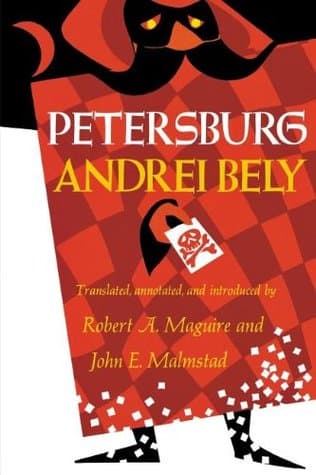
Andrei Bely (1979)
Genre
Literary Fiction / Historical Fiction
Reading Time
10-12 hours
Key Themes
See below
Sign in to track this book
In 1905 Petersburg, a student plots to assassinate his senator father, starting a symbolic event that reflects Russia's search for identity.
The novel begins in St. Petersburg, 1905, during political unrest. Apollon Apollonovich Abbleukov, a senator, starts his day with his usual precision. He thinks about geometric forms and the order he believes supports the universe and the state. His ordered world is threatened by the revolutionary feelings in Russia. At the same time, his son, Nikolai Apollonovich Abbleukov, a philosophy student and member of a revolutionary group, returns to Petersburg after being abroad. Nikolai is a conflicted intellectual, divided between his family's aristocratic background and his abstract revolutionary ideas. His return is not just personal; his group leader, Alexander Ivanovich Dudkin, has told him to commit a terrorist act.
Nikolai Apollonovich, feeling alienated, meets his revolutionary contact, Alexander Ivanovich Dudkin. Dudkin, a more unstable and mystical revolutionary, gives Nikolai a sardine tin, saying it has a time bomb. The target, not yet explicitly told to Nikolai, is his father, Senator Apollonovich Abbleukov. Nikolai is horrified by the idea of killing his father and struggles with the moral and philosophical weight of his task. The bomb becomes a central, threatening symbol, its ticking a constant, internal countdown to a catastrophic event that will shatter the Abbleukov family and the senator's ordered world.
Senator Abbleukov, despite his calm appearance, feels growing unease. He senses a coming threat to the established order, imagined as revolutionary 'scythians' in the city's shadows. He does not know the specific danger from his own son. Meanwhile, Nikolai Apollonovich cannot decide what to do. He carries the sardine tin bomb, moving through Petersburg's streets, always about to complete his mission but always finding a reason to delay. His thoughts are full of philosophy, self-doubt, and a growing sense of the absurd. The bomb stays unplanted, a ticking burden on his conscience and a source of increasing worry for Dudkin.
Alexander Ivanovich Dudkin, becoming more unstable, falls into a feverish state. He sees visions, especially of the Bronze Horseman statue, a symbol of imperial power and Peter the Great's imposing order on Russia. Dudkin believes the Horseman represents Petersburg's oppressive spirit and Russia's fate. He worries about the unexploded bomb and Nikolai's inaction, fearing the plan will fail. His mental state shows the chaotic and often irrational parts of the revolutionary movement, blurring political action, mysticism, and madness. He tries to contact Nikolai, urging him to finish the mission.
The tense atmosphere in the Abbleukov home becomes more complex with the return of Sofya Petrovna, Senator Abbleukov's wife and Nikolai's mother. Sofya is a socialite, unaware of the political unrest and her son's deadly secret. Her presence adds a contrasting element of superficiality and social maneuvering to the grim revolutionary plot. She tries to restart her social life and navigate Petersburg high society, completely unaware of the drama happening around her husband and son. Her lack of awareness shows the disconnect between the city's elite and the violent revolutionary movement.
Driven by duty, fear, and a sense of alienation, Nikolai places the sardine tin bomb in his father's study. However, his conscience immediately acts against it. Overwhelmed by guilt and the horrific idea of killing his father, he sends an anonymous note to his father, warning him of the bomb. This act shows his deep internal conflict and his inability to fully commit to the revolutionary cause. He then flees, filled with despair and a sense of coming doom, the bomb's ticking in his mind as he walks the city streets, a hunted man by his own doing.
Senator Abbleukov gets the anonymous note and, horrified, finds the sardine tin bomb in his study. At first disbelieving, he must face the reality of the threat. His life's order is shattered. In a moment of panic, he grabs the ticking bomb and throws it out his window just as it explodes. The explosion, though harmless outside, is a shock, tearing through the senator's world and making him see the violent chaos that has entered his home. He is shaken, his detachment broken.
After the failed assassination, Alexander Ivanovich Dudkin, in a final, frantic act, confronts the 'Mongol,' a figure implied to be the true, manipulative leader of their revolutionary group. Dudkin, driven by his visions and a wish to cleanse the revolutionary movement, kills the Mongol. This act marks the violent end of their specific revolutionary group and Dudkin's complete break from any organized political action. His madness ends in this symbolic act of internal purification, leaving him alone and further taken over by his delusions.
After the bomb's explosion, Nikolai Apollonovich, haunted by his actions and the near-killing of his father, leaves Petersburg. His departure shows his rejection of both his aristocratic background and the revolutionary path he briefly followed. The Abbleukov family is broken; Apollon Apollonovich's rigid world is cracked, and Sofya Petrovna remains mostly unaware of the deeper issues. Petersburg, though still full of revolutionary tension, slowly tries to return to its normal rhythm. The immediate crisis ends, but the underlying unease and potential for future violence remain, showing Russia's unstable state in 1905.
Afterward, Senator Apollon Apollonovich Abbleukov is changed. His strict adherence to order and bureaucracy is shaken. He must face the chaotic, unpredictable forces that support human existence and the Russian state. He thinks about his life, his relationship with his son, and Petersburg's enigmatic, almost spectral nature. The city, with its deceptive appearances and hidden depths, continues to have its powerful, almost mystical influence. The novel ends with unresolved tension, showing that while one crisis has passed, the fundamental conflicts and potential for upheaval in Petersburg and Russia continue, caught between East and West, order and chaos.
The Protagonist/Antagonist
Starts as an unyielding symbol of order, but the bomb incident shatters his rigid worldview, forcing him to confront chaos and the human element.
The Protagonist
Begins as a detached intellectual revolutionary, struggles intensely with a moral dilemma, and ultimately rejects violence and flees, seeking a different path.
The Supporting/Antagonist
Starts as a committed revolutionary, but his sanity deteriorates, leading to mystical visions and a violent, self-destructive act.
The Supporting
Remains largely unchanged, a static character highlighting the obliviousness of her social class amidst profound upheaval.
The Antagonist/Mentioned
A shadowy, static figure whose death signifies the internal collapse of Dudkin's revolutionary cell.
The Supporting/Mentioned
A static, minor character, serving to illustrate certain aspects of the revolutionary milieu.
The Symbol/Mentioned
Its symbolic power intensifies throughout the novel, becoming a central image in Dudkin's madness and representing the enduring spirit of the city.
The novel looks at the fragmented identities of its characters, especially Nikolai Apollonovich, who struggles to balance his aristocratic background with his revolutionary ideas. Petersburg itself is a city dealing with its identity, caught between its European appearance and its ancient, 'Scythian' Russian soul. Characters look for meaning amidst political chaos and personal alienation, often finding only more fragmentation. Nikolai's inability to fully commit to either his father's world or the revolutionary cause shows the difficulty of forming a clear identity in a turbulent time.
“Petersburg — or rather, the phantoms of Petersburg — appeared to him as a hallucination.”
Bely often blurs reality, dream, and hallucination. Petersburg is often described as an illusory city, a 'phantom' existing more in its inhabitants' minds than as a physical place. Characters like Dudkin have vivid hallucinations, and even Apollon Apollonovich's rigid world is built on abstract, geometric illusions. This theme questions what is real and how much of human experience is made from perception, thought, and psychological states. The bomb, for example, is both a physical object and a powerful psychological idea.
“All Petersburg is a phantom.”
The plot of Nikolai being told to bomb his father directly addresses political radicalism mixed with the idea of killing a father figure. The revolutionary act is not just political but also personal and symbolic, representing the younger generation's wish to destroy the old order (the 'father'). Nikolai's internal struggle shows the moral and psychological costs of such extremism. The novel explores the fanaticism, mysticism, and often self-destructive parts of the revolutionary movement, as seen in Dudkin's madness and his murder of the Mongol.
“A son, a brother, a father — what is that compared to the ideal?”
Senator Apollon Apollonovich represents order, carefully structuring his life and the state around geometric principles and bureaucratic precision. This order is constantly threatened by the revolutionary chaos in Petersburg. The novel contrasts Apollon's rigid, abstract order with the fluid, unpredictable, and often violent forces of revolution and human psychology. The bomb's explosion, even if harmless, shatters Apollon's perceived order, making him face existence's inherent chaos. The city itself, built on a swamp, symbolizes imposing artificial order on a wild, chaotic natural world.
“The senator's head was a cube.”
Petersburg is not just a setting but a character, showing Russia's paradoxical spirit – a city built on a swamp, a European facade over an Asiatic soul. It is a place of grandeur and decay, order and chaos, reason and madness. The novel looks at the tension between Russia's Western identity (symbolized by Peter the Great and his city) and its ancient, mystical, 'Scythian' roots. Characters are shaped by the city's atmosphere, and its symbolic weight reflects the larger struggle for Russia's national identity and future.
“Petersburg is the brain of Russia.”
Narrative technique mirroring characters' internal thoughts and perceptions.
Bely employs stream of consciousness to delve deeply into the characters' inner lives, particularly Nikolai's and Dudkin's. The narrative often shifts abruptly, mimicking the free flow of thoughts, memories, and associations, blurring the lines between external reality and internal experience. This technique allows for a fragmented, subjective portrayal of events, emphasizing the psychological turmoil and philosophical musings of the characters. It contributes to the novel's sense of unreality and its exploration of the mind's role in shaping perception, making the reader privy to the characters' anxieties, delusions, and intellectual struggles.
Objects and figures imbued with deeper, often shifting, metaphorical meanings.
Bely uses extensive symbolism to enrich the novel's themes. The sardine tin bomb is not just a weapon but a symbol of parricide, revolutionary extremism, and the ticking countdown to chaos. The Bronze Horseman statue represents oppressive imperial power, Peter the Great's violent imposition of order, and a demonic force in Dudkin's mind. Geometric shapes symbolize Apollon Apollonovich's rigid, abstract worldview. The very city of Petersburg is symbolic of Russia's conflicted identity. These symbols are often fluid, taking on different meanings depending on the character's perception, deepening the novel's exploration of reality and illusion.
A self-aware narrator who comments on the story and its construction.
The novel features a highly self-aware, intrusive narrator who frequently addresses the reader directly, comments on the act of storytelling, and even questions the reality of the characters and events. This metafictional approach undermines the traditional sense of a fixed reality, reinforcing the theme of illusion. The narrator's presence reminds the reader that they are engaging with a constructed text, further blurring the boundaries between fiction and reality. This device contributes to the novel's modernist aesthetic and its exploration of consciousness and representation.
Recurring words, phrases, and images that create a hypnotic effect and emphasize themes.
Bely extensively uses repetition of words, phrases, and images (leitmotifs) to create a rhythmic, almost musical quality in the prose. Recurring elements like the 'yellow-red' color of the Petersburg sunsets, the sound of the bomb's 'tick-tock,' or descriptions of Apollon Apollonovich's 'cube' head, serve to emphasize key themes and character traits. This technique builds a hypnotic atmosphere, reinforcing the sense of obsession and the cyclical nature of certain ideas. It also creates a cohesive, dreamlike texture, where certain images become ingrained in the reader's mind, much like they are in the characters' consciousness.
Exaggerated, distorted imagery and situations that highlight the irrationality of the world.
The novel frequently employs grotesque and absurdist elements to depict the distorted reality of Petersburg and its inhabitants. Characters are often described with exaggerated physical features or behave in bizarre, irrational ways. The situation of a son being tasked to bomb his own father, and the comical misplacing of the bomb, leans into the absurd. This device highlights the irrationality and inherent madness lurking beneath the surface of seemingly ordered society, reflecting the profound psychological and social upheaval of early 20th-century Russia. It also serves to critique the dehumanizing aspects of bureaucracy and revolution.
“Petersburg is a phantom city, a city of ghosts, a city of the dead.”
— Describing the city's atmosphere and its symbolic nature.
“The Bronze Horseman gallops through the centuries, and Petersburg gallops with him.”
— Referencing Pushkin's statue and the city's relentless, imposed progress.
“Everything is a mask, and behind the mask—nothing.”
— Reflecting on the characters' identities and the city's superficiality.
“The Neva flows not with water, but with the blood of time.”
— Poetic description of the river as a metaphor for history and suffering.
“In Petersburg, even the stones whisper conspiracies.”
— Emphasizing the pervasive sense of intrigue and political unrest.
“A man is but a shadow cast by the city's walls.”
— Commenting on the individual's insignificance within the urban landscape.
“The revolution is not in the streets; it is in the mind.”
— Exploring the psychological turmoil preceding social upheaval.
“Memory here is a labyrinth without an exit.”
— Describing the characters' struggles with personal and historical past.
“The fog does not conceal; it reveals the city's true form.”
— Using weather to symbolize the uncovering of hidden realities.
“Every step on these pavements echoes with the footsteps of ghosts.”
— Evoking the city's haunted, historical weight.
“To live in Petersburg is to be suspended between dream and nightmare.”
— Capturing the surreal, disorienting experience of the city.
“The bomb ticks not in the briefcase, but in the soul.”
— Metaphor for internal conflict and impending personal catastrophe.
“Colors here are not hues, but screams of the atmosphere.”
— Describing the novel's synesthetic, expressive style.
“In this city, even love is a political act.”
— Highlighting how personal relationships are entangled with larger forces.
Ready to see how well you understood this book? Take our interactive quiz with 10 questions.

Andrei Bely was a Russian Symbolist writer, poet, and literary critic. He is best known for his novel "Petersburg" (1913), a seminal work of Russian Modernism, celebrated for its experimental style and complex portrayal of the city and its inhabitants. Bely's theoretical writings also significantly influenced the Symbolist movement.







